Loading document...
To be read in conjunction with the Selborne Drive Conservation Area Order 1st September 2003
Department of Local Government and the Environment Rheynn Reiltys Ynnydagh as y Chymmyltaght
1.1 In order to justify the selection of an area for Conservation Area status, it is necessary to undertake an appraisal of such an area’s character and appearance. The intention of this procedure is to clearly set out the justification for Conservation Area designation, with the added aim of summarising a practical, distinct and factual assessment of the area in a working document. The character appraisal has been the subject of consultation with The Advisory Council on Planning and the Environment, The Douglas Corporation and many other interested parties. The Town and Country Planning Acts place a duty upon the Department of Local Government and the Environment to determine which parts of the Island are areas of special architectural or historic interest, the character or appearance of which it is desirable to preserve or enhance, and to designate such areas as Conservation Areas.
1.2 The unique and cohesive character which Douglas possesses as a fine seaside town has long been recognized, not only by the Island’s local community, but possibly to an even greater extent, by visitors to our shores, who readily compare the variety and quality of the Capital’s architecture, to some of the finest townscapes throughout the British Isles.
1.3 The Island has always tended to ‘wait and see’ before adopting patterns of living and approaches to legislation and commerce. The same may be said of the historical development of architectural fashions in the Island. We find architectural styles or ‘periods’ identified by reigns of various English Monarchs, taken up at a leisurely pace and still remaining in use for years after such styles were abandoned for new approaches, outside of the Island. This
tendency can be a little confusing when trying to date a property, but it has also been instrumental in achieving the unique blend of buildings remaining today.
2.1 Douglas occupies a choice location on a wide, east-facing bay, marked by headlands to the north and south, and backed by steeply sloping brooghs to the west.
2.2 The town had confirmed its position as the principal trading harbour of the Isle of Man during the eighteenth century. The majority of buildings were sited in a triangle around the harbour which, during the late 1700s and early 1800s, was the fashionable area. However, during the nineteenth Century, a number of developments were to occur which encouraged the rapid growth of the town and Douglas was to prove attractive to residents from other parts of the Island, as well as “second home” owners and tourists alike.
2.3 Along with the development of major sections of the town’s infrastructure, the relocation from Castletown to Douglas in 1869, of the House of Keys, was probably one of the most important influences on the subsequent growth of the settlement.
2.4 In response, people increasingly chose Douglas as their main place of dwelling and the town gradually spread along the shore front and uphill onto the brooghs behind. Initially, access was very difficult, but major works afforded access to areas behind the promenades and the opening of the former Ballabrooie, Ballakermeen and Ballaquayle estates for development saw further increases in the number of residences constructed during the Victorian period.
3.0 LOCATION AND TOWNSCAPE
3.1 Upper Douglas is characterised by a number of small areas and distinctive neighbourhoods, which possess fine examples of terraced properties. It is a common feature that within such areas, a wide variety of house designs can be found and the influence of Georgian, Regency, Victorian, Edwardian, and Arts and Crafts Periods are all recognisable and this unique mix gives vibrance and vitality to the built fabric of the Island’s Capital.
3.2 The townscape of upper Douglas is distinguished by a number of fine, and often very elegant, civic spaces in the form of squares and gardens, which provide a focus for surrounding terraced properties. Additionally, the avenues and other approach roads to these spaces are lined with carefully designed terraces, whose architectural language, detailing and rhythms provide a foretaste of the overall approach adopted in the enclosing architecture of the squares themselves. These early examples of town planning, although rigorous in their approach to detail, form and layout, succeed in creating a sense of spaciousness, charm and gentility which are now synonymous with the identity of substantial, predominantly residential, areas of Upper Douglas.
3.3 From the mid nineteenth Century onwards, impressive Victorian terraces gradually developed north of the main town centre and away from the busy, and heavily populated, harbour area. Many were arranged to both create and enhance frontal views, being laid out around green spaces and gardens. The approach to ‘period’ architectural styles adopted in the Island does not always adopt a text book format in terms of design detail or expected dating: this again adds a Manx flavour to the resulting architecture such as is not found elsewhere.
3.4 In considering the Conservation Area designation the Department assessed that it was of primary importance to protect and enhance the setting of major routes into the capital. The Conservation Area takes in Selborne Drive, Somerset Road, Albany Road, Brunswick Road, Cronkbourne Road, Tennis Road, Thorny Road plus a number of other minor roads which traverse the area. At its most northerly extent the area also includes Lancaster, Hildesley and Malvern Road.
3.5 Whilst an initial study was carried out on an area focusing on Brunswick Gardens, the recommendation that resulted from that study indicated that the quality of buildings in the locality justified a wider designation.
3.6 By the 1870s, development associated with tourism, in particular, had been occurring on such a scale that much of the land to the crest of the ground above Douglas Bay had been infilled.
3.7 With ongoing demand for development land, the Trustees of Farrant’s Ballaquayle Estate decided to sell off more land. This involved farmland which gently sloped westwards down to Port e Chee and the River Glass. It also had the advantage of enjoying extensive views westwards towards the mountains. The developers seemed to have identified that there was increasing demand for family home with gardens, in an overall greener setting away from the busy town and harbour.
3.8 In a prospectus for the sale of plots in the area prepared by Frederic Saunderson and Alfred Haviland we are told;
The whole of the Estate has been well laid out with roads, which are wide, well constructed, and so arranged that, whilst affording free communication, the
4
picturesqueness and the beauty of the site are not marred, and the beauty of the site not interfered with'.
Many of the plots were also sold off with covenants that No house to be used as Hotel, Tavern, Inn, Public House, Shop, Stable or Cowhouse' – the intention was obviously to set a high standard for the potential residents.
3.9 To the eastern side of the area in Albany Street, Berkeley Street, ‘upper’ Brunswick Road and Alexander Drive, the density of site coverage is still quite tightly packed with development occurring in the 1880s onwards.
3.10 The ‘Woodbourne’ on the corner of Alexandra Drive and Brunswick Road is one of the most distinctive, and distinguished, buildings in the area and one of the relatively few non-residential properties. The architect was J W Rennison, who came to the Island in the mid 1870s after designing the Villiers Hotel. The impressive brick built structure remains substantially as originally designed and represents a fine contribution to the built environment. The Woodbourne comprises the Hotel, number 22 Alexandra Drive and two shops in Brunswick Road linked to the main block by an arched bridging over the access to the yard behind. The main body of the hotel steps forward onto the street and is ennobled by a 3-storey turret which makes the transition from round plan form at ground and first floors, through corbelled details, to a square plan form at second floor, being capped by a steep, swept slated roof, finishing in a flat top, in the French manner. The public faces of the building are rich terracotta red formed in Ruabon brick with local red sandstone cills, window heads and brackets; decorative panels and finials add interest and the building is finished with a purple Welsh slate roof.
3.11 Styles in this eastern corner of the area vary from relatively plain Victorian frontages, to variety of approaches attributable to experiments in Arts and Crafts architecture by the brothers John and principally, Robert Douglas. There is a certain hidden charm in this quiet collection of streets where there is obvious pride in the quality and appearance of buildings.
3.12 Robert Douglas was a builder by trade in the family firm. However, he was much influenced, through attendance at ‘Art School’ by Baillie-Scott. Douglas acquired most of the land between Albany Road and Quarterbridge Road. At the time the only route through the area was the present Brunswick Road. His purchase included an area known as Strawberry Fields. On this he built or partly redeveloped the older existing property to form a red brick bungalow (Brunswick Cottage) in which he lived and has his workshop and greenhouse, until his death in 1941. The property now called ‘The Elms’ has been extended and modernised in recent years and the land to the rear had been the subject of modern development.
3.13 At the junction of Brunswick Road and Quarterbridge Road, another friend of Baillie-Scott’s – David Robertson, designed Ard Beg (now The Old Thatch) and which is a Registered Building. The house, which is thatched in Norfolk Reed, was built by Mr F. Robertson who came to the Island and was appointed as Second Master at Kensington Road Art School in Douglas.
3.14 Properties which overlook Brunswick Gardens show various adaptations, influences and interpretations of the Arts and Crafts style which was to dominate residential development in Douglas, even into the post- World War 1 period. Properties abutting upon Brunswick Road side of the gardens, predominantly date from the 1890’s, whilst those on Brunswick Road side were
6
developed between 1900 - 1920. The use of rough-cast render; red brick elevations; applied half-timbering; red clay tiles or green Westmorland slates; and the movement away from sliding sash windows, are all features evident in the area and which serve to draw together the variety of forms, to give a sense of a homogenous group. Walls and hedges are also the predominant form of boundaries; gone are the decorative iron railings. It would seem that the gardens were always intended to remain as open space and even landscaped for public use, however we know that Robert Douglas negotiated with the Douglas Corporation that the gardens remain as open space. Following Douglas’ death, Mr. Moore took the nurseries into Trust and the protection of Conservation Area status would help ensure that this area remains as a ‘green pocket’ which adds so much to the rural character of the neighbourhood. This language continues along Somerset Road where we find some striking, yet restrained and pleasingly detailed properties, which then give way once more to late Victorian/ Edwardian terraces.
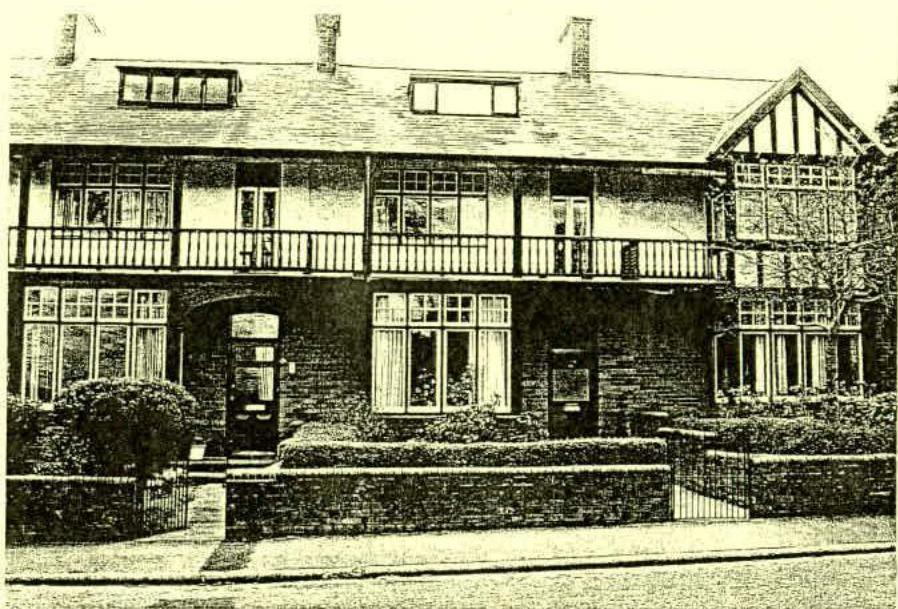
3.15 In Thorny Road we find a delightful unspoilt terrace which features first floor balconies from which spring bracketed columns supporting the projecting eaves above. The lively elevations and crafted timber detailing add much to the street scene and make a very positive contribution to the Conservation Area.
3.16 At the northern extremity of the area are three parallel roads of Lancaster Road, Hildesley Road and Malvern Road. This area was laid out at the turn of the nineteenth to the twentieth century in an area apparently known at that time as ‘Siberia’ as if to illustrate its remoteness from much of the town. Malvern Road is clearly visible across the town with its distinctive yellow brick, highly modelled and crenellated elevations. The bold use of imported bricks combine with terracotta embellishments, to provide a very confident and prominent terrace. The use of red Ruabon brick
7
is employed in the adjacent Hildesley and Lancaster Roads, in almost identical forms, however, the use of monochrome brick intensifies the appearance of durability and contrasts with the sense of playfulness seen in Malvern Road.
3.17 Selborne Drive was laid out from 1883 and originally the entire length from Hawarden Avenue to Quarter Bridge Road was known as Selborne Road. The Western Section adopted the title ‘Drive’ from around 1900. The properties in this area are almost all large, semi-detached, late Victorian/Edwardian residences. Materials tend to be smooth or rough-cast render, slate roofs which often feature prominent projecting gables over squared bays. Houses are set within low-walled gardens to the front and the density of development is much less intensive than the high Victorian terraces seen elsewhere in the town. The title ‘Drive’ is highly appropriate given the completely straight layout of this important roadway. Properties maintain a uniform set back giving a sense of Edwardian elegance to the area. There is some repetition of design features in the pairs of houses such as Edwardian sliding sash windows; curved eaves soffits; square bayed windows, some of which are framed with smooth-rendered banding; and rendered elevations. The use of this language serves to unify the appearance of the group which is one of the most stylish approaches to residential area of the upper town.
3.18 The influence of Arts and Crafts is seen in a variety of other developments in the area, as found in Tennis Road and Sartfell Road. The Arts and Crafts approach to architecture seems to have injected local designers and builders with a confidence to introduce their own ideas, as well as adapting those of others. It should also be remembered that illustrations of house designs would be readily available in publications such as Country Life, or The Builder during the period when this area was undergoing major development.
8
3.19 At the western end of the Conservation Area the presence of detached and semi-detached villas in Alexander Drive, located in mature garden settings, are an important and positive part of the overall semi-rural essence in this locality on the ‘fringes’ of the town. The mature trees and planting whilst providing privacy for the elegant dwellings, provide a source of welcome green environment after the intensity of the tightly knit terraces nearby.
4.1 The area contains a high quality mix of properties, which are predominantly residential and are principally of the Edwardian or Arts and Crafts style of architecture. The vast number of properties in the area appear to be well cared for and retain many qualities which together are worthy of protection and enhancement.
4.2 The relatively few negative elements identified, are largely judged to be reversible, given time, appropriate guidance and support. As such, they are not considered to be of sufficient weight so as to deflect from the overall special quality and character of the Selborne Drive Conservation Area. The support of appropriate planning policies and improved levels of grant assistance, now in place, is of great importance to this initiative. Conservation Area designation aims to maintain and improve the unique qualities of a particular area, whilst also allowing it to prosper and consolidate.
Copyright in submitted documents remains with their authors. Request removal
