‘Supporting Planning Statement’, Sarah Corlett Town Planning Consultancy. August 2021
For the:
Proposed Alterations and Extensions to Ballamona Farmhouse Ballamona Estate, Quines Hill, Port Soderick.
Planning Statement To Support Alterations And Extensions Of Dwelling And Conversion Of Outbuildings To Residential Accommodation Together With The Erection Of A Summerhouse, Ballamona Farm, Quine’S Hill, Braddan
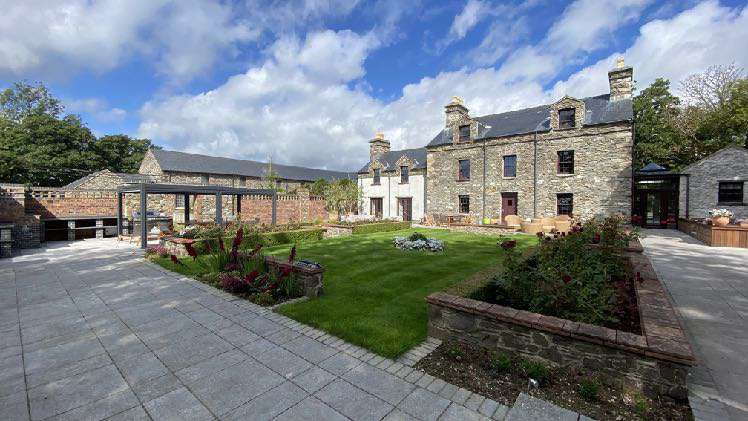
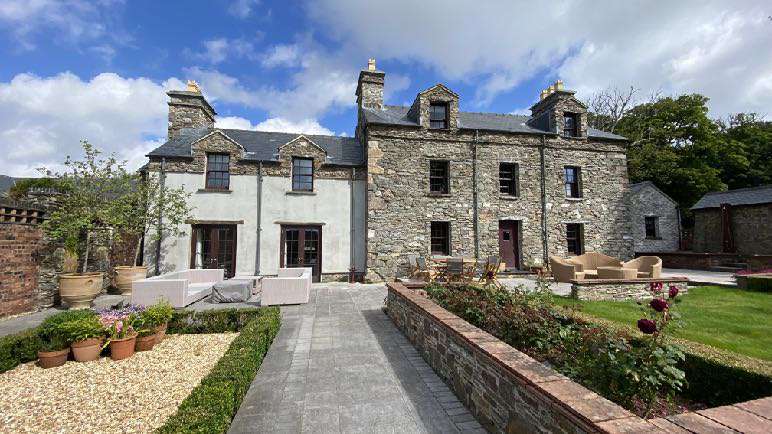
A wide-angle photograph showing a large stone detached house with a landscaped rear garden, paved patio, and pergola structure under a blue sky.
Executive summary<br><br>The site lies within an area designated as not for a particular purpose and where development is generally discouraged. There are two buildings on this part of the site which are the subject of this proposal: one is an existing dwelling with its associated curtilage and the other is an L shaped stone barn which sits within it.<br><br>We believe that it can be demonstrated the proposed works comply with the Strategic Plan policies which protect the countryside and the character and appearance of the existing buildings whilst finding a more appropriate use for an existing outbuilding of interest, in compliance with the objectives of the Strategic Plan housing policies.
1.0 INTRODUCTION
1.1 Ballamona Farm estate comprises a significant area of farmland which stretches from the Isle of Man Steam Railway line to the Old Castletown Road (A25). There are two accesses into the farm yard area, both from the A25. Can you clarify the extent of the holding in acres/hectares?
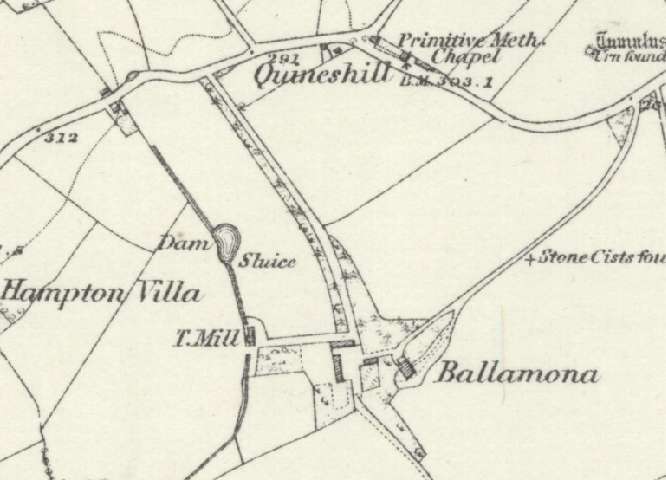
1.2 The farm accommodates a number of buildings most of which appear on the 1860s County Series maps:
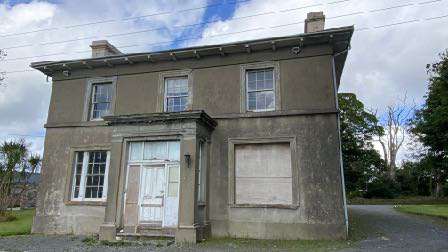
1.3 There is a manor house which sits at the eastern edge of the group and is a hipped roofed dwelling which is presently unoccupied. This has approval for replacement (see Planning History).
A historical map extract showing the site location and surrounding rural area, including nearby landmarks like Hampton Villa and Ballamona.A photograph showing the front elevation of a two-story detached building with weathered walls and boarded windows, set in a rural environment.A photograph showing a detached house with an attached single-story structure featuring a large white garage door, set in a rural environment with a gravel driveway.
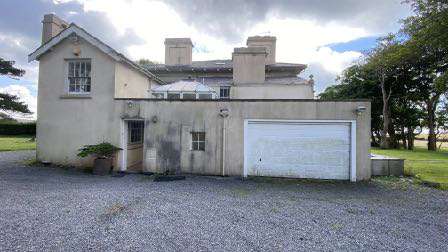
1.4 To the west of this, only 20m at the closest point and separated by two small outbuildings, is what is believed to be the original farmhouse which has been extended over time (see Planning History).
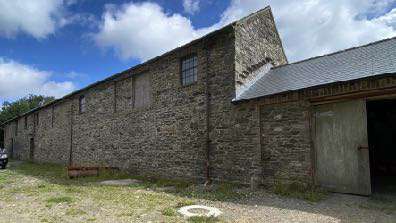
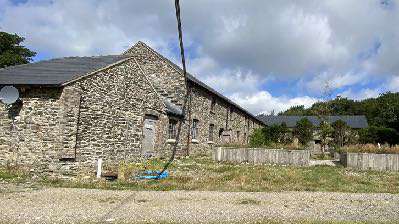
1.5 To the west there is a now L shaped stone outbuilding, formerly barns but with permission for use as offices (see Planning History). On the 1860s maps this building is split into two.
1.6 In front of the farmhouse are formal gardens with raised beds and a pizza oven with stone and brick walling.
A photograph showing a large mixed-material dwelling with a stone section and a rendered extension, featuring a paved patio and landscaped garden.A photograph showing a long stone outbuilding with boarded windows and a slate roof, next to a smaller structure with a large wooden door.A photograph showing a large stone outbuilding or barn with a slate roof, situated in a rural setting with a wooden fence in the foreground.
2.0 Planning history
2.1 The site has been the subject of a number of applications which are set out as follows, separated into each section of the site:
2.2 Manor House
2.2.1 04/01191.B - roofing over internal yard area - permitted
2.2.2 12/01245/B - erection of replacement dwelling with garage block and landscaping permitted
2.3 Farm House
2.3.1 10/00493/B - alterations, extensions and renovation of existing dwelling - permitted
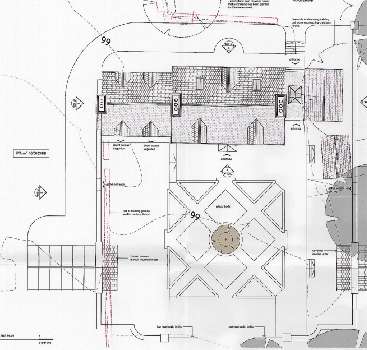
A colored site plan illustrating the layout of a property featuring a large natural swimming pool, tennis court, and extensive landscaping.Architectural site plan showing the property layout with a driveway, building footprint, and landscaping features including a natural swimming pool.
2.3.2 18/00228/B - extension to farmhouse and barn, development of private equestrian facilities with horse walker, relocation of poly tunnel and associated landscaping - withdrawn
2.4 Barns
2.4.1 10/00339/B - conversion of barns into estate office with facilities - permitted and commenced: the upper floor was converted and has been used for office use: the lower floor is in the process of being converted.
2.5 Mill
2.5.1 90/04196/A - approval in principle for conversion of derelict mill into a dwelling permitted
2.5.2 10/00340/B - conversion of mill into a private dwelling - permitted.
2.5.3 10/01468/B - conversion of redundant mill into private residential accommodation permitted
2.6 Additional development
2.6.1 11/00489/B and 11/00898/B - erection of a stable block to the north of the farm yard approved
2.6.2 17/00294/B - erection of poly tunnel - approved
2.6.3 17/00738/B - erection of poly tunnel - approved
2.6.4 17/01001/B - extension of existing manage -approved
3.0 Planning policy
3.1 The site lies within an area not designated for a particular purpose and just outside the Active Travel Investment Plan area on the Area Plan for the East adopted by Tynwald in
Architectural elevation drawing showing the front facade of a large detached house with attached and detached structures.This is an architectural section drawing showing a two-story house with an attached garage and a natural swimming pool in the garden.
2020. The entire farmyard, just excluding the mill building is identified as an area containing Registered Trees. This is confirmed on the Government mapping which identifies Registered Tree Area 0770 in this location.
3.2 The site lies within an area designated on the Braddan Local Plan of 1991 as within an area of an area of High Landscape or Coastal Value and Scenic Significance. However, the Area Plan for the East clarifies that this system of landscape classification has now been superseded by the Landscape Character Assessment, which designates this site as part of a much larger area of Incised Inland Slopes (Douglas Head) and where the following landscape strategy is: Conserve and enhance:
a) the character, quality and distinctiveness of the area, with its open and panoramic views over large rectilinear fields;
b) its steep winding small lanes enclosed by grassed Manx hedges;
c) its scattered hill farms fringed by trees.
Key Views Open and expansive views from most of the area out to sea, along the coast, over Douglas Bay and inland over the incised inland plateau up to the northern Uplands.
Telecommunications tower on hill top forms highly visible landmark in surrounding areas
3.3 This landscape area is distinct from the Rugged Coast which sits to the south around the Marine Drive where the key views are “open expansive and panoramic views out to sea from Marine Drive and from coastal footpaths including Road ny Foillan, views along the rocky coastline over various prominent headlands and view out to sea form Port Soderick framed by rocky cliffs.
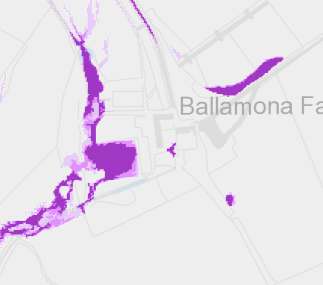
3.4 Parts of the site are identified on the Government flood risk mapping as at risk of surface water flooding.
A digital map showing a location labeled 'Ballamona Fa...' with irregular purple zones overlaid on a road network, likely indicating land designations or environmental constraints.
3.5 The site is not within a Conservation Area nor are any of the buildings within the site Registered nor are any of the buildings on the site identified in the Braddan Local Plan as being worthy of consideration for such status. The Area Plan for the East contains no such list.
3.6 The countryside is protected for its own sake under Environment Policy 1 (Environment Policy 2 identifies the protection of the landscape character as the most important consideration although this designation no longer applies to the site following the adoption of the Area Plan for the East) and there is a general presumption against development as set out in General Policy 3. There are exceptions to this, including the conversion of existing rural buildings of interest to other uses, subject to certain criterial (Environment Policy 16 and Housing Policy 11) and for extensions to existing rural dwellings (Housing Policies 15 and 16).
3.7 Specifically elements are provided with particular protection in other policies in the plan: trees are protected under Environment Policy 3 and I suspect that the tree to be removed to facilitate the garage is Registered so information will be needed to demonstrate why this is acceptable along with any other trees that need to be removed to facilitate the development.
3.8 Ecology is protected under Environment Policy 4 and in this case you may need to provide information on any trees to be removed and their capacity to support wildlife, particularly bats and birds and also the capacity of the unused parts of the barn to accommodate these (I saw what looked like swallows flying in and out of the ground floor of the northern section of the barn when I was there).
4.0 The proposal
4.1 Proposed is the linking of the existing dwelling with the barn and the conversion of the barn to form residential accommodation with the retention of the existing offices at first floor within the northern section of the barn, forming a single residential unit.
4.2 The proposed changes are as follows:
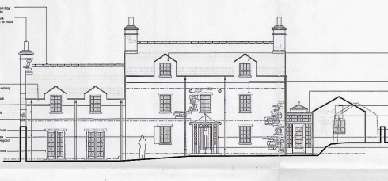
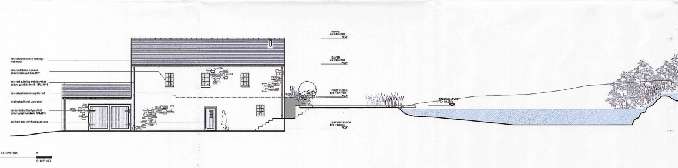
4.2.1 Western elevation of the barn The existing external stone steps are to be replaced with a new external staircase material? A new single storey porch feature with two new doors and a hipped lean-to roof is to be introduced on the western elevation and two new windows alongside and a new, slim window in between the doors. The flue previously approved emerging from the western roof plane is not to be provided. A new flat roofed extension is proposed to replace the existing southern annex. This will have a brick exterior and grassed, flat roof with brick balustrade around the edge.
4.2.2 Southern elevation of the barn This is to remain as existing.
4.2.3 Northern elevation of the barn This is to remain as originally approved other than the omission of the flue in the northern plane
4.2.4 Eastern elevation of the barn This is to remain as existing other than where the proposed annex joins to to it. Some of the windows are to be blocked up but where the existing apertures are to be retained and infilled with brick so as to distinguish them from the rest of the elevation and to identify them as original openings rather than completely covering them up. The existing apertures at ground floor level will be used to form the doors providing access into the new annex.
4.2.5 New extension A new extension is proposed to link the existing dwelling to the barn. This is to be single storey, flat roofed and modern in character, finished in timber cladding and will span the 20m distance between the two existing buildings, with a width of 7.8m. This new link will accommodate a kitchen and dining area with storage space and linking to the existing house which will accommodate on the ground floor, a kitchen and sitting area with an existing rear lobby linking to one of the existing stone outbuildings to the east providing laundry space.
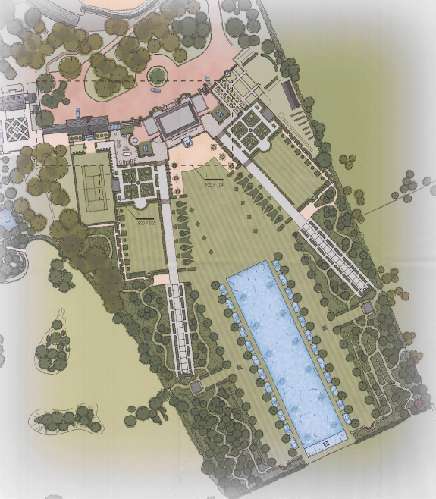
4.2.6 Proposed layout The new ground floor accommodation where previously there was to be office accommodation, will provide recreation facilities for the occupants of the dwelling, a utility room, entrance hall and dressing room which complement the new bedroom to be provided in the flat roofed extension to the south of the building where there is currently a pitched roofed annex. To the west of this will be a new walled garden incorporating a 3.1m by 2.3m pool.
A lobby for the first floor offices is also proposed on the ground floor of the existing barn in the northern section.
The northern section of the existing barn at first floor will remain as offices with the remainder providing a gym and the existing house providing three en-suite bedrooms.
4.3 Also proposed is the erection of a garage to the west of the barn where there is currently car parking. This will be ??
5.0 Assessment
5.1 The proposal will need to demonstrate that either it complies with the relevant planning policies or if it doesn’t, why it should be considered acceptable.
5.2 Housing Policy 15 would be the appropriate policy in respect of guidance on the extension of the existing house as the existing is traditional in terms of its proportions, fenestration, finishes and character even though it has clearly been extended.
5.3 This requires that extensions respect the proportion, form and appearance of the existing property. It could be considered that the proposal, by virtue of the modern appearance and materials, do not do that.
5.4 However, it will be useful to explain that this has been a deliberate approach as, due to the distance between the two buildings and the necessary length of the link, it would not be possible to design something which would complement buildings either side which are completely different in scale, appearance and character and that it is considered that a more appropriate design approach is to propose something which is deliberately different and which maintains the characters of both adjoining buildings and does not intend to give the impression that it is an original part of the building group. This approach has been used very successfully on old buildings, even those which are historically or architecturally important, such as Tynwald Mill which is a Registered Building and has glazed annexes to facilitate its use for more modern purposes.
5.5 As such, it is considered that the proposal, in terms of its proportion, form and appearance does respect the existing buildings and complies with the intention of the policy.
5.6 The barns have already been approved for conversion from their original purpose as agricultural buildings, to office accommodation. This has been implemented insofar as the upper floor has been converted and was used for office accommodation although more recently only the northern section is so used. There are relatively few changes proposed to this building to facilitate this new use and what is proposed is considered to accord with what Housing Policy 11 aims to achieve - that is, the sensitive conversion of older buildings to new uses which will ensure their continued maintenance and use.
5.7 It is not considered necessary to justify the new use in terms of the redundancy of the original use of the building as this was considered and deemed acceptable in the earlier application for conversion to offices. However, the existing openings are not suitable for agricultural use of any kind and would be limited in terms of their suitability for equestrian use. The building has not been used for agricultural or equestrian use for some time as will be appreciable from a visit and internal inspection of this building. Similarly its historical/ architectural interest was also established with the earlier approval.
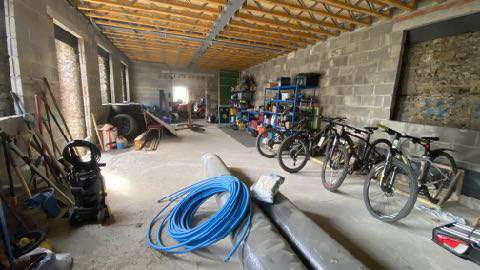
Interior photograph of a building under renovation featuring exposed wooden roof trusses, cinder block walls, and stored items like bicycles.
5.8 The applicant has a desire for additional recreational facilities associated with the house (particularly golf simulator and gym facilities) and rather than extending the house or providing new detached structures, it seemed more appropriate to utilise the existing barns and in so doing, link these to the house with a structure that did not detract from the architectural or historical interest of either existing building. This use, rather than the offices, results in fewer vehicles needing to park on the site, fewer traffic movements and more privacy and security for the occupants of the dwelling. The existing landscaping in front of the space between the two existing buildings provides a domestic context to the barn on this side and thus, its residential use would appear more appropriate than offices.
5.9 The replacement of the existing southern part of the barn with a flat roofed area will result in a more streamlined building and a more simple layout which is considered more complementary than the existing pitched roofed arrangement which is at odds with the remainder of the majority of the building which takes a simple L shaped form with basic pitched roofing. This current section of the building appears to have had a much larger opening on the western elevation blocked off and on the eastern elevation there appears to be evidence of alterations in the form of new brickwork additions on the south eastern corner and around the doorway and window next to the main two storey part of the building.
6.0 Additional information required for the application
6.1 A tree survey and protection plan will be needed for the proposal, particularly for the proposed garage which results in the removal of an existing tree and the proposed summerhouse which will be close to existing trees.
6.2 I don’t think a Structural Engineer’s report is required for the barn as the renovation and structural work was largely approved under the earlier application. However, a description of the structural works, what has been undertaken already and what is proposed would be useful.
6.3 Ecological information may be required to demonstrate that there will not be any harm on bats and birds from the removal of any trees and the conversion of parts of the building which may be used by them. A survey may be required and it may be that the works need to be timed for when the trees/buildings are not used (ie the barn openings are blocked off so birds and bats cannot get in but you need to ensure that there isn’t anything hibernating in there before you do that).
6.4 I don’t think a Flood Risk Assessment is required as the proposed works don’t appear to encroach into the areas at risk of flooding which are mainly the lower area to the west of the parking area.
General Policy 3: Development will not be permitted outside of those areas which are zoned for development on the appropriate Area Plan with the exception of:
(a) essential housing for agricultural workers who have to live close to their place of work; (Housing Policies 7, 8,
9 and 10);
(b) conversion of redundant rural buildings which are of architectural, historic, or social value and interest; (Housing Policy 11);
(c) previously developed land(1) which contains a significant amount of building; where the continued use is redundant; where redevelopment would reduce the impact of the current situation on the landscape or the wider environment; and where the development proposed would result in improvements to the landscape or wider environment;
(d) the replacement of existing rural dwellings; (Housing Policies 12, 13 and 14);
(e) location-dependent development in connection with the working of minerals or the provision of necessary services;
(f) building and engineering operations which are essential for the conduct of agriculture or forestry;
(g) development recognised to be of overriding national need in land use planning terms and for which there is no reasonable and acceptable alternative; and
(h) buildings or works required for interpretation of the countryside, its wildlife or heritage.
Environment Policy 1: The countryside and its ecology will be protected for its own sake. For the purposes of this policy, the countryside comprises all land which is outside the settlements defined in Appendix 3 at A.3.6 or which is not designated for future development on an Area Plan. Development which would adversely affect the countryside will not be permitted unless there is an over-riding national need in land use planning terms which outweighs the requirement to protect these areas and for which there is no reasonable and acceptable alternative.
Environment Policy 16: The use of existing rural buildings for new purposes such as tourist, or small-scale industrial/commercial use may be permitted where:
a) it is demonstrated that the building is no longer required for its original purpose and where the building is substantially intact and structurally capable of renovation;
b) the reuse of the building will result in the preservation of fabric which is of historic, architectural, or social interest or is otherwise of visual attraction;
c) it is demonstrated that the building could accommodate the new use without requiring extension or adverse change to appearance or character;
d) there would not be unacceptable implications in terms of traffic generation; a) conversion does not lead to dispersal of activity on such a scale as to prejudice the vitality and viability of existing town and village services; and f) the use of existing buildings involves significant levels of redevelopment to accommodate the new use, the benefits secured by the proposal in terms of impact on the environment and the rural economy shall outweigh the continued impact of retaining the existing buildings on site.
Proposals to convert rural buildings to residential accommodation will be considered along with the advice given at Section 8.10 of this document.
Housing Policy 11: Conversion of existing rural buildings into dwellings may be permitted, but only where:
(a) redundancy for the original use can be established;
(b) the building is substantially intact and structurally capable of renovation;
(c) the building is of architectural, historic, or social interest;
(d) the building is large enough to form a satisfactory dwelling, either as it stands or with modest, subordinate extension which does not affect adversely the character or interest of the building;
(e) residential use would not be incompatible with adjoining established uses or, where appropriate, land-use zonings on the area plan; and
(f) the building is or can be provided with satisfactory services without unreasonable public expenditure.
Such conversion must:
(a) where practicable and desirable, re-establish the original appearance of the building; and
(b) use the same materials as those in the existing building. Permission will not be given for the rebuilding of ruins or the erection of replacement buildings of similar, or even identical, form.
Further extension of converted rural buildings will not usually be permitted, since this would lead to loss or reduction of the original interest and character.
Housing Policy 15: The extension or alteration of existing traditionally styled properties in the countryside will normally only be approved where these respect the proportion, form and appearance of the existing property. Only exceptionally will permission be granted for extensions which measure more than 50% of the existing building in terms of floor space (measured externally).
Housing Policy 16: The extension of non-traditional dwellings or those of poor or inappropriate form will not generally be permitted where this would increase the impact of the building as viewed by the public.
Copyright in submitted documents remains with their authors. Request removal
Source & Provenance
Official reference
22/01167/B
Source authority
Isle of Man Government Planning & Building Control