PLANNING APPEAL REBUTTAL STATEMENT ON BEHALF OF THE APPLICANT IN SUPPORT OF THE EXTENSION OF THE CURTILAGE OF THE EXISTING SPA, ERECTION OF SERVICE BUILDING, ERECTION OF WALLING, INSTALLATION OF SAUNA AND SPA FACILITIES WITH TERRACING, DECKING AND LANDSCAPING, BRIGHTLIFE, ANDREAS ROAD, ANDREAS IM7 4EN
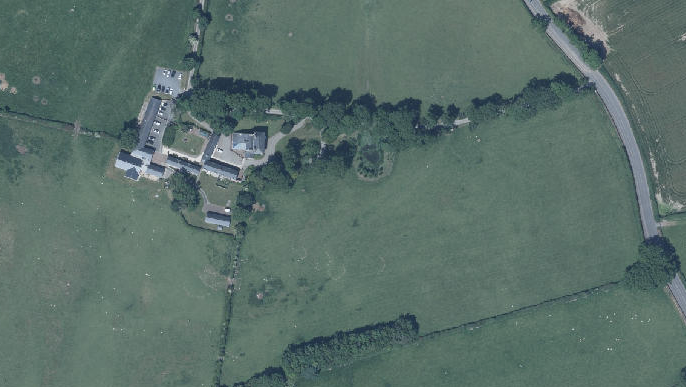
An aerial view of a rural property featuring a cluster of buildings surrounded by green fields, hedgerows, and a nearby road.
1.0 INTRODUCTION
1.1 This rebuttal statement responds to the planning officer’s appeal statement dated 2nd September, 2025. This rebuttal should also be read in conjunction with our original submissions to the appeal.
1.2 We fully appreciate that the planning officer will not have seen our appeal statement prior to formulating his submission and some of the matters raised by him have already been addressed by us in our statements which have already been submitted.
1.3 We would nevertheless wish to respond to a number of statements contained in the officer’s appeal statement.
2.0 REBUTTAL
2.1 We refer to the officer’s Appendix 1.
3.2.1.2 The statement says, “The appellant’s claim that the Planning Officer misunderstood the operational layout of the spa is not substantiated by any spatial or functional analysis. While the submission includes a site plan and location plan, these merely illustrate the proposed layout and do not engage with the evidentiary requirements of the Strategic Plan.”
2.2 We alleged in our reasons for the appeal that this was the case and explained in our appeal statement that persons using the spa would find it difficult and inconvenient to access spa facilities which are not immediately adjacent to the existing spa, as they will be in dressing gowns and slippers and often in bathing costumes with wet hair. Whilst we accept that the officer will not have seen our statement before writing this, we still maintain that most people would understand the need for spa facilities to be physically adjacent to each other to work properly.
2.3 We would submit that the reason for the location of the spa extension is self evident but have already provided further information in our appeal statement, should further “evidentiary requirements” be necessary. We do not disagree that "The Strategic Plan (2016) establishes a strong and multi-layered presumption against development in the countryside" but we would suggest that the officer needs to understand how the spa works before concluding that the location is not
acceptable and that there are other locations within the site which would be acceptable, although to date there is no evidence of where these other areas are.
2.4 We believe that the officer has misread Environment Policy 1 where he says at 3.2.1.2 (3) that "development will not be permitted unless there is both an overriding need and no reasonable alternative." EP1 says that development which would adversely affect the countryside will not be permitted and we have yet to see evidence of how the development will adversely affect the countryside.
2.5 He says at 3.2.1.2 (5) that "This is not incidental to the existing spa use but represents a substantive expansion of the developed estate."This is clearly incorrect as people will not go into the outside spa unless they have already gone into the spa. The spa extension is entirely incidental to the existing spa and are struggling to understand how it could be interpreted as otherwise.
2.6 He says at 3.2.1.2 (6) "However, it would be vital to note that the site has already undergone incremental curtilage growth (See Figure 2), resulting in a spatial configuration that should now be sufficient to accommodate the proposed spa facilities." It isn't clear on what basis the existing curtilage "should be sufficient to accommodate the proposed spa facilities" as it could clearly not be accommodated within the existing spa floor area or within the small area in front of the sun lounges. It is helpful however that the officer confirms that the curtilage has been extended in the past.
2.7 The statements at 3.2.1.2 (6) that “The Strategic Plan does not support continued outward expansion where internal capacity remains untested. Moreover, there is nothing to suggest that the associated spa facilities cannot be located away from the main spa building, with functional linkages provided to connect the new facilities to the existing, particularly as adjacent land is constrained. The absence of any comparative spatial analysis or justification for why such an approach was not considered here further undermines the claim that the proposed location is functionally indispensable" again, in our
view demonstrate a misunderstanding, or lack of understanding of how the spa works and the reason why it needs to be adjacent to the existing spa.
2.8 Unfortunately EP1 is misquoted again at 3.2.3.2 (1) where the officer says "Environment Policy 1 is clear: the countryside is to be protected for its own sake, and development that undermines its openness and rural qualities is not supported unless there is an overriding national need." EP 1 makes no reference to openness or rural qualities, it simply says "adversely affect” and again, we have yet to understand how the proposal adversely affects the countryside.
2.9 Again at 3.2.3 (4) Strategic Policy 4 doesn't “require that proposals integrate with the site’s context, preserve openness, and avoid domestication of rural land”. It actually states
Proposals for development must:
a) Protect or enhance the fabric and setting of Ancient Monuments, Registered Buildings(1), Conservation Areas(2) , buildings and structures within National Heritage Areas and sites of archaeological interest;
(b) protect or enhance the landscape quality and nature conservation value of urban as well as rural areas but especially in respect to development adjacent to Areas of Special Scientific Interest and other designations; and
(c) not cause or lead to unacceptable environmental pollution or disturbance.
2.10 It is our position that our proposal enhances the nature conservation value of the site as confirmed by Ecosystems Policy Office, and would have a positive impact on the appearance of the countryside at this point by providing a much softer edge to the spa facilities, introducing landscaping and stone walling where there is presently a simple post and wire fence.
2.11 We are very disappointed at the underlined part of this statement at 3.2.3.2 (5): The Strategic Plan is designed to prevent incremental development creep, and the domestication of undeveloped agricultural land, particularly in the absence of overriding need, is precisely the form of change that the policy framework seeks to resist.
2.12 The scheme has been designed to meet a very real and pressing need for the applicant. It has been designed to incorporate sensitive and ecologically beneficial landscaping as well as the spa facilities which the applicant would hope to have. We take exception to the suggestion that the Strategic Plan was formulated precisely to prevent this type of development. Whilst we fully understand the need to balance any environmental harm against any benefits of the proposal and to apply the policies of the Strategic Plan, to suggest that this is “precisely the form of change that the policy framework seeks to resist” is very disappointing.
2.13 The officer states at 3.2.3.2 (6), “Accordingly, the appellant’s argument fails to engage with the relevant policy tests. The proposal introduces a new spatial character and function to the land, incompatible with its rural designation and contrary to the expectations of the Strategic Plan. The domestication of the landscape is both evident and material, and the refusal is justified on policy grounds. We don't disagree with the fact that the site isn't designated but would hope that the inspector understands the actual impact of what is proposed including the proposed landscaping and how the proposed features will be incorporated into the new landscape around the spa compared with the existing post and wire fence boundary which provides no ecological benefit and is poorer as a boundary feature than what is proposed.
2.14 The officer’s concern about the lack of soil samples has been addressed in our main appeal statement and we consider such a small reduction in the agricultural field does not justify the concern which has been expressed about this element of the scheme.
2.15 In terms of the officer’s concern about impact on ecology, we would submit that our appeal statement more than demonstrates that his concerns in this regard are entirely misplaced and would reiterate our concern that should the officer have considered there to be an impact on ecology and biodiversity, that he should have sought professional advice from his colleagues in the Department before concluding that the development would be harmful and that further ecological information was required, neither of which is supported by the Ecosystem Policy Office.
2.16 The officer’s paragraph 3.2.6.2 appears at odds with how this concern is usually dealt with. Generally, a condition would be attached to an application where there was a concern that wildlife, or the environment generally could be adversely affected by the lighting associated with a development. Unless the officer was persuaded that no lighting scheme could possibly be designed for this site where it would not be unacceptable, a condition would be the appropriate way of dealing with any potential concern rather than a reason for refusal. The application includes reference to low level bollard lighting and shows bollard type lighting on the plans. We are struggling to see how this could possibly be considered to be unacceptable, particularly given the comments of Ecosystem Policy Office after the decision, “The design statement included a section which said that a bat survey could be undertaken, but we did not feel it necessary given the lack of habitat removal and distance from the majority of the trees. The statement goes on to say that the lighting will be in compliance with the IPL guidelines and we would be supportive of that.”
2.17 The officer’s position about economic argument seems to be based on the fact that he thinks there is space elsewhere in the site where the spa could go. We have already addressed this both earlier in this statement and in the initial appeal statement so do not wish to make further comments in this respect. The applicant has explained that in order to continue offering a facility which is competitive and reflects the needs of today’s customer, it needs to provide additional facilities which can only be provided alongside the existing spa facilities. If these facilities cannot be accommodated on site, they are fearful that the spa will not continue to be viable, resulting in the loss of employment opportunities as well as the main, if not only spa facility in the north of the Island.
2.18 Whilst we fully accept that applications must be determined on the basis of the information provided, we feel that the officer could have engaged with us more and sought information both from ourselves and others which would have addressed some of his concerns.
2.19 In terms of his recommended conditions, we would suggest that C4 is unnecessary taking into consideration the post decision comments of the Government’s ecological adviser. We would also suggest that C6 is disproportionate to the scale of the proposed development and is not justified. In terms of C8, the existing surface water system is designed to accommodate the Brightlife spa building and hard landscaping as well as the attenuation tank from the main spa pool. The surface water discharges to an existing field drainage ditch under an approved licence to do so. The additional increase from the small hot tubs and any hard landscaping should have minimal impact on this and we would suggest that C8 is not necessary.
3.0 CONCLUSION
3.1 The ability for Brightlife to accommodate outdoor wellbeing facilities is essential to its continued success as the primary, if not only well being centre in the north of the Island.
3.2 The business generates employment and offers a facility which attracts custom from local people and visitors alike. Its continued successful operation is considered to be an important element of the economy of the north of the Island.
3.3 We believe we have demonstrated that the outdoor spa facilities are economically important to the business and that they could not reasonably be located elsewhere within the approved curtilage of the facility. It is clear that the curtilage of the site was extended when the spa was created and what is proposed is not excessive in area and will not be publicly visible.
3.4 Care has been taken to design something which, although it cannot be publicly seen, is attractive and contributes not only to the landscape but also to the
biodiversity of the area. The Ecosystem Policy Office has confirmed to us that the proposal will result in a biodiversity net gain.
3.5 We believe that the proposal will enhance the site and the surrounding area and that the multiple benefits outweigh the presumption against development here as the land is not designated for development. The beautiful, natural setting of the spa and the site generally adds to its attraction as a wellbeing facility and it is not something which could be accommodated in an established town without significantly changing the nature of what it strives to be.
3.6 We would submit that the proposal results in no harm, will enhance the biodiversity of the site and will improve the facilities available on the site for the benefit of the Island generally and the north particularly and believe that an exception to the presumption against development here is justified and that the application should be permitted. We would therefore ask that the appeal is allowed and the spa is permitted to expand as proposed.
Sarah Corlett 08.09.25
Copyright in submitted documents remains with their authors. Request removal
Source & Provenance
Official reference
AP25/0028
Source authority
Isle of Man Government Planning & Building Control