Loading document...
Please reply to the signatory
Tel: (01624) 685910
Fax: (01624) 686443 Email: [email protected]
Our Ref: 25/90081/B Your Ref: Jennifer Chance, M.R.T.P.I. Director of Planning & Building Control Lorna Milestone, Planning Appeals Administrator, Chief Secretary's Office, Government Offices, Buck's Road, Douglas, IM1 3PN. 19 September 2025 WRITTEN REBUTTAL ON PA 25/90081/B (AP25/0028)
Proposal: Extension to the curtilage to create a landscaped garden with terraced decking, external sauna, spa pools and glazed garden pod. Creation of a service yard and erection of a prefabricated service building to house the filtration equipment for the proposed spa pools.
Address: Brightlife, Ballalheaney, Andreas Road, Andreas, Isle of Man, IM7 4EN
This document provides additional comments on behalf of the Department in relation to the appellant’s Statement of Case (SoC) for the above referenced appeal. It addresses the spatial analysis diagrams submitted by the appellant to justify the location of the proposed development and reinforces previously articulated matters in the officer’s Report and the Department’s initial appeal statement.
The subject site remains demonstrably outside any designated settlement boundary and is located on land unallocated for development within the 1982 Development Plan, as well as being located on land classed as Class 3/2 soil on the Agricultural Land use Capability Map of the Isle of Man. The appellant has not adequately justified why the proposed spa garden, and associated facilities could not be accommodated within the existing curtilage of the Brightlife complex. The reliance on proximity to the existing spa suite as the primary rationale for the proposed location does not satisfy the policy tests under the Strategic Plan and remains a significant point of contention.
The following sections directly address the spatial diagrams submitted by the appellant and the proximity-first rationale advanced therein:
The applicant’s appeal continues to rely on a proximity-first approach, asserting that the proposed spa garden must be located immediately adjacent to the existing spa suite for operational convenience. However, as set out in the Department’s appeal statement, this rationale does not satisfy the policy tests under the Isle of Man Strategic Plan.
The Strategic Plan requires that development in the countryside must demonstrate:
The Department has already provided sufficient evidence to show that the Brightlife site contains ample undeveloped land within its existing curtilage, and that no spatial constraint analysis or operational flow diagrams have been submitted to justify the necessity of the proposed location. The proximity-first logic, while operationally convenient, does not override the presumption against development in the countryside.
There are established examples within the UK where spa facilities incorporate external wellness features, including spa gardens, that are not directly adjacent to the principal spa building. These demonstrate that immediate proximity is not essential for operational viability, as connectivity is achieved through transitional landscaping and structured pathways. This reinforces the position that alternative configurations within the existing curtilage could have been reasonably explored without necessitating encroachment into undeveloped countryside.
These facilities demonstrate that immediate adjacency is not a prerequisite for operational viability, and that functional linkages can be achieved without encroaching into undeveloped countryside. The applicant’s failure to explore such alternatives within the existing curtilage further undermines the justification for the proposed location.
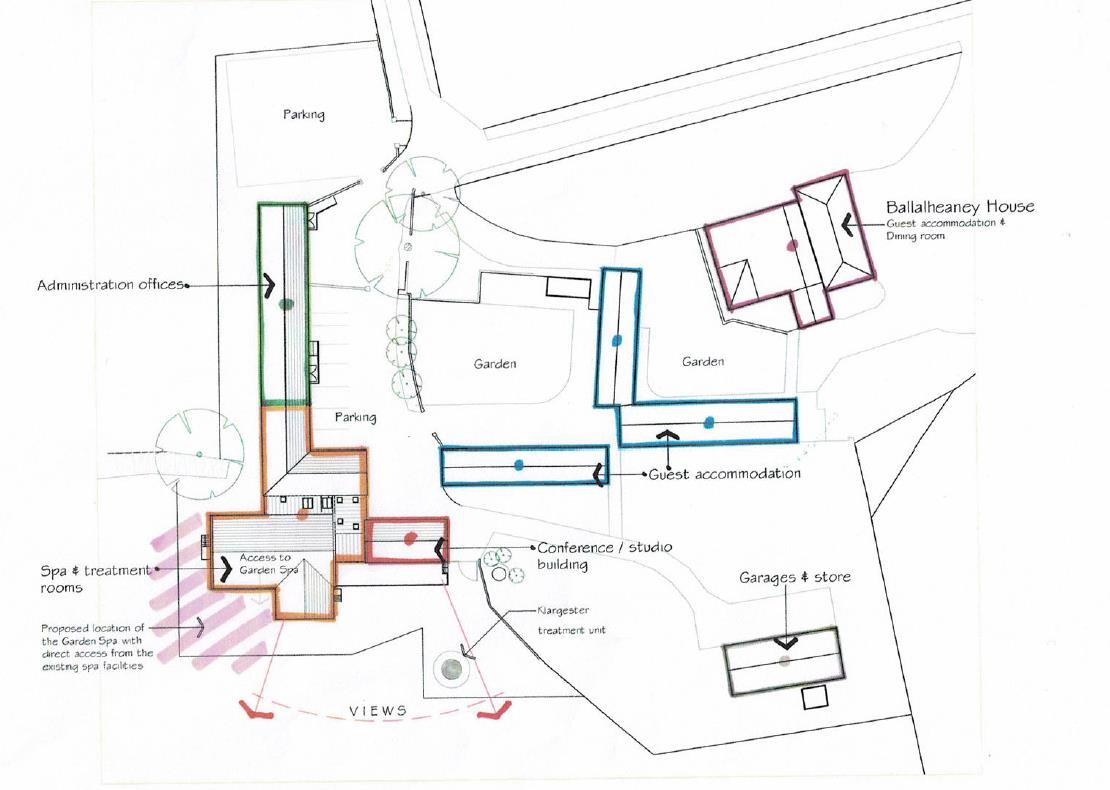
This diagram illustrates the spatial relationship between the spa suite and other buildings on site. However, it inadvertently reinforces the Department’s position for the following reasons:
In effect, the diagram illustrates that the site is not spatially constrained, and that the proposed encroachment into undeveloped countryside is a matter of preference, not necessity.
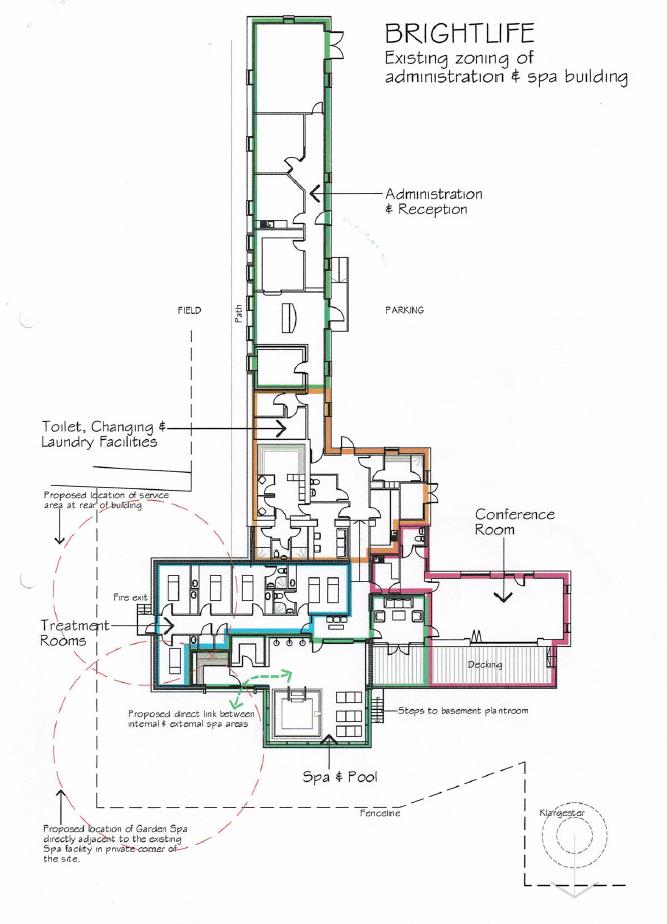
This diagram focuses on the internal layout of the spa suite and its connection to the proposed garden spa.
While the diagram seeks to justify adjacency between the proposed spa garden and the existing spa suite, it ultimately reinforces the proximity-first rationale without addressing the policy requirement to explore reasonable alternatives. It provides no evidence of spatial limitations within the existing curtilage, nor does it demonstrate that the proposed location is functionally indispensable. The justification relies primarily on guest comfort and flow, which, while operationally relevant, do not override the strategic planning framework. The Strategic Plan does not permit countryside encroachment based solely on operational convenience, and in the absence of demonstrable functional necessity, the proposal remains in conflict with established policy.
The spatial diagrams submitted by the appellant do not demonstrate that the proposed location is functionally indispensable, nor do they show that reasonable alternatives within the existing curtilage have been explored or ruled out. The diagrams fail to provide any comparative spatial analysis or evidence of operational constraints that would preclude alternative configurations. Instead, they reinforce the Department’s position that the proposal represents a substantive expansion into undeveloped land, driven by preference rather than policy-compliant necessity. As noted earlier, examples from the UK demonstrate that spa gardens can be successfully integrated without immediate adjacency. This further weakens the appellant’s justification and reinforces the Department’s position that the proposed location is not policy compliant.
Yours sincerely,
Paul Visigah, B. Tech (Hons), MSc, RTP, MRTPI Senior Planning Officer
Copyright in submitted documents remains with their authors. Request removal
