Re: Proposed Conversion and alterations to existing redundant storage barn to provide a residential dwelling - Barn Adjacent to Field 134413, Churchtown, Lezayre, Isle of Man
Please find attached a copy of my Statement of Case in respect of an appeal ref AP25/0016 relating to P/A 24/00534/B. Appendices have been bound into the document.
I will attend the hearing and if required by the appointed inspector will request the structural engineer to attend. Should you require any further information please do not hesitate to contact us. Yours faithfully Tony Lloyd-Davies
Mr Tony Lloyd-Davies MAPM For and on behalf of Cornerstone Architects Enc: As set out in the body of the text
79 Parliament Street Ramsey Isle of Man IM8 1AQ Tel 01624 810810 Fax 01624 810811 www.csarc.im [email protected]
architects development consultants interior designers project managers planning supervisors
Planning Appeal Statement of Case – Appeal Ref AP25/0016
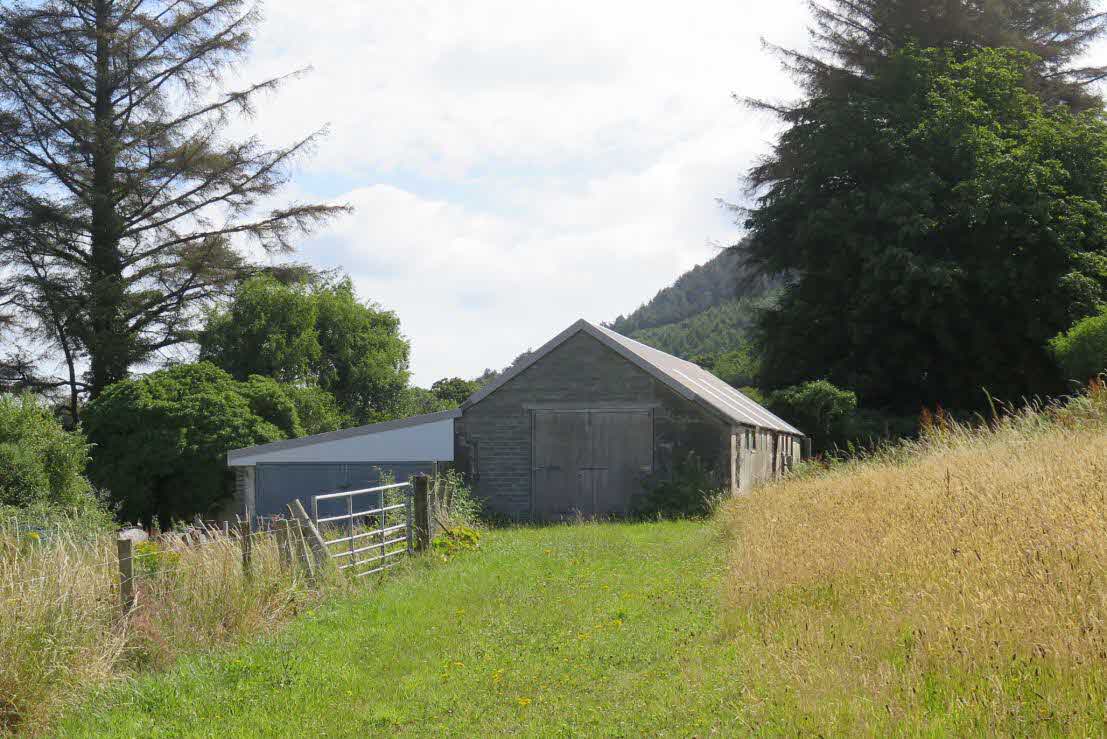
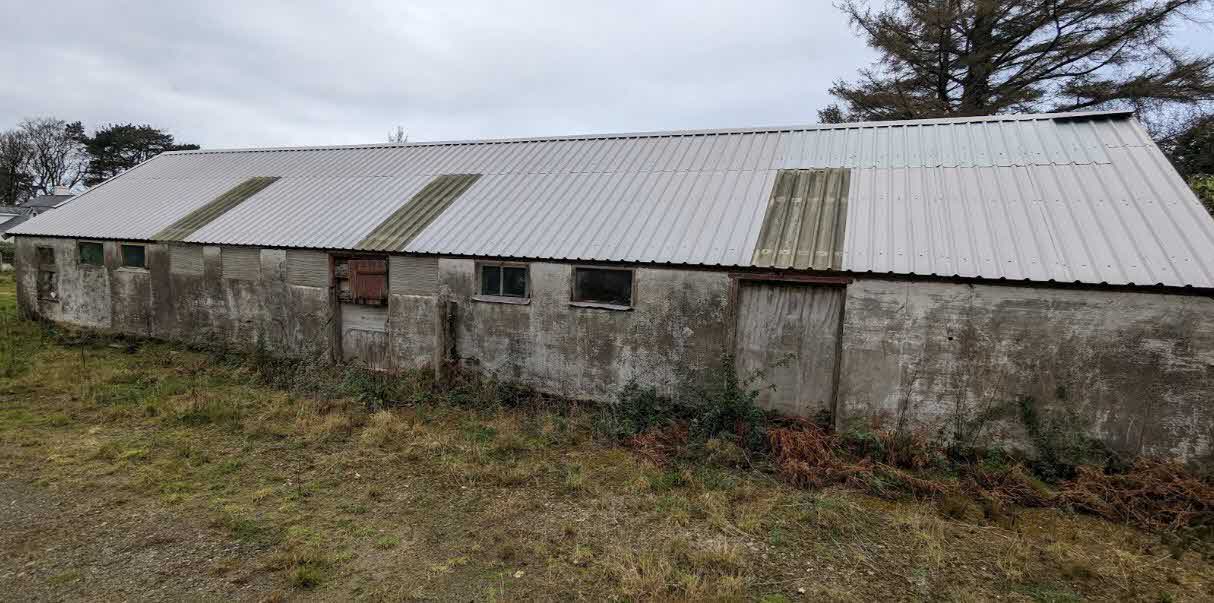
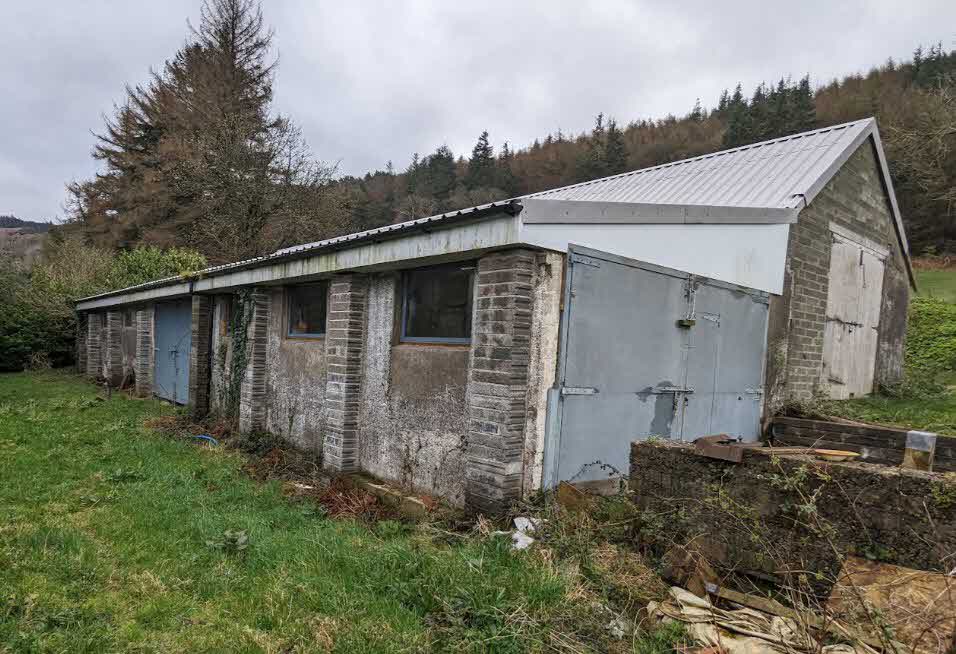
A photograph showing a large, grey agricultural barn situated in a grassy rural field with trees and fencing nearby.
In support of the conversion of an existing redundant storage barn to provide a residential dwelling.
Barn adjacent to Field 134413, Churchtown, Ramsey Isle of Man
Prepared By
Cornerstone Architects Ltd 79 Parliament Street Ramsey Isle of Man IM8 1AQ
On behalf of the applicant/appellant in objection to the planning committee’s decision to refuse the planning application 24/00534/Bby a split decision.
1.0Introduction.This appeal statement should be read in conjunction with the submitted documents which were considered by the planning committee in their meeting of 28th April 2025. Comments in ‘Italics’ when referencing third party notes are mine.
1.1In the opening address to the committee the planning officer confirmed his assertion that the building was in his opinion not suitable for structural repair. He also confirmed that the building fails to meet criteria for refurbishment/conversion in that the building must have architectural or historic value and that the criteria to satisfy HP11 were not met. He confirmed that the policy does not provide for all buildings in the countryside to be developed. He advised the committee that the Policy is set out to provide guidance on acceptable development. Confirming also that this does NOT mean all buildings are suitable for conversion.
1.2 The applicant relies on their submissions to the planningprocess and the submission to the planning committee setting out the argument in favour of the redevelopment. This is provided at Appendix A in full. The relevant drawings are referred to in the amended Design and Access statement (29/02/2024).
1.3 The applicant resides at Ballachree Cottage adjacent to the application site and within his ownership. His requirement for storage and outbuildings has changed and his detached garage (Ballachree Cottage) provides for his everyday needs.
In addition to the proposed development site the applicant also owns Ballachree Cottage as well as field 132132 (2.12 acres) and field 134413 (3.77 acres) which are directly to the south of the application site.
As he ages his health has deteriorated and there have been spells in hospital. There are close family members willing to care for the applicant and his wife and the proposal allows for them to stay in their home without burdening the public purse in terms of third-party care. The proposal is to develop the property and in the short term allow his son to reside in the single storey barn conversion whilst caring for him and in the future allow the applicant to move when he can no longer manage the stairs in the Ballachree cottage allowing effectively a house swap. There is no proposal to separate the two properties and sell on the open market.
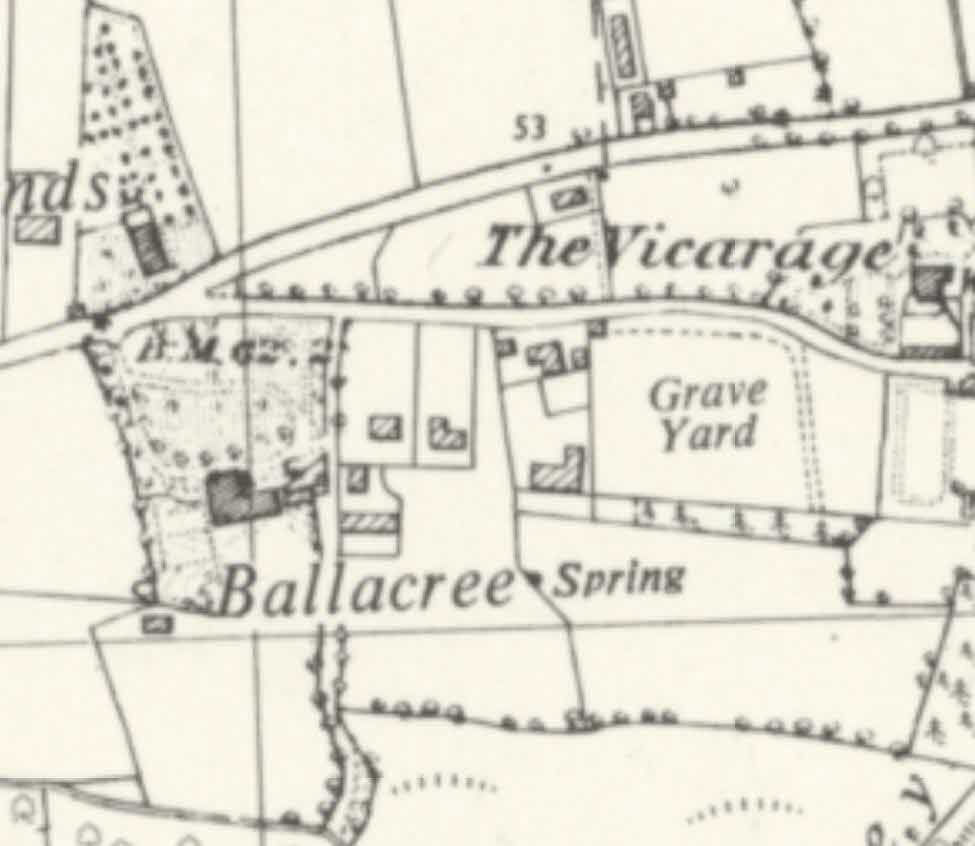
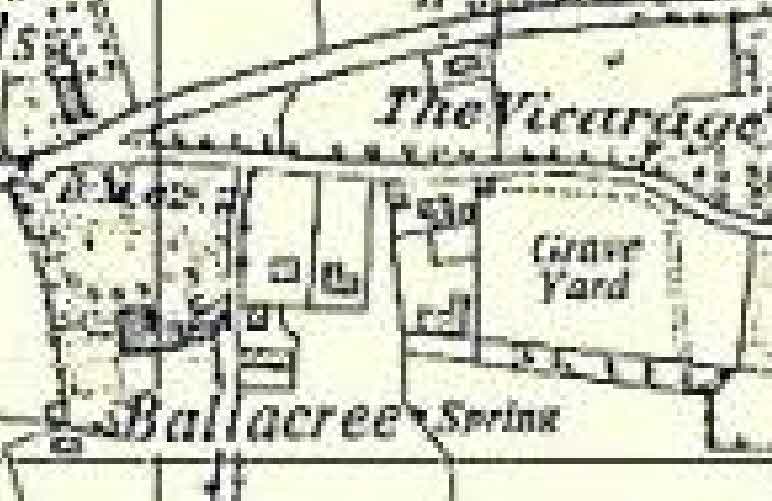
2.0 Site History: The existing residential site curtilage including a private access track extends to 0.61 acres. The age of the existing barn is unknown, but it does appear on OS mapping dated between 1949-1973.
See map below extract taken from National Library of Scotland Ordnance survey Map Series 1949-1973. The property is located immediately to the West of the graveyard and indicated with a RED dot.
This image shows a historical map or site plan detailing the location of 'The Vicarage', a graveyard, and surrounding fields.
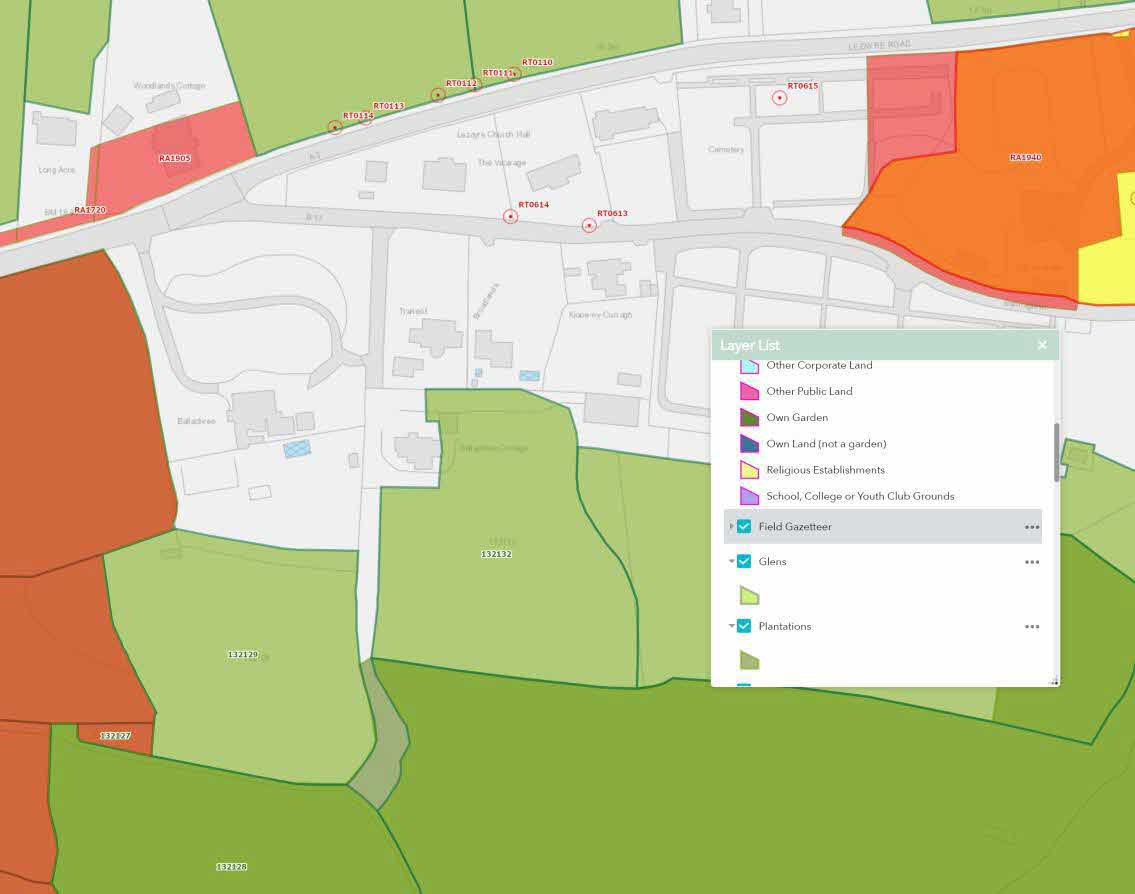
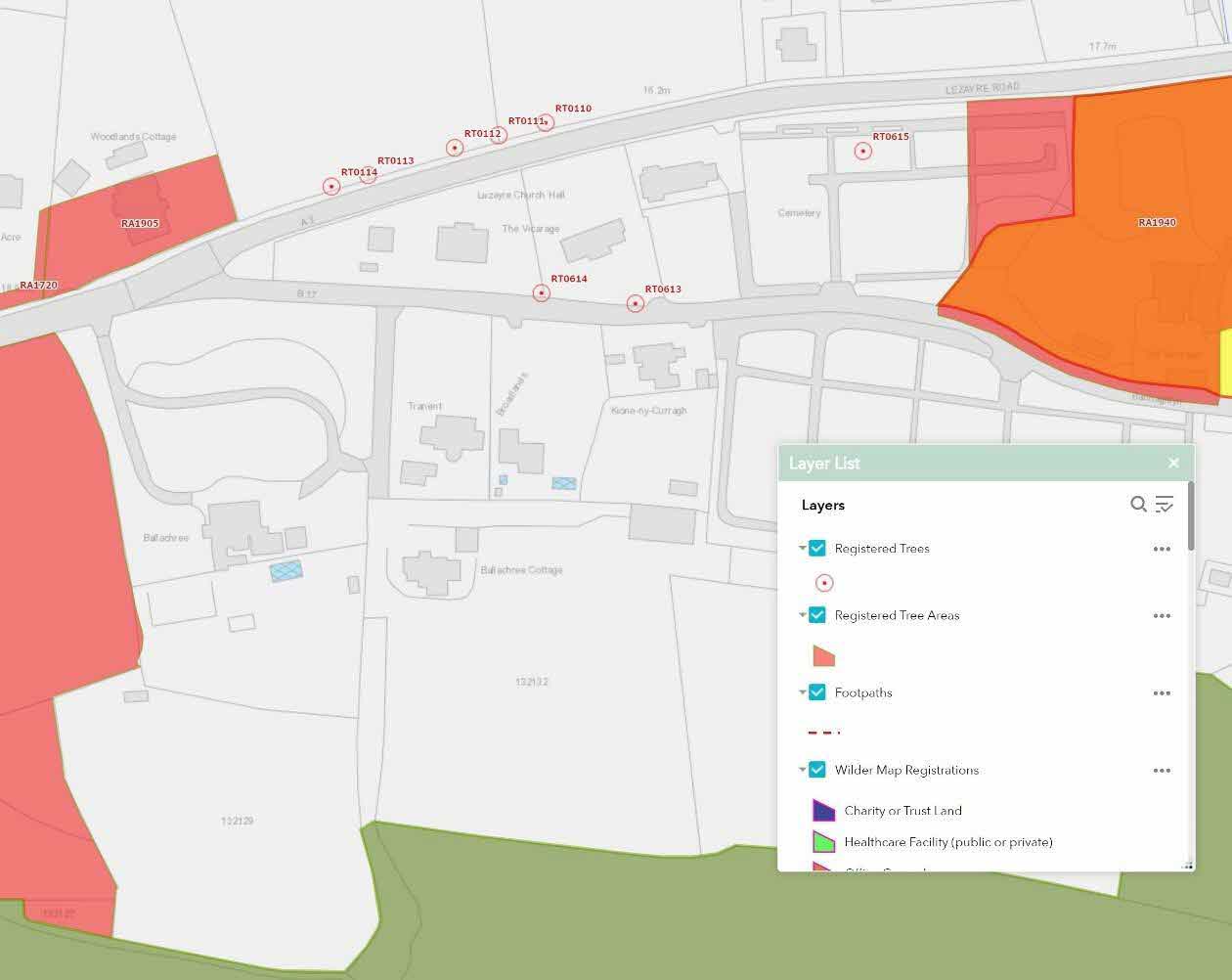
Maps 2 and 3 identify the site in the context of (2) the field gazetteer, and importantly the grey shading indicates that the site is recognised as part of the collection of properties known as Churchtown, and not agricultural land use. And Map 3 recognises that there are no registered trees or registered tree areas affecting the site use.
A digital planning map showing property boundaries, land use categories, and nearby buildings in a rural area.A digital planning map showing the site location in Lezayre with surrounding properties, road access, and overlays for registered trees and land designations.
3.0 Planning History. There have been several applications on the wider site owned by the applicant.
08/01001/A–Approval in Principle to erect a dwelling- approved on appeal.
09/00296/R - Creation of an access road on land behind Broadlands, Churchtown - Approved.
10/00133/REM –Reserved matters application for the erection of a dwelling Approved on appeal.
14/00054/B for Repair and alterations to existing barn. Barn Adjacent To Field 134413 Churchtown Ramsey Isle of Man - Approved
The planning Officer made the following comment when recommending approval for the scheme: "The existing roof of the building and the building itself is significant(ly) intact, neither adds to the visual amenities of the area, and it could be argued the proposed works will improve this current situation. Certainly the works, which are mainly related to the roof and roof structure, will enable the building to be utilised. It is likely if no works are undertaken the building will become redundant and continue to adversely affect the immediate countryside."The comments of the officer I concur with.
15/00903/B – Erection of a dwelling with detached garage and extension to residential curtilage – Approved. It is pertinent to note that the approval considered the context of the extant policiesrelating to locationwhich have not changed in the intervening period.
22/01433/B - Erection of a replacement agricultural building - Application Withdrawn. I am not aware of the reasons why this application was withdrawn.
The inspector in considering P/A 15/00903/B used discretion and concluded that ‘I consider it reasonable to depart from the general requirement of housing Policy 14 of the strategic Plan …..’ See My Appendix B for a full copy of the inspectors’ report and the context of the statement and I suggest that a similar departure from Policycould apply in this case also.
4.0 The application proposal. This application is for the conversion and alterations to the existing storage barn to provide a residential dwelling. The existing barns are split into two levels with a dual pitch roof over the upper level and a catslide roof to the lower level.
The previous use of the building was as a storage building for the residential properties Ballachree and Tranent. Since the construction of Ballachree Cottage the applicant has purchased the property to bring it into one ownership.
Ballachree Cottage has a large, detached garage and is used in conjunction with that property rendering the application site all but redundant. The existing building is far too large to be used under its current use as storage for a single domestic propertyand is considered redundant for its current use.
The property is in an area where amenity space and gardens can be provided without conflict with any neighbours.
The closest property, Broadlands, will be further screened by introducing a Manx bank which will be planted with native species hedging. It should also be noted that the house has in recent times been developed with an external polytunnel which provides separation from the proposed barn conversion/dwelling.
Approval has also been granted for works as described below.
Proposal: Alterations to provide improved living accommodation, removal of existing roof and building an additional storey above to be clad in natural timber and re roofed in either natural slate or standing seam metal. Address: Broadlands Churchtown Ramsey Isle of Man IM7 2AN. It is not known whether these works have been commenced.
Amount. The existing building has a GEA of 239m² which will provide adequate area to provide accommodation for a three double bedroomed dwelling house and a large single garage. No extensions are proposed.
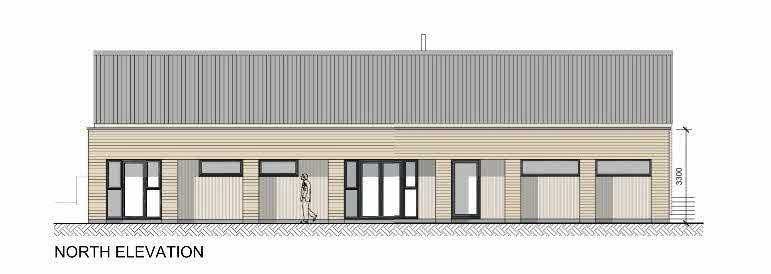
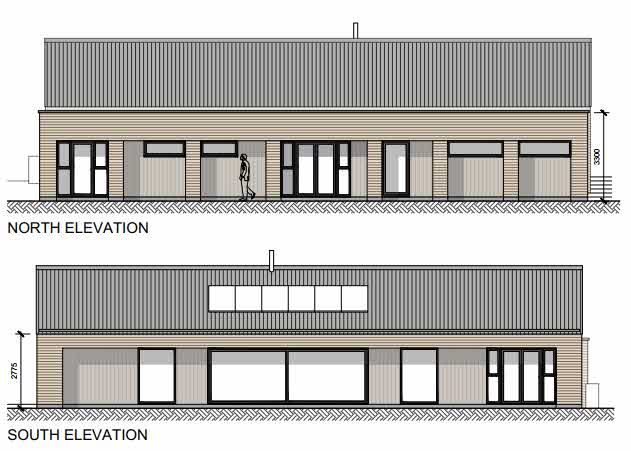
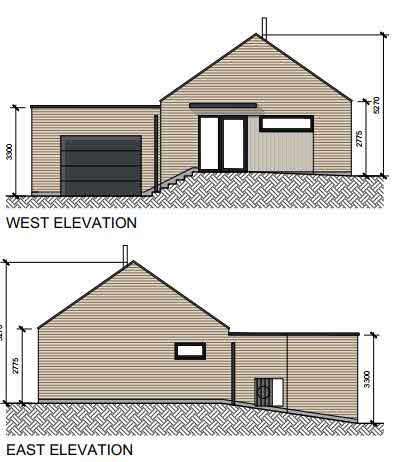
Layout. The main accommodation will be provided on the raised upper level with ramped external access to a parking and turning area. There will be steps both internally and externally to access the lower level. The garaging will be located on the lower level in thenorthwest corner of the building to reduce any overlooking of adjoining properties from habitable rooms. All principal views from habitable rooms will be to the garden to the North or the applicants’ fields and the plantation to the South.
Scale and Mass. The main roof of the building will be raised slightlytoachieve sufficient height for the doors to the south elevation of 2.1m. The roof of the lower catslide section will also be lifted and it is proposed to have a flat roof in this area to achieve a contemporary appearance suitable for the proposed building.
Landscaping. The building is currently located within an existing established garden setting. The access track will be resurfaced with a self binding gravel finish. The proposed parking area will be surrounded by a Manx sod bank which will be planted with native mixed hedging. A patio will be provided to the south of the building adjoining the proposed living area and new trees will be planted near the turning area. All trees on site are to be retained and protected. See site plan for details of species to be planted.
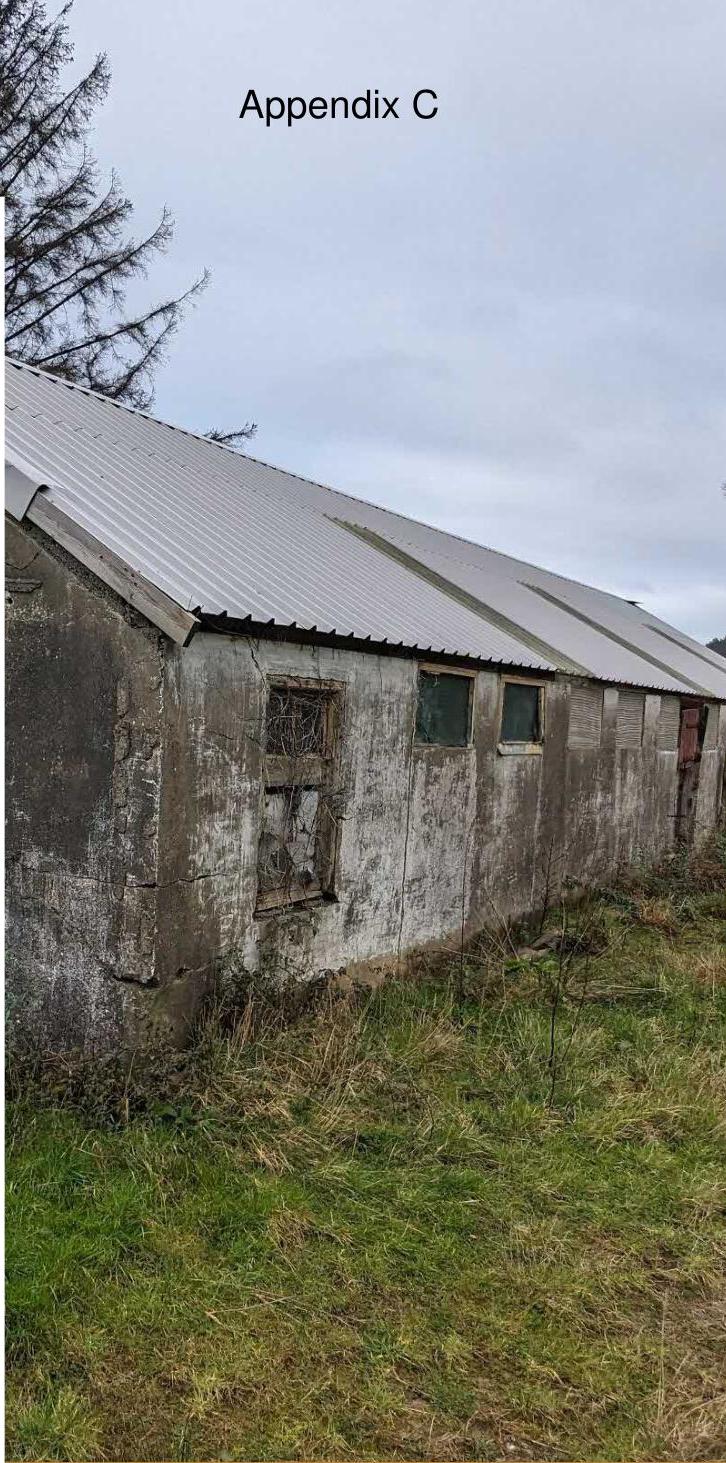
Appearance. The existing storage building is of a non-traditional utilitarian design and is not in keeping with its countryside / residential setting. There has been structural buttressing works carried out in the past to the north elevation which are also unsightly.
It is proposed to clad the building in a natural untreated locally sourced larch cladding much more in keeping with its setting and the woodland beyond. It is proposed to retain as much of the existing fabric as possible whilst also providing enough light and amenities required for a new dwelling.
The roofing materials will be dark coloured slate or raised seam metal.
Windows will be triple glazed and energy efficient.
The resulting proposals allow for the reuse of a redundant building whilst also enhancing its appearance with a new contemporary aesthetic. This will also benefit the views of the building within the landscape and from surrounding properties and public vantage points.
Use. The existing use of the building for storage is now redundant, the building is no longer required for its original purpose which was a builder’s store and general maintenance shed. It is substantially intact and structurally capable of renovation. See Structural Engineers report at AppendixCwhich accompanied the application.
The proposed use is for a single domestic dwelling unit which will optimise the use of this previously developed land and redundant building. The applicant resides at Ballachree Cottage and there is no proposal to separate the site and sell on the open market. It is proposed that the dwelling will be occupied by a member of the family.
Access. The existing vehicular access to/from the site is via a private access track which links with a shared access driveway and connects to the B17 Lezayre Church Road. The access serves as a secondary access to Ballachree, the principal access for the existing Ballachree Cottage and the development site. There will be an accessible path from the parking area and garage to the front door which will be fitted with a level access threshold.
Energy. All materials used in the proposed development will be sourced from local suppliers and using local materials where possible. A Solar Photovoltaic system will be installed on the south facing roof which will be linked to a battery storage system in the garage. Heating and hot water will be provided using an Air Source Heat Pump. Water efficient fittings will be used in all bathrooms, kitchen and utility rooms to limit water consumption to a maximum of 125 litres per person per day.
5.0 PLANNING POLICY REFERENCED BY CASE OFFICER.
5.1 Site Specific:
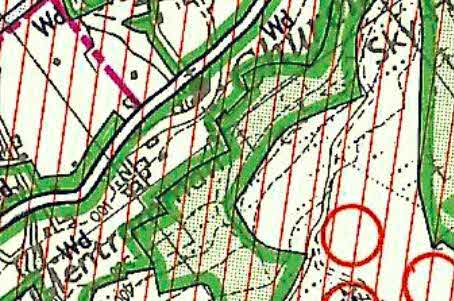
5.1.1 The site lies in an area not zoned for development and is not within any recognised settlement boundary.I disagree and refer to the mapping provided below to illustrate this. Map 4 is a snip from the 1982 Development Plan North Map,andI have marked with aREDdotmy interpretation of the location for the barn–this is within the settlement boundary of Churchtown/Glentramman, and I submit is therefore zoned as suitable for development subject to necessary approvals. Map 5 is a snip from Google Maps to orientate the location from current imagery.
Map 5 5.1.2 The site is also situated within an Area of High Landscape or Coastal Value and Scenic Significance on the 1982 Development Plan.I agree and this annotation does not prevent well designeddevelopment. 5.1.3It is not located within anyConservation Area or Registered Tree Area and does not contain any Statutorily Protected Trees or Registered Buildings. I agree with all aspects of this statement.
A close-up extract from a topographical map showing field boundaries, vegetation, and contour lines with red markings indicating specific areas.
5.1.4The site is not prone to flood risks.I agree with this statement.
5.2 National: STRATEGIC PLAN
5.2.1 The following policies from the 2016 Strategic Plan are considered pertinent in the assessment of this application;
1. Strategic Policy 2 - Priority for new development to identified towns and villages.This does not prevent development in other areas.
2. Strategic Policy 4(b) - Protection of built heritage and landscape conservation The proposal does not impact on built heritage and landscape interpretation.Thesiteisinan areaofHigh LandscapeorCoastalValueand ScenicSignificanceinwhichtheprotectionofthecharacterofthelandscape is animportantconsiderationunlessthe developmentwouldnotharmthe characterofthelandscape. I suggest that in this case there is no harm as the existing building is to beimproved/bettered and already sits in the context of the land.
3. Strategic Policy 5-Design and visual impact.Itisvery difficultto definethe characterofthelocality,since thereisnodominant buildingstyle. The designintentionisof amodern interpretation of atraditional barn conversion, timberclad,but withtallwindows often found insuch conversions.Itwould not resultinany adversevisualimpact,particularly sinceitwouldnotbeprominent inanypublicviewpoint.Itisanimaginative additiontothegroupofbuildingswithinwhichitwillbeset.
4. Strategic Policy 10 - Sustainable transport. The site iswithin 200m of a bus routeserved by the No 5, 5a, 5c, 6, 6a and 6cbuses. The site is within 1.5km of theboundaryof theService Centre of Ramsey and is easily accessible by walking or cycling.
5. Spatial Policy 5 - New development will be located within the defined settlements I consider that the Churchtown/Glentramman settlements are established and the site falls within the boundaryor permitted in the countryside in accordance with General Policy 3. I do not consider GP3 to apply due to the settlementboundarylocation.
General Policy 2 - General Development ConsiderationsIn the context that the proposal is within theidentifiedsettlement boundary GP 2 does apply–it reads:
General Policy 2: Development which is in accordance with the land-usezoning andproposals in the appropriate Area Plan and with other policies of this Strategic Plan will normally be permitted, provided that the development:
(a) is in accordance with the design brief in the Area Plan where there is such a brief;No brief exists for this site
(b) respects the site and surroundings in terms of the siting, layout, scale, form, design and landscaping of buildings and the spaces around them;The proposalcomplies with this part of the policy.
(c) does not affect adversely the character of the surrounding landscape or townscape;The proposalcomplies with this part of the policy.
(d) does not adversely affect the protected wildlife or locally important habitats on the site or adjacent land, including water courses;The proposalcomplies with this part of the policy.
(e) does not affect adversely public views of the sea;The proposal complies with this part of the policy.
(f) incorporates where possible existing topography and landscape features, particularly trees and sod banks; The proposalcomplies with this part of the policy.
(g) does not affect adversely the amenity of local residents or the character of the locality;The proposalcomplies with this part of the policy. Adjacent neighbours have recently obtained planning permission with no privacy or amenity issues raised.
(h) provides satisfactory amenity standards in itself, including where appropriate safe and convenient access for all highway
users, together with adequate parking, servicing and manoeuvring space;The proposalcomplies with this part of the policy.
(i) does not have an unacceptable effect on road safety or traffic flows on the local highways;The proposalcomplies with this part of the policy.There are no objections from the Highway Services division of the DoI.
(j) can be provided with all necessary services;The proposal complies with this part of the policy.Services exist to the existing building.
(k) does not prejudice the use or development of adjoining land in accordance with the appropriate Area Plan;The proposal complies with this part of the policy.
(l) is not on contaminated land or subject to unreasonable risk of erosion or flooding;The proposalcomplies with this part of the policy.
(m) takes account of community and personal safety and security in the design of buildings and the spaces around them; andThis is a matter for building control which will be addressed.
(n) is designed having due regard to best practice in reducing energy consumption.The proposalcomplies with this part of the policy.
7. General Policy 3 - Exceptions to development in the countryside I do not consider this Policy to apply.
8. Environment Policy 1 - Protection of the countryside and ecology. The development is of a residential nature on an existing footprint.DEFA Ecopolicy team have no adverse comments to the application.
9. Environment Policy 3 - Protection of trees and woodland I do not consider this Policy to apply. No trees are affected by the proposals.
10. Environment Policy 4 Wildlife and Nature Conservation I do not consider this Policy to apply as the development is of a residential nature on an existing footprintand the EcoPolicy team at DEFA have no adverse comments on the application.
11. Housing Policy 4 - Sets criteria for new Housing in the Countryside The application is for a simple conversion this is not a significant developmentand does not create additional footprint area.
12. Housing Policy 11 - Conversion of rural buildings to dwellings - Policy applies and the proposal addresses aspects of the policy as set out: The application whilst not directly meeting the criteria forHP11Policy associated with refurbishment in the countryside does reflect the intent of the policy.Ihave been unable to establish any historical context for the property however the design respects the existing features and constraints presented by the building.
It is redundant for its current use and following refurbishment by a previous owner involving replacement roof and support masonry in the form of buttressing this provides a canvas for us to have designed a well thought out solution which respects neighbours in terms of privacy and allows a poor building to be brought back into meaningful use.
The proposal is for residential use by a direct family member to allow for the elderly applicant and his wife to remain in the main house in their dotage. The accommodation is modest and will ensure this property in the countryside does not become a further derelict in the landscape. The design is unashamedly modern using a sympathetic palette of materials which can be sourced locally. It is single storey, accessed from an existing driveway and providescar parking to service the property.
The proposal represents significant planning gain;supporting statements have been provided to assist the officer in their assessment and whilst the structure requires attention it is capable of full refurbishment. The use is compatible with all surrounding properties.
13. Transport Policy 4 - Highway safety. There are no objections from the Highway Services division of the DoI.
14. Transport Policy 7 - Parking provisions these are met by the application proposals.
15. Paragraph 8.10 - Conversion of Rural Buildings to Dwellings. 8.10 Conversion of Rural Buildings to Dwellings -I quote the full paragraph referred to to inform the appeal process and submit that there is,as previously applied on this site,latitude to allow deviation where quality is proposed and where the proposal will providea useful contribution to the housing stock, ensure retention of our built heritage (whether historicinnature or not) and most importantly improve the appearance of what might otherwise become derelict fabric.
8.10.1 Throughout the countryside, there are examples of buildings which are no longer suitable or needed for their originally intended use, but which are of sufficient quality or interest to warrant retention and re-use.
8.10.2 Conversion of such buildings into dwellings can make a useful contribution to the housing stock, ensure retention of our built heritage, and improve the appearance of what might otherwise become derelict fabric. The following policy is therefore appropriate:
Housing Policy 11: Conversion of existing rural buildings into dwellings may be
(a) redundancy for the original use can be established; The proposalcomplies with this part of the policy.
(b) the building is substantially intact and structurally capable of renovation; The proposalcomplies with this part of the policy.My Appendix C provides a full appraisal by a StructuralEngineer.
(c)the building is of architectural, historic, or social interest;This aspect of the Policy is not complied with. I have been unable to identify any historic context for the property andrespectfully request the inspector to apply professional judgment in considering their recommendation.
(d) the building is large enough to form a satisfactory dwelling, either as it stands or with modest, subordinate extension which does not affect adversely the character or interest of the building;The proposalcomplies with this part of the policy.
(e) residential use would not be incompatible with adjoining established uses or, where appropriate, land-use zonings on the area plan; andThe proposalcomplies with this part of the policy.
(f) the building is or can be provided with satisfactory services without unreasonable public expenditure.The proposalcomplies with this part of the policy. Such conversion must: (a) where practicable and desirable, re-establish the original
appearance of the building; and The proposal makes good use of local materials and creates a rural building of quality.
(b) use the same materials as those in the existing building. Permission will not be given for the rebuilding of ruins or the erection of replacement buildings of similar, or even identical, form. The embedded image confirms a deviation from the use of the existing materials.
Further extension of converted rural buildings will not usually be permitted, since this would lead to loss or reduction of the original interest and character.
8.10.3 Permission will be given in certain circumstances for the reestablishment of residential use where there is an abandoned dwelling, since such dwellings can sometimes have a negative impact, usually arising from the sense of dereliction and dilapidation.....
6.0 OTHER MATERIAL CONSIDERATIONS REFERENCED BY THE CASE OFFICER. My comments in ‘italics’
6.1 Planning Circular 3/91 - Guide to the residential development in the countryside. I submit that this Guide does not strictly apply where refurbishment is proposed.
6.2 Residential Design Guide (2021) This document provides advice on the design of new houses and extensions to existingproperty as well as how to assess the impact of such development on the living conditions of those in adjacent residential properties and sustainable methods of construction.
I have previously sought clarification on where the guide will be applied and have been advised by the Planning Department that it is meant in the context of where there is likely adverse effects of proposed development on existing neighboursand within existing residential developments–I submit that in this case the proposal is significant betterment of what exists and there is limited effect on neighbours and none which should warrant refusal.
Para1.1.7 It is intended to apply to any residential development within existing villages and towns, including individual houses, flats, houses in multiple occupation, conversions and householder extensions, and
1.1.8 It is envisaged that separate guidance will be provided for dwellings in the countryside, although some of the broad principles set out within this document may still be relevant to such proposals provide some assistance.
6.3 The Isle of Man's Biodiversity Strategy (2015 - 2025)
6.3.1 The Department's Biodiversity Strategy is capable of being a material consideration. It seeks to manage biodiversity changes to minimise loss of species and habitats, whilst seeking to maintain, restore and enhance native biodiversity, where necessary.
The EcoPolicy team has no comments regarding the proposed development.
7.0 Structural Appraisal – see Appendix C for a full copy of the submitted information. I refer you Mr/Madam Inspector to this detail in full. The executive summary is pertinent and particularly para 1.5 which reads:
7.1There are areas of cracking and areas where the walls are leaning. Cracking is generally not severe (and to be expected with the type of construction). The areas of leaning walls observed appeared to be mostly longstanding defects.
7.2 Further at para 2.3 the limitations of the survey are noted:
Limitations 2.3 This appraisal has the following limitations:
• Areas of the structure were obscured by vegetation (particularly ivy), and some areas of render/plaster which may mask defects
• Areas were accessed from the ground only
• Defects relevant to the adequacy of the structure only are noted in general
• The appraisal was non-intrusive and subsequent intrusive investigations will be required to confirm assumptions with regards to foundation bearing depths and condition under vegetation or finishes.
7.3 The applicant acknowledges that further investigation is required to establishfoundation depths and understands the implications if underpinning is required.
7.4 In the section ‘Suitability for Redevelopment’ the engineer clearly states that there are areas requiring structural replacement including areas of the North wall where it has been found to be leaning.
7.5 There is no statement advising that the building cannot be economically restored and I ask what structural engineering qualification the planning officer has to conclude differently.
7.6The conclusion reached and thestatements to the committee (as minuted) regarding the structural integrity are flawed and I submit contributed to the split decision being made by the committee.
7.7 Reason for refusal 2 relies on the officer’s recommendation which is at deviance to that of the structural engineer.
7.8 Reason No 3 for refusal appears also to be open to challenge in that it relates to spatial strategy for new housingand does not acknowledge that the
application is for the conversion of a redundant building. It also refers to the structural integrity of the building.
8.0 Conclusions: The planning committee assessed the application consideringthe recommendations of the full report written and presented by the case planning officer. For the reasons set out above I consider this report to be flawed and to have negatively influenced certain members of the committee in their decision.
8.1 I do, as stated in this evidence, agree that the application needs to be considered in the context of the site and what is being requested for approval and will require professional judgement to be applied where the proposal falls short policyterms.
8.2 I rely on the open nature of the appeals process and the professional judgement for assessment of written policy to allow consideration of individual parts making the whole and a recommendation based on the merits of the proposal.
8.3 Large parts of the officer’s report are accurate, and I agree with however those statements on the assessment of the site as being within an area not zoned for development and those relating to the structural integrity of the building are being challenged. If appropriate and the inspector thinks it appropriate, I can arrange for the engineer to attend the appeal.
8.4 I request, Sir/Madam, that the decision of the planning committee be reversed and that your recommendation to the Minister be that the Appeal be allowed and approval for the conversion of the redundant barn confirmed with conditions.
Appeal made by [redacted] against the decision of the Planning Authority to refuse to approve reserved matters of a permission for the erection of a dwelling on and opposite Ballachree Cottage, Churchtown, Ramsey.
I held an inquiry into the appeal on 16 March 2011, following a site visit on 14 March. At the inquiry the Appellant was represented by Mr Hugh Logan, Architect. The Planning Authority was represented by Ms Laura Davy.
The Appeal Site And Surroundings, And The Proposed Development
The appeal site is a piece of land situated behind and above frontage development at the south west of Churchtown. It is the site of a now demolished cottage. To its south and east is pasture land which rises to the south. At the north is a substantial four square dwelling; to the north east a stone clad bungalow. To the west is Ballachree, a mansion in its own grounds, and beyond that open countryside. To the east are the large cemeteries of Churchtown, and, some distance away, the church, a modest former vicarage, and a row of traditional cottages running back from the road.
Access to the appeal site is by a track which runs from the road through Churchtown.
The appeal proposal would implement an approval in principle for a replacement dwelling granted in 2008. This approval required demolition of the existing dwelling and clearance of all resulting materials.
The Case For The Appellant
The material points are:
Approval in principle for a replacement dwelling had been granted on appeal in December 2008¹. The design now presented was the result of lengthy discussion.
Strategic Plan Housing Policy 14 set out the design requirements where a replacement dwelling was permitted. These governed size and character, and stated: “Exceptionally permission may be granted for buildings of innovative, modern design where this is of high quality and would not result in adverse visual impact”. The policy then went on to require the use of materials reclaimed from the original dwelling, but this had been precluded by the terms of the permission in principle. The policy also discussed the
¹ Appeal 08/0162 – Appellants Appendices C, D
terms under which a replacement dwelling might be permitted which would be larger than indicated earlier in the policy.
The site lay in an area of High Landscape or Coastal Value and Scenic Significance in which the protection of the character of the landscape was the most important consideration unless the development would not harm the character of the landscape or the location of the development was essential.
There were a number of precedents² where innovative development had been permitted under these policies. Some were of greater size in relation to the dwelling being replaced than the appeal proposal, and required exceptions to the policies. Some were visible from roads and public places, which the appeal proposal was not. All were designs which did not reflect any traditional approach to form or, for the most part, materials.
In her assessment, the planning officer had concluded that the only matters at issue were whether the proposal was innovative, and the design and visual impact of the proposal. However, the reason for refusal acknowledged that the design was innovative, so the only matter at issue was the design and visual impact of the proposal
It was very difficult to define the character of the locality, since there was no dominant building style. The design intention was of a modern interpretation of a traditional barn conversion, timber clad, but with tall windows often found in such conversions. It would not result in any adverse visual impact, particularly since it would not be prominent in any public viewpoint. It would be an imaginative addition to the group of buildings within which it would be set.
The Case For The Planning Authority
The material points are:
The proposed building followed an approval in principle for development on the site, which had included approval of the siting of the dwelling. Its floor area would comply with the restriction on the size of replacement dwellings set out in Housing Policy 14. In terms of design, the policy stated that replacement dwellings in the countryside should generally be in accordance with policies 2-7 of Planning Circular 3/91, the thrust of which was that they should be of traditional design. However, HP14 recognised that exceptionally permission may be granted for buildings of innovative, modern design where this is of a high quality and would not result in adverse visual impact. Although the policy went on to state that designs should incorporate the reuse of such stone and slate as are still in place on site, and that in general new fabric should be finished to match the materials of the original building, it was recognised that condition 3 on the approval in principle meant that original materials could not be re-used.
² See Appellant’s appendices K-O
It was not considered that the design was exceptional. Despite the concept of the design having evolved from that of a Dutch Barn, and the proposed palette of materials being timber, steel and glass, the resulting appearance was too akin to that of a modern commercial office, which may be more appropriate to a business park than an area of high landscape value. The site was fairly exposed, and the dwelling would appear a dominant feature in the landscape.
The Case For The Lezayre Parish Commissioners
The material points are:
The proposal was too big and would not be in keeping with surrounding properties. Whilst it was stated that the dwelling would use the existing septic tank on the site, its position was not shown. Permission should be refused.
Inspector’S Conclusions
The main consideration in this appeal is whether the proposed dwelling would have a harmful visual impact, adversely affecting the character of the landscape.
Housing Policy 14 governs decisions on the design of replacement dwellings in the countryside. It is a long, discursive and wide ranging policy, and as such is susceptible to misinterpretation. In this instance, parts of the policy do not apply. I set out below the whole policy, annotated with my views on its applicability.
“Where a replacement dwelling is permitted, it must not be substantially different to the existing in terms of siting and size, unless changes in siting or size would result in an overall environmental improvement. The new building should therefore generally be sited on the “footprint” of the existing,...”. These matters were determined in the 2008 appeal report and decision. The proposal complies with this decision.
“and should have a floor area which is not more than 50% greater than that of the original building” The proposal meets this criterion.
“Generally the design of the new building should be in accordance with policies 2-7 of Planning Circular 3/91. Exceptionally permission may be granted for buildings of innovative, modern design...” Circular 3/91 deals with maintaining the traditional character of building within the countryside, the essence of which is to carry on traditional Manx design and construction methods, by reference to surrounding traditional buildings. Clearly, where an innovative modern design is presented, the advice of Circular 3/91 is not broadly applicable. The exception applies.
“permission may be granted for buildings of modern innovative design where this is of high quality and would not result in adverse visual impact” This is the only part of the policy which remains to be satisfied.
3
The policy then goes on to require re-use of materials, which is not possible in this case, due to earlier planning decisions having been complied with. It then states "in general, new fabric should be finished to match the materials of the original building". However, it is clear from the Planning Authority evidence at the 2008 inquiry that the original building was of no particular merit, and I view this part of the policy as unimportant in the circumstances of this case.
There is then a sentence which sets out policy where an increase of more than 50% above the original size is proposed. That is not the case here.
Environment Policy 2 requires that the character of the landscape is protected as the most important consideration. I do not agree with the Planning Authority that the site is exposed – it lies at the foot of a slope against the wooded surrounds of the developed area. Furthermore, the impact upon the character of the landscape has to be judged against the fact that there was a dwelling on the site which is to be replaced. This is not a case where the alternative is retention of undeveloped land. I find no conflict in principle with this policy, subject to there being no adverse visual impact, which is the remaining operative part of Housing Policy 14. The high quality of the landscape provides a context for this judgement.
The Planning Authority witness took the view that where a replacement dwelling was permitted in the open countryside, the judgement as to its visual impact was purely a matter of scale and form in its setting. However, where there were surrounding dwellings, then the design should acknowledge their character. Whilst I appreciate that judgements of this sort are difficult, and may be assisted by local references, there is no support for this approach once it is accepted that a design is an innovative, modern one. I have not therefore sought features in the surrounding development to act as a yardstick for this proposal.
I turn then to the substance of the issue – whether the proposal would be visually intrusive. The fact that it is unlikely to figure prominently in any public view does not in my view remove the need for good design, but intrusion implies offence to a view, which undoubtedly involves a third party.
Whilst I accept the description of the Planning Authority witness that the materials are those commonly found in business park developments, I do not consider that this rules them out in a countryside residential use. It would not be appropriate for it to be repeated too widely, but if that became the case, the design would no longer be innovative. In this case the design chosen is simple, and unencumbered by fussy detail. The form of the building expresses its structure, and its positioning within the site means that anyone gaining a view up the long access would perceive the smaller of the elevations. From the east the building would sit against a wooded backdrop. All together I consider the approach to be an admirable expression of planning policy. For this reason I shall recommend that the appeal is allowed.
The Planning Authority suggested four conditions should be applied to the permission. C1 and C2 are standard uncontentious conditions. C3 requires
landscaping to be carried out according to approved details. Whilst the plans do show outline planting proposals, these are not so specific that they provide an enforceable detail. I do not consider that any important public interest would be served by seeking to require implementation of the landscaping details shown on the submitted plans. C4 would remove the permitted development rights to extend or provide outhouses and the like. Conditions such as this should be applied only in exceptional circumstances, and there should be some clearly identifiable harm which could result if the condition was not applied. Bearing in mind that the replaced dwelling was not subject to such a restriction, I do not consider that this condition would be appropriate.
Recommendation
I recommend that the appeal be allowed, and planning permission be granted, subject to conditions C1 and C2 proposed by the Planning Authority.
David Ward BSc(Hons) CEng MICE FCIHT Inspector.
22 March 2011
Ballachree Barn Structural Inspection
A photograph showing the side elevation of a long, weathered agricultural barn with a corrugated metal roof and concrete walls.
1.1. This report appraises the condition of the barn structure at Ballachree, Churchtown, Lezayre.
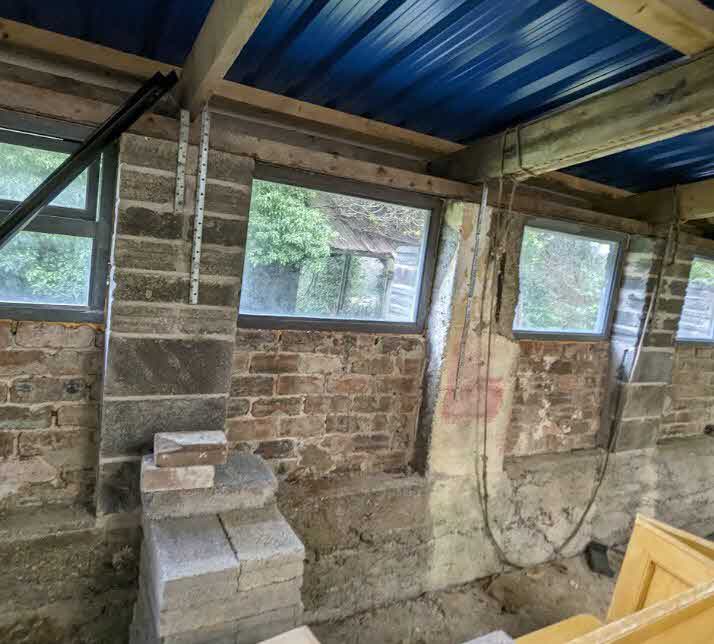
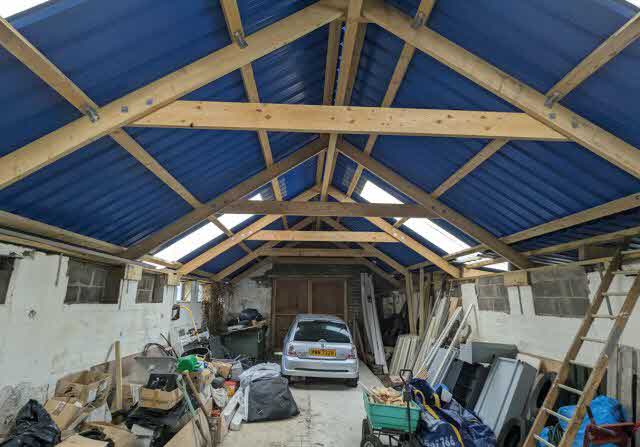
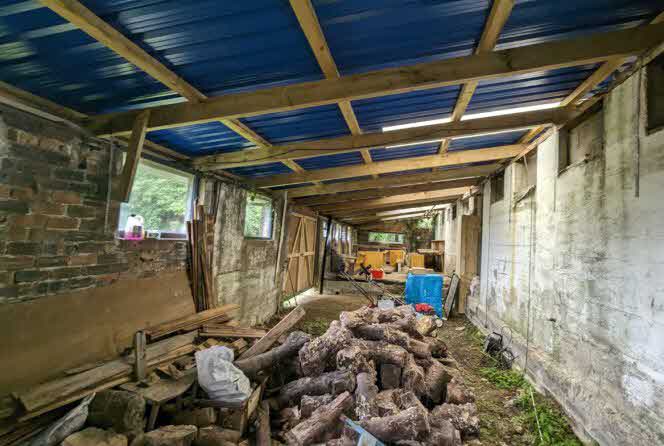
1.2. The site was visited and inspected in March 2024. There is a principal shed, with a lean-to extension. The walls are a combination of plain concrete and masonry, with a timber roof and metal sheeting.
1.3. There are proposals to convert the barn into a residential dwelling.
1.4. The existing barn has extensively plain concrete walls, with areas of masonry (infill and replacement). The roof is timber with metal cladding. Existing floors are a mixture of disparate concrete slabs and areas of soil (in the lean-to barn).
1.5. There are areas of cracking and areas where the walls are leaning. Cracking is generally not severe (and to be expected with the type of construction). The areas of leaning walls observed appeared to be mostly longstanding defects.
2 Introduction and Background
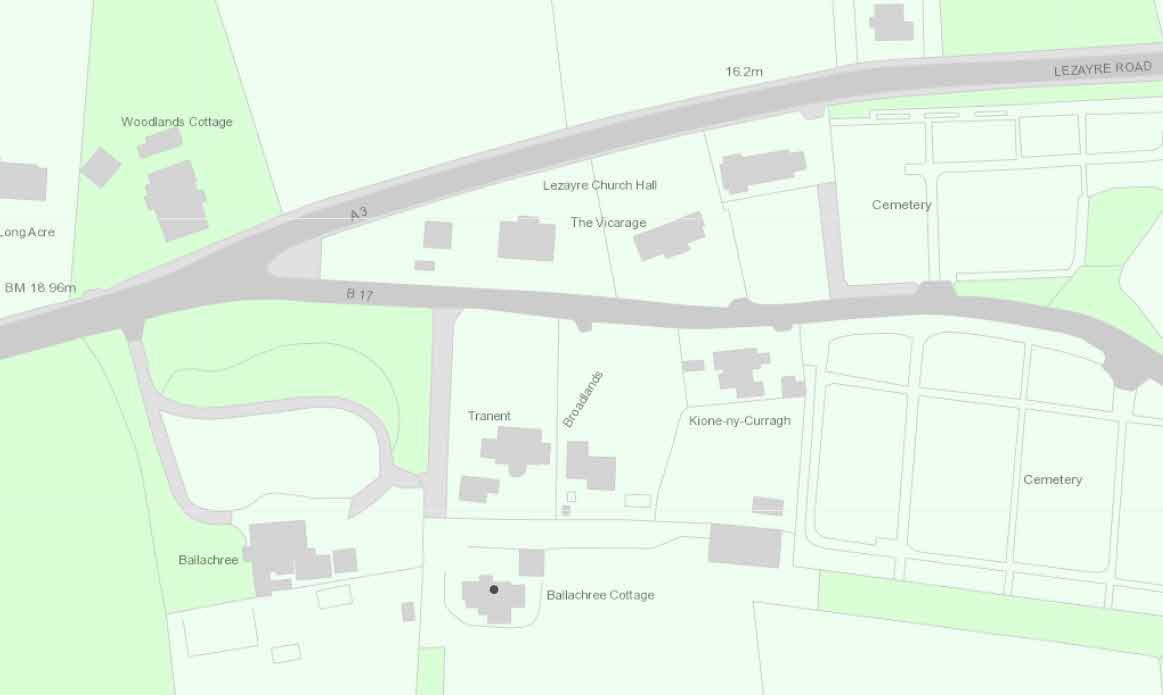
A site location map showing the property at Ballachree Cottage and surrounding buildings like Lezayre Church Hall along Lezayre Road.
2.1. Axis Consulting Engineers have been engaged to undertake an appraisal of a barn structure at Ballachree, to assess the condition of the structure proposed for redevelopment.
2.2. The barn is located off a short access road, leading up to Ballachree Cottage, off Churchtown Road.
Location plan
Lezayre Road
North
Churchtown Road
Ballachree barns
Figure 1 - Location Plan
Historic Information
A vintage black and white site plan showing property boundaries and surrounding features like 'The Vicarage' and 'Grave Yard'.A scanned historical map showing the site location relative to nearby landmarks such as Lezayre Vicarage and the Cemetery.
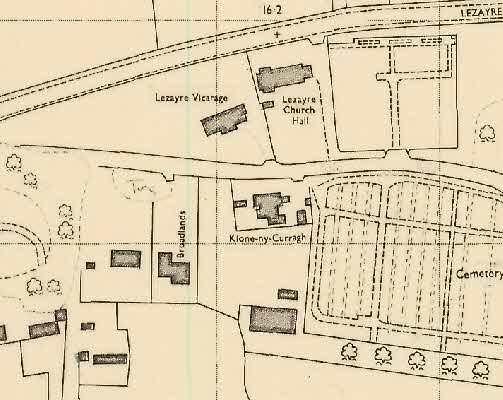
The site exists on the 1950s Ordnance Survey map. It is not known the exact year of construction.
Figure 2 - extract from the 1950s Ordnance Survey map showing the barn, highlighted red
Figure 3 - extract from the 1980s Ordnance Survey map showing the barn, highlighted red
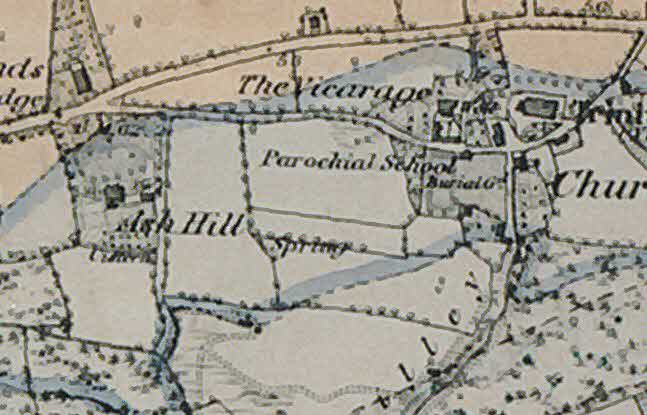
Extracts from the British Geographical Survey notes undertaken of the area suggest a nearby spring, aligning with the position of a ditch/small stream. The area is shown as consisting of glacial boulder drift deposits.
Figure 4 - extract of Lamplugh's geological survey notes
Limitations
2.3. This appraisal has the following limitations: Areas of the structure were obscured by vegetation (particularly ivy), and some areas of render/plaster which may mask defects Areas were accessed from the ground only Defects relevant to the adequacy of the structure only are noted in general The appraisal was non-intrusive and subsequent intrusive investigations will be required to confirm assumptions with regards to foundation bearing depths and condition under vegetation or finishes.
A vintage map extract showing land parcels, field boundaries, and buildings including 'The Vicarage' and 'Parochial School'.
3 Inspection Report
This image displays a ground floor plan of a building, showing a large garage area, a workshop, and a log store.
Structural description
Southern Elevation
“Main barn”
East Elevation
West Elevation
“Lean-to barn”
Northern Elevation
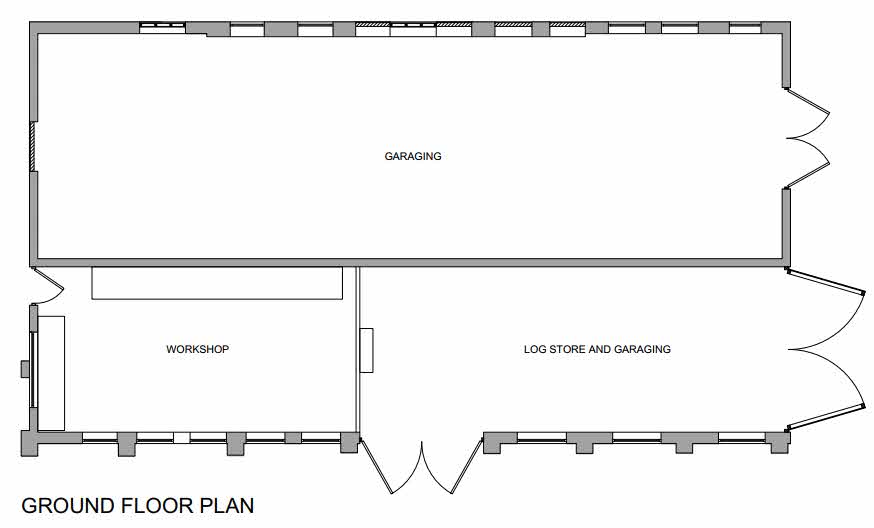
Figure 5 – plan of the barns, taken from architect’s plans.
3.1. The site comprises the main single storey barn (circa 20x6m), with an additional lean-to area (circa 4.5m width, running the full length of the barn). The barn is currently used for garaging/storage, but its past use appears to have been agricultural. Both sections of the barn are open throughout, with the only separating wall between the main barn and the lean-to. There are blocked up openings on this separating wall that were possibly previously external doors, suggesting the leanto has been added on after the construction of the original barn.
3.2. Walls were generally circa 1 foot thick (305mm), formed of cast concrete. Board marks were visible on the concrete face. There were areas of infill blockwork visible, and blockwork piers abutting the lean-to area. There are extensive openings on the northern and southern elevation, and large doors on the western gable elevation. Other areas of the wall were blockwork, such as on the western gable.
3.3. On the southern elevation there are blockwork piers built along the wall, with masonry infill. These
are built off a section of concrete wall which likely extends to the foundation.
Figure 6 - northern elevation wall construction
3.4. Floors were concrete slabs. The main barn has a concrete floor at nominally the same level, with a large slope to the separating wall. The lean-to area is split level, with the ‘log store and garaging’ (Figure 5) area circa 600mm lower than the workshop and adjacent main barn.
3.5. The roof comprised timber A-frames in the main barn (circa 2.2m spacing, but not evenly spread across the structure), with timber purlins and metal sheeting. The roof appears to have been reconstructed in modern times. A-frames are positioned in line with openings (i.e. where solid masonry extends up to wallplate level) and there was extensive restraint strapping visible.
Interior photograph of a building under renovation featuring exposed brick walls, newly installed windows, and wooden roof beams with blue corrugated sheeting.
Figure 7 - internal of the main shed (left) and lean-to (right)
3.6. On the lean-to, there are ’principal rafters’ at circa 1400mm spacing with transverse timbers (‘purlins’) sitting on the rafters, with metal sheeting.
3.7. In both areas the purlins are the ‘wrong’ orientation with the shallow side spanning between Aframes/rafters.
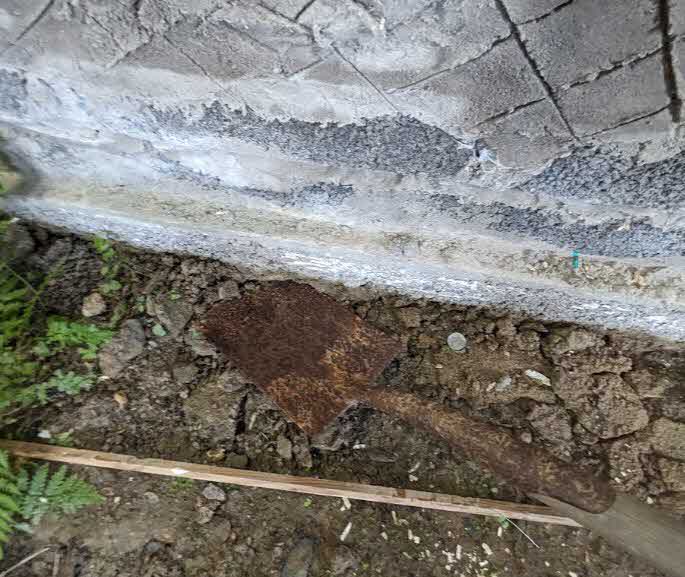
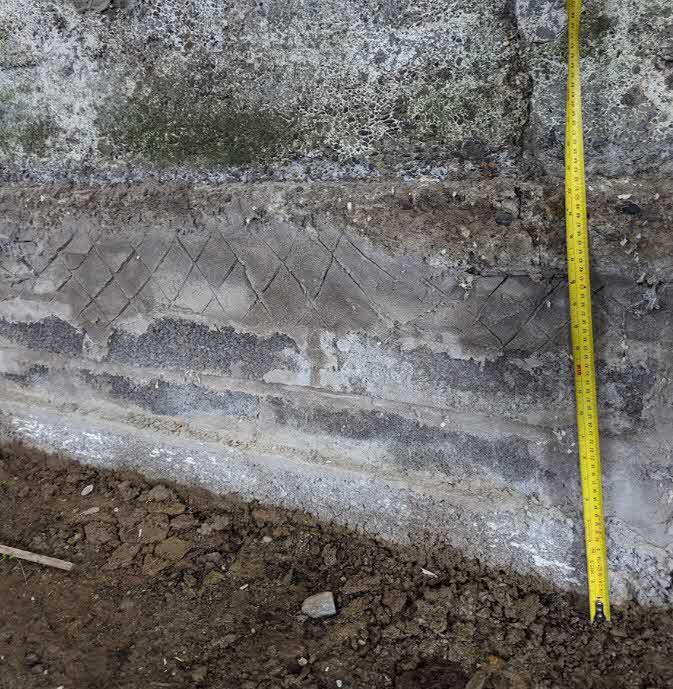
3.8. There was areas of foundation visible on the separating wall, this appeared relatively rudimentary with a circa 100mm thick concrete footing (appearing the width of the wall), with masonry supporting the floor slab (and the wall built off this).
Figure 8 - barn as seen from the southern elevation.
Interior view of a large barn or outbuilding featuring exposed wooden roof trusses and blue corrugated roofing, with a car parked inside.Interior photograph of a long, narrow barn structure with a blue corrugated roof and a large pile of logs on the floor.A photograph of a long, single-story agricultural barn with a corrugated metal roof and weathered concrete walls situated in a grassy field.
Figure 9 - barn from the northern/western elevation
Defects Observed
Walls
3.9. The southern elevation was generally leaning out, circa 2-3%. The walls were generally relatively plumb at ground level and ‘kicking out’ circa half way up the wall. This may be a result of roof spread.
3.10. The western gable (appearing to have been rebuilt with blockwork) appeared relatively plumb. The mortar joints were relatively wide at circa 25mm. The eastern gable also appeared relatively plumb.
3.11. The northern elevation (the lean-to main wall) had areas with extensive leans, particularly on the eastern side (up to 6.5%). There was a visible difference in verticality between some of the block on flat buttressing piers and the infill masonry, suggesting that the buttressing may have been added subsequently (or possibly reconstructed). It is unknown what foundations these are constructed on to and whether that has been any foundational rotation or settlement.
A photograph showing a long, single-story brick and concrete agricultural building with large metal doors in a rural setting.
3.12. The separating wall showed a slight lean in towards the main barn.
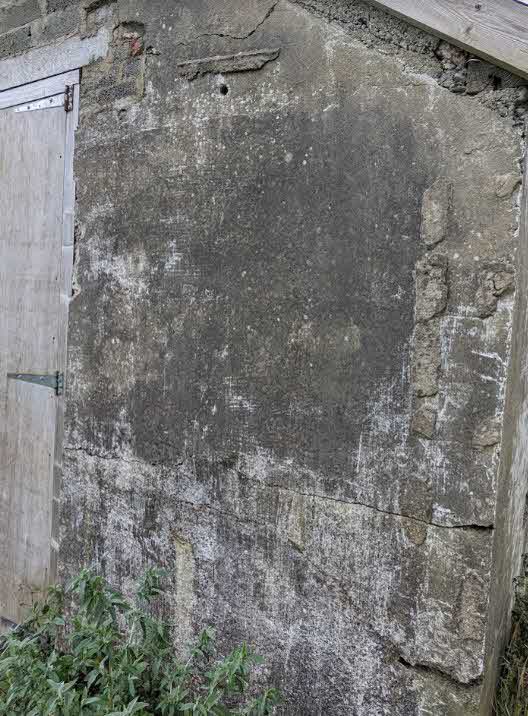
3.13. There were areas of cracking observed on the walls. These were generally relatively small cracks (< 1mm). There were no sign of construction movement joints and the walls appear to be not reinforced, therefore many of these cracks are anticipated to be shrinkage and expansion cracks.
Figure 10 - diagonal crack on western gable
3.14. There were other cracks visible in areas such as the western gable suggesting a small amount of historic movement.
Roof
3.15. The roof appears to have been re-roofed at some point in recent years. For its purpose as storage the roof appears in relatively good condition.
3.16. The wallplate was exposed in areas and was relatively soft as a result of insect damage (and possibly areas of wet rot).
A close-up photograph of the weathered exterior wall of an old stone or concrete outbuilding, featuring a wooden door and vegetation at the base.
Lintels
Figure 11 - wallplate with insect damage and signs of wet rot.
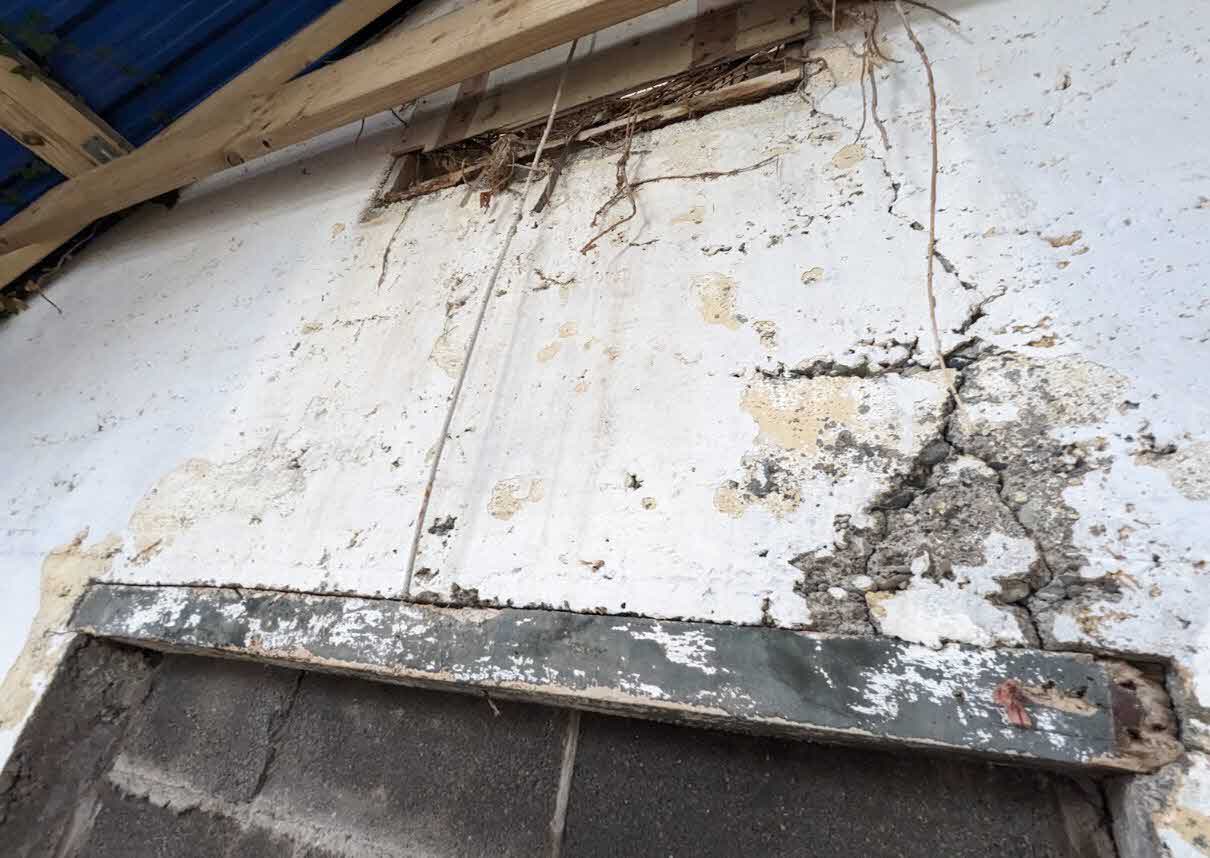
3.17. Lintels were of varying condition. On the eastern gable there was a lintel that appeared to have deficient arrangements (showing minimal bearing), and there was cracking visible above this which may be a result of this. In general timber lintels are likely to require replacement.
A close-up photograph showing the dilapidated condition of a white rendered wall with peeling plaster and exposed concrete, likely part of a barn structure.
Floors and ground conditions
3.18. Floors appeared to have been constructed and altered at various points in time. On the main barn there was an excessive fall across the floor.
3.19. On the lean-to area of barn, the floor was only made up in part with areas of soil visible. The ‘workshop’ area is raised up with a circa 50mm slab visible on soil.
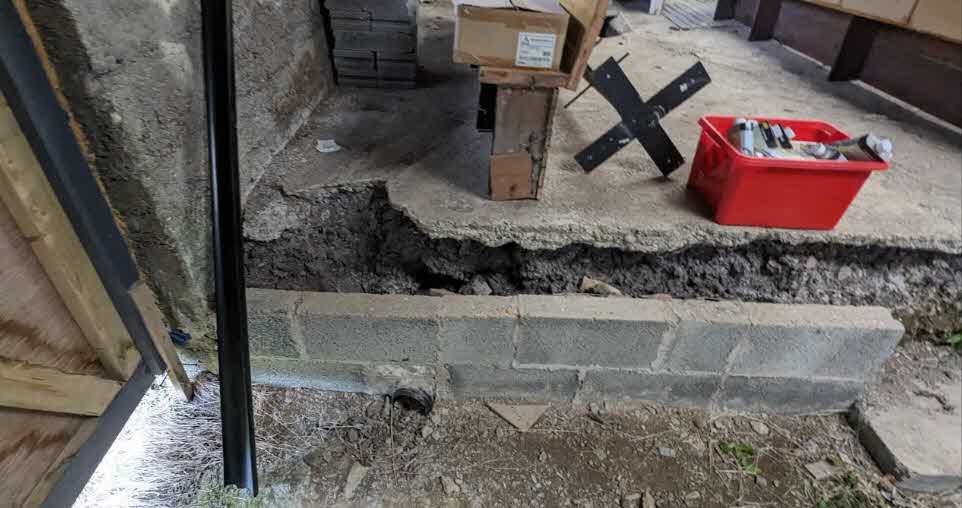
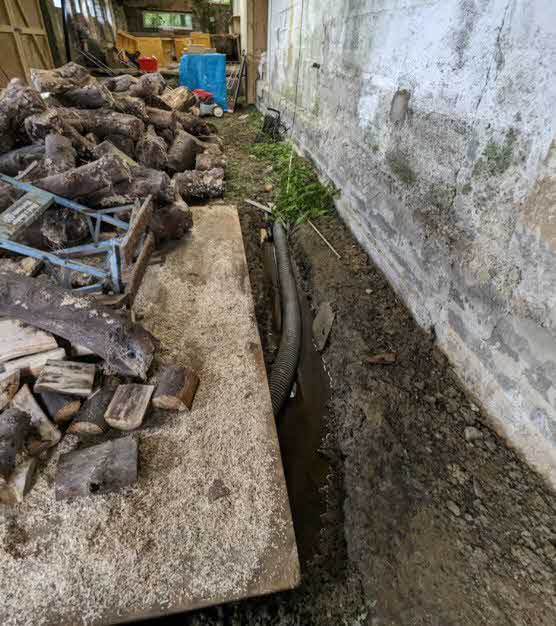
3.20. The ‘log store and garaging’ area was saturated, with running water visible and a drain pipe running through to pick this up. This appears to be the stream, collecting from outside the garage door.
A photograph showing the interior of a building under construction, featuring a newly laid blockwork wall and a broken concrete floor with tools and materials.
Figure 12 - saturated soil area within the lean-to.
3.21. This saturated area is immediately adjacent to the exposed footing of the separating wall.
Figure 13 - bottom of separating wall foundation exposed (spade shown going under base of footing)
3.22. The foundations for the separating wall are minimal. Whilst this is the only area of foundation visible, it is anticipated that other walls may have similar construction as they appear to have been constructed at a similar time.
Figure 14 - wall buildup of the separating wall. Circa 100mm thick concrete, 300mm block on flat masonry, 100mm floor slab with plain concrete wall built off this.
Defect Summary
Defect
Severity
Comment
Recommendation
Saturated soil in and around lean-to and western gable
High
Coming from stream above the site.
Improve water management in area.
Walls leaning out (southern elevation)
Medium
Moderate lean on these walls, consider strengthening.
Assess in detailed design.
Walls leaning out (northern elevation)
High
Approximately half of the run.
Reconstruct these areas of walls (to suitable design).
Wallplates showing signs of rot
Medium
Replace any rotten sections, weatherproof with suitable fascias etc.
Deficient timber lintels
Medium
Localised to certain openings
Replace
Foundations
TBC
Further investigation required to confirm foundation arrangements.
Investigate at detailed design stage.
Cracking on walls
Medium
In general, of little concern (shrinkage/expansion). Some may relate to a small amount of movement/leaning.
Monitor, investigate as part of other issues.
4 Suitability for Redevelopment
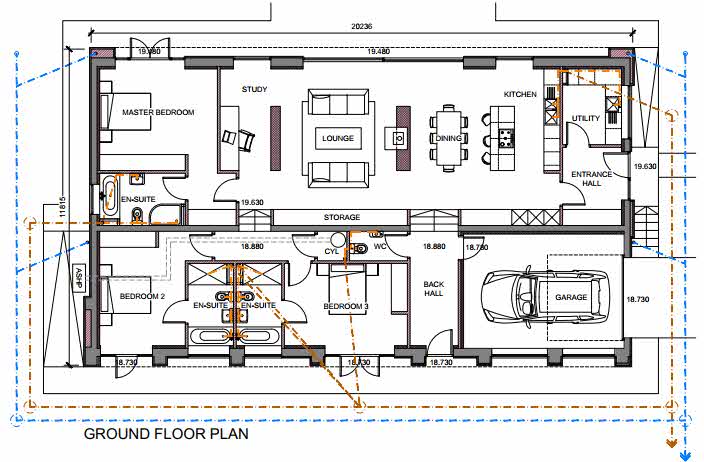
Architectural ground floor plan showing the layout of a converted barn dwelling including bedrooms, living spaces, and a garage.The image displays architectural elevation drawings labeled 'North Elevation' and 'South Elevation' of a single-storey building with a human figure for scale.Architectural elevation drawings showing the West and East views of a proposed residential conversion with an attached garage.
4.1. Proposed plans have been provided by the architect, with the drawings up to planning stage. It is acknowledged further detailed design will be required to verify structural properties and design supporting elements.
Figure 15 - extract from proposed development drawings
4.2. The proposed development seeks to incorporates elements of the existing structure, including the walls. Floors are reconstructed and a new roof covering is installed to incorporate suitable insulation and membrane layers.
4.3. There is some change to openings sizes and locations, it is envisaged a detailed appraisal of this would be undertaken at detailed design stage.
4.4. In general, the development appears broadly compatible with the structure, noting no change in the loadings present (and therefore structural works would largely be to mitigate future deterioration and support the revised roof and openings arrangements).
4.5. It is envisioned areas of wall would require reconstruction, where existing leaning has been observed or where openings are modified. As the existing building fabric does not hold significant aesthetic or vernacular value, it is anticipated it may be more economical to rebuild rather than rehabilitate sections. This should be further investigated at detailed design stage.
4.6. Further investigation would be required to confirm foundation arrangements, such as the buttressing areas and also for the external walls.
4.7. No tanking, damp proof course are present across the structure. There is also no insulation present and this would require architectural consideration to retrofit these.
5 Conclusion
5.1. This report assesses the condition of the barn structure at Ballachree Cottage.
5.2. The barn is in moderate condition for its current use as garaging and storage. There are some wall defects and floor issues. It is anticipated that these would be resolved as part of any redevelopment plans.
5.3. The building is of a reasonable age (present on the 1950s Ordnance Survey mapping), and it is believed that the majority of observed defects are longstanding with no obvious signs of ongoing deterioration (provided drainage is adequately maintained). However it is recognised that for its proposed change of use into a dwelling, it may be prudent to rebuild sections of walls with deterioration rather than seek to strengthen them.
5.4. The proposed redevelopment is sympathetic to its existing structural form with no change in loadings other than ground supported slabs.
5.5. The detailed design should seek to appraise any retained elements in more detail, which may include intrusive investigations to confirm foundation arrangements and calculations to appraise the roof frame (including ceiling tie height and spacing), and buttressing arrangements.
5.6. There is an existing stream that discharges at the western gable, which has resulted in saturation of this area and the inside of the lean-to barn. Any redevelopment should address water management as a key concern.
6 References
[1] The Institution of Structural Engineers, Appraisal of existing structures (Third Edition), London: IStructE, 2010.
[2] Ordnance Survey, County Series Map, https://maps.nls.uk/geo/find/#zoom=10&lat=54.2672&lon=4.6542&layers=101&b=1&z=1&point=54.0988,-4.4870, 1868.
[3] Lamplugh, The geology of the Isle of Man, Memoirs of the Geological Survey (District), 1903.
[4] Ordnance Survey, 1950s OS mapping.
[5] Ordnance Survey, 1980s OS Mapping.
[6] BRE, “Digest 251 - Assessment of damage in low-rise buildings”.
Copyright in submitted documents remains with their authors. Request removal
Source & Provenance
Official reference
AP25/0016
Source authority
Isle of Man Government Planning & Building Control