Mr. A. Johnstone, Planning Appeals Secretary, Cabinet Office, Government Offices, Buck’s Road, Douglas, IM1 3PN. Senior Planning Officer 3 February 2025. Dear Mr Johnstone,
PA No: 24/91152/GB Proposal: Demolition of single storey flat roof elements at western side of building, and erection of a new dwelling on land to west of existing building (in association with registered building consent application 24/01173/CON).
Address: Groudle Glen House, King Edward Road, Onchan, Isle Of Man, IM3 2JY.
Please find a statement that sets out the position of the Department in respect of the above planning application.
The statement relies upon the Planning Officer’s original report which was determined by a Principal Planner on 17th December 2024, which is online and forms part of the planning file.
The enclosed statement comprises the following parts:
1. Appendix 1 – Statement of Case
2. Appendix 2 – DEFA Ecosystem Policy Team Statement of Case
In the event that the appointed Planning Inspector is minded to recommend that the application be approved, then the four-year expiration condition should be attached along with consideration to any potential conditions included at 4.0 of the Statement of Case.
Yours sincerely,
Paul Visigah, B.Tech (Hons), MSc, RTP, MRTPI Senior Planning Officer
Appendix 1
STATEMENT OF THE
Department of Environment, Food and Agriculture Planning & Building Control Directorate
Planning statement on behalf of the Department relative to:
Demolition of single storey flat roof elements at western side of building, and erection of a new dwelling on land to west of existing building (in association with registered building consent application 24/01173/CON).
Groudle Glen House, King Edward Road, Onchan, Isle Of Man, IM3 2JY. PA Reference: 24/91152/GB Prepared on behalf of the Planning Department by Senior Planning Officer: Mr Paul Visigah, B.Tech (Hons), MSc, RTP, MRTPI
1.0 Appeal against refusal for PA 24/91152/GB
The reasons for refusal were:
1. The application is considered to be contrary to Strategic Policy 1, Spatial Policy 4, Paragraph 4.3.11, Spatial Policy 5, General Policy 3 and Environment Policy 1 of the Strategic Plan (2016) and the site designations of the Sulby Local Plan (1998) [should be Area Plan for the East] and no 'other material considerations' have been identified that would outweigh these formally adopted policies which should be afforded significant weight having been informed by public consultation, public inquiry and adoption by Tynwald.
2. Whilst the design of the new dwelling would fit with the style of the buildings along the road to the east of the former hotel, the proposed siting, layout, scale, and arrangement of the new building on the site, would fail to relate positively and appropriately to the site character as it does not take into account a proper analysis of site context in terms of siting, layout, scale, and spaces between buildings, and would have a deleterious impact on the application site, by resulting in a particularly intrusive infill development within the site when viewed from the surrounding area. In fact, the new dwelling would be at jar with the Arts and Craft Design of the building on site, and would dominate views when approaching the site from the west along the MER and King Edward Road, thus diminishing the role of the existing building on the site. The proposal, therefore, conflicts with General Policy 2(b), and Strategic Policies 4 and 5 of the Isle of Man Strategic Plan 2016.
3. The parking and access arrangements as proposed would create an adverse impact on the existing highway, as the visibility in both directions would be below the acceptable standards, having obstructions impacting on the visibility, which would make it difficult for vehicles to exit the site in a safe and appropriate manner, contrary to the principles of General Policy 2(h and I) and Transport Policy 4 of the Strategic Plan (2016). The proposed parking would also fall short of the standards stipulated in Transport Policy 7 of the Strategic Plan and set out in the Manual for Manx Roads.
4. The scheme as proposed would result in vehicles projecting onto the adjoining public footway, and the visibility is such that would increase the potential for increased conflict and risk to pedestrians. This would be contrary to Transport policies 6 and General Policy 2 (h) of the Strategic Plan 2016.
5. Insufficient information has been provided to support that the proposed development would not impact on the ecology of the site or the adjacent site of conservation value, or result in adverse impacts on trees within the adjacent woodland, and as such the development is considered to be contrary to Environment Policies 3 and 4, and Strategic Policy 4 of the Strategic Plan.
2.0 Legal and Policy Position
In accordance with S10 of the Town Country Planning Act the application has been considered;
S(4) In dealing with an application for planning approval or an application under subsection (3), the Department shall have regard to —
(a) the provisions of the development plan, so far as material to the application; (ab) any relevant national policy directive under section 2A;
(b) any relevant statement of planning policy under section 3;
(c) such other considerations as may be specified for the purpose of this subsection in a development order or a development procedure order, so far as material to the application; and
(d) all other material considerations.
There is a statutory duty to take into account the above, and while it is recognised that weight to be given is a matter for the decision maker.
That being said, it shall be noted that the Development Plan and other Adopted Policies do not have primacy as they do in the UK. The Isle of Man is also different from the UK as there is no presumption in favour of development as set out in the NPPF, and there is no 5-year land supply requirement.
In this application, the most weight has been given to the Strategic Plan; the Area Plan for the East; the Town and Country Planning Act 1999; Planning Policy Statements 1/01: Policy and Guidance Notes for the Conservation of the Historic Environment of the Isle of Man; as they have been through a statutory process, which includes evidence base and public consultation process, and are adopted by Tynwald.
Other material considerations referred to in the officer report include Residential Design Guide (RDG) which followed targeted consultation and adoption by the Minister and has therefore been afforded greater weight, along with the IOM Biodiversity Strategy 2015 to 2025; and the Manual for Manx Roads: Movement and Place Practitioner's Guide.
3.0 Response to Reasons for Appeal
This report addresses those issues directly which were highlighted as the basis for the appeal. For a full assessment of the initial application please refer to the original Officer’s Report which would have been supplied with the initial documentation.
3.1 There appear to be three main issues raised by the appellants. The issues include:
1. Justifications and Material Considerations Addressing Reason for Refusal 1. This highlights six reasons why the development is justified for the location which includes –
a. Alignment with Strategic Objectives;
b. Correction of Policy Application;
c. Consistency with the Local Context;
d. Environmental and Heritage Sensitivity;
e. Material Considerations: The development delivers social and economic benefits, including the creation of high-quality housing that adds to the area’s appeal; and
f. Public Benefit and Local Support.
2. Justifications and Material Considerations Addressing Reason for Refusal 2. This includes:
a. Support from the Registered Buildings Officer;
b. Condition of the Existing Building;
c. Redevelopment of Redundant Land;
d. Enhancement of the Site Character;
e. Visual and Functional Considerations;
f. Policy Alignment and Benefits;
3. Justifications and Material Considerations Addressing Reason for Refusal 3. This includes:
a. Visibility and Access Arrangements;
b. Mitigating Traffic Safety Concerns;
c. Compliance with Parking Standards;
d. Alignment with Policy Objectives;
4. Justifications and Material Considerations Addressing Reason for Refusal 4. This includes:
a. Commitment to Pedestrian Safety;
b. Visibility Improvements;
c. Alignment with Policy Objectives;
d. Contextual Considerations;
5. Justifications and Material Considerations Addressing Reason for Refusal 5. This includes:
a. Clarification on Trees and Adjacent Landscaping;
b. Ecological and Conservation Safeguards;
c. Minimal Risk to Adjacent Sites;
d. Alignment with Policy Objectives;
e. Commitment to Further Evidence.
3.2 FOLLOWING SECTION ADDRESSES THOSE ISSUES DIRECTLY
3.3 Justifications and Material Considerations Addressing Reason for Refusal 1.
3.3.1 The response to these matters are as follows:
a. Strategic Policy 1 and Spatial Policies 4 and 5 emphasize sustainable development and careful integration of new housing within existing settlements. The proposed development respects the architectural and historical character of Groudle Glen House and incorporates design principles that ensure environmental sustainability, aesthetic enhancement, and appropriate scale. The proposal supports local housing needs while utilizing previously developed land, reducing the need to encroach upon greenfield sites.
Response:
3.3.1.1 The appellant seems to consider that the scheme aligns with the strategic objectives, yet does not stipulate which of the Strategic objectives referred to. Below are strategic policies that refer to housing and new development:
i. 3.2 Resources (c) To guide most new development to existing settlements, thus making the optimum use of existing and planned infrastructure and services.
ii. 3.3 Environment (i) To protect the countryside and coastal areas for their own sake.
iii. 3.6 Social (a) To provide for sufficient housing of an acceptable standard and of an appropriate nature and in appropriate locations to meet the needs of the community (including special needs).
All these echo the position of the policies highlighted in the Officer report that development be kept away from the countryside and within settlements were sites have been designated for such use.
3.3.1.2 Whilst Strategic Policy 1, and Spatial Policies 4 and 5 emphasize the need for sustainable development as articulated in the appellants reasoning to allow the development, it also emphasises the need for new development to take into account the needs for access and amenity standards. It is not considered that this scheme addresses a number of issues which have resulted in the proposal being refused, particularly the conflicts with the policies which guide new development in the countryside.
3.3.1.3 The site of the proposed dwelling does not sit within an existing settlement, as it sits without the settlement boundaries of Onchan and Douglas, which are the closest settlements. Thus, the proposal would fail to align with Strategic Policy 2 which stipulates that “New development will be located primarily within our existing towns and villages”, as well as Housing Policy 4 which reinforces the principles of Strategic Policy 2. Moreover, the definition of previously developed land which is referenced in STP 1 and which the appellant relies on as a basis for this development clearly states that the fact that a site is judged to be a previously developed land does not mean it has to support a dwelling by stating the following: “There is no presumption that land that is previouslydeveloped is necessarily suitable for housing development nor that the whole of the curtilage should be developed.” In this case, it is judged that the site is not suitable for the new housing development for the reasons articulated in the Officer report, as well as the evident inability to effectively accommodate the new dwelling on site whilst providing for safe vehicle parking within the site due to the limited size of the site.
3.3.1.4 It is also important to note that the scheme would be contrary to the policies which allow new housing in the countryside which the site constitutes (See Section 7.2 of the Officer Report).
3.3.1.5 With respect to the assertion that the development supports local housing needs, the Strategic Plan is clear that “In line with the Island Spatial Strategy, the housing needs of the Island will continue to be met by concentrating new residential development in the existing settlements (Paragraph 5.26 of the Strategic Plan). This is in line with the provisions of HP4 and STP 2. For clarity, the countryside is not a designated location for new housing save for replacement dwellings (HP 12, 13 and 14), conversions (HP 11), or erection of agricultural dwellings (HP 7, HP 8, HP 9 and HP 10), with there being a clear presumption against hew housing in the countryside as articulated in GP3 and EP1.
b. Correction of Policy Application: The Sulby Local Plan (1998) is not relevant to this site, as Groudle Glen House is not located within the designated area covered by this plan. The decision should focus on applicable policies relevant to the Onchan area and the specifics of this proposal and shows that the application has not been property considered by the Planning Officer.
Response:
3.3.1.6 There are typographical errors in the report which refer so the Sulby Local Plan rather than the Area Plan for the East. However, the site is not allocated for development in the Area Plan for the East and has been assessed on that basis therefore this error has no bearing on the consideration. It is clear the site is in Onchan, and the basis for the refusal has not changed given that the site sits outside a defined settlement boundary, which means that it is development in the countryside that does not meet any of the allowances provided under GP3 as an exception to new development in the countryside (See Paragraphs 7.2.2 and 7.2.3 of the Officer Report for clarity on this matter): They state:
“7.2.2 The Strategic Plan indicates further presumption against new housing on land not zoned for development and within the countryside by stating that "New housing will be located primarily within our existing towns and villages, or, where appropriate, in sustainable urban extensions of these towns and villages where identified in adopted Area Plans"(HP 4), and these positions are reinforced by the Area Plan for the East. As has already been noted,the site sits outside the defined settlement boundary of Onchan and Douglaswhere priority for new housing is to be within the urban core or in sustainable extensions supported by the right infrastructure such as schools, health care provisions, open space, recreational facilities and utility services (See Paragraph 3.4.5 of the Area Plan for the East Written Statement, and Paragraphs 8.3.1 and 8.3.2 of the Strategic Plan ), and it is not considered that the current site meets any of these criteria, given its location in relation to the boundaries of Douglas and Onchan, and existing infrastructure within these settlements.
7.2.3 It should be noted that the current Area Plan (See Map 6-Onchan) makes provision for new residential development in Onchan and does not include the current site. Furthermore, the Area Plan assesses housing need, by assessing the opportunities in the countryside in terms of the potential to add to any groups of houses and sustainability issues of such, and this does not in any way include the site or its immediate locality as a suitable site within group of houses in the countryside (see Paragraphs 12.5.1 and 12.5.2 of the Area Plan Written Statement). It is, therefore, considered that there is no local need for additional housing on the application site (which is a nonallocated sites, and any opportunities for such need should have be assessed through the Area Plan process, which in this case did not include the immediate locality.”
c. Consistency with the Local Context: The new dwelling has been carefully designed to blend harmoniously with the surrounding styles of housing. It reflects local architectural styles, ensuring minimal visual impact while preserving the distinctiveness of the area.
Response:
3.3.1.7 This matter has been clearly addressed within Paragraph 7.3.1 to 7.3.5 of the Officer report so no further comments would be made within this statement.
d. Environmental and Heritage Sensitivity:
o The demolition of the flat-roof elements will enhance the aesthetic integrity of the site.
o The proposal includes modern, energy-efficient materials and methods, contributing to climate resilience while minimizing its carbon footprint.
Response:
3.3.1.8 There is no objection to the removal of the flat roof element on the existing building on site, and this is clearly articulated in Paragraph 7.2.5 of the Officer report. However, the acceptability of removing the unsympathetic extension is no basis to allow a new dwelling on site given that the existing building could be sympathetically extended to meet the needs of current or future occupants without the need for a new dwelling. Likewise, the existing dwelling could be improved to achieve higher energy efficiency, so the argument that the proposal would contribute to climate resilience while minimizing its carbon footprint is unsubstantiated. In fact, an additional dwelling in an unsustainable location which is likely to increase the need to travel by private car would undermine this claim.
e. Material Considerations:
o The development delivers social and economic benefits, including the creation of high-quality housing that adds to the area’s appeal.
o The strategic policies cited were developed to guide broad planning principles. However, this specific proposal includes mitigating measures that align with these principles when considered in the local context.
Response:
3.3.1.9 With regard to the first matter, quality housing should be provided in areas that are designated for such use in line with the Area Plan provisions, and the policies within the strategic Plan which guide new housing development on the island. So any assumed social and economic benefit in this case is not sufficient to set aside the policies within the Strategic Plan, particularly as the said regeneration of the site could be carried out without the need for a new dwelling.
3.3.1.10 With regard to the mitigation measures which align with broad planning principles the appellant refer to, I am unsure as to what mitigating measures is being referred to which makes for allowing a new dwelling on a site not zoned for development in the countryside (and which fails GP3, EP1, HP 4, STP2). Moreover, it is clear that the proposed development is beyond the capacity of the site as evident in the inability to address the highway concerns due to the size of the site and scale of proposed development. Besides, no supporting information has been provided to show why a different policy approach should be used for the site, nor any articulation of the elements of the site context that should allow for the setting aside of the Strategic plan policies that guide development in the countryside. Therefore, it is considered that there are no basis in relation to the site context to allow for a new dwelling on site.
f. Public Benefit and Local Support: The development is supported by a commitment to maintaining the area’s heritage and character while addressing housing needs. Thomas Sinden the Registered Buildings Officer supports the application.
3.3.1.11 The appellant asserts that there is public benefit and local support for the development as there is a commitment to maintaining the area’s heritage and character while addressing housing needs. However, it would be important to point out that land use zoning is designed to ensure orderly development and land use. As such, ignoring the zoning requirements within the area plan, contrary to policies which guide development in the countryside cannot be judged to align with broader community planning goals as is being adjudged by the appellant. These factors are typically considered in planning assessments to ensure that development aligns with the public interest.
3.3.1.12 Further to the above, there is clear objection from the local community as evident in the objection from the Groudle Glen Railway charity which are part of the local community. Likewise, no other member of the community have made written comments in support of the application. It is also important to note that the local commissioners who are representatives of the local community clearly object to the application. It is, however, worth noting that the weight of public opinion is not a material consideration. Thus, these neither serve as a basis to refuse or accept the application.
3.3.1.13 The comments that the Registered Buildings Officer supports the application, is noted. However, it is clearly articulated within the consultation response from the RB Officer that the “comments relate solely to the impact of these works on the special interest of the registered building and its setting, and do not make any judgement on any other material planning matters”. The officers comments do not include consideration of matters such as the zoning of the site, impacts on highway safety, and matters related to biodiversity, which the Registered buildings officer comments do not in any way relate to.
3.4 Justifications and Material Considerations Addressing Reason for Refusal 2.
3.4.1 The response to these matters are as follows:
a. Support from the Registered Buildings Officer The scheme has been supported by Thomas Sinden, the Registered Buildings Officer, who was consulted during the pre-consultation process. His endorsement underscores the sensitivity and appropriateness of the proposal in relation to the registered building and its surroundings.
Reason:
3.4.1.1 This matter has been assessed within Paragraph 3.3.1.11 to 3.3.1.13 of this statement. However, it would be important to note that support from the Registered Buildings Officer to allow work on the building and within the site is not an indication that an application for
a new dwelling should be allowed. As has been noted within the officer report, the new dwelling, by virtue of its size, block form, and height, would dominate views to the dwelling when approaching from the north, and this is not considered to be appropriate in relation solely to the registered building and its setting, as.
3.4.1.2 To be clear, the existing former hotel building is particularly pleasant and a reflection of its time design (The Arts and Crafts movement) 2hich was pivotal in the evolution of architecture style and finesse, with its strong visual presence in the street scene amplified by its proximity to the highway. However, this proposal would strongly compete in visual terms against the existing property on site, diminishing it presence and importance in the street scene, and it is not considered that this relationship would respect the registered building and its setting in terms of scale and massing.
b. Condition of the Existing Building: The adjacent building, which is registered, is in a severe state of disrepair and suffers from numerous unsympathetic extensions added over the years. Response:
3.4.1.3 The assertion that the adjacent building, which is registered, is in a severe state of disrepair and suffers from numerous unsympathetic extensions added over the years, and that the current proposal would facilitate the funding of works is noted. However, there is no guarantee that such goals would be achieved on site, as there still remains pertinent concerns with how the stated funding would be enforced, or that any funds from one would be directed to the other. Perhaps, it would be vital to point out that just being in same ownership is not enough guarantee that the said
funding would be carried out as suggested, nor is it guaranteed that the new dwelling would remain in the same ownership as the registered building. Moreover, there is nothing that precludes repurposing the registered building, and/or adding more sympathetic extensions to make it suitable for a new use which would be more viable.
3.4.1.4 While the need to repair a registered building is a material consideration in planning decisions, it doesn't automatically justify allowing a new dwelling within its curtilage. Therefore, it must be clearly demonstrated that the new development is essential to secure the long-term preservation of the listed building and that no other funding sources are available. In this case, there is no evidence that all other options for repair have been explored before considering a new dwelling as the only option available. Likewise, there is no viability assessments provided to make this case that such options would be unviable.
3.4.1.5 It is perhaps worth noting that the planning history of the site does not suggest that attempts at developing the site has been focused on repairing the building, or repurposing it, as most of the applications have sought replacing the existing building on site. More so, the approval to allow repurposing under PA 13/00531/A was never implemented (See planning history of site for clarity on these matters).
3.4.1.6 As no evidence that other funding sources have been explored before considering the erection of a new dwelling, or viability assessments to show that the erection of a new dwelling would be the only viable option, the argument for the development on the above lacks merit.
c. Redevelopment of Redundant Land:Response:
3.4.1.6 Matters relating to the site being redundant as a previously developed land have been clearly articulated in the Officer Report and Paragraphs 3.3.1.2 and 3.3.1.3 of this report.
d. Enhancement of the Site Character: Response:
3.4.1.7 There is no contention that the removal of the unsympathetic extension would improve the appearance of the site. However, erecting a building which is taller than the existing building, and would completely obscure views to the registered building when approaching from the northwest along King Edward Road cannot be judged to harmonize with the existing context or enhance the overall appearance of the site. Further assessments of this impact are in the officer report.
e. Visual and Functional Considerations: Response:
3.4.1.8 These matters are similar to the issues raised in (d) above, and the issues relating to visual impacts have also been addressed within the officer report. As such no further comments would be made here.
f. Policy Alignment and Benefits:Response:
3.4.1.9 In dealing with development in the countryside, particularly housing, there are a number of policies which are relevant such as HP 4, EP 1, GP2, SP 2, and none of these have been considered in the appellant’s statement, which clearly suggest that these policies have not been considered during conceptualisation for the development. It has also been addressed earlier in this statement that the arguments made by the appellants on the basis of STP 4 and 5 fails to provide a clear justification to ignore the disposition of the Strategic plan towards new dwellings in the countryside.
3.4.1.10 Further to the above, it is clearly articulated within Strategic Policy 2 that the Area Plans will define the development boundaries of centres such as Onchan to provide for a range of housing, yet the current site is outside the defined development boundary (as it sits without the settlement boundary), so this scheme clearly fails the provisions of Spatial policy 2. The above position is further reinforced by Spatial Policy 5 which states that “New development will be located within the defined settlements, and that development will only be permitted in the countryside in accordance with General Policy 3.” It is also not considered that the proposal aligns with General Policy 3, as it is not an exception allowable under this policy.
3.5 Justifications and Material Considerations Addressing Reason for Refusal 3:
3.5.1 The response to these matters are as follows:
a. Visibility and Access Arrangements:i. The access design has been carefully developed to ensure it provides the
safest and most efficient entry and exit points possible within the constraints of the site.
Response:
3.5.1.1 The proposed access does not offer safe access onto the highway, so this cannot be considered to be the most efficient option. If the site context does not allow a new dwelling and safe access, it implies that the site context has not been carefully considered. As such, the Departments position that the scheme fails GP2, TP 4 and TP7, as well as the Manual for Manx Roads remains. Moreover, the objection from DOI Highways have not been overcome by this proposal.
ii. A visibility splay assessment, based on current traffic conditions and speeds along King Edward Road, can be provided to demonstrate that the access arrangements meet acceptable safety standards.
Response:
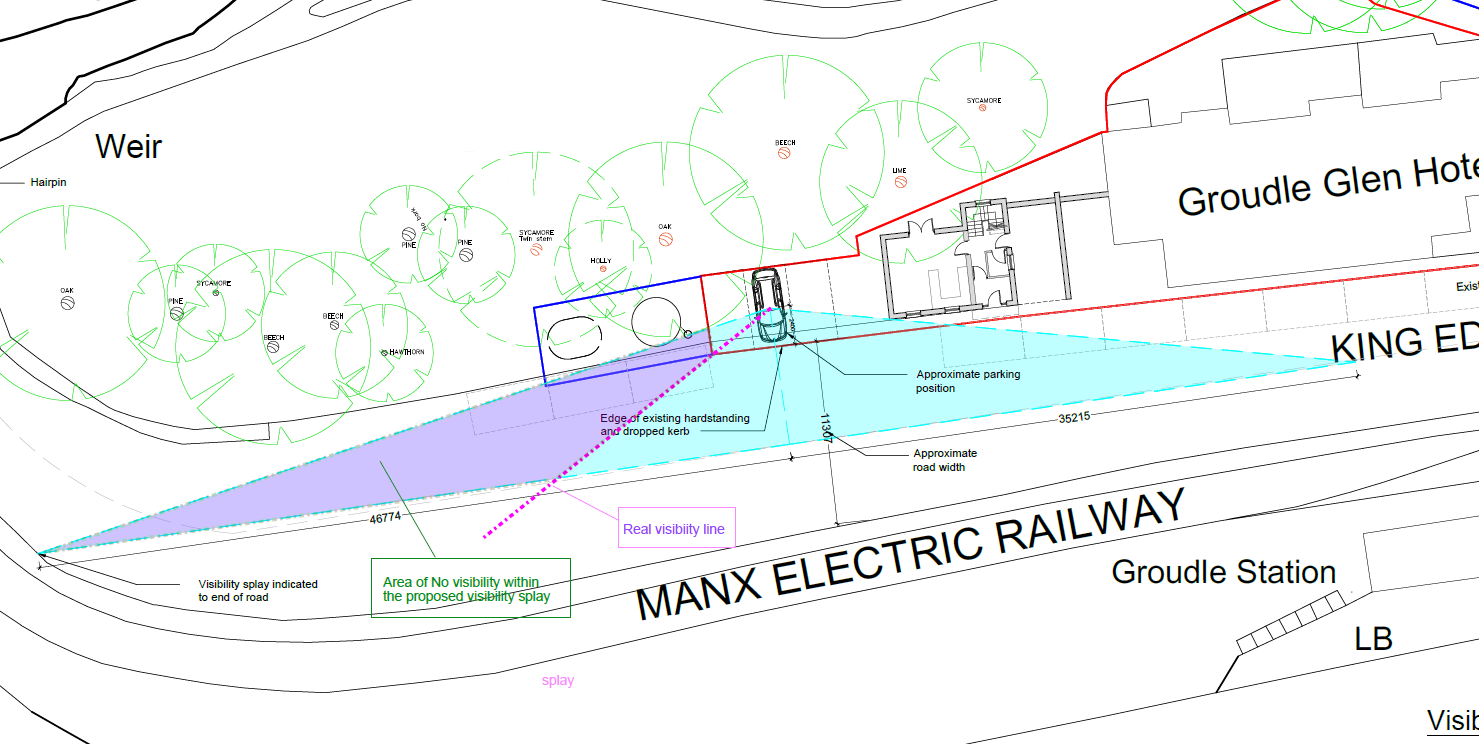
3.5.1.2 Visbility splay drawings have already been submitted by the appellants and these were judged to be unacceptable, as the new dwelling will be in the way of the visibiliy splay, particularly as vehicles exiting the site would have to be on the highway in order for the driver to have a clear view of the highway. Therefore, I am unsure what further visibility splay drawings the appellant is referring to.
Fig.1: Drawing showing obstructions to visibility superimposed on apellanst visibility drawing
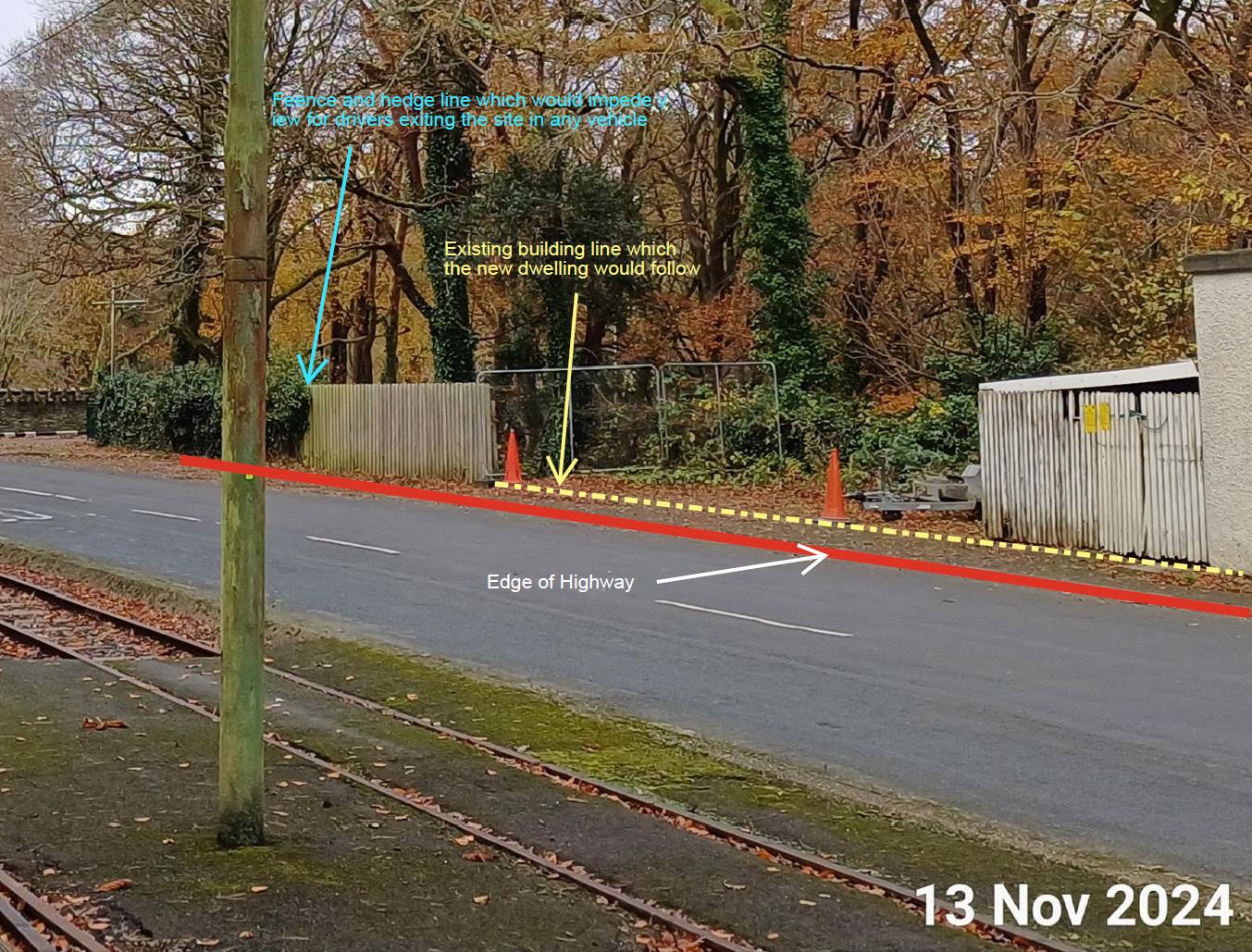
3.5.1.3 From review of the superimposed drawings above, it is clear that the visibility on the western side is actually not as is being depicted in the appellants visibility drawing as the existing fence to the west which provides an enclosure for the biodiscs, as well as the hedging on that part of the site bondary competely blocks this view such that visbility is significantly diminished on the western side of the proposed visibility splay, and this increases the highway safety concerns for the parking proposed for the new dwelling on site. See supreimposed annotations and drawings over applicants submitted visiblity drawingabove which shows that over 50 percent of the western visibiity would be obscured by existing boundary features.
The annotated photo below also provides evidence of the diminished visibility from the proposed parking areas. It is perhaps worth reinforcing the fact that this parking areas measures 5m long which is 500mm shorter than the minimum parking space length stipulated in the Manual for Manx Roads.
This image displays a technical site plan showing visibility splays and parking arrangements near the Groudle Glen Hotel and Manx Electric Railway. It details landscaping features like trees and road access points.
Fence and hedge line which would impede view for drivers exiting the site.
Ptoto 1: Restrcitions to visbility from the proposed parking areas.
3.5.1.4 It has alsready been stated earlier that DOI Highways object to the application on these basis, with the matter also discussed extensively within Section 7.6 of the Officer report.
3.5.1.5 It should be noted that DOI Highways sought alterations to the scheme, one of which involves “reconfiguration of the garage to minimise impact to on-street parking and increase in length to 6m”; a change which cannot be achieved without the submision of a new dwelling design and floor plan, and there is no basis to allow for such alteration at appeal, as that would mean assessing a totally different scheme than that which was intially considered by the Department. Moreover such a change would be contrary to Article 10 (7) of the Development Procedure Order 2019 that states; “For the avoidance of doubt, the grounds of appeal cannot be based on a material alteration of the terms of the application given under article 5.”
b. Mitigating Traffic Safety Concerns: Traffic flow and speed data along King Edward Road and the MER approach should be considered in context. The road’s characteristics and traffic volume does not necessitate full compliance with generic visibility standards.
Response:
3.5.1.6 The Strategic Plan is clear on what needs to be done with regard to parking provisions for new development, and the need to provide safe and convenient access for all highway users. These are well documented in GP 2, TP6, and TP 7, with no provision made for the relaxation of safety standards. Likewise, the development is not recognised to be of overriding national need in
land use planning terms and for which there is no reasonable and acceptable alternative (GP 3), which should provide a basis for such exemptions.
c. Compliance with Parking Standards
o The proposed parking provision is in line with the practical needs of the development and reflects the anticipated use of the site.
o The application can be supplemented with details of cycle storage, visitor parking, and shared parking solutions to support sustainable transport modes and address the standards set out in Transport Policy 7.
Reason:
3.5.1.7 The matters related to the standard of parking provisions have been addressed within the Officer report. As such, no further comments would be made at this stage.
3.6 Justifications and Material Considerations Addressing Reason for Refusal 4
3.6.1 The response to these matters are as follows:
a. Commitment to Pedestrian Safety: The design of the proposed development prioritizes pedestrian safety by ensuring that vehicle movements are carefully controlled and managed. The proposal includes measures to prevent vehicles from projecting onto the public footway:
o Adequate on-site turning and manoeuvring spaces to ensure vehicles can exit in a forward-facing direction by reverse parking arrangements.
o Clear demarcation of pedestrian pathways to separate them from vehicular movement areas.
Response:
3.6.1.1 The potential impacts on pedestrian safety has been accessed in Paragraph 7.6.1 of the Officer Report. Further to the assessment offered in the Officer report, it would be important to reiterate that walls of the building and obstructions to the western visibility (detailed in the Fig 1 and Photo 1 above) limit views for drivers exiting the site and make it difficult for drivers to see approaching pedestrians and vehicles when existing in a forward direction, and this concern is further exacerbated by the fact that the highway is a major artery liking Douglas with Onchan. Moreover, DOI Highways have expressed concerns with the site layout, which does not make adequate provisions to accommodate vehicles due to its length. As such, it is considered that the scheme as proposed would fail to comply with policy GP2 (h & i), and Transport 6, therefore it is difficult to see how these failings of the scheme represent a commitment to pedestrian safety.
b. Visibility Improvements Visibility concerns will be addressed through site-specific design modifications if required, including:
o Removal or adjustment of any obstructions near the access point to improve sightlines.
o Installation of safety mirrors or signage to enhance driver awareness of pedestrian activity in the vicinity.
o These measures will reduce the likelihood of conflicts between vehicles and pedestrians, aligning the scheme with the safety objectives of Transport Policy 6.
Response:
3.6.1.2 These matters have been addressed in the Officer report and other sections of this statement, as such no further comments would be made here.
c. Alignment with Policy Objectives:
o Transport Policy 6: The proposed development seeks to minimize the risk of conflict between vehicles and pedestrians by incorporating robust design solutions. By optimizing on-site arrangements, the development supports a safe and pedestrian-friendly environment.
o General Policy 2(h): The proposal has been designed to ensure that access arrangements do not adversely impact public safety.
Response:
3.6.1.3 These matters have been addressed in the Officer report and other sections of this statement, as such no further comments would be made here.
d. Contextual Considerations:
o The public footway near the proposed site access has relatively low pedestrian traffic, minimizing the potential for conflict. This context should be considered in assessing the risk posed by the development.
o A pedestrian safety assessment can be undertaken to demonstrate that the measures proposed effectively mitigate potential risks.
o The footway width at the point of access and egress is a minimum of 2m in width and extends further than this in places.
o When the wearing line of the road is taken into consideration the sight lines and widths required are compliant with the speed of traffic in this area given the tight bends slowing down traffic considerably.
Response:
3.6.1.4 The comments made by the appellants are noted. However, the area also holds a number of activities particularly for the Groudle railway which means that there are periods during the year when there is significant pedestrian traffic from visitors to the area, and the scheme as proposed poses potential hazards, particularly as most of these activities involve families with children.
3.6.1.5 The comments that the footway is two meters wide is a misrepresentation of the facts here, as the existing footway on this side of the road would barely be 1.2m wide.
3.6.1.6 With regard to the comments regarding the context of the area, it would be important to point out that the Strategic Plan is clear that “High levels of car ownership have led to an increase in the level of parking expected for new residential development, and outside of town centre
locations these standards should not be relaxed.” This obviously states that there is no basis to reduce parking standards for sites outside of town, such as the application site.
3.6.1.7 These further reinforce the argument that the development does not take into cognisance the site context which should include ascertaining whether the site area would be sufficient to accommodate a new dwelling together with the required services and parking to meet the stipulated minimum standards.
3.7 Justifications and Material Considerations Addressing Reason for Refusal 5:
3.7.1 The response to these matters are as follows:
a. Clarification on Trees and Adjacent Landscaping:
o The trees and adjacent landscaping are located outside the development site and at a considerably different level. This physical separation significantly reduces the likelihood of any direct or indirect impact from the proposed development.
Response:
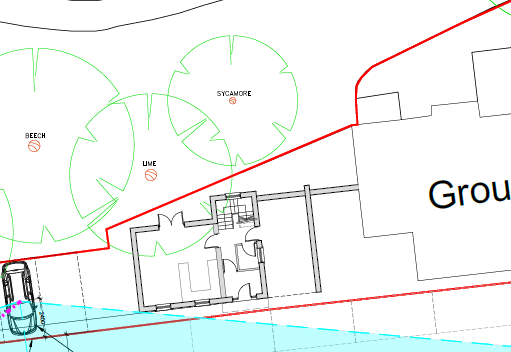
3.7.1.1The details presented in the submitted drawing is at variance with this assertion made by the appellants. See Extract from the appellants plans which show that the new dwelling, which would be about 8.7m tall would be in the way of some of the tree, given that it would sit within the tree canopy area.
Fig 2: Dwelling in relation to tree within the Groudle Glen Designated Wildlife Site (4178/001).
Architectural ground floor plan showing the layout of a proposed new dwelling extension adjacent to an existing building, including site features like trees and parking.
o The proposed works, including construction activities, do not encroach on the root protection zones (RPZs) or the canopy spread of trees within the adjacent woodland.
Response:
3.7.1.2 It is difficult from information provided to ascertain whether the dwelling would be within the RPZ’s or not, as a new foundation would go deeper than the current level of the hardstanding and it is not clear if any tree roots lie in this area, hence the need for tree surveys to be carried out prior to the design of new development, particularly where they are to be in close proximity to trees. The concern here is further exacerbated by the fact that these are not just trees within a curtilage, but trees which sit within a protected zone, such that any impacts on the trees would have far reaching consequences than just the potential for damage of loss of a tree, but evident ecological impacts.
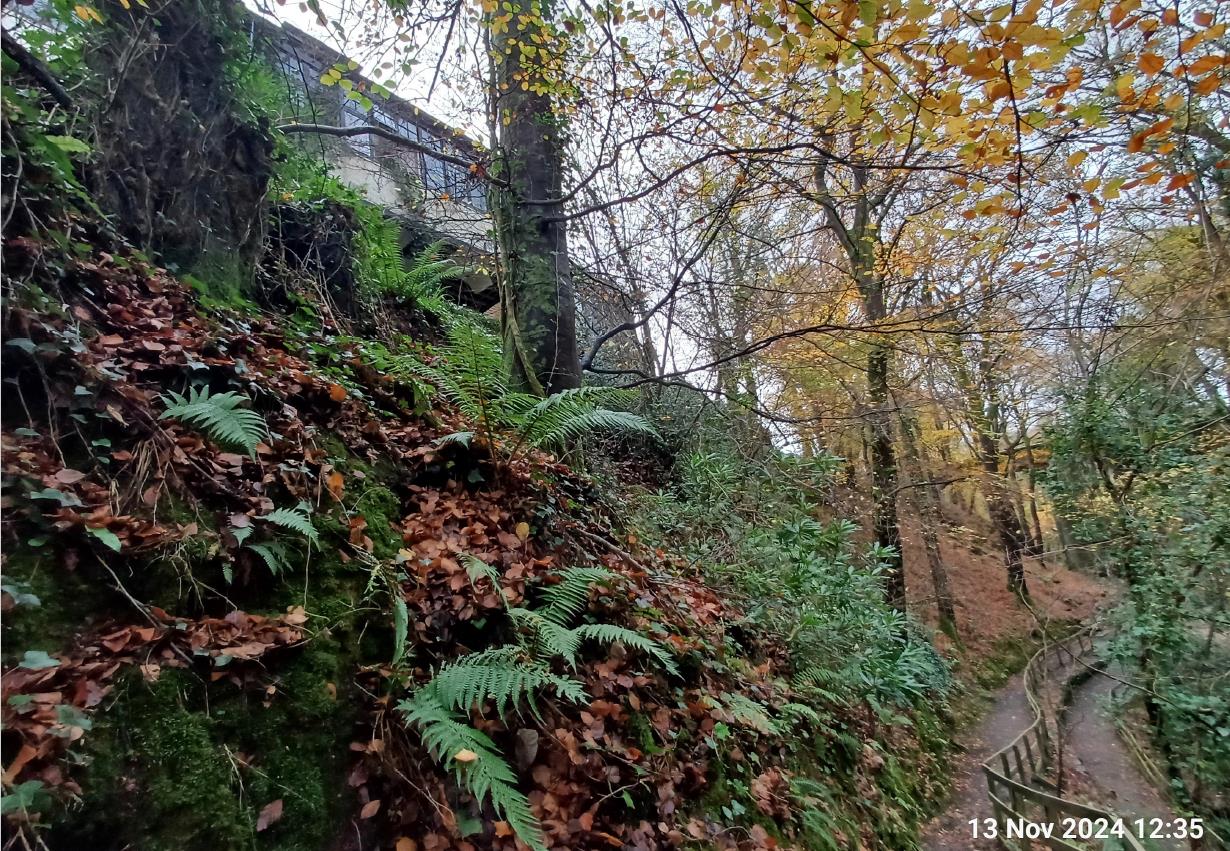
3.7.1.3 Further to the above, evidence from photographs taken during the site visit do not show a simple relationship between the tress and the proposed dwelling as is being suggested by the applicant, given that the trees on the boundary sit on differing levels and it is unclear from just visual observation to ascertain whether there would be no impacts on the trees. See below phots taken during the site visit which highlights this concern.
Photo 2: Photo showing trees along northern boundary of site on various levels.
b. Ecological and Conservation Safeguards
o The development is sited on previously developed or disturbed land (e.g., a redundant car park) and avoids any areas of significant ecological sensitivity.
Response:
3.7.1.4 The assertion that the site avoids any areas of significant ecological sensitivity is a simplified evaluation of the facts on ground as there is no information to justify this position. DEFA Ecosystem Policy Team advise that there is insufficient information to ascertain the real impact on the proposal for reasons clearly articulated in their consultation comments. Besides, the site is such where the precautionary principle applies given that it sits adjacent a protected site.
3.7.1.5 In reviewing the proposal within the context of the precautionary principle (Paragraph
3.3 [a]) of the Strategic Plan, it would be vital to note that the precautionary principle accepts that if an action has a suspected risk of causing harm to the public or the environment, in the absence of scientific consensus that the action or policy is harmful, the burden of proof that it is not harmful falls on those taking the action, which in this case is the applicant. This means that even if there isn't definitive scientific proof of harm, it's prudent to avoid actions that could potentially damage the protected site. As no information has been provided to justify the reasoning that there would be no harm to the adjacent protected site, it is considered that in this case the scheme fails Strategic policy 4 and Environment Policy 4.
o To further ensure compliance with Environment Policy 3, a preliminary ecological assessment will be provided to confirm there are no adverse impacts on local biodiversity or adjacent conservation areas.
Response:
3.7.1.6 These matters have been addressed in the Officer report and other sections of this statement, as such no further comments would be made here.
c. Minimal Risk to Adjacent Sites:
o The significant difference in elevation between the development site and the adjacent woodland creates a natural barrier, effectively mitigating any potential impacts on the trees or the broader ecological network.
o Construction activities will be carefully managed to ensure no runoff, soil erosion, or disturbance affects the adjacent site.
Response:
3.7.1.7These matters have been addressed in the Officer report and other sections of this statement, as such no further comments would be made here.
d. Alignment with Policy Objectives:
o Environment Policy 3: The proposal respects and safeguards biodiversity, avoiding any direct or indirect harm to adjacent conservation areas.
o Environment Policy 4: The development avoids harm to trees and landscapes of significant conservation value, focusing activities on previously developed land.
o Strategic Policy 4: The project supports sustainable development principles by ensuring natural assets outside the site remain unaffected.
Response:
3.7.1.8 These matters have been addressed in the Officer report and other sections of this statement, as such no further comments would be made here.
e. Commitment to Further Evidence: While the separation of the development from adjacent ecological features already ensures minimal impact, the applicant is prepared to submit supporting studies (e.g., ecological surveys) to confirm this subject to conditional approval.
Response:
3.7.1.9 As has been noted earlier in this statement, the act of ignoring the consultation advise on the grounds that further evidence could be submitted at appeal conflicts with the provisions of Article 10 (7) of the Development Procedure Order 2019 that states; “For the avoidance of doubt, the grounds of appeal cannot be based on a material alteration of the terms of the application given under article 5.”Therefore, if the appellant considers that adjustments could be made to the development of the site in order to address the reasons for refusal, then a new application should be submitted to address the reasons for refusal, and not for new informtion to be submitted at appeal.
3.7.1.10 It is also worth noting that planning conditions are not always the solution to planning problems, hence the insistence on resolving issues with conditions oversimplifies the planning process and sometimes create unnecessary complications. To clarify, the Problem with new information at Appeal is that they undermine the process. It should be noted that the planning process is designed to allow for thorough review and public input before a decision is made. Introducing new information at the appeal stage disrupts this process, may ultimately raise concerns with fairness, particularly for those who may not have the chance to comment on the new information submitted. Therefore, whilst planning conditions are a valuable tool, they should not be seen as a cure-all for every planning issue, as sometimes, the most responsible decision is to refuse permission for development, and for no development to occur.
3.7.1.11 Further to the above, the DEFA Ecosystem Policy Team have noted that imposed conditions may not address ecological concerns for the site by stating that “if a decision were taken without a survey, then conditions should require a bat survey, and where appropriate, suitable mitigation to be submitted for consideration by the Planning Committee. However, this risks constraining the mitigation, or requiring a resubmission, should the mitigation affect the plans.” This clearly points to the need for surveys to be carried out to ascertain the best options to develop the site before plans are submitted for determination.
3.8 Conclusion
This statement seeks to address the initial reasons for appeal articulated in the appellant’s Appeal Request. Additional statement(s) would be provided further to the appellant’s providing additional statement(s) on the issues highlighted in their appeal request, should they raise issues not already addressed in the Officer Report and appeal statement.
4.0 Potential Conditions
4.1 In the event that the Inspector is minded to recommend approval it is recommended that the following condition(s) be applied:
C 1: Standard 4 years The development hereby approved shall be begun before the expiration of four years from the date of this decision notice.
Reason: To comply with Article 26 of the Town and Country Planning (Development Procedure) Order 2019 and to avoid the accumulation of unimplemented planning approvals.
C 2: Ecological Survey No development shall commence until an ecological survey of the site has been submitted to and approved in writing by the Planning Authority. The ecological survey shall identify matters of ecological interest within the site and immediate surroundings, and measures to mitigate ecological impacts where appropriate, including a timetable for their implementation. The development shall not be carried out unless in accordance with the approved details.
Reason: To provide adequate safeguards for the ecological species existing on the site.
C 3: External Lighting No external lighting shall be installed at the site unless a detailed external low level lighting scheme which is in accordance with the recommendations outlined in the BCT and ILP Guidance Note 8 Bats and Artificial Lighting (12th September 2018), has been submitted to and approved in writing by the Planning Department. Such low lighting schemes shall be carried out strictly in accordance with the details submitted and thereafter be retained as such.
Reason: To provide adequate safeguards for the ecological species existing on the site.
C 4: Tree Protection No development shall be commenced until a scheme for the protection of the trees (a tree protection plan) which shall be prepared in accordance with the recommendations of British Standard BS5837:2012 (Trees in relation to Design, Demolition and Construction) has been submitted to and approved in writing by the Department.
Such a scheme shall include details of all trees and other planting which are to be retained on site, as well as those which directly adjoin the site; a planting specification to include numbers, species and positions of all new trees and shrubs; and a programme of implementation. Within the Construction Exclusion Zones identified on this drawing, nothing shall be stored, placed or disposed of above or below ground, the ground level shall not be altered, no excavations shall be made, no mixing of cement or use of other contaminating materials or substances shall take place, nor shall any fires be lit.
Any retained tree which within five years of the approved development being occupied or completed (whichever is the later) dies, are removed or become seriously damaged or diseased shall be replaced by a similar species, of a size to be first approved in writing by the Department, during the
next planting season or in accordance with a programme of replacement to be agreed in writing with the Department.
Reason: To safeguard the existing trees and planting to be retained within the site.
C5: Access, Parking and Turning Areas The development hereby approved shall not be occupied or operated until all access arrangements, including visibility splays, vehicular and pedestrian areas have been provided in accordance with the approved plans. Such areas shall not be used for any purpose other than for purposes associated with the development and shall remain free of obstruction for such use at all times.
Reason: To ensure that sufficient provision is made for off-street parking in the interests of highway safety.
C6: Materials - Details Within three months to the installation of external finishes and materials, details of all external finishes, including the manufacturer's details, specification and colour of all the materials/roof/wall/windows/doors/garage doors/rainwater goods to be used in the external finish for the approved development shall be submitted to and approved in writing by the Department.
The development shall not be occupied or brought into use unless the external finish has been applied in accordance with the approved details.
Reason: To ensure that the development is carried out to the highest standards of materials, in the interests of the appearance of the development and the visual amenities of the area.
C7: Define Curtilage Prior to the occupation of the development hereby approved, a Plan which shows details of the land area to form the curtilage of the new dwelling shall be submitted to and approved in writing by the Department. The residential curtilage shall be laid out in accordance with the submitted plan and retained as such thereafter.
Reason: to ensure the curtilage is clearly defined in the interest of protecting the countryside.
C8: Remove PD (All) Notwithstanding the provisions of the Town and Country Planning (Permitted Development) Order 2012 (or any Order revoking and/or re-enacting that Order with or without modification) no extension, enlargement or other alteration of the dwelling, and no garages or other free standing buildings shall be erected within the curtilage of the dwellings hereby approved, other than that expressly authorised by this approval, without the prior written approval of the Department.
Reason: To control development in the interests of the amenities of the surrounding area.
Appendix 2
DEFA Ecosystem Policy Team Statement of Case
From: Costain, Sophie (DEFA) Sent: 07 February 2025 14:29 To: Visigah, Paul
Subject: RE: PA 24/91152/GB - Demolition of single storey flat roof elements at western side of building, and erection of a new dwelling on land to west of existing building (in association with registered building consent application 24/01173/CON)
Good afternoon
RE: PA 24/91152/GB - Demolition of single storey flat roof elements at western side of building, and erection of a new dwelling on land to west of existing building (in association with registered building consent application 24/01173/CON)
The application site is immediately adjacent to Groudle Glen Wildlife Site. Wildlife sites, though not statutorily designated or recognised by law, are nonetheless sites of high wildlife value which should be recognised through the planning system. Amongst other reasons, Groudle Glen was selected as a Wildlife Site for its area of broadleaved woodland with well-developed ground flora, and its natural watercourse with a high proportion of semi-natural habitat on both banks. The woodland of this Wildlife Site is within meters of the application area, and the watercourse only approx. 15m away. These habitats support a variety of wildlife including bats, birds, fungi and invertebrates. The application has not demonstrated that works can be undertaken without damage to the Wildlife Site. There is potential for damage through construction, via the demolition of the extension (bats), through the installation of clear glass balustrades (posing collision risks to birds in flight) and the through the potential installation of external lighting.
The bat survey requested by the Ecosystem Policy Team in its consultation response of the 14th November 2025, has not yet been provided. The condition of the building and the suitability of the adjacent habitat increase the likelihood of a bat roost being present in the building which is to be demolished. The bat survey is therefore required in order to determine if bats are present and therefore inform avoidance and mitigation requirements. Surveys should be provided prior to determination to avoid situations where changes to the development proposals are required in order to accommodate bats.
Should this application be approved, we request that conditions are secured for the following
• No works (including demolition) to commence unless a bat survey undertaken by a suitably qualified ecological consultancy, containing suitable avoidance and mitigation measures, has been provided to planning and approved in writing.
• No works to commence unless measures for the protection of the adjacent Wildlife Site have been approved.
• No works to commence unless a plan detailing the measures that are to be put in place to prevent bird strikes on the clear glass balustrades, is submitted to Planning and approved in writing. Measures could include use of etching, ultraviolet coatings or decals.
• No external lighting to be installed unless a sensitive low level lighting plan, following best practise as detailed in the Bat Conservation Trust and Institute of Lighting Professionals Guidance Note 8/23 on Bats and Artificial Lighting (2023), has been submitted.
Best wishes
Sophie Costain (she/her) (Miss)
Ecosystem Policy Officer
Department of Environment, Food & Agriculture, Thie Slieau Whallian, Foxdale Road, St Johns, Isle of Man, IM4 3AS Website: www.gov.im/defa Tel +44 (0)1624 685963 | Mob +44 (0)7624 431301 | Email [email protected] Ecosystem Policy Team Tel +44 (0)1624 651577 | Email [email protected]
DEFA - working for a clean, safe, healthy, attractive and vibrant environment which will be enjoyed by present and future generations alike. Our Island, Our Environment, Our Future. Working Together for a Sustainable Future Gobbragh Cooidjagh Son Traa Ry-Heet Shassooagh
Copyright in submitted documents remains with their authors. Request removal
Source & Provenance
Official reference
AP25/0001
Source authority
Isle of Man Government Planning & Building Control