SOC Sarah Corlett Tpc Appeal Statement on Behalf of the Applicant
AP24/0010·15 pages·PDF
Appeals & Inquiry›Appeal Statement
3 of 3use ← → arrow keys
Loading document...
SOC Sarah Corlett Tpc Appeal Statement on Behalf of the Applicant
APPEAL STATEMENT ON BEHALF OF THE APPLICANTS IN RESPECT OF THE REFUSAL OF
24/00287/C: CHANGE OF USE FROM A VETERINARY PRACTICE TO OFFICES, BALLASTRANG, CASTLETOWN ROAD, BALLAGLONNEY, SANTON IM4 1EU
1.0 Introduction
1.1 I am Sarah Corlett, Director of Sarah Corlett Town Planning Consultancy Ltd, established on the Isle of Man in 2021. I have been instructed by the applicant, Mr. GarnettOre in respect of the appeal against the refusal of 24/00287/C to prepare a statement which sets out the planning policies and context for the appeal and include reasons why the appeal should be allowed and the application permitted.
1.2 I was employed by the Isle of Man Government as a planning officer between 1990 and 2021, ultimately in the role of Principal Planner. My duties included the determination of planning applications, the preparation of reports on planning applications, presentation of applications to Planning Committee and representation of the Planning Committee at planning appeals and representing the Department in Court.
1.3 I hold a Bachelor of Science Degree in Town Planning from Heriot-Watt University and have been a Member of the Royal Town Planning Institute since 1992.
1.4 Further information on me and my practice can be found on my website sarahcorlett.com.
1.5 This statement has been prepared having regard to the established principles of town planning and the relevant policies, legislation, guidance and regulations of the Isle of Man Government and represent my professional opinion in the matter of the proposed development.
2.0 The planning application and appeal
2.1 The application was submitted on 6th March, 2024 and was refused under delegated authority on 22nd April, 2024. No communication was sent to the applicant nor any queries raised with them prior to the issue of the decision.
2.2 The reasons for refusal were as follows:
1. The proposal would be at odds with those policies that specifically seek to direct office development to existing centres and would result in a piecemeal of smaller office use within the countryside that deteriorates the town and village vitality and viability contrary to Strategic Policy 2, Spatial Policy 5, Strategic Policy 9, General Policy 3 (c) and (g), Environment Policies 1 and 2, Environment Policy 16 (a) and (e), Paragraph 9.3.3, Business Policy 7(b) of the Isle of Man Strategic Plan 2016.
2. Planning history provides evidence of other non-office uses being accepted at this site and which would help to maintain the future use and upkeep of the building without harm to town or village centres. The veterinary use has not be demonstrated as being redundant nor that there aren’t other more reasonable and appropriate uses for this building in this countryside before an office use comes forward and this is at odds with Strategic Policy 2, Spatial Policy 5, Strategic Policy 9, General Policy 3 (c) and (g), Environment Policies 1 and 2, Environment Policy 16 (a) and (e), Paragraph 9.3.3, Business Policy 7(b) of the Isle of Man Strategic Plan 2016.
3. The unsustainable location of the site will increase demand for private car use and it is not been made clear whether sufficient parking is truly available for the office use without compromise to neighbouring properties or without adversely impacting the shared access lane or highway safety and is considered to fail Strategic Policy 1(c), Strategic Policy 10, Environment Policy 16 (d), Paragraph 9.3.3, Business Policy 8, and Transport Policies 1, 4, and 7 of the Isle of Man Strategic Plan 2016.
2.3 The applicant submitted a request for an appeal with the following reasons:
1. The planning officer has misinterpreted Environment Policy 16 insofar as this requires demonstration that the building is no longer required for its original not its current purpose.
2. The planning officer has misunderstood or not familiarised themselves with the site in respect of the amount of car parking that is available which is sufficient for the proposed office use and has not had any regard to the previously approved uses and the level of parking required or generated by them, in their dismissal of the application for this reason.
3. The planning officer has not taken into account in applying the policies which direct development to existing settlements, that Environment Policy 16 allows for the creation of offices within undesignated areas if the development complies with the requirements of that policy.
4. The planning officer has not taken into account in applying the policies which direct development to existing settlements, that any use, other than agriculture or equestrian will generally be directed to existing settlements or land designated for that purpose and there is no evidence in the report to explain why office use on this site is any more unacceptable than the other uses to which the building could be put in accordance with Environment Policy 16.
5. The planning officer has not taken into account in their report the fact that the earlier application for change of use of the building from agricultural was for a learning centre which has similar characteristics to the proposed office use and similarly the veterinary practice which we would suggest would generate as much if not more traffic and customers than the proposed office use.
6. The planning officer has not explained how the development would be contrary to Environment Policy 1 which protects the countryside for its own sake, given that the building and site are not publicly visible, there are no proposed changes to the building and the use has similar characteristics to both previously permitted uses.
7. The planning officer does not explain how the development is contrary to General Policy 3 in that sub paragraph b refers as an exception to the conversion of redundant rural buildings which are of architectural, historic or social value and this building must have been considered as such when it was originally permitted for conversion to tourist and learning centre uses. Regardless of this, we would submit that it is of such interest and whilst GP3b
only refers to Housing Policy 11, the preceding text does not specify solely conversion of such buildings to housing.
8. The planning officer has not clarified which are the “other more reasonable and appropriate uses for this building in the countryside” given the characteristics of the previously approved uses, the fact that no changes are proposed to the building and the level of car parking requirement would be similar if not less than the previously approved uses, nor why these unspecified uses are more reasonable and/or appropriate.
3.0 Appeal submission
3.1 It is our submission that the application complies with all of the relevant policies in the Strategic Plan. Furthermore, we would also submit that there has been no demonstration of harm from the proposed use in the planning officer’s report. We are also of the view that the recommendation was made and the decision issued in undue haste without the planning officer having visited the site nor sought any further information which may have overcome at least some of their concerns (eg car parking, the level of traffic generated by the lawful use as a veterinary practice, why the building is now considered redundant for that purpose).
3.2 To establish the background to this application, Mr. Garnett-Ore was born on a farm in Ballabeg and he and his wife have been associated with this site since their marriage when they lived in the Railway Cottage and rented and managed Ballastrang Farm. The state of the farm at that time ranched out and poor with hedges having fallen down, no fencing and the buildings had been ruined through cattle damage and walls knocked down. The then owner offered the farm for sale and they took the opportunity to own the land they managed, and bought it. The holding originally had 55 acres. They repaired the fencing and buildings and improved the land. The acreage associated with the farm today is much less around 15 acres and is still managed but without the need for the buildings which were originally associated with the farm holding.
3.3 In 1996 the owners decided to diversify and applied to use the stone barn which was by then redundant for its original purposes, for alternative, non agricultural purposes specifically a learning centre and tourist accommodation (96/00500/B) whilst continuing to grow their own vegetables and make their own hay with the adjacent farmer renting the fields to graze his calves. The application for the learning centre and tourist unit was permitted on review. The applicant’s wife had previously worked in the health sector and thought at the time that the building would make a suitable premises for massage and therapies and the teaching thereof but unfortunately became ill so was no longer able to continue with this enterprise. Whilst she tried employing someone else to do this, it was not successful and so in 2017 they sought permission for an alternative use, as a veterinary facility.
3.4 This application, 17/01124/C was permitted and the use was taken up. The veterinary practice occupied the building for five years and despite initially being content with the size
of the building and the site, the practice decided that they wanted to expand and move to larger premises. They moved to Kennaa near St. John’s last year.
3.5 When the practice was operational on the site, they had, towards the end of their tenancy, up to 5 vets, 3 veterinary nurses and 4 administration staff and the practice also included emergency consultations. Daily appointments were considerable in number Monday to Friday and including evening and weekends for emergencies. Sometimes as many as 16
-20 vehicles were accommodated in the car park, with difficulty. Clearly the practice generated customers and the size and nature of the building resulted in the animals which were treated being smaller rather than agricultural or equestrian cases. Whilst the officer noted in their report on the 2017 application that the proposed use would be harmonious with the countryside setting of the site, this might be the case if the animals treated were agricultural or equestrian where such treatment would be difficult in a built up area, but given the limited size and traditional nature of the building, it is more likely that the majority of animals treated would be small and domestic in nature with a number of veterinary practices on the Island successfully treating small animals from a town centre location or built up area and in practice the majority of creatures treated were small.
3.6 It is fully accepted that the site is not designated for development and as such that there is a presumption against development here. However, there is clearly policy which supports some forms of rural development, including the re-use of buildings which are redundant for their original purposes. The first reason for refusal states that the use of the building for offices would be contrary to the policies which direct development to existing settlements - notably the following policies are cited:
Strategic Policy 2, Spatial Policy 5, Strategic Policy 9, General Policy 3 (c) and (g), Environment Policies 1 and 2, Environment Policy 16 (a) and (e), Paragraph 9.3.3, Business Policy 7(b)
3.7 It should be noted that Environment Policies 1 and 2 do not relate to sustainable development but relate to the presumption against development which is harmful to the countryside with EP 2 specifically protecting the character of the landscape. There is no evidence in the officer’s report that the development will be harmful to the countryside, only that in their view the proposed use should be located in a settlement. There are no changes proposed to the building and there will, we would say that the proposed use will not result in any material change to the context or setting of the site, arguably resulting in less traffic
and fewer vehicles. The reference to Environment Policies 1 and 2 in reason 1 is therefore inappropriate.
3.8 Reason 1 also states that the development would result in “a piecemeal of smaller office use within the countryside that deteriorates the town and village vitality and viability”. This concern, combined with the concern that the proposed use is inappropriate in the countryside and should be located in a settlement completely ignores the provision in Environment Policy 16 and the preceding paragraphs that not only can rural buildings accommodate “commercial” uses which are non agricultural but also and specifically, “it is acknowledged that small scale enterprises can promote healthy economic activity in rural areas whether this be for commercial, industrial, tourism, sport or recreation uses”. This wording, within paragraph 7.13.2 goes on to clarify that:
“There is, however, a general presumption against the introduction of new uses into the countryside (including industrial or office uses):
(a) for which there is no local need;
(b) which would materially effect the rural character of an area;
(c) which would necessitate the creation of new buildings; and
(d) which would be more appropriate in industrial zones, business parks or within urban centres.”
3.9 There is therefore provision for the introduction of non agricultural uses in the countryside where it can be demonstrated that there is a local need and where there would be no harm: there is no evidence either in the officer’s report nor in the reason for refusal as to why the proposed use is unacceptable and rather, the officer seems to have taken a blanket objection to the use of this rural building (or indeed any) as an office.
3.10 EP16 and the preceding paragraphs refer to a variety of alternative uses of existing rural buildings including industry, tourism and commercial use, all of which are generally directed to existing settlements. If such uses must always be located in existing settlements and not in the countryside, then this policy could never be effective or taken up. It is not understood why, given this provision, the officer has decided that in this case, office use is not acceptable, without any further explanation or why in this case there is a concern about “a piecemeal of smaller office use in the countryside”. ‘Piecemeal’ suggests that this is part of a wider provision of office use in the countryside and we are unaware of, and there is no evidence of further such office use which would result from an approval of this application,
nor indeed why this would be harmful or unacceptable, given the provision within EP16 for this very use.
3.11 The reference to “commercial use” in EP16 is understood to refer to offices as section 9.3 of the Strategic Plan is titled “Commerce” and proceeds to discuss offices. Retailing is dealt with under “Retail” so is clearly not considered to be “commercial”. The use of rural buildings as offices is clearly acceptable under EP16. The use of rural buildings for offices is no different in general policy terms to use as residential (which is directed to settlements in Housing Policy 4), tourism (Business Policy 11), industry (Business Policy 2): EP 16 clearly makes an exception for such uses in undesignated areas.
3.12 In this case, and looking at EP16, the officer has misdirected themself in requiring that the test is that the building must be redundant for its existing purpose. It clearly says “original” purpose. This test was met when the application was initially approved for conversion in 2007. The building remains redundant for its original (agricultural) purpose. Interestingly the officer’s report for the 2017 application makes no mention of the building having to be demonstrated as being redundant for its existing use when recommending approval for the veterinary practice and indeed makes no inquiry into or mention of the need to question why the existing use as a learning centre was no longer required. It would appear that for some reason, a different approach is being taken in the case of this current application.
3.13 The officer did not enquire from the applicant why the veterinary use was now considered inappropriate or no longer required for the building. Had they done so, they could have learned that the number of customers and staff and the emergency consultations were not as compatible with their adjacent residential uses as they had first imagined or experienced. In addition, the building had been damaged by the occupier. They would also have learned that the veterinary practice wished to expand and also that the building is not now as suitable for such purposes as it once was, with the advancement of treatment and equipment much of which is less suited to older, smaller buildings than once it might have been. On vacation of the building, the property was marketed for lease with no interest from any vets and the only interest was for the use of the building as an office but as there was no planning approval in place, the applicant was not able to accept that offer. The offer made on the basis of the use of the building for offices demonstrates that there is a local need for such accommodation and the reverse for a veterinary practice - ie no demand at all for that use. Had the planning officer asked, this information could have been provided.
3.14 The reasons for refusal suggest that there is some sort of hierarchy in terms of the acceptability of uses for rural buildings with, in the mind of the planning officer, offices being below the veterinary practice and learning centre. The policy does not state that there is any preference for one type of use over another and the officer does not explain why office use is less preferable than the veterinary or learning centre uses. In the applicant’s experience, the veterinary practice operation did give rise to some issues whereas with an office use, the number of customers, if any, and staff is not likely to exceed those of the veterinary practice, or indeed the learning centre so it is considered that the office use is at least as acceptable as the previous uses, and arguably more so. Interestingly in the 2017 application, the officer compares the comings and goings of the proposed use to those of the previous use although no such comparison appears to have been undertaken in the current case.
3.15 It is not understood why an office use is any less acceptable here than is the previously approved learning centre or the veterinary practice, both of which would ordinarily be directed to an existing settlement and both of which would generate similar amounts of traffic to the proposed use, if not more.
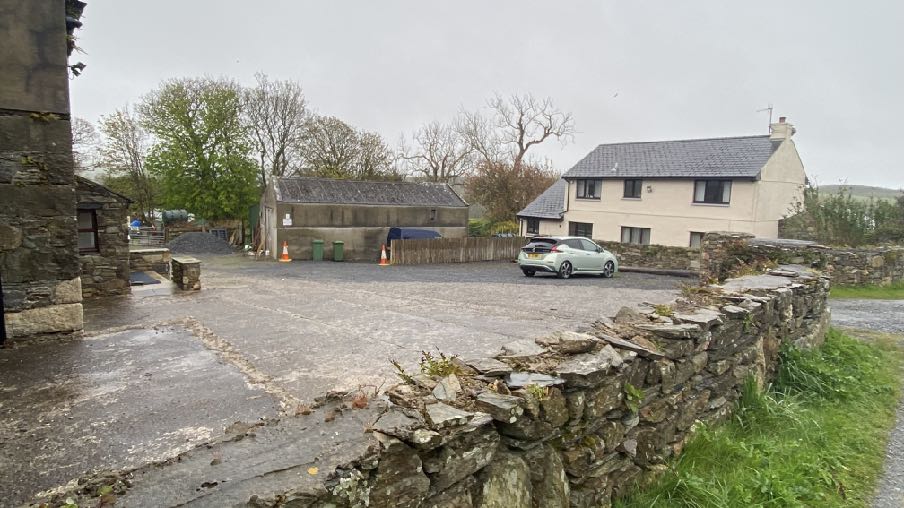
3.16 The planning officer indicates in their report that they did not visit the site. This is unfortunate as they then go on to query whether it has been demonstrated that sufficient parking is truly available for the office use without compromise to neighbouring properties or without adversely impacting the shared access lane or highway safety. A site visit would have confirmed the amount of parking which is available, which is clearly shown in the submitted plans and again, it is difficult to understand why this appears to be an issue, given the previously approved changes of use and the amount of parking and traffic that they would have generated. Indeed in the 2017 application officer’s report it is stated, “The number of comings and goings of visitors are not expected to be so significantly different to the current approved use to warrant a highway concern. The veterinary clinic is to operate at reasonable hours and is unlikely to impact the amenities of the adjoining tourist unit or the surrounds to a significant level to warrant a refusal.”
3.17 In terms of highway safety the traffic generated from the use as proposed will utilise a lane which serves the applicant’s home. The lane continues past the access to the application site to a further dwelling, The Brambles, and large outbuildings associated with that property. It is not understood, or explained in the officer’s report how the proposed use
would materially increase or change the impact on highway safety including parking, from the impact generated by the existing lawful use. Indeed, we would suggest that there would be a reduction in use of the lane, in the number of people occupying the building and the amount of parking spaces required: staff and customers for an office are more likely to car share or take public transport than are customers with animals. It is notable that there is no objection to the application from the adjacent neighbour nor Highway Services Division of Department for Infrastructure: as such, we would submit that the reason for refusal relating to parking and highway safety is not supportable.
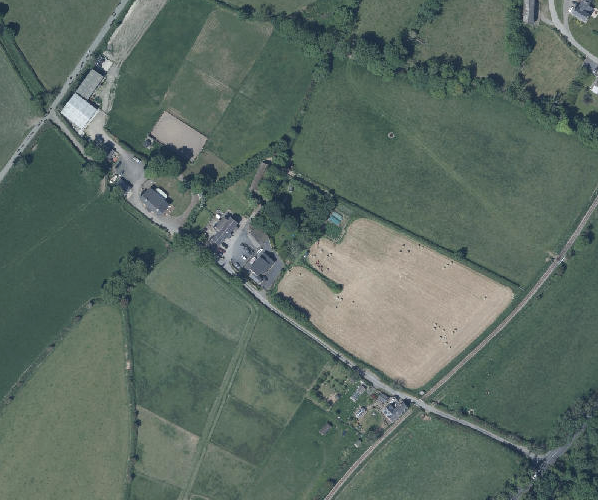
3.18 No assessment appears to have been undertaken by the planning officer in terms of the parking standards applicable to this proposal. The out of town office requirement is one space per 15 sq m of nett office space which results in a requirement for 9.6 spaces. This is less than the parking spaces required for the staff and customers for the veterinary practice. The area for parking for both the barn and the tourist unit would accommodate at least 12 vehicles considering the space available and the parking space standards in Manual for Manx Roads (5m x 2.6m with a 6m aisle separating the spaces). This can be easily calculated from the submitted plans. The standard for medical and health services, which could be applied to both of the previously approved uses, is 3 spaces per consulting room plus staff parking. This again would result in an increased amount of parking required for those uses compared with the proposed use for offices.
4.0 Conclusion
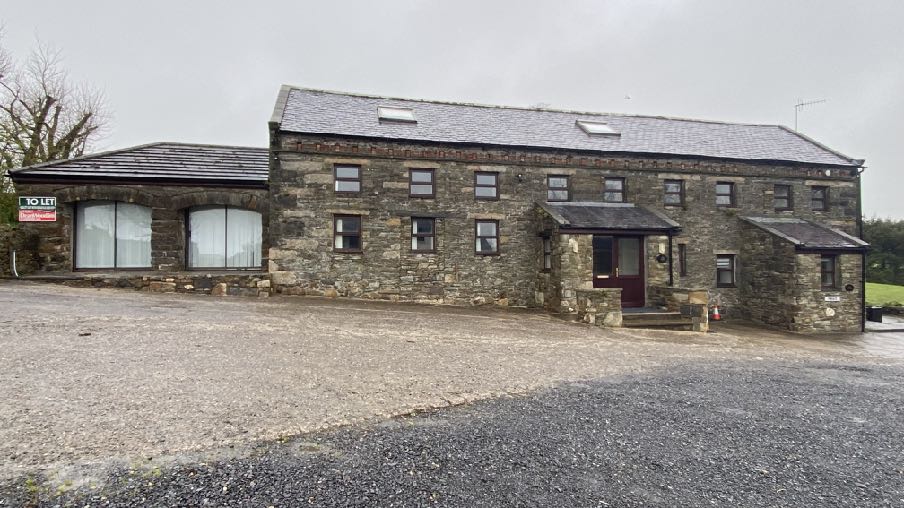
A photograph of a stone building complex with a gravel forecourt, featuring a mix of traditional stone walls and modern extensions with large windows.
4.1 The application concerns an old and attractive building which has previously, on two occasions been considered suitable for conversion to a different, non agricultural use. These two previous uses - the learning centre with a tourist unit, and the veterinary practice were approved without query about highway safety or car parking capacity.
4.2 The Strategic Plan policies support the re-use of such buildings and there is no requirement for a new use to have to be demonstrably better than others, nor that the previously approved use is no longer viable. All that is required is that the proposed use satisfies the criteria in Environment Policy 16.
4.3 This policy requires the satisfaction of six criteria:
a) the building is no longer required for its original purpose and is substantially intact and structurally capable of renovation: the redundancy from its original agricultural purpose was demonstrated in the 2006 application and the building remains redundant for agricultural purposes due to the limited acreage now associated with the holding and the fact that there is a tourist unit physically adjacent.
b) the reuse of the building will result in the preservation of fabric which is of historic, architectural, or social interest or is otherwise of visual attraction; this test was satisfied when the 2006 application for conversion to the learning centre and tourist unit were approved. The building has not significantly changed since then so remains of the requisite historic, architectural or social interest.
c) it is demonstrated that the building could accommodate the new use without requiring extension or adverse change to appearance or character; no changes are proposed to the existing building with all previous changes approved.
d) there would not be unacceptable implications in terms of traffic generation; the proposed use would generate no more and probably fewer vehicle movements than either of the previously approved uses and there is sufficient space to provide the amount of vehicles which will be generated by the proposed use and in accordance with the Strategic Plan requirements.
e) conversion does not lead to dispersal of activity on such a scale as to prejudice the vitality and viability of existing town and village services; there is no evidence that the use of this building, which has a nett office area of 144 sq m, would lead to the loss of vitality or viability of any town or village. It is relevant that the nearest settlement to the site is Ballasalla which has limited capacity for office uses, demonstrated by the number of applications within Balthane Industrial Estate for non industrial uses such as hairdressing, personal training/gym. It is also notable that the previously approved uses would also usually be directed to a settlement but were nevertheless considered to be acceptable.
f) the use of existing buildings involves significant levels of redevelopment to accommodate the new use, the benefits secured by the proposal in terms of impact on the environment and the rural economy shall outweigh the continued impact of retaining the existing buildings on site; there is no redevelopment to accommodate the new use.
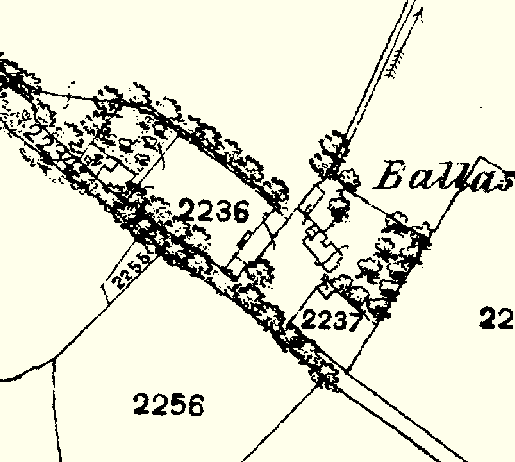
4.4 It is our submission that the proposed office use of the barn would satisfy all of the relevant planning policies and would result in the continued retention and maintenance of an attractive and old agricultural building (which appears on the 1860s County Series mapping) which has already had two non-agricultural uses approved and carried on within it.
A black and white map extract showing land parcels, boundaries, and vegetation with plot numbers and a partial road name.
4.5 There is no evidence that the proposed office use would affect the vitality or viability of any adjacent settlement centre nor would adversely affect highway safety. We have demonstrated that the proposed use would result in no more, and probably fewer vehicle movements than did the previous two approved uses and that the proposal complies with the parking standards of the Strategic Plan.
4.5 As such, we would request that the appeal is allowed and planning approval is granted for the change of use of this building to offices.
Sarah Corlett 22.05.24
Copyright in submitted documents remains with their authors. Request removal
Source & Provenance
Official reference
AP24/0010
Source authority
Isle of Man Government Planning & Building Control