Loading document...
Hot water will be principally provided by the ground source heat pump (see renewables section of this report) via a hot water storage cylinder, supplemented by the LPG boiler.
The electrical system will generally follow the convention for a domestic property with main incoming single phase supply, backed-up by the wind turbine – see renewables section of this report.
In all other respects the electrical system will be conventional with ring mains, from fused and RCCB protected circuits at the main distribution board, located in the workshop area. Wall mounted electrical sockets and light switches will be located at the requisite heights above finished floor level for wheel chair use in accordance with the IoM Building Regulations.
Computer network, hi fi, entertainment and security systems are beyond the scope of this report.
The full range of renewables technologies has been investigated and each has been considered in terms of its appropriateness to the building, the energy, and issues of practicality and functionality. Refer to the Appendices for more details of each technology.
The following renewables have been considered:
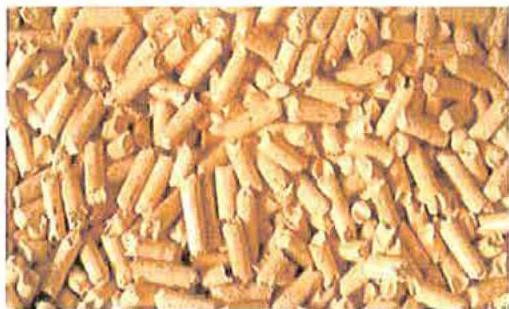
Biomass boilers are beginning to mature as a technology in the UK, with pellets or wood chips being the main fuel options. These boilers now offer very high efficiencies – up to 90% for pellet boilers. The effective carbon neutrality of the fuel depends to an extent on the source of the wood – generally speaking wood fuel should be sourced within a radius of 20 miles to minimise the energy consumed in transportation.
Unfortunately, the Isle of Man does not currently have a commercial source of wood based biomass for use with domestic boilers, and, as such, investigations into this source of power have not continued further.
Wood chips are the ideal biomass fuel – unfortunately not yet available in the IoM
Ground source heat pumps are a mature and well established means of providing carbon savings, when generating heat for space heating and hot water generation. The carbon savings arise from the way the system effectively absorbs solar heat energy from the ground – this being achieved by water based systems of the following types:
Open boreholes were eliminated at an early stage, due to uncertainty of the appropriate geological conditions. The site is also on a steep gradient, which may complicate the connection to an aquifer, and for such a small load the difficulty in obtaining an abstraction licence, were seen as an additional obstacle. Closed loop boreholes were also seen as an expensive option for the relatively small load.
Having considered the options, it was felt that slinky coils buried in the area at the front of the property would offer the best option for ground heat absorption. These coils would be laid in a continuous trench a minimum of about 1m deep. The flow and return pipes would be connected together below ground, and terminating in the boiler room at ground floor level. The circulating pump would be located in the plantroom.
{{image:438598}} A typical 'slinky' coil - closed loop ground source system {{image:438599}}
The ground loops will feed a heat pump, producing low temperature hot water at $35^{\circ}\mathrm{C}$, which is then circulated round the underfloor heating system as described above. The heat pump will operate in parallel with the LPG boiler, with the heat pump acting as the 'lead boiler', to make most use of this low carbon heating system. In effect the heat pump and LPG boiler will be sized to provide $100\%$ backup in the event of either system failing. The heat pump is therefore also around 25kW heating capacity.
Subject to more studies, it is expected that a closed loop ground source heat pump system will be used on this project as the primary means of heating.
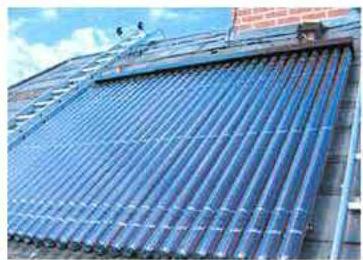
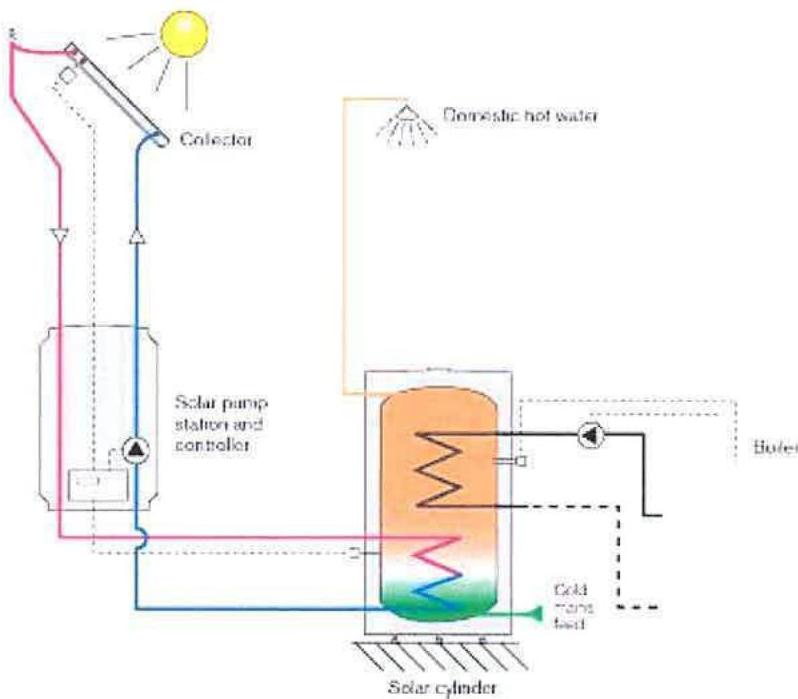
Solar collectors are a proven and cost effective renewable technology, which can make significant carbon savings on a domestic property. By providing a solar panel with a net area of $2.1\mathrm{m}^2$ to cover an approximate annual hot water demand of 800kWh, the solar system should provide around $60\%$ of the domestic hot water requirements of Baroose Farm, representing a worthwhile saving on hot water heating costs. The panel will be mounted on the ground on a frame facing due-South and tilted at an angle of around $35^{\circ}$ from the horizontal. The panel will consist of evacuated tubes which will extract solar energy from even a cloudy sky (diffuse heat), which is beneficial considering the relatively low direct sun hours per year on the site.
The flow and return pipes will reach the house via pre-insulated below ground pipes connected to the hot water storage tank via a dual coil, so that the system can provide the primary heat source with boost via the other coil fed by the heat pump/boiler. There will also be a conventional electric immersion heater for backup. This will require further analysis during detail design stages of the project.
An evacuated tube solar panel
Typical arrangement for solar collectors generating hot water – backed-up by a boiler
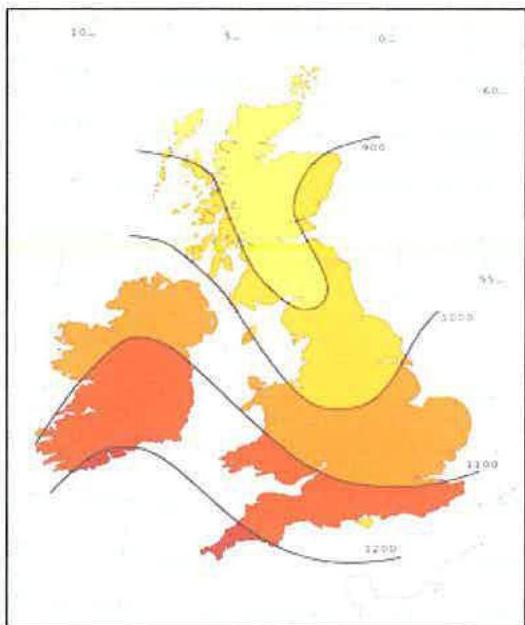
PV cells generate electricity from the sun's rays and so are useful at reducing grid produced electricity – thereby reducing carbon emissions. However, to be effective they require good levels of total annual insolation on the site – the Isle of Man is not well suited to PV due its relatively low annual sun hours. PV cells are also very expensive, and when considering the other renewables being proposed, they were not considered worth pursuing further for this project.
UK solar irradiation Annual Total kWh/m2
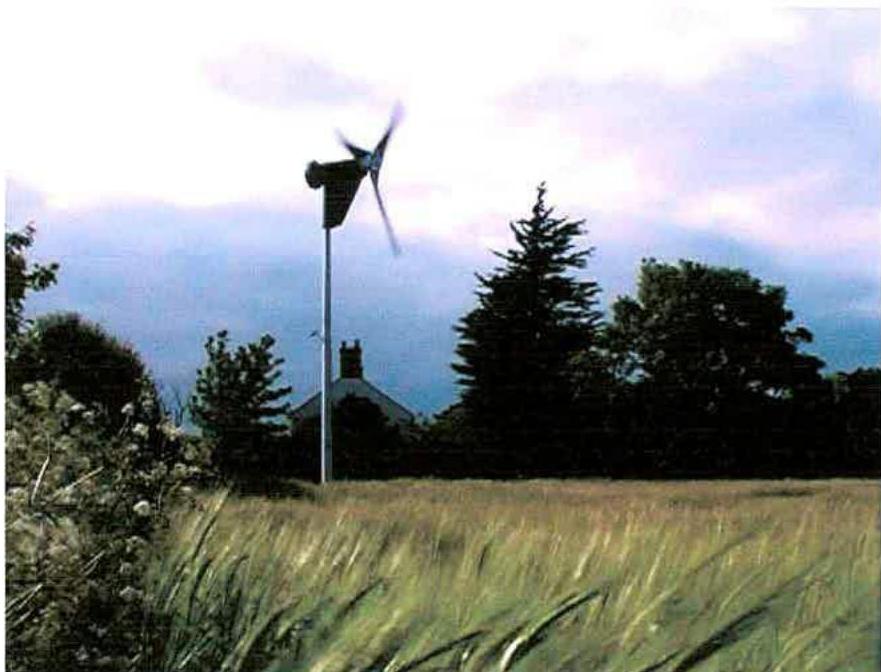
Small scale wind turbines can be an effective way to produce electricity serving a domestic property such as Baroose Farm – the region of Baldrine has a very good average wind speed, offering a very economical installation. Numerous misconceptions have held back the use of wind turbines on a local scale, but modern units have been specifically developed to overcome these issues, with low noise usually being the toughest hurdle to overcome.
When considering the options available, we quickly focused on the Proven unit; as this is one of the most reliable and robust units on the market currently. With the unit being located around 50m from the nearest property we are confident that noise will not be an issue. The unit is expected to be located on the site, as shown in the architect's drawing reference: K056/P/10-02., however, this will be subject to further detailed assessments with the unit manufacturer.
Although the unit proposed is rated as producing 2.5kW – this is really only the peak output on very windy days – the important factor is the average wind speed for the site: this is around 8.1m/s (DTi data base) and the power output is therefore likely to be around 1.0kW average: a 1.0kW output closely matches the average electrical load for a house. An estimated annual output is around 6000kWh per annum.
The unit would be floor standing on a pole of approx 11m high (although this could be reduced to 6.5m if 11m was felt to be too obtrusive visually), secured to a concrete base. The site is very well suited to a wind turbine with no major obstructions to clean air streams from the prevailing direction, which is essential to ensure a reasonable output from the unit.
We propose a grid-tied system, that is: the power generated by the turbine is used on site to satisfy the local demands but any additional power produced or when the building is unoccupied, will be exported to the grid (subject to agreement with the local REC).
In the context of the likely low annual occupied period of the house, a high output wind turbine connected to the grid represents the potential to make the house go beyond carbon neutral ie carbon negative or a net producer of power. This is because the wind turbine will continue to produce power and thus carbon savings during unoccupied periods, when the on-site demand is virtually zero, thus accruing carbon savings beyond the annual on-site demand.
A Proven wind turbine
The design team set out to minimize the environmental impact of Baroose farm, and as a result we have achieved an exemplar standard for a residential property. The design demonstrates a serious commitment to the environment which will actively utilise many features to reduce the 'carbon footprint' overall.
This has been achieved by open debate in design workshops to understand the driving forces and create a building which responds to nature rather than fights against it. The building respects the landscape, and blends into the site - helping to provide shelter from cold northerly winds. The building form orientation and position has been influenced by the sun in terms of daily and seasonal phases, providing beneficial heating, good daylighting - allowing lights to be turned off, and avoiding excessive summer heat gains. The building uses high levels of insulation, and low infiltration combined with thermal mass to keep heat in during winter, and out during the summer.
The mechanical and electrical services design then takes the base efficiency of the house design and builds on this by using modern proven plant to minimise energy consumption, and provides robust sources of heating, electrical power, low energy lighting, and ventilation.
And finally, layered over the top this is the extensive use of low carbon/renewable technologies, which are expected to make a significant contribution to overall carbon savings.
The combined benefits of the scheme are summarised as follows:
These renewable technologies are likely to raise the profile of the building, putting it in the top league of exemplar modern sustainable domestic properties.
Copyright in submitted documents remains with their authors. Request removal
