Loading document...
Report for: Mr & Mrs Bellis, Erin Brae & Mrs J C Oloughlin, Queens Hotel Report by: Environmental Protection Unit
Prepared by: Simon Renton MSc, AMIOA Environmental Protection Officer
Environmental Protection Unit Department of Local Government & the Environment Murray House Mount Havelock Douglas
Tel: (01624) 685892 Issue: 1 Issue Date: 2 September 2005
| Section | Subject | Index |
|---|---|---|
| 1. | Summary | 3 |
| 1.1 | Loud Amplified Music | 3 |
| 1.2 | Fan Noise | 4 |
| 1.3 | Beer Garden Noise from People’s Voices | 4 |
| 2. | Recommendations | 4 |
| 2.1 | Loud Amplified Music | 4 |
| 2.2 | Fan Noise | 5 |
| 2.3 | Beer Garden Noise from People’s Voices | 5 |
| 3. | Noise Monitoring | 6 |
| 3.1 | Instrumentation | 6 |
| 3.2 | Noise Monitoring Summary | 6 |
| 4. | Recording Analysis Results | 8 |
| 4.1 | Recording 1 – Amplified Music 25 Aug 05 | 8 |
| 4.2 | Recording 2 – Amplified Music 25 Aug 05 | 9 |
| 4.3 | Recording 3 –Background Noise 25 Aug 05 | 10 |
| 4.4 | Recording 4 – Amplified Music 26 Aug 05 | 11 |
| 4.5 | Recording 5 –Fan Noise 27 Aug 05 | 12 |
| 4.6 | Recording 6 –People in Beer Garden 27 Aug 05 | 13 |
| 4.7 | Recording 7 –People in Beer Garden 27 Aug 05 | 14 |
| 4.8 | Recording 8 –People in Beer Garden 28 Aug 05 | 15 |
| Appendix 1 | General Advice on Sound Control of Entertainment Buildings | 16 |
| Appendix 2 | Noise Investigation Sheet | 17 |
| Appendix 3 | Equal Loudness Contours | 18 |
| Appendix 4 | Blue Box Music Monitor & Controller | 19 |
| Appendix 5 | Formula Sound Noise Control | 22 |
Following the request of Mr & Mrs Bellis of Erin Brae noise recordings were taken during 25 August to 28th August 2005.
The Digital Recording (DAT) machine was operated by Mr & Mrs Bellis and recordings made in his first floor living room at the front of the building with the windows closed. The source of noise is alleged to be amplified music, a fan and people’s loud voices in the front Beer Garden at the Queens Hotel, Douglas Promenade Douglas. The recordings were analysed by 01 dB Symphonie sound level meter in the office at a later date.
A copy of the noise investigation diary sheet filled in by Mr & Mrs Bellis is attached in Appendix 2. A summary of noise monitoring compared to the recommended Noise Limit Criteria (see Table 1 on Page 5) is as follows: Table 2 – Summary of Noise Monitoring 21 – 23 July {{table:112755}}
Table 2 shows that noise levels on 25 and 26 August exceeded the criteria recommended in order to prevent noise nuisance, particularly at 63 – 100 Hz 1/3 Octaves.
Human hearing is more sensitive to small increases in low level low frequency noise levels than high level low frequency noise levels, see Appendix 3.
Without additional sound insulation it is my opinion the Queens Hotel may not be able to satisfy noise limit criteria Categories A - C for loud amplified music public entertainment events such as live bands, given the close proximity of adjacent residential premises and existing construction.
Given that live bands have previously performed at the Queens Hotel without complaint it may be possible to control noise levels to noise limits in Categories A & B by means of an entertainment noise controller and sensitive arrangement of sound environment within the Queens Hotel, but this would have to be investigated.
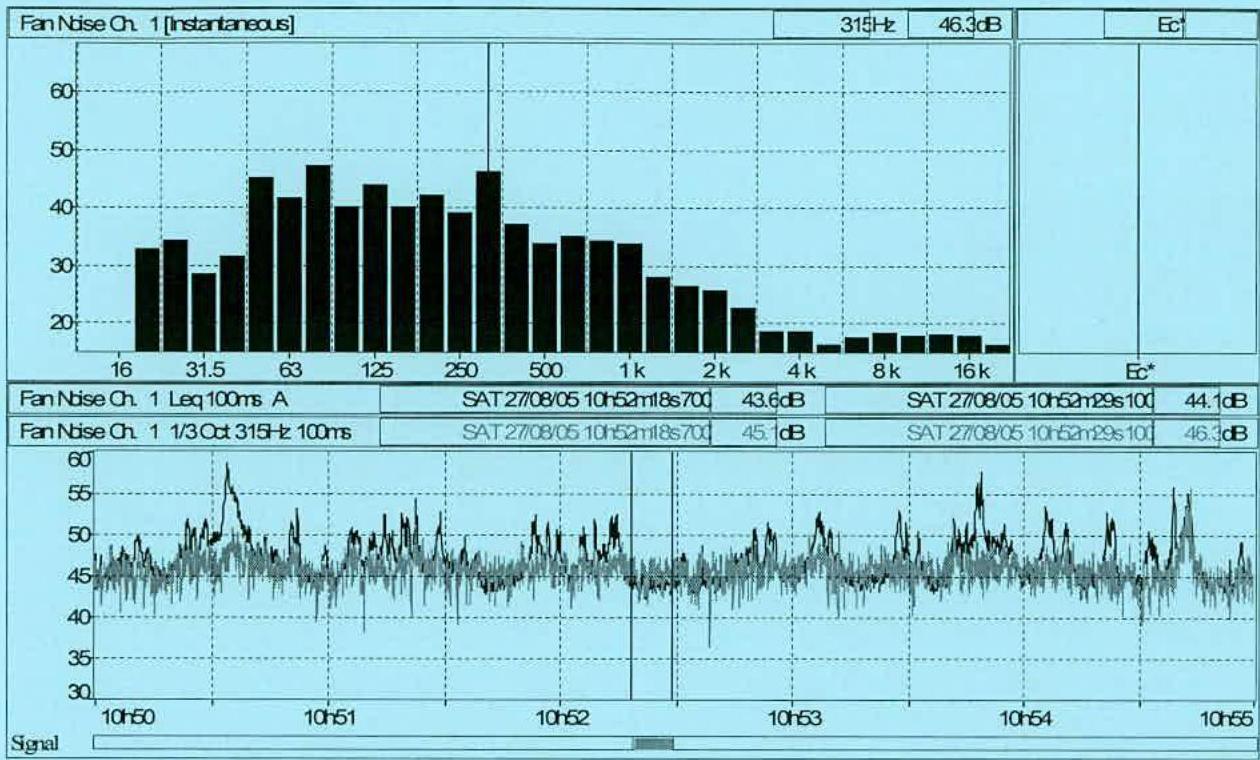
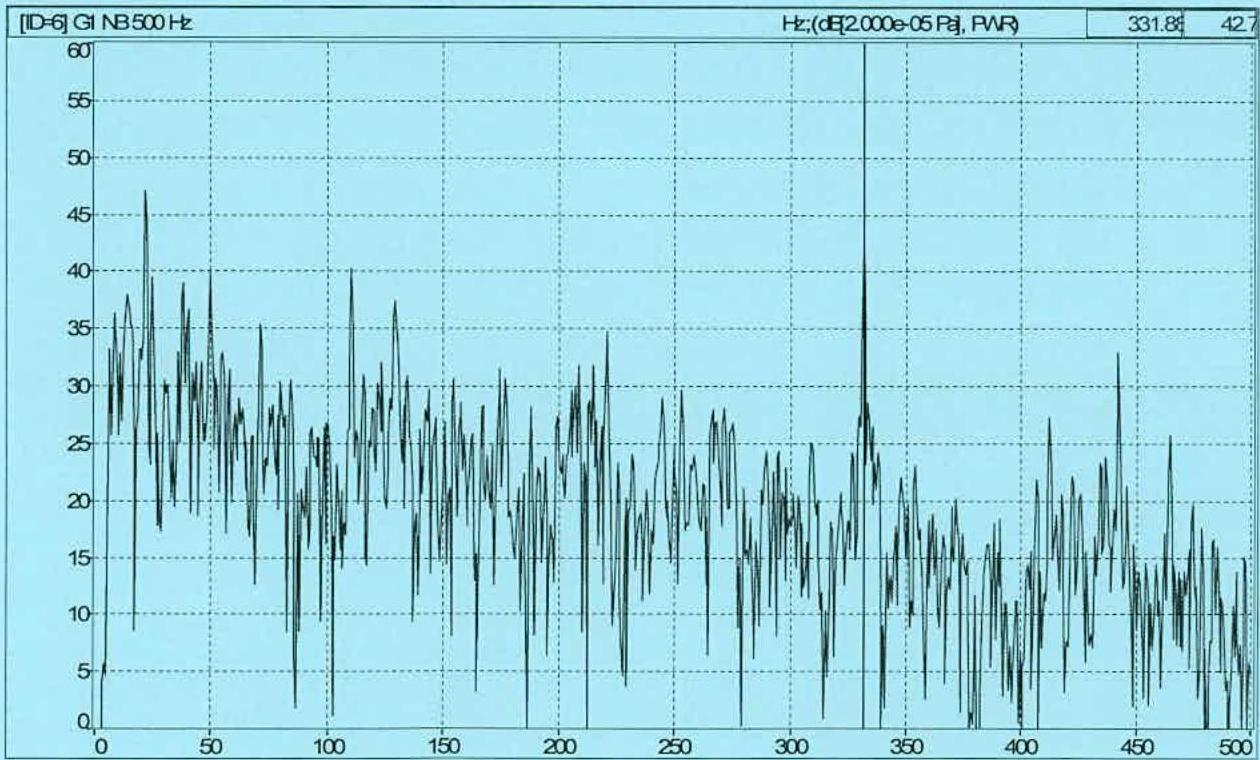
Analysis of recording of fan noise indicates a fan with an audible annoying tonal noise at 315 Hz 1/3 Octave (332 Hz -see Section 4.5). This is 45 - 33 = 12 dB above background at 315 Hz 1/3 Octave.
At this stage it would be difficult to establish that noise from people in the beer garden is sufficient to cause nuisance as noise levels are below background noise from traffic (see Sections 4.6 – 4.8). However, people generally find noise from traffic more acceptable than that from voices of rowdy people. Also people’s voices vary considerably in volume, which will largely be out of the control of the licensee.
Sound insulation works are considered by the Queens Hotel including secondary glazing, double door lobby to prevent noise escaping when customers leave and sound attenuated air vents to prevent noise escaping through them. Depending on how effective these are will depend on whether an entertainment noise controller is necessary.
Some general advice on sound insulation is provided in Appendix 1.
The most effective means of controlling the sound levels at source would be for the Queens Hotel to install their own sound amplification equipment with sound limiter such as AVC2 – Automatic Volume Control as referred to in Appendix 5, set to comply with noise limit criteria in Table 1 below.
If amplification equipment for loud amplified music public entertainment events is to be supplied by visiting entertainment, i.e. band, an entertainment noise controller could be installed such as illustrated in Appendix 4 (Blue Box) and Appendix 5 (Sentry MK-2), set to comply with noise limit criteria in Table 1 below. This type of entertainment noise controller does have drawbacks compared to the type referred to in the paragraph above such as the amplification equipment can be tripped off by loud voices from customers. Although Formula Sound appear to have an additional product the AT-1 (Appendix 5) which may overcome some of these problems.
```markdown TABLE 1 – RECOMMENDED NOISE LIMIT CRITERIA BY ENVIRONMENTAL PROTECTION UNIT (DLGE)
The fan responsible for tonal noise at 315 Hz 1/3 Octave should be identified and attenuated such as by slowing the speed of the fan, installation of a sound attenuator or installation of a quieter fan.
I recommend that use of the Beer Garden is restricted to 2300 hrs. This is to prevent sleep disturbance to local residents.
| Up to 12 events per calendar year | |||||||
| Category | Time | Broadband | Low frequency 1/3 octaves Linear | ||||
|---|---|---|---|---|---|---|---|
| LAeq, 5 min | 40 Hz | 50 Hz | 63 Hz | 80 Hz | 100 Hz | ||
| A | 1000 – 2400 hrs | 30 dB | 54 dB | 48 dB | 47 dB | 45 dB | 43 dB |
| More than 12 events per calendar year | |||||||
| Time | Broadband | Low frequency 1/3 octaves Linear | |||||
| LAeq, 5 min | 40 Hz | 50 Hz | 63 Hz | 80 Hz | 100 Hz | ||
| B | 1000 – 2300 hrs | 30 dB | 54 dB | 48 dB | 47 dB | 45 dB | 43 dB |
| C | 2300 – 2400 hrs | 25 dB | 49 dB | 43 dB | 42 dB | 40 dB | 38 dB |
| N.B. Where background noise levels are higher than limits above the ‘Noise Limit Criteria’ shall be no louder than background. |
| Sound Level Meter: | Symphonie | Serial No: 1835 |
| Microphone | 01dB A&V MCE 212 | Serial No: 42451 |
| Calibrator | B&K Type 4231 | Serial No: 2147475 |
Conforms to IEC 1260 Class 1. There was no significant drift (less than 0.1 dB) in the calibration tone between the beginning and end of DAT tape recording.
Analysis of tape recordings taken during the evenings of 25 and 26 August 2005 indicate noise levels from amplified music at the Queens Hotel could be considered a noise nuisance at Erin Brae.
To reduce noise to an acceptable level will require for example at 80 Hz 1/3 Octave a reduction from approximately 60 dB to 40 dB i.e. 20 dB. Internally such a reduction would cause the entertainment to be too quiet to provide satisfactory entertainment other than background noise and as such this indicates there is inadequate sound insulation.
Indeed the Queens Hotel only has sash windows which have air vents cut into them, so there will be very little attenuation provided by them (estimate - 10 dB).
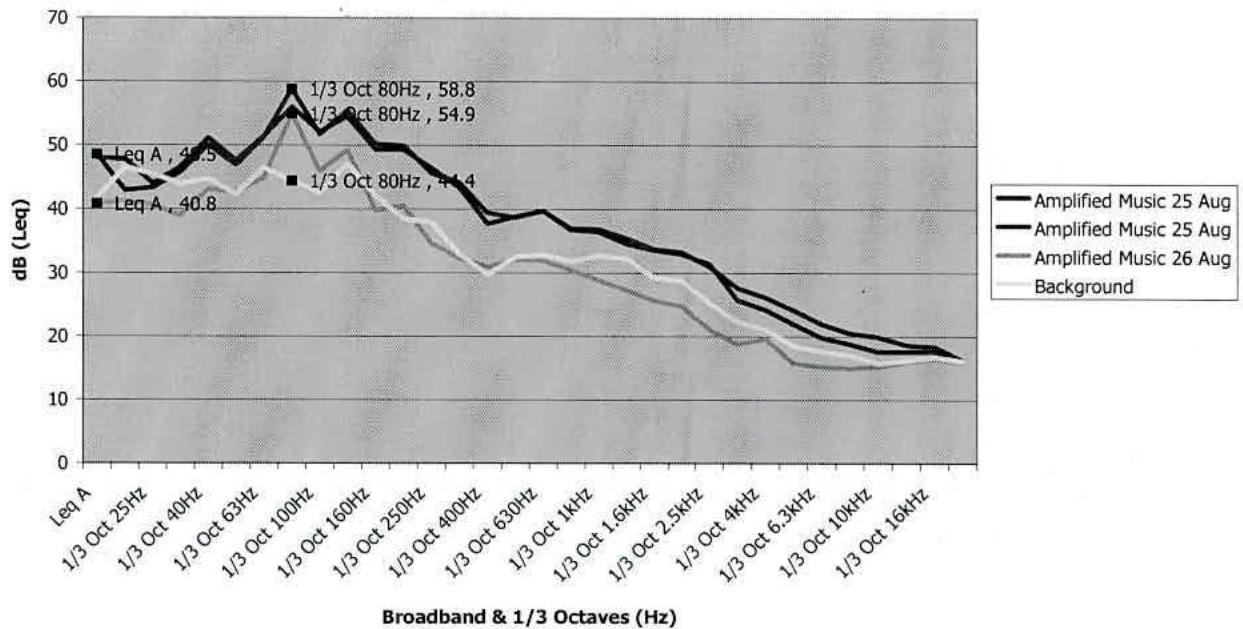
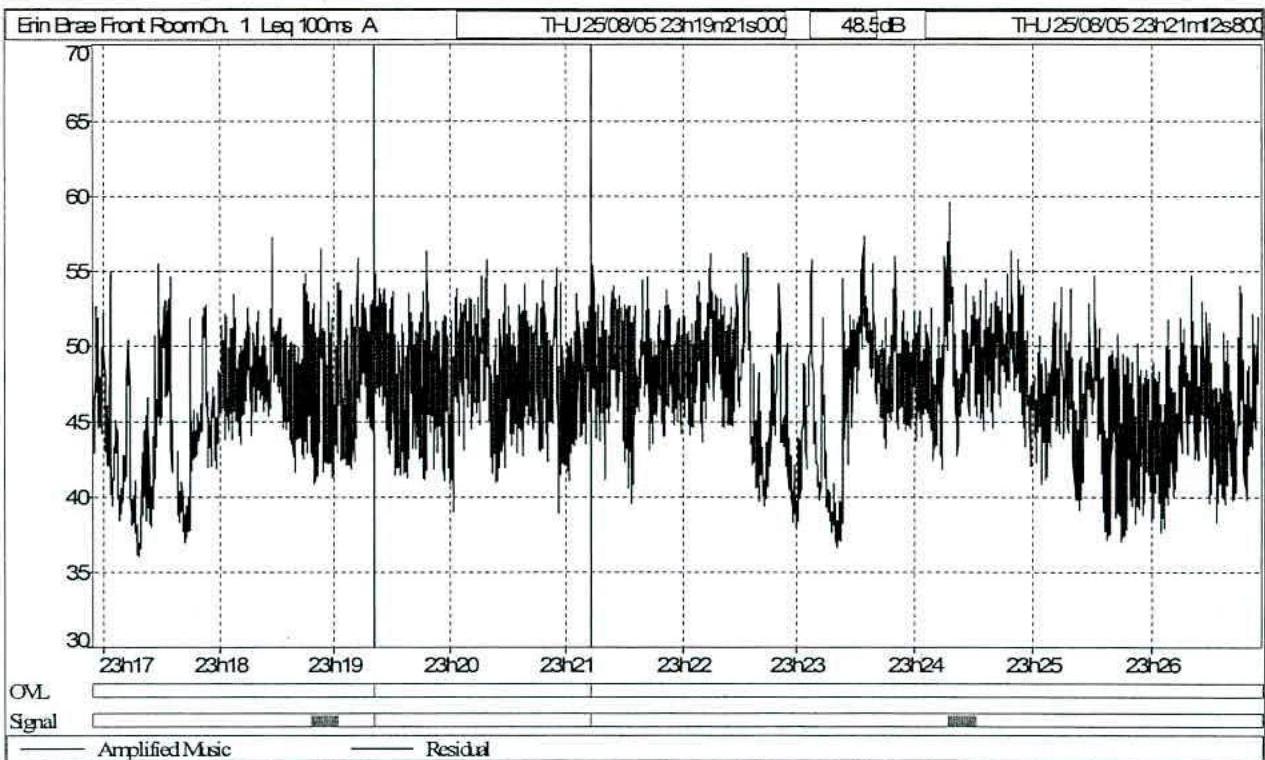
Chart 1 below illustrates that amplified music on 25 and 26 August 2005 produced noise from as low as 40 Hz 1/3 Octave, with the most predominant peaks of noise above background noise levels in the 80 Hz 1/3 Octave. Average Leq levels of noise from amplified music are 59 – 44 = 15 dB above background noise levels, which is likely to be the minimum level of attenuation likely to be necessary before noise becomes acceptable to residents of Erin Brae. This level of attenuation could be achieved such as by secondary glazing and attenuated air vents.
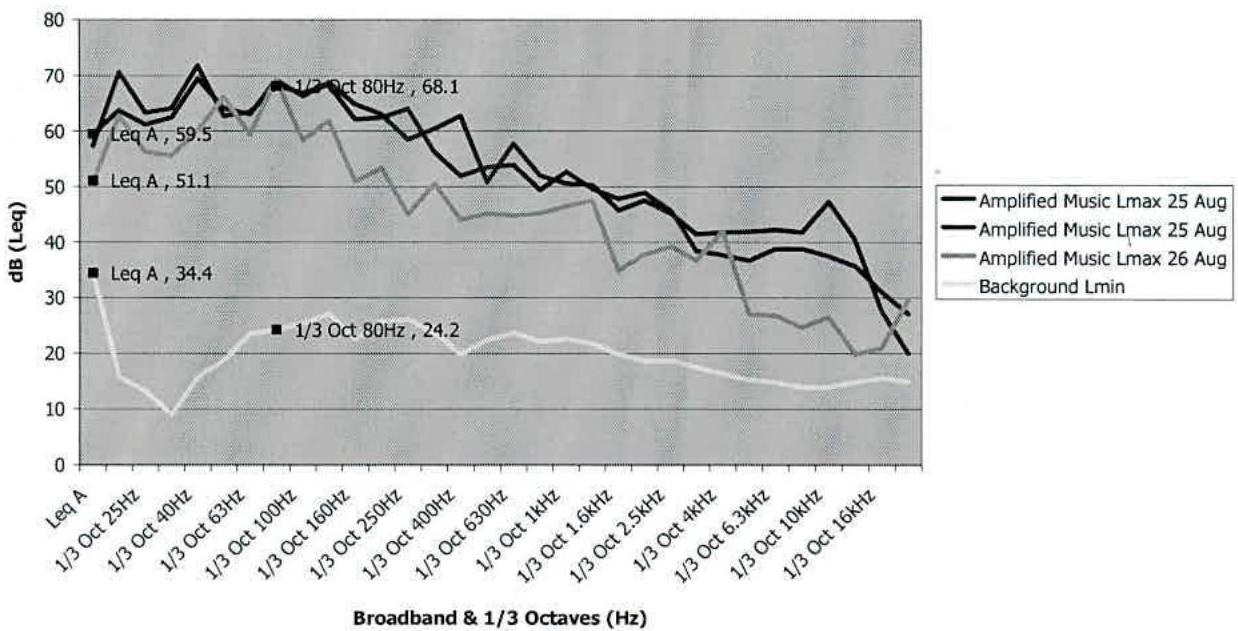
Chart 2 illustrates that the maximum noise levels from amplified music are for example at 80 Hz 1/3 Octave approximately 44 dB above residual background noise levels. The difference between the maximum noise levels and residual background noise levels are a good indication of the attenuation (44 dB @ 80 Hz 1/3 Octave) that would be necessary to cause noise from amplified music at the Queens Hotel to become inaudible at the Erin Brae. However, this level of attenuation is not likely to be achievable without very considerable sound insulation works.
Amplified Music (Leq) from Queens Hotel @ Erin Brae Compared to Background Noise (Leq)
Amplified Music (Lmax) from Queens Hotel @ Erin Brae Compared to Background Noise (Lmin)
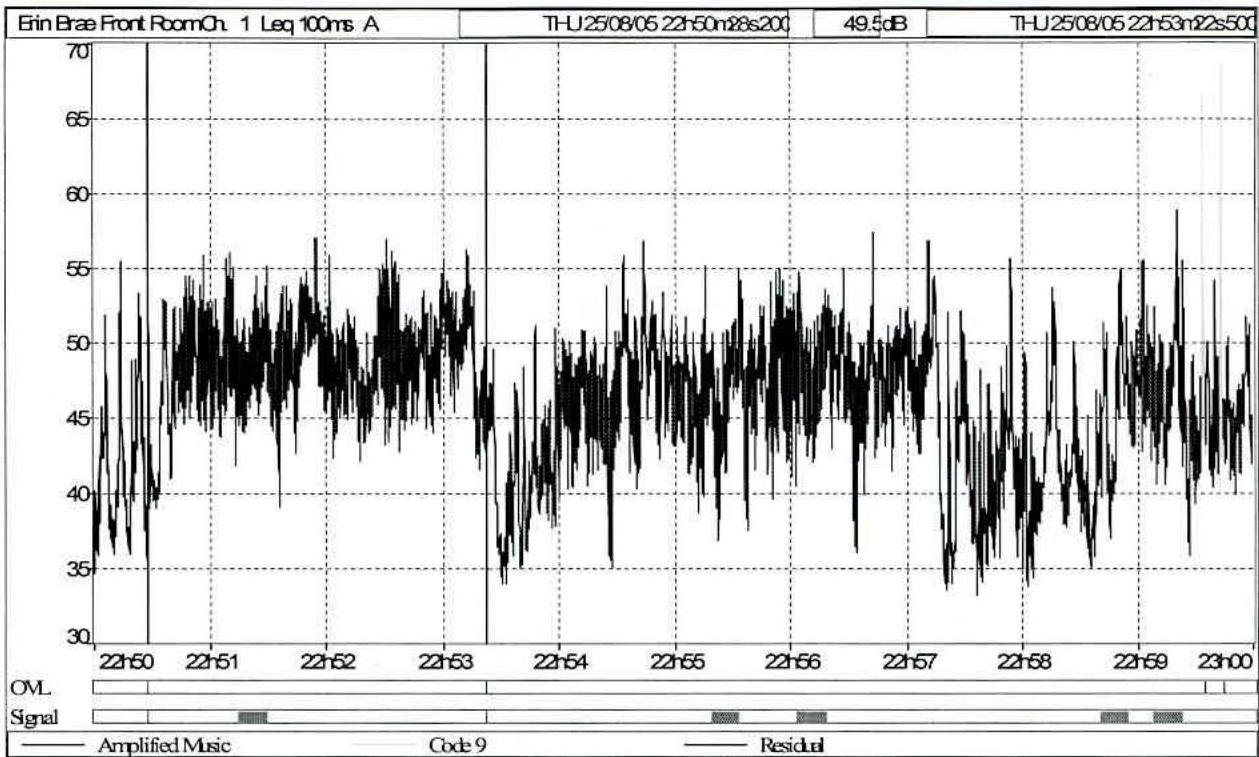
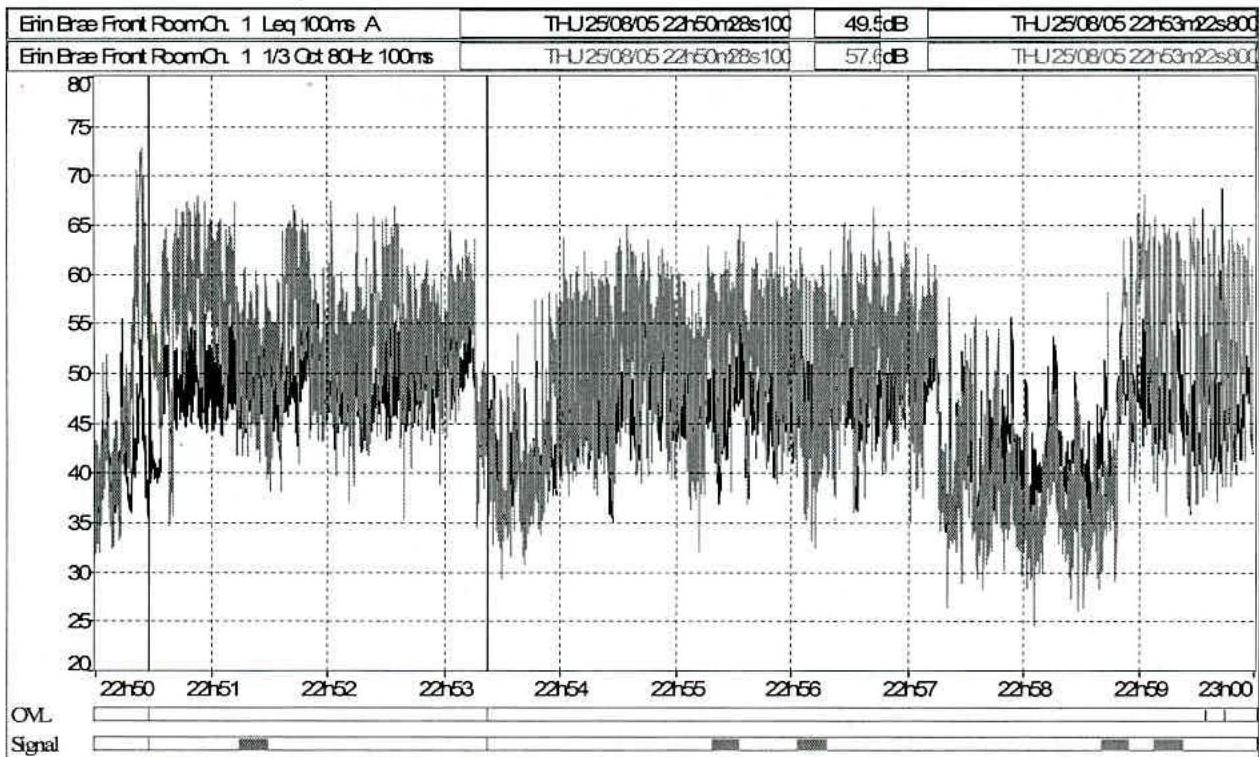
Source: Live Band at Queens Hotel Receiver: Erin Brae Living Room, Front of Building, Windows Closed.
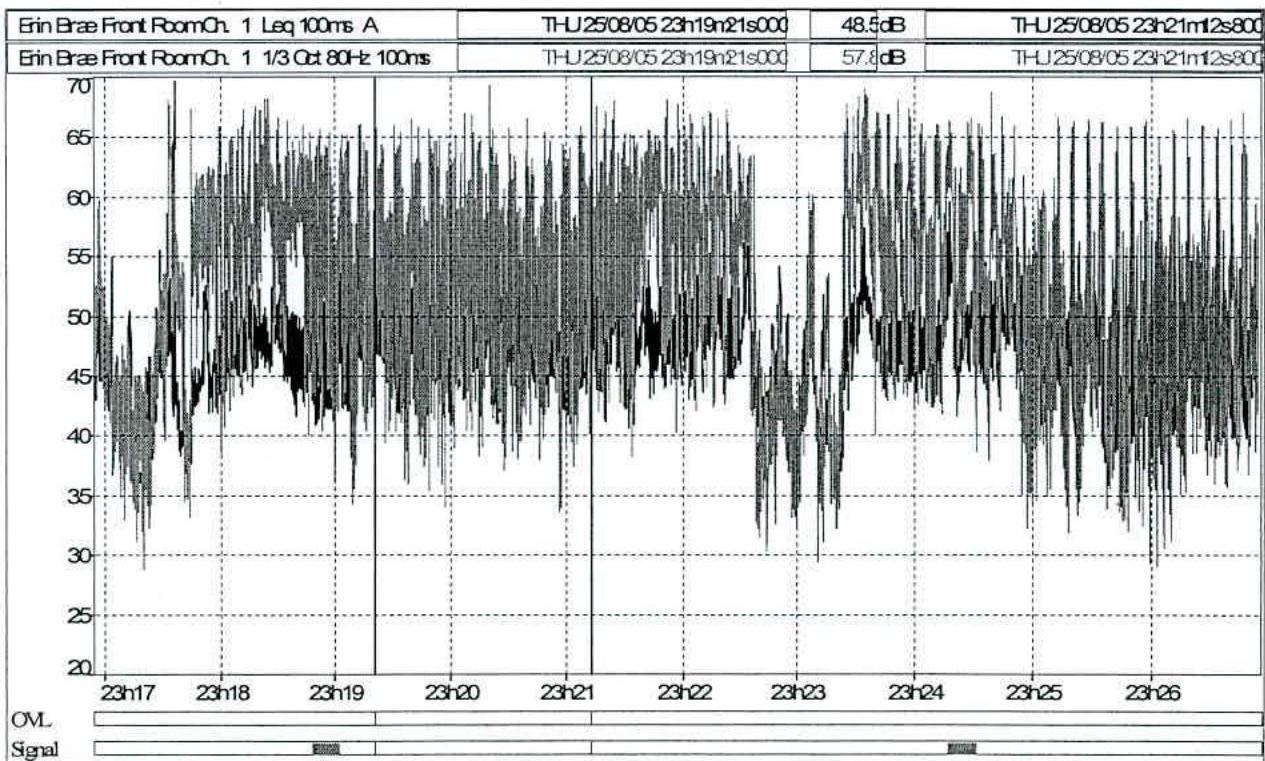
Source: Live Band at Queens Hotel Receiver: Erin Brae Living Room, Front of Building, Windows Closed.
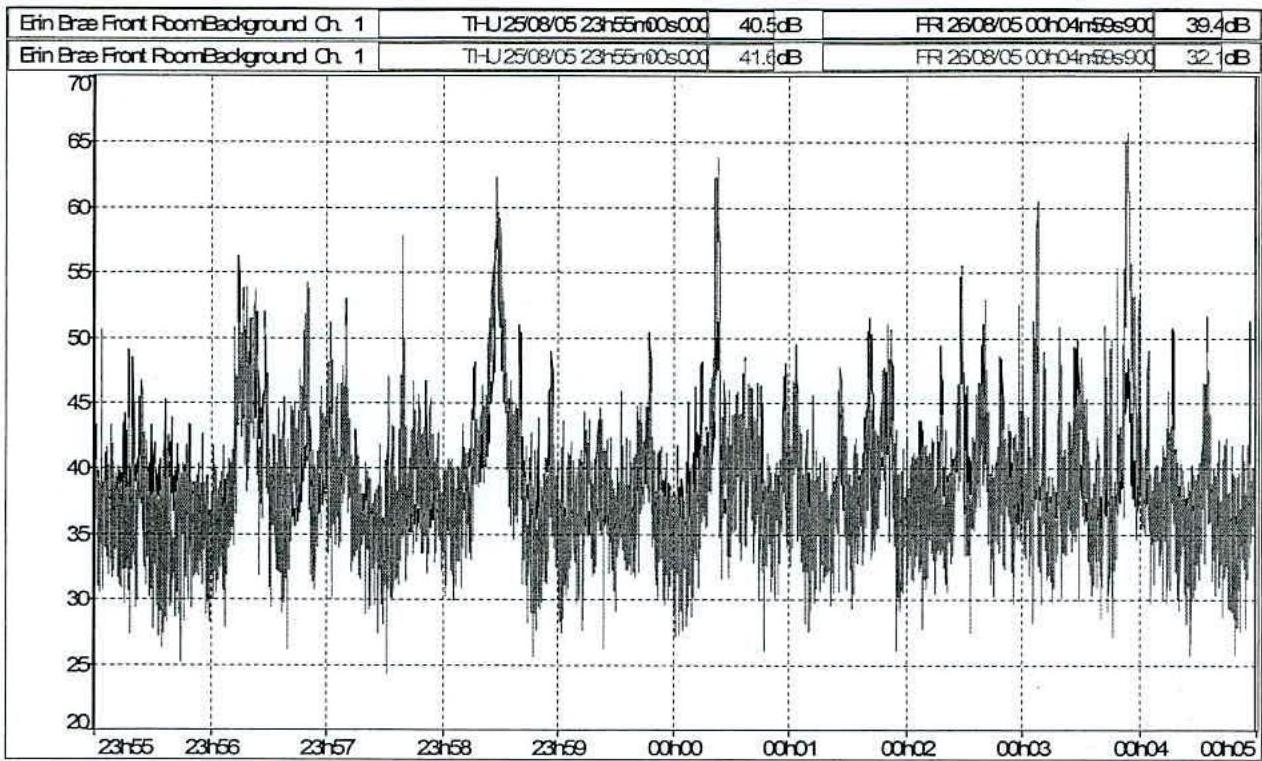
Source: Background Noise Receiver: Erin Brae Living Room, Front of Building, Windows Closed.
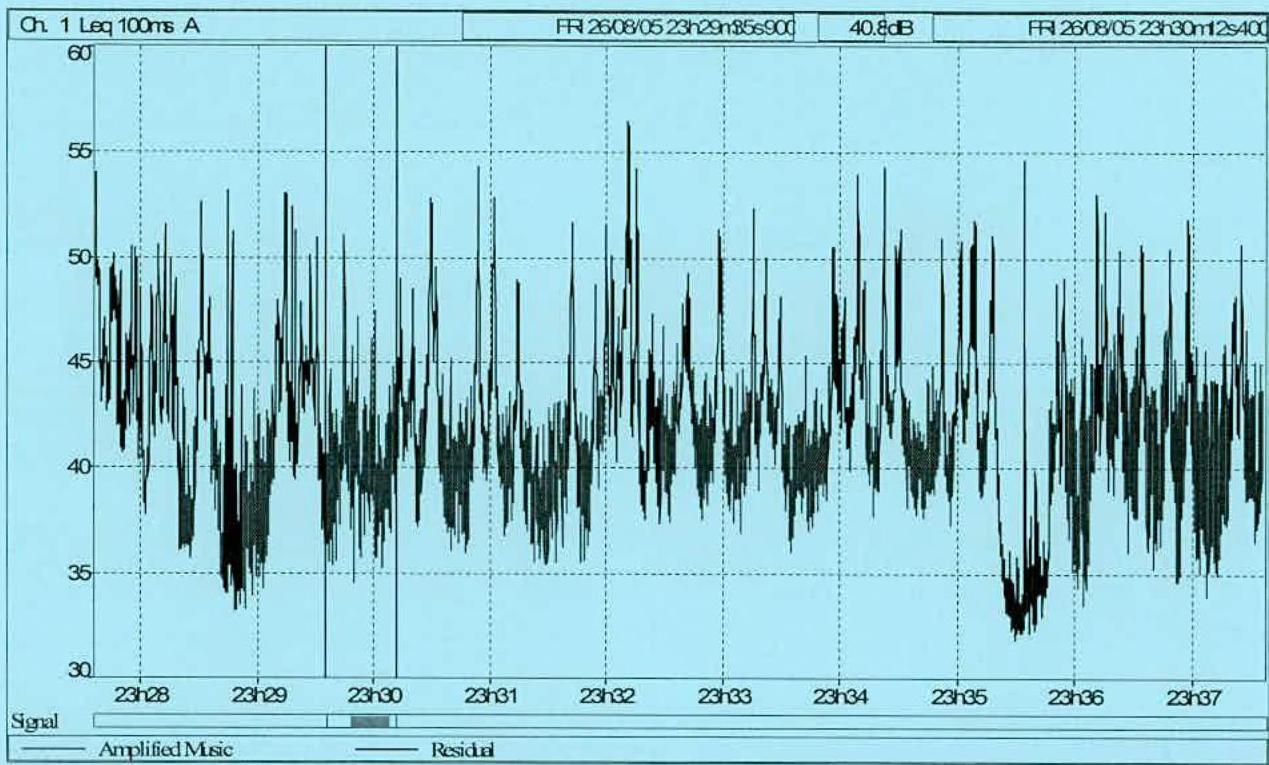
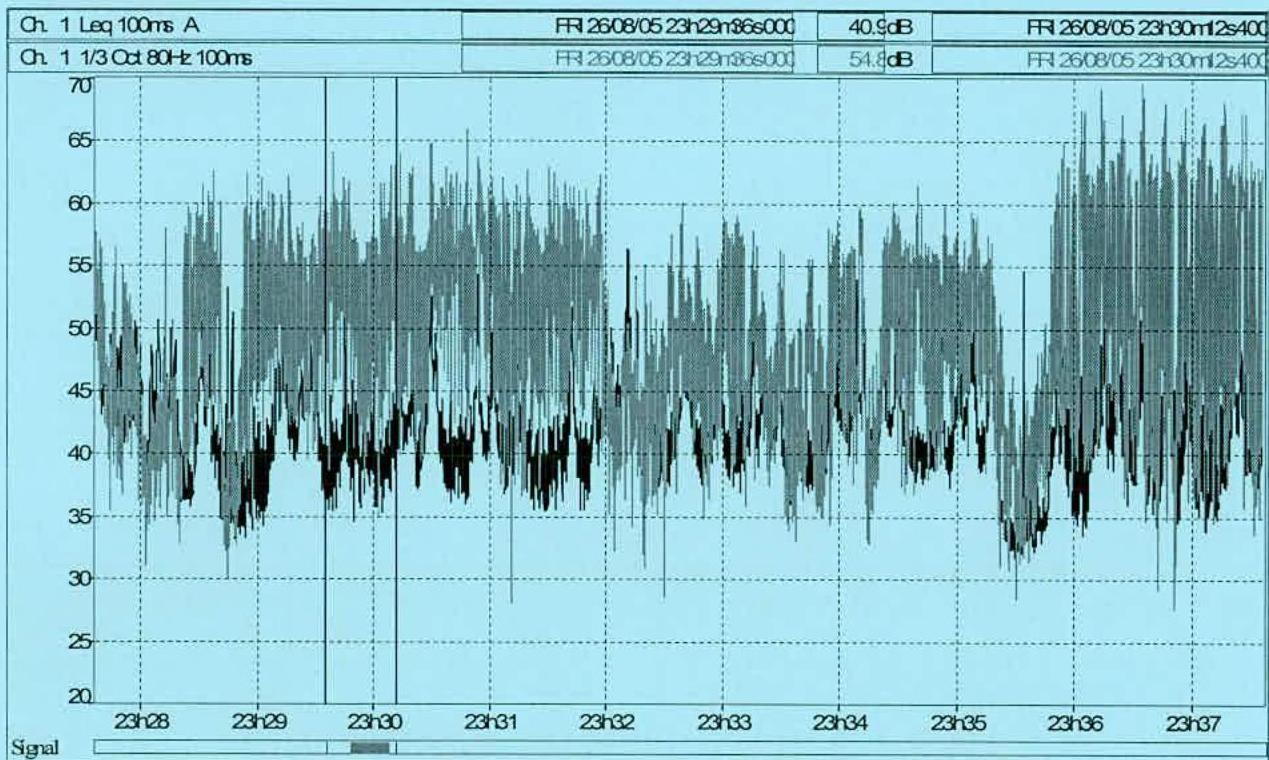
Source: Live Band at Queens Hotel Receiver: Erin Brae Living Room, Front of Building, Windows Closed.
Source: Fan noise at Queens Hotel Receiver: Erin Brae Living Room, Front of Building, Windows Closed.
| Source | Leq specific dB | Lmin dB | Lmax dB | Duration cumulated h:m:s:ms |
|---|---|---|---|---|
| Traffic | 45.5 | 38.0 | 52.6 | 00:01:55:200 |
| People | 43.7 | 38.2 | 49.7 | 00:00:04:600 |
| Code 9 | 46.3 | 37.6 | 55.0 | 00:00:09:600 |
| Residual | 41.8 | 36.5 | 52.7 | 00:02:50:600 |
| Overall | 43.8 | 36.5 | 55.0 | 00:05:00:000 |
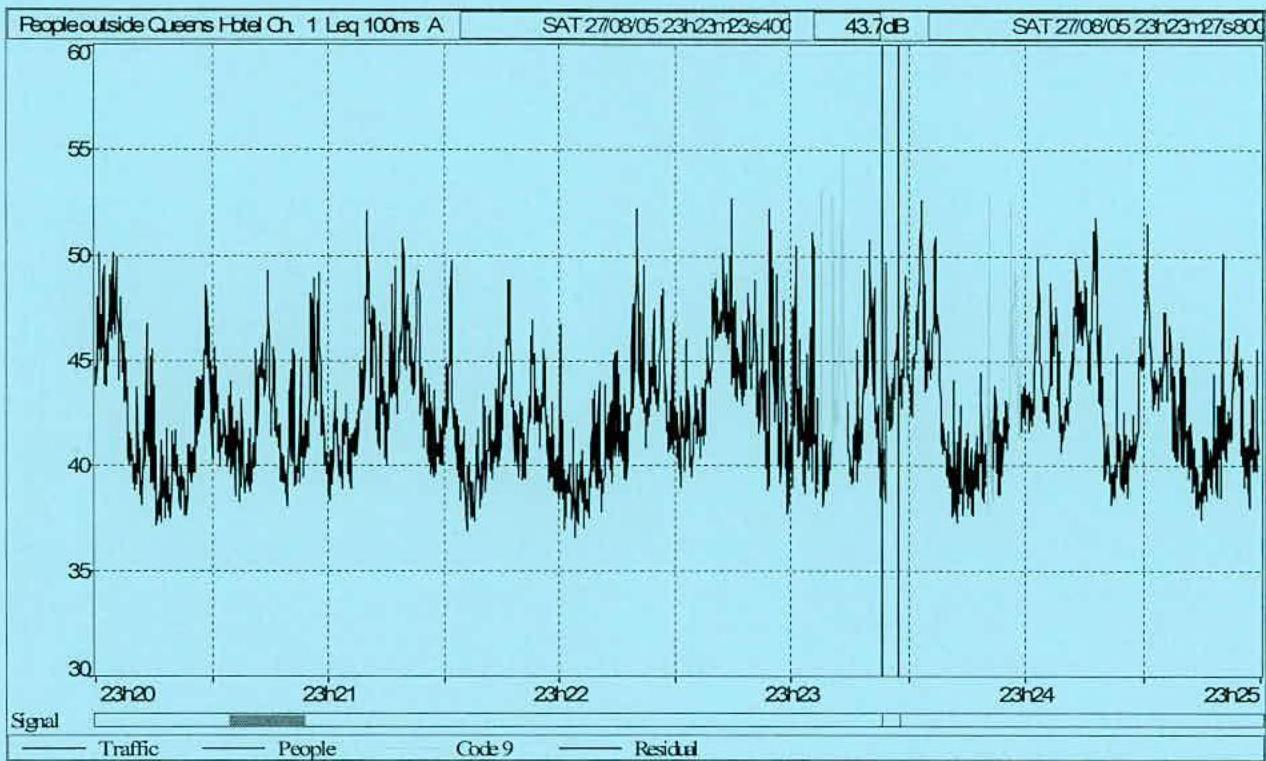
Source: People’s voices in Queens Hotel Beer Garden Receiver: Erin Brae Living Room, Front of Building, Windows Closed.
File 27Aug05_050901_141413.cmg Location People outside Queens Hotel Ch. 1 Weighting A Data type Leq Start 27/08/05 23:20:00:000 End 27/08/05 23:25:00:000
| Source | Leg specific dB | Lmin dB | Lmax dB | Duration cumulated h:m:s:ms |
|---|---|---|---|---|
| Traffic | 46.4 | 39.6 | 54.2 | 00:02:04:600 |
| Residual/People | 42.8 | 36.8 | 52.1 | 00:02:55:400 |
| Overall | 44.7 | 36.8 | 54.2 | 00:05:00:000 |
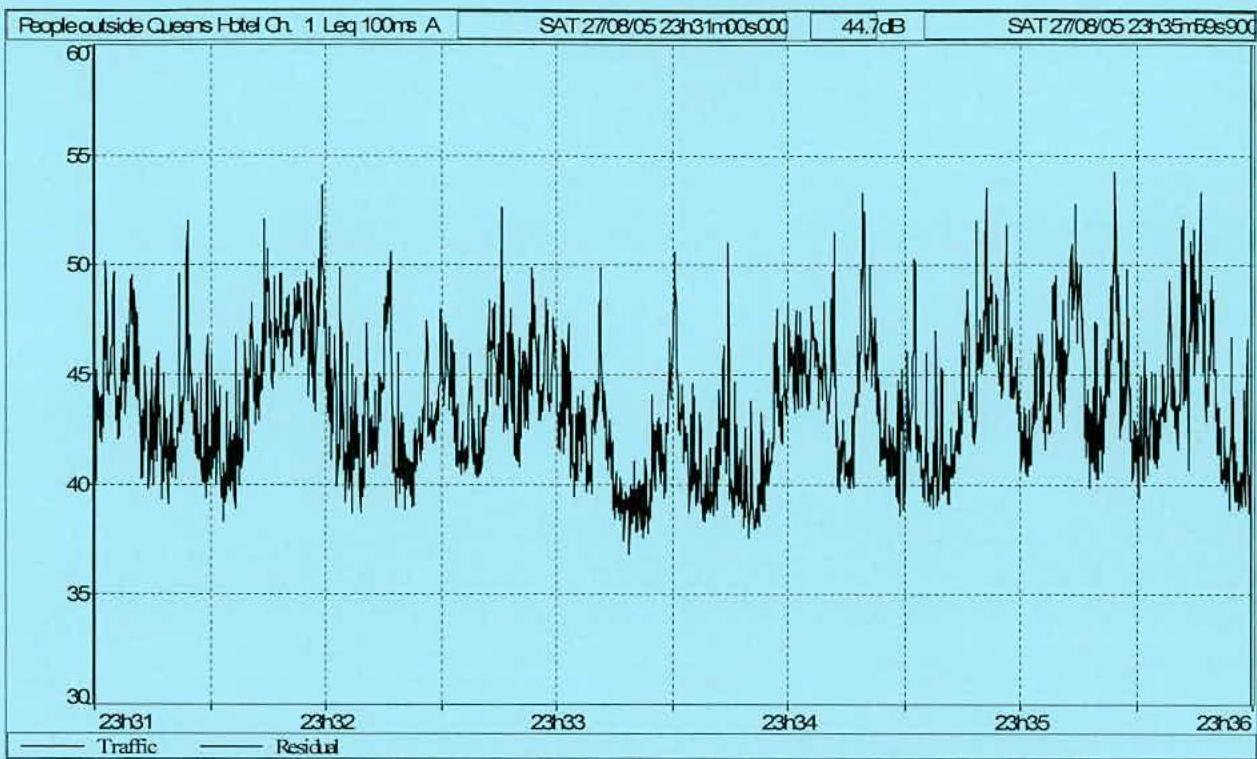
Source: People’s voices in Queens Hotel Beer Garden Receiver: Erin Brae Living Room, Front of Building, Windows Closed.
File 27Aug05_050901_143949.cmg Location People outside Queens Hotel Ch. 1 Weighting A Data type Leq Start 27/08/05 23:31:00:00 End 27/08/05 23:36:00:00
| Leq specific | Lmin dB | Lmax dB | Duration cumulated h:m:s:ms | |
|---|---|---|---|---|
| Source | dB | |||
| People | 42.3 | 35.9 | 61.0 | 00:04:06:600 |
| Residual | 45.4 | 37.2 | 58.3 | 00:05:53:400 |
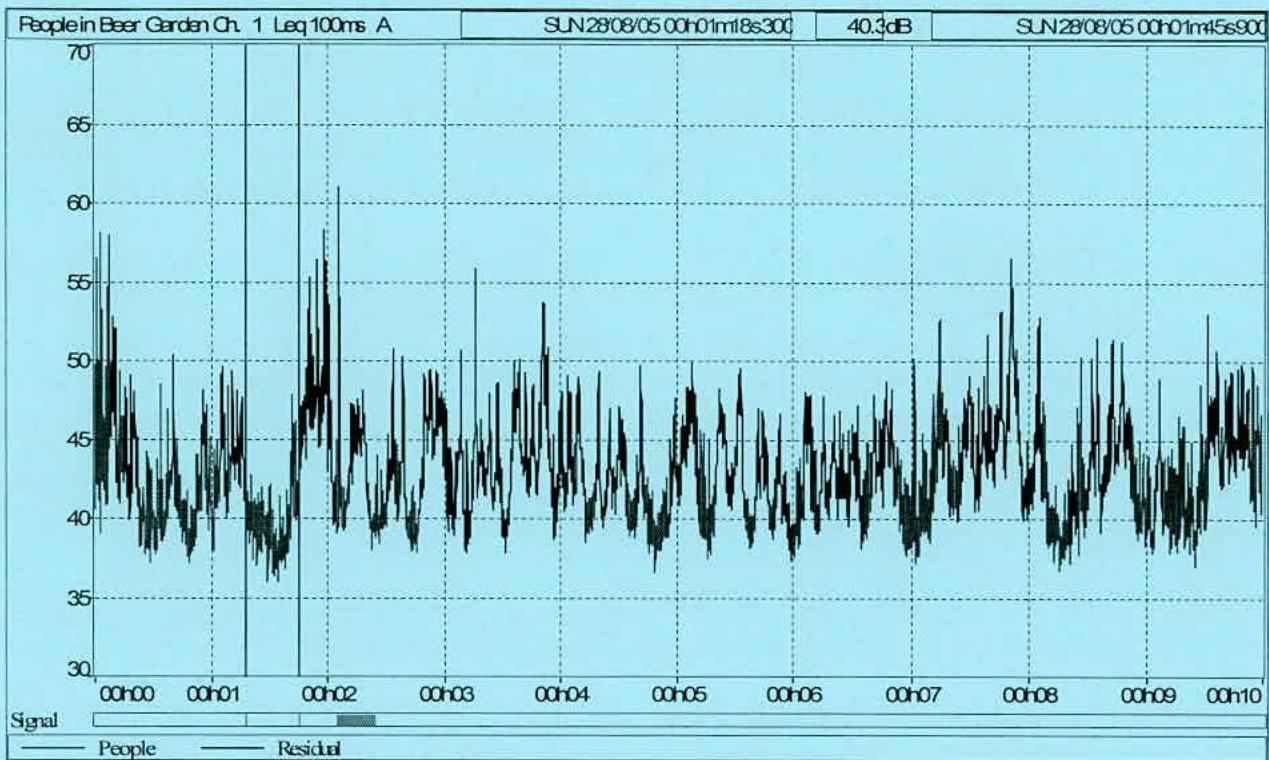
Source: People’s voices in Queens Hotel Beer Garden Receiver: Erin Brae Living Room, Front of Building, Windows Closed.
File 28 Aug 05_050902_104004.cmg Location People in Beer Garden Ch. 1 Weighting A Data type Leq Start 28/08/05 00:00:00:000 End 28/08/05 00:10:00:000
Appendix 1 – GENERAL ADVICE WITH RESPECT TO SOUND CONTROL OF ENTERTAINMENT BUILDINGS
Generally noise emission will be due to leakage through, and secondary radiation from roofs, doors and windows, and from any lightweight frame type constructions.
Windows
The windows should be provided with secondary glazing with at least 8mm toughened glass (preferably 10mm). The sealing of the glazing needs to be totally effective, hardwood frames are recommended, the reveal-depth should be maximized and lined with absorbent lining.
Mechanical Ventilation
The provision of lined or baffled ducting and/or insertion of silencers into the exhaust path will improve the sound insulation but impede air flow. The capacity of the fans will need to be assessed to ensure this does not need to be increased. A place of public entertainment will require a ventilation capacity of 10 – 15 air changes per hour.
External Doors
If purpose built acoustic doors are not used then use at least 50mm solid core doors with rebated meeting stiles, well hung into close fitting frames and fitted with compression seals.
INTERNAL ACOUSTIC ENVIRONMENT
The licensee can also minimise noise breakout by intelligent use of acoustical design within the public area.
At the stage and dace floor is the only area we really want loud music, the ceiling in the area should be fairly live. It can be hung with lighting equipment to provide some scatter.
Loudspeakers can be positioned around the perimeter of the dace floor, facing in towards the centre to provide plenty of volume just where it is wanted, but the enclosure masking and low frequency phase cancellation effects will minimise radiation elsewhere.
Public areas away from the dance floor can be screened with partitions, which can also be placed to act as acoustic barriers at locations near areas of weakest sound insulation such as doors, vents and windows.
Absorbent materials can be used to cover floor or seating areas such as carpet and plush upholstery, this will provide wide-band absorption.
So ideally an environment can be created which has a nice lively “hot spot” around the stage and dance floor, with a perimeter of heavily damped panels/absorbent coverings keeping acoustic energy away from perimeter structures of the building.
Copyright in submitted documents remains with their authors. Request removal
