Loading document...
To be read in conjunction with the Olympia Conservation Area Order 1st September 2003
Department of Local Government and the Environment Rheynn Reiltys Ynnydagh as y Chymmyltaght
1.1 In order to justify the selection of an area for Conservation Area status, it is necessary to undertake an appraisal of such an area’s character and appearance. The intention of this procedure is to clearly set out the justification for Conservation Area designation, with the added aim of summarising a practical, distinct and factual assessment of the area in a working document. The character appraisal has been the subject of consultation with The Advisory Council on Planning and the Environment, The Douglas Corporation and many other interested parties. The Town and Country Planning Acts place a duty upon the Department of Local Government and the Environment to determine which parts of the Island are areas of special architectural or historic interest, the character or appearance of which it is desirable to preserve or enhance, and to designate such areas as Conservation Areas.
1.2 The unique and cohesive character which Douglas possesses as a fine seaside town has long been recognized, not only by the Island’s local community, but possibly to an even greater extent, by visitors to our shores, who readily compare the variety and quality of the Capital’s architecture, to some of the finest townscapes throughout the British Isles.
1.3 The Island has always tended to ‘wait and see’ before adopting patterns of living and approaches to legislation and commerce. The same may be said of the historical development of architectural fashions in the Island. We find architectural styles or ‘periods’ identified by reigns of various English Monarchs, taken up at a leisurely pace and still remaining in use for years after such styles were abandoned for new approaches, outside of the Island. This
tendency can be a little confusing when trying to date a property, but it has also been instrumental in achieving the unique blend of buildings remaining today.
2.1 Douglas occupies a choice location on a wide, east-facing bay, marked by headlands to the north and south, and backed by steeply sloping brooghs to the west.
2.2 The town had confirmed its position as the principal trading harbour of the Isle of Man during the eighteenth century. The majority of buildings were sited in a triangle around the harbour which, during the late 1700s and early 1800s, was the fashionable area. However, during the nineteenth century, a number of developments were to occur which encouraged the rapid growth of the town and Douglas was to prove attractive to residents from other parts of the Island, as well as “second home” owners and tourists alike.
2.3 Along with the development of major sections of the town’s infrastructure, the relocation from Castletown to Douglas in 1869, of the House of Keys, was probably one of the most important influences on the subsequent growth of the settlement.
2.4 In response, people increasingly chose Douglas as their main place of dwelling and the town gradually spread along the shore front and uphill onto the brooghs behind. Initially, access was very difficult, but major works afforded access to areas behind the promenades and the opening of the former Ballabrooie, Ballakermeen and Ballaquayle estates for development saw further increases in the number of residences constructed during the Victorian period.
3.0 LOCATION AND TOWNSCAPE
3.1 Upper Douglas is characterised by a number of small areas and distinctive neighbourhoods, which possess fine examples of terraced properties. It is a common feature that within such areas, a wide variety of house designs can be found and the influence of Georgian, Regency, Victorian, Edwardian, and Arts and Crafts Periods are all recognisable and this unique mix gives vibrance and vitality to the built fabric of the Island's Capital.
3.2 The townscape of upper Douglas is distinguished by a number of fine, and often very elegant, civic spaces in the form of squares and gardens, which provide a focus for surrounding terraced properties. Additionally, the avenues and other approach roads to these spaces are lined with carefully designed terraces, whose architectural language, detailing and rhythms provide a foretaste of the overall approach adopted in the enclosing architecture of the squares themselves. These early examples of town planning, although rigorous in their approach to detail, form and layout, succeed in creating a sense of spaciousness, charm and gentility which are now synonymous with the identity of substantial, predominantly residential, areas of Upper Douglas.
3.3 From the mid nineteenth century onwards, impressive Victorian terraces gradually developed north of the main town centre and away from the busy, and heavily populated, harbour area. Many were arranged to both create and enhance frontal views, being laid out around green spaces and gardens. The approach to 'period' architectural styles adopted in the Island does not always adopt a text book format in terms of design detail or expected dating: this again adds a Manx flavour to the resulting architecture such as is not found elsewhere.
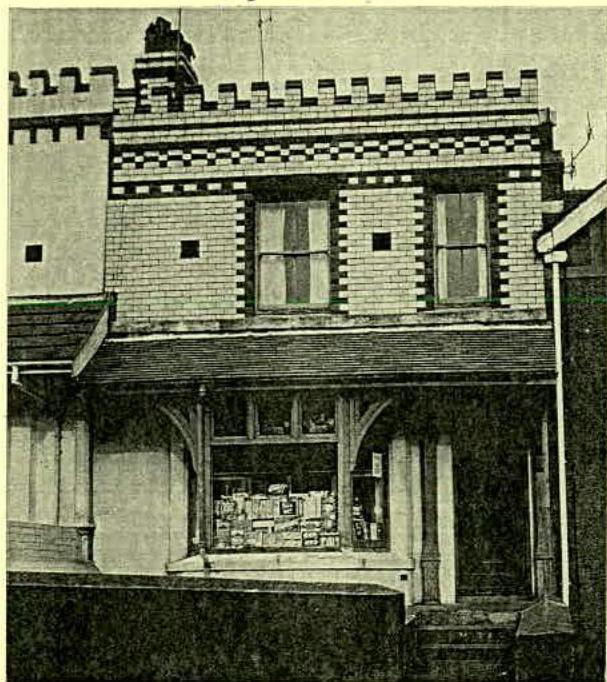
3.4 This terrace has come into focus due to its uniqueness within the townscape of Douglas. This is partly attributable to the employment of ‘diaper-work’ – found nowhere else in the Island.
3.5 The term refers to surface decoration consisting of repetitive patterns of diamonds or squares, using contracting colours of brickwork. It is not unusual to find the work embellished with flowers or other ornamental features. In the case of Dukes Terrace, feathered ornamentation is used to decorate key-stones over the head of many window and door openings. Synonymous with the name of the terrace are the presence of Ducal and other Regal names, fashioned in terracotta and set into the front elevations of the houses. Some properties have been smooth rendered or pebble-dashed which detracts from the overall unity of the terrace and would be discouraged. The aim would be to encourage an overall pattern of fenestration to be adopted when replacing windows, together with a painting colour scheme to help enhance the appearance of these curious but special properties. Progressing around the corner into Marathon Drive the use of yellow and red brickwork is continued in these properties which date from 1898, but their use is employed in a more restrained manner. A number of properties in this road retain their crenellated parapets and projecting canopies provide roof coverings to timber framed bay windows. Several properties retain their stained glass windows which add interest and the group is largely in tact in this frontage. Worthy of special mention if the small local shop at the lower extent of the group. This property appears to be virtually in its original condition and adds much to the character of the area.
3.6 The Douglas Corporation purchased the land formerly used as a sports stadium, in 1926 and the building of Victoria Crescent and properties on Marathon Drive followed. The scheme was
designed by Joseph E Teare and laid out in 1929. It must surely be the finest example of municipal housing in Douglas and repairs and upgrading carried out in recent years by the Corporation have largely maintained the quality the these buildings and their contribution to the townscape of Douglas. The properties follow the Arts and Crafts with the use of red Rosemary roof tiles and references to half timber picked out in render on pairs of projecting gables. The green open space of the Crescent, provide a pleasing outlook and much used facility for families in the area. This form of housing layout owes something to the development of the Garden City movement, which developed ‘rural’ style housing with garden facilities and prescribed access to open spaces. The design is carried on into the corporation houses in Marathon Drive and others in Falcon Cliff Terrace.
3.7 Alongside the above mentioned houses sits the terrace of four Registered Buildings designed by M. M. Baillies Scott, Architect of international repute who was responsible for setting the highest standard of Arts and Crafts architecture on the Island.
3.8 The properties were built in 1897-98 by W MacAdam a local developer and it is astonishing to think that this style was being pioneered by Baillie Scott when much of the highly decorative properties of the late Victorian period were being built elsewhere in the town. The properties are finished in uniform rough-cast render and have very simple fenestration. They were ground-breaking in their time and make a noteworthy contribution to the Conservation Area.
4.0 CONCLUSION
4.1 Negative elements identified are largely judged to be reversible, given time, appropriate guidance and support. As such, they are not considered to be of sufficient weight so as to deflect from the overall special quality and character of the Olympia Conservation Area. Many problems can be rectified and features improved with careful consideration and appreciation of the urban environment. The support of appropriate planning policies and improved levels of grant assistance, now in place, is of great importance to this initiative. Conservation Area designation aims to maintain and improve the unique qualities of a particular area, whilst also allowing it to prosper and consolidate.
| Application No: 050127 | Page of | |
| Views Expressed - Name | Invite | Inform |
| APP | ||
| DOT H | ||
| Douglas Corp |
Copyright in submitted documents remains with their authors. Request removal
