Loading document...
4.3.2 The habibat within the Site offer suitable foraging and commuting habitat for bats. 4.3.3 Connectivity to tree lines, hedgerows and areas of open green space within the wider landscape also exist, further increasing the Sites suitability for foraging and commuting bats.
Birds 4.3.4 Although no evidence was recorded the scrub, trees, bracken and semi improved grassland provide suitable nesting habitat for both arboreal and ground nesting birds.
4.3.5 The stream which is just outside the development boundary is flowing and has a limited suitability for frogs. However, the wider landscape supports waterbodies and the on-Site habitats provide suitable terrestrial habitat for this species.
4.3.6 The habitats within the Site provide suitable foraging, basking and over wintering opportunities for common lizards.
Other Species 4.3.7 The survey identified no evidence of other protected species within the Site.
5.1.1 There are no designated sites within 1 km of the Site and the proposed works will result in no deleterious effect to designated sites.
5.2.1 A single area of ASNW lies approximately 1 km north west of the site. Well beyond the 15 m commonly recognised as a safe working distance when working in close proximity to ancient woodland site, the proposed will result in no deleterious effects to this or any other Ancient Woodland sites.
5.3.1 The riparian habitat at the edge of the stream featured an unconfirmed fern species which resembled the Schedule 7 narrow buckler fern. Policy dictates that these species of principal importance should be considered as part of the planning process. Care should therefore be taken to avoid these plants during any development works. Should works be required within 5 m of the upper stream bank, further surveys to determine the presence / likely absence of narrow buckler fern and if present, to inform the associated mitigation strategy will be required. 5.3.2 The grassland habitats have potential to support orchid. All orchid are protected under the Wildlife Act 1990 and further surveys to determine the presence / likely absence of orchid should be conducted during the core flowering season of May - August. 5.3.3 Although the detail of the works are as yet unknown, the potential for nutrient and sediment leaching into the adjacent stream should be considered and mitigated where required. Processes that have potential to pollute (refuelling plant, etc.) should be undertaken within an appropriate spill zone located an appropriate distance from the watercourse. . 5.3.4 To ensure the long-term integrity of the retained trees is maintained, they should be protected in accordance with BS 5837:2012 'Trees in Relation to Design, Demolition and Construction'. An example of appropriate tree protection measures is presented in Figure 2.
5.4.1 Although none was identified during the survey, the data search returned records of Japanese knotweed Fallopia japonica along the site boundary by the stream in 2006. Further surveys to
determine the presence / likely absence of Japanese knotweed should be conducted during the active growing months of May to August. If identified as present, the removal of this invasive species must be conducted in the appropriate manner.
Bats - Roosting habitat 5.5.1 Historical records have identified the presence of bats within the wider landscape, however the trees within the site do not support PRF for bats. 5.5.2 No further surveys to determine the presence/likely absence of roosting bats are required.
Bats -Foraging and Commuting Habitat 5.5.3 The vegetated banks, scrub, scattered trees, watercourse and grassland all provide suitable commuting and foraging habitat for bats. An isolated plot within a mosaic of similar habitat within the wider landscape, application of activity surveys to determine the Sites use by foraging and commuting bats is considered disproportionate in this instance. 5.5.4 Should permission for the proposed development be granted, measures to maintain existing flight lines should be implemented in full. The retention and where appropriate enhancement of existing boundary features should be achieved through the planting of native species rich hedges. The inclusion of invertebrate friendly planting within the wider landscape scheme will serve to provide foodstuffs for invertebrates and subsequently bats and other fauna. 5.5.5 Since lighting can be detrimental to the use of vegetation by foraging and commuting bats, any external lighting required to facilitate the proposed work should be sensitive to the boundary features, avoiding direct illumination of them, for example through the use of directional lighting. The Institution of Lighting Professionals (ILP), in partnership with the BCT, has published guidance relating to bats and lighting - this is available at the following link; https://www.theilp.org.uk/documents/guidance-note-8-bats-and-artificial-lighting/
Birds 5.5.6 Historical records of birds of relevance to the Site are limited, yet suitable nesting habitat exists in the form of scrub, trees, bracken and grassland. The habitats are also considered suitable to support bird species of conservation concern such as skylark, woodcock Scolopax rusticola and to a lesser degree curlew. 5.5.7 All nesting birds are protected under the Wildlife Act 1990 and it is recommended that prior to the start of where works surveys to determine the presence / likely absence of nesting birds
be conducted. When considering the size and nature of the Site, application of a full suite of nesting bird survey in accordance with the Common Bird Census (CBC) methodology would be disproportionate. Monitoring of the sites nesting bird status should, however, be conducted whilst conducting the orchid presence / likely absence surveys noted above. 5.5.8 In the event that rare or notable bird species are recorded breeding within the Site, this should be mitigated accordingly. 5.5.9 To ensure the welfare of nesting birds are maintained, works to areas deemed sensitive to the presence for nesting birds should conducted outside the core breeding period for birds of late February - August (inclusive). Should this timeframe be unobtainable, a thorough search for the presence of nesting birds should be conducted by a suitably experienced ecologist prior to the start of works. Should evidence of breeding birds be recorded, works within 5 m of the nest, or works that have potential to destroy the nest, should stop until the eggs have hatched and the chicks fledged, or the nest is deemed by a suitably experienced ecologist to have been abandoned.
5.5.10 Historical evidence identified common frog as present within 50 m of the Site and the habitats to be affected by the proposed are suitable to support the species. 5.5.11 As habitats suitable to support common frog are to be affected, further surveys to determine the current status of frog within the local vicinity should be conducted. To maximise effectiveness such surveys should be conducted of waterbodies within 250 m of the application boundary during the period March / April in any given year. The search should determine the presence / likely absence of common frog through the observation of spawn clumps. Population estimates can be made through the number of clumps recorded.
5.5.12 Historical evidence identified common lizard as present within the Site and the semi-improved grassland, scrub and spoil piles all provide suitable habitat to support the species. 5.5.13 Common lizard are protected under the Wildlife Act 199 from killing and injury. As the proposed works will result in the loss of suitable habitat for reptiles, further surveys for reptiles will be required prior to the start of work. 5.5.14 Reptile surveys involve a minimum of seven visits undertaken by a suitably qualified ecologist, typically between late March and early October depending on the weather conditions. The
surveys must be undertaken in suitable weather conditions and should avoid prolonged periods of particularly hot or cold weather. 5.5.15 To avoid harm or injury to reptiles, no works that are likely to impact on habitats suitable to support reptiles can take place until these surveys have been completed and any necessary mitigation implemented.
5.5.16 Beyond those noted above there are no field signs indicative of the Sites use by protected species. Therefore, no further surveys to determine the presence of other protected species are required in this instance. 5.5.17 Should at any point during the development a protected or notable species be identified within the Site, all works should stop, and the appointed ecologist consulted on the appropriate manner in which to proceed.
6.1 Opportunities to include biodiversity enhancements within the Site exist and in accordance with the requirements of the NPPF the following recommendations are considered appropriate for the Site:
7.1 In response to the proposed residential construction at Kiondhodag, Foxdale, the Site has been subject to a Preliminary Ecological Appraisal. 7.2 Development of the Site will have no detrimental impact upon designated sites of nature conservation or areas of Ancient Woodland. 7.3 Potential impacts to the narrow buckler fern and off-site stream through nutrient and sediment leaching should be considered and mitigated where required. 7.4 Historical records of the invasive Japanese Knotweed are identified within and suitable habitats and historical records of orchid exist in close proximity to the Site. Further surveys to determine the presence / likely absence of these species should be conducted. 7.5 Retained trees should be protected to avoid compaction of collision damage. 7.6 No further surveys for bats are required. Measures to maintain and enhancement existing flight lines, increase roosting opportunities and encourage prey items should be incorporated within the design. 7.7 Further surveys to determine the presence of nesting birds, common frog and reptiles are required. If present the impacts on these species will require further consideration. 7.8 The likelihood of other protected and notable species to occur within the Site is considered Negligible and no further surveys for other protected species are required. 7.9 Should at any point a protected or notable species be identified, all works should stop, and the appointed ecologist consulted on an appropriate manner in which to proceed. 7.10 Recommendations to enhance the Site's suitability for wildlife have been provided.
Bat Conservation Trust and the Institute of Lighting Professionals (BCT\&ILP) 2018. Guidance Note 8; Bat and Artificial Lighting in the UK. https://www.theilp.org.uk/documents/guidance-note-8-bats-and-artificial-lighting/
CIEEM (2017). Guidelines for Preliminary Ecological Appraisal. 2nd Edition. Chartered Institute of Ecology and Environmental Management. Winchester.
Collins, J. (ed.) (2016). Bat Surveys for Professional Ecologists: Good Practice Guidelines (3rd edn). Bat Conservation Trust, London.
Isle of Man Government. (2012). Manx Hedgerow Management Code of Best Practice. Department of Environment, Food and Agriculture. https://www.gov.im/media/277574/manx hedge management.pdf
JNCC (2010). Handbook for Phase I Habitat Survey; A Technique for Environmental Audit. Peterborough. Manx Wildlife Trust; www.manxwt.org.uk Stace (2010). New Flora of the British Isles (Third Edition). Cambridge University Press Wildlife Act. 1990. https://www.gov.im/media/1363689/wildlife-act-1990.pdf
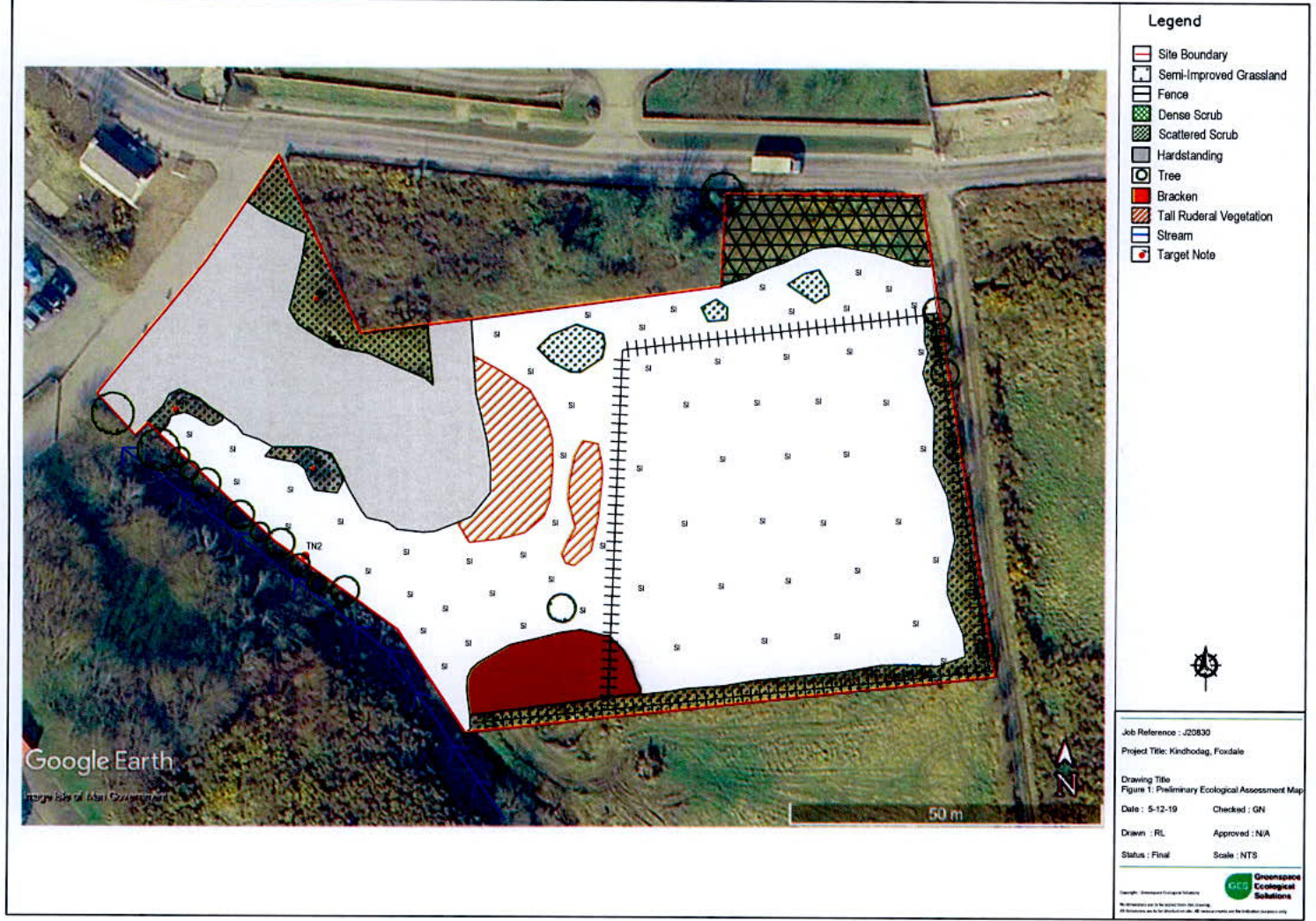
Legend Site Boundary Bank Improved Grassland Fence Dense Scrub Scattered Scrub Hardstanding Tree Bracken Fall Ruderal Vegetation Steam Target Note
Copyright in submitted documents remains with their authors. Request removal
