Loading document...
Written Representations {{table:484760}}
Consultations
| Close Ny Mona, Bernahara Rd, Glen Duff, Lezayre | Supports the Proposal |
| Glen Duff House, Glen Duff, Lezayre | Supports the Proposal |
| Laurel Mount House, Glen Duff, Lezayre | Interest expressed - no objection |
| Glenduff Farm, Glen Duff, Lezayre | Supports the Proposal |
THE APPLICATION SITE AND PLANNING APPLICATION
The application site comprises the Curtilage of two semi-detached dwellings. Firstly, Sycamore House (formerly known as Laurel Mount Cottage) & also a Bungalow, which adjoins Sycamore House by a linked walkway lounge (forming the commercial area known as Lezayre Tearooms/Café Rosa. Located on the northern side of Lezayre Road in the Glen Duff hamlet of Lezayre. The site is almost directly opposite the Department of Transport's Glen Duff work depot.
The planning application seeks approval in principle for the erection of two traditional replacement dwellings, with permission to re-site on the grounds of environmental, visual and amenity improvements, further detail of which is enclosed.
| Consulttee: | Highways Division |
| Proposal Notes: | Existing Separate Entrances with increased visibility/safety splays |
| Consulttee Notes: | Awaiting comment |
| Consulttee: | Lezayre Parish Commissioners |
| Proposal Notes: | Replacement of two existing parish-rated dwellings, more traditional style |
| Consulttee Notes: | Awaiting comment |
| Consulttee: | M.E.A, Water, Gas |
| Proposal Notes: | Re-routing supply, close proximity to existing & separate supplies. TBC |
| Consulttee Notes: | Awaiting comment |
The application site and surrounding land has been the subject of a number of previous planning applications, two of which are suggested may be specifically material to the assessment of this current application:
PA 08/00055/A - Sought approval in principle for the erection of a replacement 'gentleman's residence' dwelling with ancillary buildings (one main house \& one linked guest cottage). This application was approved in principle subject to reserved matters \& design.
Planning application 09/00486/LAW sought a Certificate of Lawful Use of a bungalow extension as a separate dwelling. The submitted application contained evidence sufficient to demonstrate that the building and associated residential Curtilage as defined in red on the location plan and file drawing no. DP1962 date stamped the 24th March 2009 had been used as a separate dwelling, known as The Bungalow, for a period of time in excess of ten years. Further clarified by a site plan produced and signed by the Department on 1/7/09.
N/A Written Representations, see P. 1
In terms of land use currant designation, the application site is not designated for any site specific purpose under the 1982 Development Plan Order, with part of the site comprising white land and part private parkland. There is a long established use of the land as both a site of residential occupation and commercial usage.
The application site is located within a general wider area of land that is classified as being of high landscape value and scenic significance. This designation was challenged by Independent Inspector R.S Hawthorn in PA 02/01048/A - on appeal. Who stated, "Point 10: The designation of the locality as being of High Landscape Value and Scenic Significance was difficult to reconcile with the Glen Duff Highway Depot opposite, which was not only visually intrusive, but floodlit at night, and a source of noise and heavy traffic movements. In contrast, the proposed would be well screened from the highway, and inconspicuous in the countryside".
Arguably, 'Previous Developed Land' General Policy 3 (c) - see annotated Site Plan \& Scheme 2 for clarification, definition \& qualification on this point.
In terms of strategic plan policy, the Isle of Man Strategic Plan contains a number of policies that, as Applicants, we considered may be specifically material to the assessment of this current planning application:
General Policy 3 states: "Development will not be permitted outside of those areas which are zoned for development on the appropriate Area Plan with the exception of: (a) essential housing for agricultural workers who have to live close to their place of work; (Housing Policies $7,8,9$ and 10 ); (b) Conversion of redundant rural buildings which are of architectural, historic, or social value and interest; (Housing Policy 11); (c) Previously developed land which contains a significant amount of building; where the continued use is redundant; where redevelopment would reduce the impact of the current situation on the landscape or the wider environment ; and where the development proposed would result in improvements to the landscape or wider environment; (d) The replacement of existing rural dwellings; (Housing Policies 12,13 and 14); (e) Location-dependent development in connection with the working of minerals or the provision of necessary services; (f) Building and engineering operations which are essential for the conduct of agriculture or forestry; (g) Development recognised to be of overriding national need in land use planning terms and for which there is no reasonable and acceptable alternative; and (h) Building or works required for interpretation of the countryside, its wildlife or heritage."
Environment Policy 2 states: "The present system of landscape classification of Areas of High Landscape or Coastal Value and Scenic Significance (AHLV's) as shown on the 1982 Development Plan and subsequent Local and Area Plans will be used as a basis for development control until such time as it is superseded by a landscape classification which will introduce different categories of landscape and policies and guidance for control therein. Within these areas the protection of the character of the landscape will be the most important consideration unless it can be shown that: (a) the development would not harm the character and quality of the landscape; or (b) The location for the development is essential."
Environmental Policy 3 states: "Development will not be permitted where it would result in the unacceptable loss or damage to woodland areas, especially ancient, natural and semi-natural woodlands, which have public amenity or conservation value."
Housing Policy 12 states: "The replacement of an existing dwelling in the countryside will generally be permitted unless: (a) the existing building has lost its residential use by abandonment; or (b) The existing building is of architectural or historic interest and is capable of renovation. In assessing whether a property has lost its habitable status by abandonment, regard will be hard to the following criteria: (i) the structural condition of the building; (ii) the period of non-residential use or non-use in excess of ten years; (iii) evidence of intervening use; and (iv) evidence of intention, or otherwise, to abandon
Housing Policy 14 states: "Where a replacement dwelling is permitted, it must not be substantially different to the existing in terms of siting and size, unless changes of siting or size would result in an overall environmental improvement; the new building should therefore generally be sited on the "footprint" of the existing, and should have a floor area, which is not more than $50 \%$ greater than that of the original building (floor areas should be measured externally and should not include attic space or outbuildings). Generally, the design of the new building should be in accordance with the Policies 2-7 of the present Planning Circular 3/91, (which will be revised and issued as a Planning Policy Statement). Exceptionally, permission may be granted for buildings of innovative, modern design where this is of high quality and would not result in adverse visual impact; designs should incorporate the re-use of such stone and slate as are still in place on the site, and in general, new fabric should be finished to match the materials of the original building.
Consideration may be given to proposal which result in a larger dwelling where this involves the replacement of an existing dwelling of poor form with one of more traditional character, or where, by design or siting, there would be less visual impact."
This application seeks approval in principle for the erection of two replacement detached dwellings with replacement garages and reasoning for resited footprints. All drawings and images forwarded should be viewed as illustrative, given the type of planning application, however our stated aim is to construct two appropriate family homes with the minimum $4 / 5$ Bedrooms standard of size dictated by the finer, Lezayre Road Country House.
Whilst the images submitted may indicate to some, design cues common to 'show houses', be assured, it is our aim as applicants, only to construct 'family homes', albeit of high quality, locally appropriate to the premium nature of Lezayre Road properties in proximity. However, It remains the case that this planning application seeks approval in principle, not full planning approval. As such, the specifics of actual size (other than indicative), and ultimate design are not matters to be specifically examined as part of the assessment of this application.
Given that it seeks approval in principle the assessment of the planning application primarily requires an examination of the relevant planning policies contained within the Isle of Man Strategic Plan 2007. In terms of this, it can be seen that the erection of replacement dwellings are fundamentally acceptable under General Policy 3 and Housing Policy 12.
The two Replacements for 'Sycamore House' \& 'The Bungalow' are to be Manx Gentleman's Farmhouses. They qualify for larger than $50 \%$ consideration, by meeting ALL the criteria of HP14 and significantly adhering to the policy outlined in the last paragraph of HP14, otherwise referred to in other Planning Officer Reports as the 50\% 'exemption criteria'.
WHERE THIS INVOLVES:- "...The Replacement of an existing dwelling of poor form" (yes, our proposal has two existing dwellings of surveyor certified poor form) "...With One of a more Traditional Character" (yes, our proposal of two replacements will be vastly more traditional, than an 80's bungalow and poor form felt-roofed-extended cracked house.) "...Or where, by its design, or SITING, there would be less visual impact" (yes, by design, the visual impact of the proposed, would be far less than the existing ugly form and unorthodox shapes. Yes, by RESITING to new footprints, well below the Lezayre road, at the lowest, northerly areas of the site, visual impact would be substantially lessened and maintained by foliage planting) Furthermore, consider the following evidence illustrating the Visual and Environmental Impact of the two dwellings existing close proximity to the Glen Duff Highway Depot, and how the site meets all the criteria stringently for resiting to lessen the Depot's Visual and ENVIRONMENTAL Impact on the amenity and wellbeing of the current dwelling occupants.
Currently, the existing site of the two dwellings, incurs significant noise pollution directly from the Depot opposite. Notably audible reversing beep alarms \& invasive, repeating human voice 'speaking alarms'. Furthermore, strong vibration occurs to the existing dwellings from the nearby Depot, on numerous occasions, for example: when loading salt into snow ploughs, or vigorous vibrations sourcing from the compressor (which distributes the salt). Heightened vibrations are experienced to the existing dwellings when the heavy Salt Lifter-Loader is in operation. This is aside from the fleet of Road-Vacuum Sweepers creates additional disturbance, along with the testing of pneumatic drills and other new, noise-intensive equipment, \& the loading/unloading of road maintenance equipment from flat-bed lorries. (Road rollers, JCB's ect...) See Photo Evidence* In resiting each replacement dwelling, by moving each new building further back from the Depot, each to a new central position within the sites curtailage, a vast improvement will occur to the amenity of the replacement dwelling occupants. This will be further aided by the replacement dwellings improved build quality and installation of noise-reducing insulation.
As stated, the two, existing dwellings incur distinct tremors from the HGV's in the Depot opposite. This scope for structural damage is further increased from the frequent passing-by of other non DoT HGV's at speed on the Main A3 Highway, particularly as this road serves to transport significant freight from the Ramsey Shipyard Port. For these reasons, and those highlighted directly above, (detailing the activities of the depot) the main structural integrity of both dwellings has already been severely compromised over a sustained period of years, as is only to be expected from their present position and lack of foundations.* see surveyors report In resiting each replacement dwelling, by moving each new building further back from the Depot \& proximity to the Highway, the strong likelihood of structural damage to the replacement dwellings will greatly decrease in their new positions.
The opposing Glen Duff Depot is lit 24/7 for work and security reasons, with intense halogen lighting in the vehicle yard. In winter especially, the intensity of light is increased significantly with further floodlighting and the main headlight beams \& flashing orange HGV lights of numerous duty vehicles, snow ploughs \& large road salting vehicles. By resiting the replacement dwellings with a side elevation (instead of front) towards the Depot, and moved into the centre of each acre plot, this floodlit pollution will decrease significantly, an outcome benefiting both the Depot and their neighbours opposite, (the proposed dwelling occupants).
The replacement dwellings will replace ugly facades, with attractive, Manx country vernaculars. This would improve the overall appearance atheistically, of Glen Duff hamlet. With the resulting traditional appearances, far more in keeping with the Isle of Man Strategic Plan and the spirit of Circular 3/91. The public amenity value (walkers on pavement, passing vehicles) would increase from a more traditional semi-rural streetscape, otherwise blighted by the unattractive Highway Depot and the two currently existing poor-form dwellings.
The 80's extended Bungalow-Style House, The Poor form Sycamore House, and it's linked commercial extension (currently used as a Restaurant) will become fine traditional Manx Country Dwellings, consequently, the flat, feltroofed Restaurant Facility will be demolished \& removed from view. This would result in the ceasing of an intensive commercial use in this area, otherwise characterised by traditional semi-rural parkland dwellings. This would include the ceasing of a Professional Catering Kitchen, with the notable odours emissions from extensive food preparation, and the additional rubbish and waste that is created, contained and disposed of in this vicinity. Most importantly however, would be an end to the extensive public car park to the right to the property, which whilst used when the restaurant is in operation, is also used out-of-hours, by members of the public to park answer mobile phones, turn vehicles around, or allow dogs to 'relive' themselves, visitors to neighbouring properties with little parking have also commenced inappropriate use of the car park. This car park is not a 'public' one, and although we indicate as such, it would be of great benefit to build the previously approved gates (PA 08/00055/A) for the proposed replacement dwelling
The Bungalow and Cottage are in close proximity to a DAFF protected Sycamore (the only tree DAFF are interested in, on this site - all others, canopies, and proposed new trees meet guidelines). The Bungalows Kitchen gable is the closest. During Winter storms, the wind broke off large branches of this ancient Sycamore, which crashed through the roof of a large workshop at the tree's foot (this forms the site of the 'concrete base'), thankfully nobody was in the workshop at the time. Therefore, it is potentially dangerous to shelter in the nearby Bungalow (underneath the trees canopy-which the replacement dwelling would NOT be) during winter high winds/storm, as the enormous branches may fall and cause damage to property, and injury to the occupant. The resiting moves the dwellings further away from this potentially serious risk, but in doing so, allows the tree more room to flourish with professional assistance. Furthermore, resiting would permit us to remove an unsightly concrete slab base that protrudes alongside the tree. All things considered, further environmental and visual improvements through resiting, with the preservation of the Tree in conjunction with DAFF guidance.
In respect of other planning policy matters it may be considered necessary to access the proposal against Environmental Policy 2 as the application site is located within a wider areas of land that is classified as being of high landscape and scenic significance. In this respect, it is submitted that the character and quality of the landscape need not be unduly harmed by the erection of the two replacement dwellings. Especially as the application site already contains both residential, commercial and other built development, including a redundant concrete slab from a former Cabinetmakers Workshop and Concrete HGV Inspection ramps etc. The specific impact of any development would be an issue to examine as part of any subsequent reserved matters application. As regards the sites inclusion in the designation of HLVS, as previously stated, this designation was challenged by Independent Inspector R.S Hawthorn in PA 02/01048/A - on appeal. Who stated, "Point 10: The designation of the locality as being of High Landscape Value and Scenic Significance was difficult to reconcile with the Glen Duff Highway Depot opposite, which was not only visually intrusive, but floodlit at night, and a source of noise and heavy traffic movements. In contrast, the proposed would be well screened from the highway, and inconspicuous in the countryside".
In any event, there are no particular reasons why a replacement dwelling could not be erected that suitably takes account of the trees contained within the site, a comprehensive survey of which, is shown on the site plan. Furthermore, comprehensive measures to protect the sole registered tree (the Sycamore) on site, will be untaken, and the proposed creates additional distance between each dwelling and tree. Reducing the close proximity of the current dwellings.
The Proposal can be undertaken in a manner that accords with the relevant planning policy contained within the Isle of Man Strategic Plan 2007. It is therefore presented to the Planning Officer, the Planning Committee and all interested parties, that, after their own assessments, this application be favourably considered for a decision.
We trust the above have proved useful to you, in determining whether you can lend your support to the proposed.
Respectfully,
Mr. Bob Phillips Mrs. Rosa Phillips
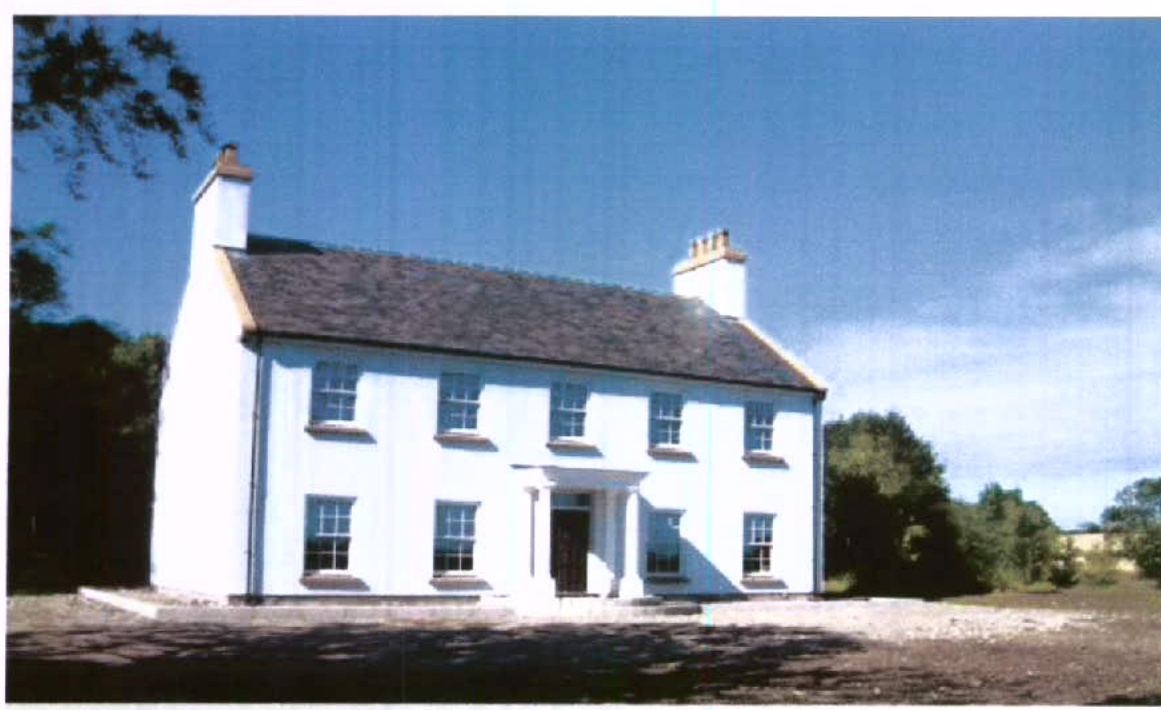
Orchard Cottage, Oatlands Rd, Andreas. Former small, poor form dwelling. Built Under HP14 Exception Criteria for a larger Dwelling over 50% Rule.
The same circumstances & standard model that this Proposal follows.
Copyright in submitted documents remains with their authors. Request removal
