1.1 The application here is a revised scheme that follows on from the recent planning appeal for PA/20/00605/B.
1.2 The appeal was dismissed in March 2023 following a hearing.
1.3 The reason for refusal:
1.4 As is clearly outlined within the reason above, it HAS been demonstrated that the use of the building as a public house/hotel is no longer commercially viable and cannot be made commercially viable. Therefore it MEETS commercial policy 4 of the Strategic Plan which is the only reason for refusal in the first instance prior to the appeal.
1.5 Please note: This application is similar to the above application 20/00605/B including the previous supporting statement barring the specifics outlined below which superseed. With this in mind, we request the Planning Officer and other Departments refer back to the previous planning statement and more so the appeal information is considered within this application to save repetition and confusion.
2.0 Proposal
2.1 Full Planning Approval is sought for the demolition of the existing Waterfall Hotel and erection of 4 terrace dwellings in it's place with associated parking and amenity space.
2.2 The proposed terrace dwellings would be set over three floor levels but with a minimal height increase of 0.8 metres with the upper floor being located within the roof space.
2.3 Each dwelling would house 3-4 bedrooms, living space and integral garage and be approx 129m2 internally each.
Key Policies for the Proposal
Below are the key Strategic Planning Policies that have been reviewed and taken into consideration during the creation of this proposal.
The application site is within an area recognised as being an area of “Residential/Woodland” under the Isle of Man Development Plan Order 1982. The site is not within a Conservation Area; nor within an area zoned as High Landscape or Coastal Value and Scenic Significance.
General Policy 2
General Policy 2 contains some useful wording: "Development which is in accordance with the land-use zoning and proposals in the appropriate Area Plan and with other policies of this Strategic Plan will normally be permitted, provided that the development:
(b) respects the site and surroundings in terms of the siting, layout, scale, form, design and landscaping of buildings and the spaces around them;
(c) does not affect adversely the character of the surrounding landscape or townscape;
(g) does not affect adversely the amenity of local residents or the character of the locality;
(h) provides satisfactory amenity standards in itself, including where appropriate safe and convenient access for all highway users, together with adequate parking, servicing and manoeuvring space;
(i) does not have an unacceptable effect on road safety or traffic flows on the local highways".
Strategic Policy 1
Strategic Policy 1: "Development should make the best use of resources by:
(a) optimising the use of previously developed land, redundant buildings, unused and underused land and buildings, and re-using scarce indigenous building materials;
(b) ensuring efficient use of sites, taking into account the needs for access, landscaping, open space and amenity standards; and
(c) being located so as to utilise existing and planned infrastructure, facilities and services."
Strategic Policy 2
Strategic Policy 2: "New development will be located primarily within our existing towns and villages, or, where appropriate, in sustainable urban extensions of these towns and villages. Development will be permitted in the countryside only in the exceptional circumstances identified in paragraph 6.3."
Strategic Policy 3
Strategic Policy 3: “Proposals for development must ensure that the individual character of our towns and villages is protected or enhanced by:
(a) Avoiding coalescence and maintaining adequate physical separation between settlements; and
(b) having regard in the design of new new development to the use of local materials and character.”
Housing Policy 14
Housing Policy 14: “ Where a replacement dwelling is permitted, it must not be substantially different to the existing in terms of siting and size, unless changes of siting or size would
result in an overall environmental improvement; the new building should therefore generally be sited on the “footprint” of the existing, and should have a floor area, which is not more than 50% greater than that of the original building (floor areas should be measured externally and should not include attic space and outbuildings)”.
Community Policy 4
Community Policy 4 - “ Development (including the change of use of existing premises) which involves the loss of local shops and local public houses, will only be permitted if it can be demonstrated that the use is no longer commercially viable, or cannot be made commercially viable.
3.0 Why can't business continue for the Waterfall Hotel?
3.1 The below are overall comments but to reiterate, the appeal findings confirmed that it had been demonstrated that the use of the building as a public house/hotel is no longer commercially viable and cannot be made commercially viable. Therefore it MEETS commercial policy 4 of the Strategic Plan which is the only reason for refusal in the first instance by the planning department and planning committee prior to the appeal.
3.2 Multiple attempts have been made over the years to make the business work but have been unsuccessful. These have been at a considerable cost to the applicant.
3.3 The catering industry be it food, drink or both has taken a different route over the last 10 years, especially after the last recession. On top of this awareness has been given in a very positive way to the risk of drink driving.
3.4 The public are not going out as much now for the sake of it to eat and drink due to the above reasons. Rising costs are meaning people stay at home more and if they do go out it is to one of the main hubs for ease of getting home. Peel is the closest location for this and as can be seen, public houses and restaurants are flourishing their due to the ease of access. Unfortunately people are not going to commute out to Glen Maye when there are closer
locations. It could be said the industry is over populated.
3.5 The Waterfall Hotel used to flourish due to the greater flexibility there used to be in the past. Competition from premises in Peel has been deemed impractical to keep up with.
3.6 The community of Glen Maye would probably argue the above and will state that a community facility is being removed. However it is deemed that only a small percentage of local residents would utilise the Waterfall Hotel as was the case with the previous attempts to run and would also not allow for a successful business to be run given the small population of the area. This in conjunction with point 3.3 creates the unfeasible situation. The village of Glen Maye is not of a sufficient size to sustain a public bar in high or low season 7 days a week and is not on a well used thoroughfare so as to generate passing trade.
3.7 Surrounding businesses have closed through the years for similar reasons. These include the old cafe, the shop which has been given permission to change to tourist accommodation, and the old post office.
3.8 The Liverpool Arms has closed it's doors to the public which is very similar to the Waterfall Hotel. Not a local position but with surrounding dwellings. However it shows a sign of the times and how public houses/hotels are not being utilised enough to continue business. The same can be said for the Ballacallin Hotel in Dalby that has recently been demolished, Close Leece Farm and ConRods coffee shop in the centre of Ramsey Town Centre to name but a few.
3.9 Comments have been made in previous applications by the public that the applicant was a typical Isle of Man based property developer out to make a quick buck. This is not the case at all which is evident by the multiple years trying to make a go of the business. The applicant has multiple high profile trading companies employing circa 60 people on the island. A lot of these companies are in the hospitality sector and has been a backbone of the business for many years.
3.10 The applicant owns a portfolio of properties leased to trading companies, all of which generate jobs on the island.
3.11 Many years have been invested in attempting to make a success of the current business. Trading losses of over £200,000 have accrued and that is as stated above from someone with vast experience within the industry.
4.0 Why can't the existing hotel be renovated and converted?
4.1 The below are overall comments but to reiterate as per 3.1 above, the appeal findings confirmed that it had been demonstrated that the use of the building as a public house/hotel is no longer commercially viable and cannot be made commercially viable. Therefore it MEETS commercial policy 4 of the Strategic Plan which is the only reason for refusal in the first instance by the planning department and planning committee prior to the appeal.
4.2 The existing hotel has been empty and vacant for over five years. This follows multiple attempts to run the business successfully.
4.3 This has led to the building slowly creeping into a state of decay. It is of original construction with stone external walls, render finish and slate roof. Given time on their own these buildings start to feel the severe effects of damp. It would require a considerable financial investment to do this.
4.4 The existing building would have to be carefully stripped right back to the bare external walls. From brief inspection, at least the internal walls, floors and roof construction are not up to current Building Regulation Standards if converted.
4.5 The existing would need considerable investment to get up to standards, especially from a thermally efficient perspective. Upgrading the insulation to the building would generally involve constructing secondary stud walls internally which would encroach on the existing floor area and take away from the usable floor space.
4.6 Conversion to one dwelling is not feasible due to the investment already put into the site and the additional investment needed to renovate. A single property would not be valued high enough to cover this.
4.7 Due to the current layout it would be required to construct a new extension onto the rear of the existing that brought it up to two storey's in height to create sufficient floor space to convert into dwellings. From reviewing, any extension to the rear would have to be similar to the proposed. However the work involved would be considerably more to tie in with the existing, create more disruption to the surroundings and also create something that was not as efficient and had a limited lifespan.
4.8 The existing whilst in a prime position at the start of Shore Rd, has minimal architectural value. Asymmetrical chimneys, uPVC windows and rooflights. The rear as stated is an amalgamation of bad design and does not have any intrinsic value.
4.9 The proposal would create dwellings that far exceeded the U-value requirements set out in the Building Standards. They would be thermally efficient and work alongside modern energy systems to completely minimise energy consumption both electrical and heating. This would not be achievable with a conversion of the existing.
4.10 Cost involved to convert or build new would be very similar. Buyers of course would have to undertake regular maintenance on the converted option. Typically, 10 year warranties are supplied with new homes which is important for potential buyers.
4.11 Through the above thought processes it is deemed that demolition and construction of new would be the most practical, feasible and efficient for both applicant, surroundings and potential purchasers.
4.12 The owner/applicant has struggled greatly to get public liability insurance for the building given its condition. It has been renewed during the previous application at the last minute from an off island insurance broker as no on island company would insure the building. The longer it is left the greater the risk becomes of it not being insurable and becoming a safety
issue.
5.0 Parking
5.1 Parking proposal remains as per previous application 20/00605/B.
5.2 Each of the 4 dwellings will have 2 parking spaces within the car park that the applicant owns.
5.3 The car park layout will be slightly altered for the proposal and have 40 spaces in total. These spaces will be to current sizing standards which cannot be said for the existing 45-47 spaces that are on the smaller side.
5.4 Covered by deeds, the car park is solely for use by the patrons of the Waterfall Hotel and visitors to the Glen Maye National Glen. A large sign is present within the car park that states this.
5.5 The two spaces per dwelling meets the space requirement outlined in the Isle of Man Strategic Plan 2016.
5.6 The deed covenant would still be in place for visitors to the National Glen to have use of the car park.
6.0 Alterations/Additions from previous applications
6.1 The dormer windows that were the only reason for the dismissal of the planning appeal have been omitted from the dwellings front elevations.
6.2 Conservation style rooflights are proposed to the front elevation in place of the dormer windows. These will have minimal impact on the surroundings and respect the surroundings via the conservation style.
6.3 It is proposed that the dwellings are highly energy efficient.
6.4 The dwellings will be heated and powered via electric. This will be in the form of solar panels and battery store.
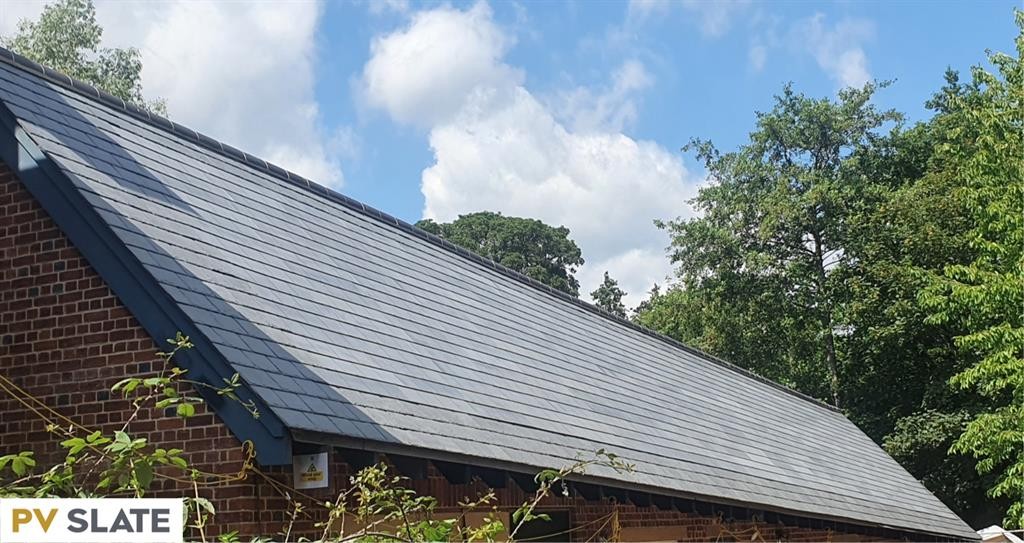
6.5 The front (South) elevation roof will have slate solar panels installed. These as can be seen in the image below are slate in aesthetics and are pleasing to the eye.
6.6 The rear lower garden area will have ground mounted solar panels installed directly behind the upper garden area wall. These will gain maximum south solar gain whilst not being visible to the surroundings. Possible manufacturer information is supplied with this planning application.
6.7 Highly efficient electric radiators will be installed alongside a thermal battery store which will heat up the water on demand directly from the solar panels.
6.8 The dwellings will be connected to the main grid but it is anticipated that the panel installation alongside the high level energy efficient construction methods will keep this
requirement to a minimum.
6.9 The above implementations are working alongside the Government and Net Zero climate change plan that by January 2025 it will be illegal to install fossil fuel products into new dwellings.
6.10 For this application, the storage building linked to the neighbouring Waterfall Cottage is not included in the proposal. This building will remain in place and will allow for no impact to occur to the neighbouring property including structurally and noise wise which have both been a concern in the past by the neighbour.
6.11 Refuse storage as per the proposed drawings will be to the front of each dwelling in a bin store to hide them from public view but be accessible upon refuse collection. These can be moved to the end of the pathways for collection.
6.12 A condition is proposed taking into account the appeal findings whereby a bat survey is to be undertaken and supplied to the relevant departments prior to any demolition taking place. Mitigation scheme to be submitted in the event of bats being present and approved in writing prior to any demolition.
6.13 As per appeal requirements, close boarded fencing to the boundary with Glen Close has been omitted. It is proposed the existing treatment remains along with additional native planting. This is outlined on drawing 20141 – PL02.
6.14 As required by the Department, material samples can be supplied for approval prior to any construction taking place.
6.15 A condition is proposed taking into account the appeal findings whereby a written/drawn scheme for the protection of all existing boundary vegetation shown as being retained to be submitted to and approved in writing by the Department prior to construction taking place.
6.16 It is proposed that the foul drainage from the dwellings runs out to the front onto Shore
Road and tap into the existing foul sewer running down the road.
6.17 A full percolation test will be undertaken at Building Control stage with the aim to separate the foul from the surface drainage to reduce the inflow to the main sewer.
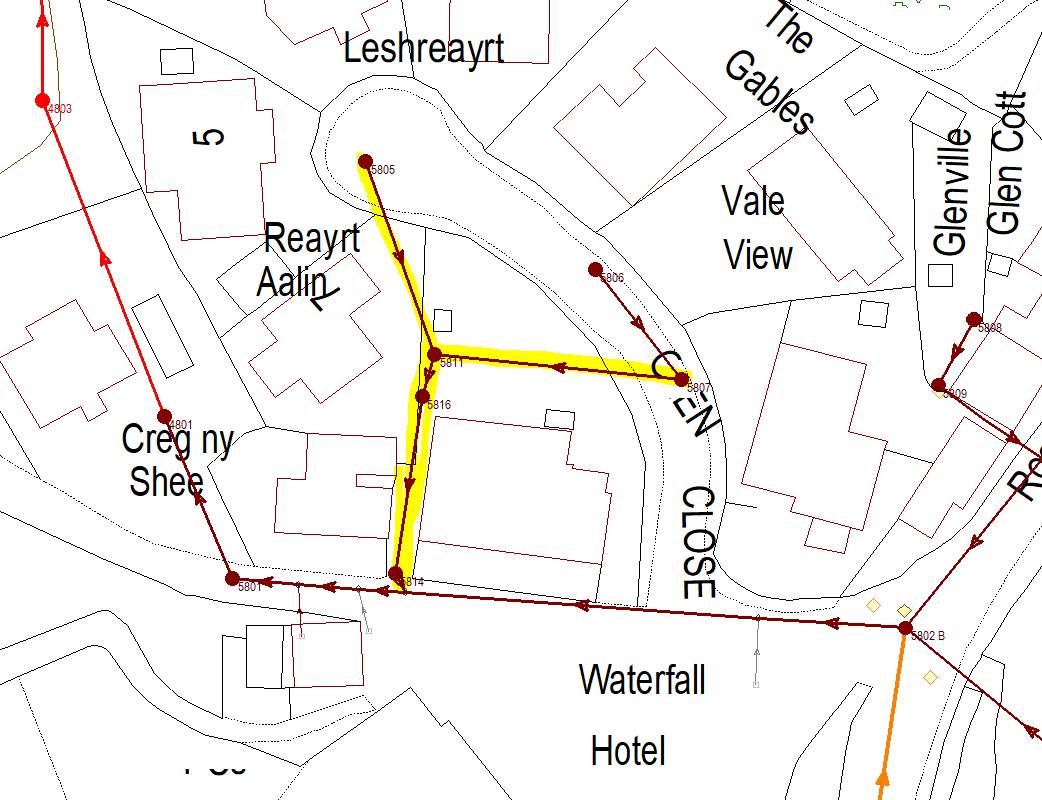
6.18 From research it has been found that a public sewer line runs approximately half way across the back amenity area of the terrace site and down the West boundary next to the neighbouring property Waterfall House. This sewer run picks up the drainage from the properties to Glen Close. Below is a snapshot of this.
6.19 All building works undertaken within 3 metres of this sewer line running through the site would be undertaken via a build over agreement with the Isle of Man Drainage Authority.
Conclusion
It should be considered that the proposal can be viewed favourably when assessed against
A site plan showing the location of the Waterfall Hotel and surrounding properties like Creg ny Shee, with highlighted boundaries and survey points.
each of the key criteria. Provisions have been made from the Development Plan with strong regard for Strategic Plan Policies:
- General Policy 2
- Housing Policy 14
- Strategic Plan 1
- Strategic Plan 2
- Strategic Plan 3
- Community Policy 4
As described in this Planning Statement, it is felt that the proposal complies with the Policies outlined above.
Copyright in submitted documents remains with their authors. Request removal
Source & Provenance
Official reference
23/01029/B
Source authority
Isle of Man Government Planning & Building Control