Loading document...
Market Square & The Parade, Castletown
March 2014
Client's Supporting Statement 2 Landscape Architect's Supporting Statement 3 Market Square - Flexible Use Diagrams 4 Masterplan 6 Proposed & Existing Image Comparisons 7 Hard Landscape 16 Hard Landscape & New Tree Pit Treatment 17 Treatment to Existing Retained Trees 18 Street Furniture & Way-finding 19
The Castletown Regeneration Committee has been developing proposals for submission to the Chief Ministers Regeneration Steering Group since 2009. Ashley Pettit Associates and Fritha Costain were appointed in 2010 to undertake a consultation with the public and stakeholders and to draw up concept proposals for regenerating Castletown. The extensive consultation included on line surveys, face to face interviews, focus groups and evening meetings and resulted in overall concepts being developed.
Following this initial consultation and overall concepts, the concepts were developed into outline projects and agreed for further consultation. The outline projects were focused around improving links to Castletown centre, shared spaces for pedestrians and cars, pedestrian routes, parking and environmental improvements. The outline projects were exhibited in the Commissioners Offices during September 2011 and feedback invited. There was strong support for the outline proposals. Following the exhibition the sketch proposals were modified in light of public comment. A Consultation Report was compiled giving the detail of the consultation and the summarising the feedback.
A presentation on the feedback from the Exhibition was given the Committee and they agreed to recommend a number of the potential projects including a Parking Study to the Chief Minister's Regeneration Steering Group. The prime elements of the proposals were to improve the Market Square as a shared area, to improve the pedestrian links from the Square to the main car parks and coach stop and to the Quayside through Castle Rushen Precincts. The Chief Ministers Regeneration Steering Group agreed to progress the proposals and to use the George Lane Link to the Farrants Way Car park/Coach park and the pedestrian link as the Pilot scheme for the regeneration. The detailed design of this Link would frame the detailed design for the Market Square.
Market Square forms the main Regeneration scheme for Castletown and the Castletown Regeneration Committee has been keen to strike a balance between creating a public square which delivers improved accessibility and open space for pedestrians whilst maintaining flexible parking provision within the town centre.
This scheme has been agreed by the Castletown Regeneration Committee. The Committee felt that it will give the Square an enhanced appearance, better provision for pedestrians and improved open space for events whilst still offering parking in a flexible format. It will strengthen the link to the coach park via the enhanced George Lane scheme and will improve the setting of Castle Rushen.
George Lane Pilot Project [completed November 2013]:
The Coach Parking Area off Farrant's Way has been re-surfaced and the edge with the road defined better. Way-marking, improved lighting and high quality stone paving provides a much better impression and leads pedestrians and coach visitors through to the Market Square and the Town.
Market Square and key adjacent link routes:
Although surrounded by high quality buildings of great historical value, the quality of the Public Realm is poor, with large areas of tarmac not befitting such an important site. The parking layout pushes pedestrians to the edges of the space. There are a number of interesting features within the Square, such as the Smelt Monument, Suncial and the War Memorial – but these are visually lost amongst the cars and tarmac. The current arrangement of bollards and street furniture particularly clutter the link from the square to the main shopping areas.
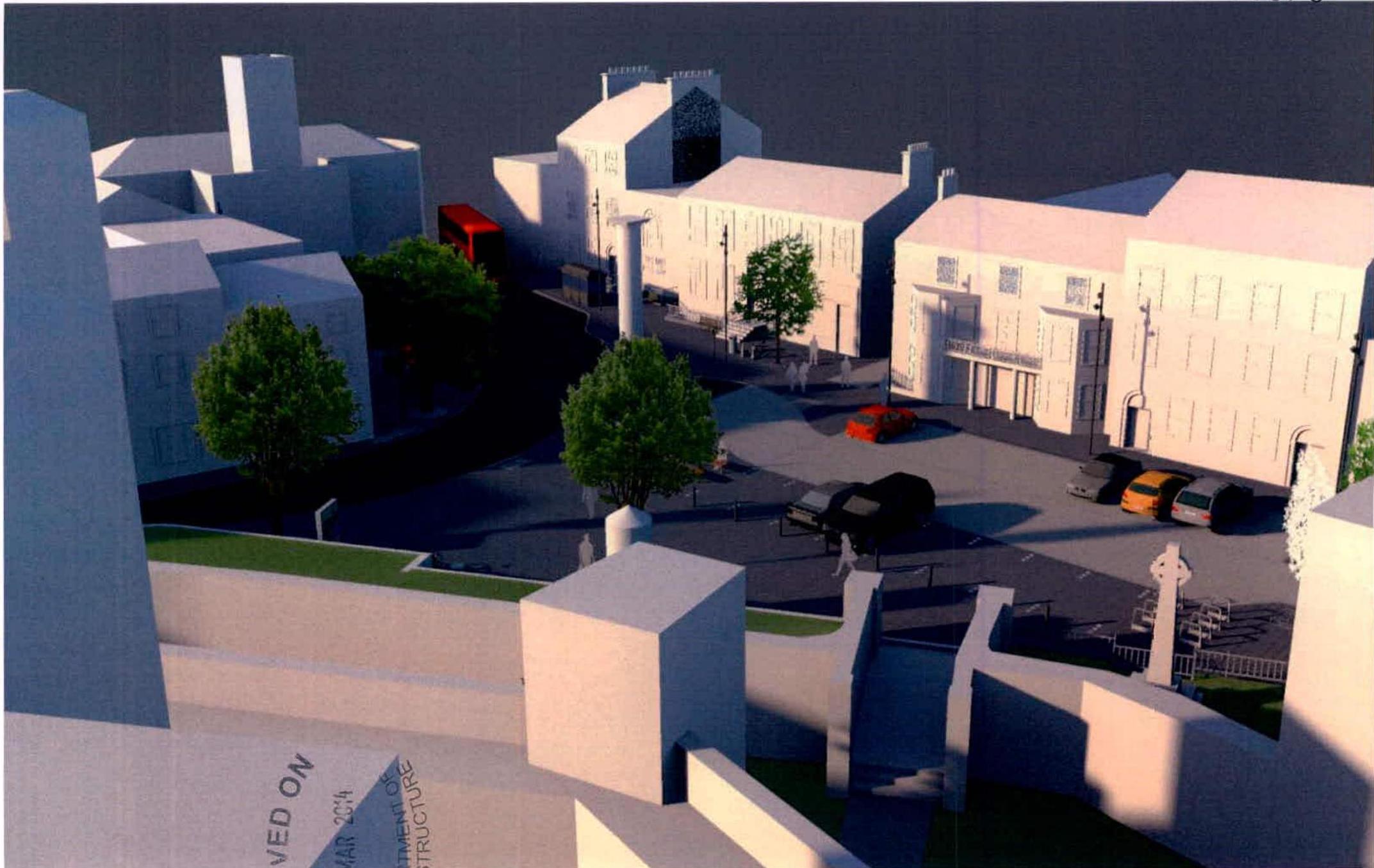
There is incredible potential to create a high quality public realm that celebrates and positively frames surrounding buildings, including Castle Rushen and existing landscape features such as the Smelt Monument. A single level stone paved square could be designed that has the flexibility to be used for events and celebrations, but also can accommodate day-to-day use for some short stay parking, service access and people on foot shopping, working and visiting Castletown. There is also potential to connect the Square better with the adjacent shopping streets, The Parade, The Civic Centre, Parliament Square and in turn parking and links beyond.
The team explored a number of options for Market Square presented these to the regeneration committee and client – outlining the general approach and intent with accompanying plans and visuals.
On the basis of positive feedback at these committee meetings the committee wish to proceed with a detailed design which retains the majority of [short-stay] parking bays within the Square [17 of the 23 bays currently in Market Place] whilst re-configuring the layout to minimise the area of space taken up by cars [parking and servicing] and maximise the positive pedestrian environment. With the new layout and use of removable street furniture [bollards – seats etc] greater flexibility can be achieved by the space for small, medium or larger events with various options for different levels of parking and servicing retained.
The Committee requested that the main area of the Carlow stone paved square was designed on a single level so that the design has the flexibility to be used for events and celebrations, but also can accommodate day-to-day use for some short stay parking, service access and people on foot shopping, working and visiting Castletown. A kerb has been retained between the permanent parking bays and the adjacent footpath running alongside the buildings. This is to prevent cars encroaching on the areas with cellars near the building.
In addition to this The Castletown Commissioners are currently in the process of remarking reserved parking bays in the George Lane Car Park [with 10 new short stay bays created for use by the general public] and re-designating them as short-stay parking. The newly completed successful Pilot Project in George Land provides a positive short link between here and the Square.
The existing service access drop-bollard system will be retained and it's surroundings improved [e.g. plethora of unsightly bollard clutter and 'dead-space' behind replaced with new trees and seating].
The Parade's current traditional arrangement of tarmac road and paved pedestrian footpath is retained as this is a busy vehicular through-route including buses. However, the environment is improved with new street furniture, lighting, stone kerbs [inc. dropped kerbs and tactile paving at key points] and paving on the footpaths and a new wearing course for the road.
The bus stop on the eastern side of The Parade has been moved closer to the southern end of the space allowing the shelter to be positioned closer to where the bus door comes to a stop.
Alnus glutinosa have been specified due to their proven resilience in coastal situations as well as its suitable possible full size once mature.
In total there are currently five new trees proposed for Market Square and The Parade. Four of these are situated at the northern end of Market Square and the fifth is in the public realm outside the post office. All four of these new trees will have the same tree pit detail that utilises a recessed tree grille to allow the paving to be laid up close to the tree trunks.
The design of the tree pits for new trees includes a root cell structure system which allows trafficked hard landscape to be installed right up to the tree trunk without causing any compaction around the new tree, allowing its roots to grow in a much larger volume of unsompected soil. In time the benefits of this will be seen as the resulting tree will be larger and more drought tolerant as it will have a much more developed, spreading root system.
The tree pit grille that has been selected (Greenleaf Castle 15B OEA) allows the paving to continue through as it is constructed using recessed trays. When the tree reaches a certain size, the inner two trays can be removed, allowing the tree more space. At this point new resin bound aggregate can be installed around the trunk and up to the now wider space left in the centre of the frame. In addition to the root cells and tree pit grille are various elements that aid the establishment of the trees. The tree anchor system prevents the root ball from moving and allows stronger root growth; there are a couple of irrigation loops that allow for watering of the tree both at a young and mature age; root barriers prevent roots from spreading into areas that they are not wanted such as services, drainage and foundations.
All existing mature trees are retained and these will have a new resin porous bound aggregate finish installed around their bases which is retained by a radius kerb before the stone paving continues. This will be an improvement on the existing situation for the trees as more water will be able to drain directly through the surface around the tree bases.
The removal of two existing trees near to the automatic bollards has been proposed. These two specimens are of relatively small size, are not distinctive specimens and don't currently provide significant landscape value. Due to their low quality they have been indicated to be removed but will be replaced with 4 new trees, 2 either side of the automatic bollard, that will be planted in tree pits that utilise a cell structure to prevent the volume of growing medium being compacted leading to fuller, healthier mature tree specimens. See drawings 53 (tree pit detail for new trees), 54 (tree pit detail for existing retained trees) and 56 (tree constraints plan) for detailed information.
No tarmac is to be used in the car parking areas. A preferred stone – Carlow – from Ireland was selected for the works and put forward to the client and regeneration committee for a number of reasons:
We are proposing bush hammered finish for kerbs/channels and mechanical finish for setts in the parking areas and flamed slabs for pedestrian areas.
New way-marking, street furniture [inc. new cycle rack provision] and lighting will help to create a universally safe and usable environment and in combination with the tree planting maximise the potential for the enjoyment of the space for everyone.
Copyright in submitted documents remains with their authors. Request removal
