Loading document...

Proposed Garage and Ancillary Room (Ancillary to Woodland Heights) Woodland Heights, Ashley Road, Onchan
Proposed Garage and Ancillary Room (Ancillary to Woodland Heights) Woodland Heights, Ashley Road, Onchan Prepared on behalf of: Mr and Mrs Millward
This Planning Statement has been prepared in support of a revised planning application for a single storey detached garage with attached garden room at Woodland Heights, Ashley Road, Onchan. The proposal represents a fundamental revision of an earlier scheme for a one bedroom ancillary dwelling. Following detailed feedback from the case officer, the applicants have withdrawn that approach and now seek permission for an ancillary garage and garden room building located wholly within the established curtilage of the existing dwelling and serving that dwelling only.
The statement describes the site and surroundings, explains the proposal, sets out the relevant policy context, summarises planning history, refers to comparable forms of development, and provides a detailed assessment of the scheme against the Isle of Man Strategic Plan 2016. It also responds directly to the officer’s earlier comments and demonstrates why the revised proposal is acceptable in planning terms and should be approved.
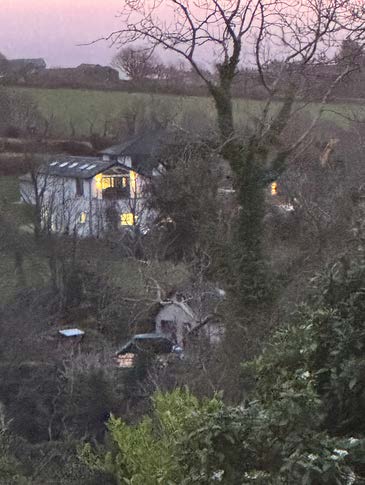
Woodland Heights is a substantial detached dwelling located off Ashley Road, east of the built up area of Onchan. It lies outside any development boundary and is therefore in planning terms within the open countryside.
The property is accessed from Ashley Road via a shared unadopted lane serving a small number of properties and terminating at the application site and associated stables. The lane is privately owned, is not heavily trafficked and is not a public through route.
The applicants’ landholding extends to several hectares and comprises:
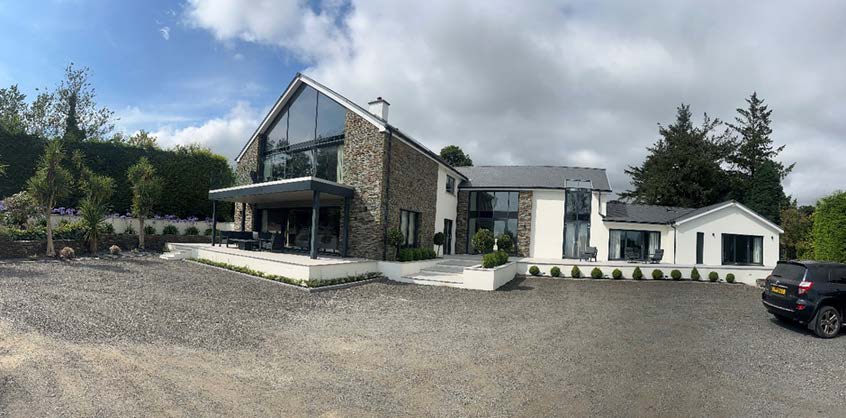
The main dwelling, Woodland Heights, a modern two storey house of contemporary design with a mix of smooth render, stone cladding and extensive glazing.
A stable block located within a field to the west of the main house.
Extensive grazing land and paddocks surrounding the domestic curtilage.
The south, east and west boundaries of the wider holding are heavily treed, with dense belts of vegetation screening views into the land. There are no public footpaths in the immediate vicinity of the site.
The nearest neighbouring dwelling, The Cottage, lies more than 70 metres to the north of the previous application site and is separated from Woodland Heights by intervening topography, planting and buildings.
Other properties such as Brownswood and houses on Maple Avenue are further distant, at approximately 110 to 120 metres.
The domestic curtilage of Woodland Heights includes an extensive rear garden that sits behind the main house. This rear garden area, which is the location for the proposed development, is entirely private and not visible from public vantage points or neighbouring properties due to the orientation of the dwelling and established boundary planting.
The existing dwelling is unequivocally non traditional in style and form. It reads as a contemporary design rather than any reinterpretation of a traditional Manx farmhouse or Circular 3/91 dwelling. The proposal is therefore set within the curtilage of a modern countryside dwelling rather than a vernacular property.
The site has a relatively modest but relevant planning history. The key permissions are: 16/00256/B – Alterations and two storey extension to dwelling (permitted). 15/01017/B – Erection of stable block in Field 531216 (permitted). 12/00165/B – Creation of new field access (permitted). 07/00802/B – Alterations and extension to the original dwelling (permitted).
More recently, an application was submitted for a modest single bedroom residential unit within Field 531216 to provide self contained ancillary accommodation.
That proposal was designed in a traditional stable like form and set within the field to the south of Woodland Heights. The case officer advised that, notwithstanding its modest scale and appearance, the scheme would be regarded in policy terms as a new dwelling in the countryside and that it conflicted with the Strategic Plan.
Following further correspondence and a site meeting, the officer suggested that if ancillary accommodation were to be pursued it should be located within the existing residential curtilage, preferably at the rear of the dwelling, and that any garage element should be subordinate and visually contained.
In light of that clear advice, and having further reviewed their needs, the applicants have chosen not to progress the stand alone ancillary dwelling. Instead they have completely re worked the scheme and now seek permission solely for an ancillary garage and garden room in the rear garden, capable of providing sleeping accommodation as and when required, while remaining ancillary to the main dwelling.
The revised proposal is for a single storey detached building incorporating:
A two bay garage providing two car spaces, together with storage and domestic workshop space to accommodate the applicant’s personal classic motorbike collection;
An attached open plan garden room, ancillary to the main dwelling, providing flexible domestic accommodation including hobbies, home office use and sleeping accommodation, together with a shower room, WC and kitchenette; and
An external covered area between the garden room and the garden to provide a sheltered outdoor seating and kitchen / BBQ area.
The garage element will provide secure parking for two vehicles together with dedicated storage and workshop space for the maintenance, storage and enjoyment of the applicant’s personal vehicles and classic motorbikes. The use is wholly domestic in nature and directly related to the occupation of Woodland Heights.
The attached room will provide a single open plan ancillary space linked to the main dwelling. It is expressly intended to allow sleeping use, for example for guests or extended family, supported by basic facilities in the form of a shower room, WC and kitchenette. Notwithstanding this, the accommodation will remain subordinate to and reliant upon the main house and will not operate as a separate residential unit.
The building will be used only in connection with the main dwelling at Woodland Heights and will form an integral part of that residential planning unit. It is not intended to function as a separate dwelling and is not capable of independent occupation in planning terms.
The garage and garden room are to be located in the rear garden of Woodland Heights, fully within the established domestic curtilage. The structure is set close to the rear elevation of the main house and positioned so that the house itself, together with boundary planting, screens the building from all external viewpoints.
Key characteristics of the siting include:
No encroachment into the front field or wider agricultural land; Development confined to an already domesticated part of the site; Retention of the open character of the fields that form the public rural landscape; and No change to the relationship with the nearest neighbours, who will continue to see only the main dwelling and tree belts.
Access to the garage will be via the existing driveway serving Woodland Heights. No new access from Ashley Road is proposed and no changes are required to the shared lane.
The building has been designed as a contemporary, low key structure that is clearly subordinate to the main dwelling. The form is rectilinear with a flat roof, chosen specifically to keep the height to a minimum and avoid competing with the two storey main house.
Proposed external treatments include:
Smooth render and areas of stone cladding, matching the existing dwelling; Aluminium framed glazing to the garden room and covered terrace, reflecting the modern fenestration of Woodland Heights; A restrained, neutral colour palette to ensure the building recedes visually; and Simple, clean detailing consistent with the contemporary architectural language of the main house.
The internal layout is straightforward: two enclosed parking bays together with storage and domestic workshop space on one side, the open plan garden room with shower room, WC and kitchenette on the other, and a covered outdoor space between the building and the main garden. The covered area will provide a functional transition between indoor and outdoor living, improving the usability of the rear garden without introducing any new overlooking or noise issues.
The overall footprint and volume are modest relative to the host dwelling. In floorspace terms the building is significantly below 50 percent of the existing house, ensuring it is clearly subordinate when considered against the Strategic Plan’s guidance on extensions to countryside properties.
The proposal is explicitly ancillary to Woodland Heights. The building:
Does not constitute a separate planning unit or independent dwellinghouse; Is functionally, physically and visually linked to the main dwelling; and Will be accessed solely via the same driveway and garden as the existing house.
While the attached room includes sleeping accommodation and basic facilities, this use is incidental to and dependent upon the main dwelling. There is no separate curtilage, no independent access, and no intention or ability for the building to operate as a standalone unit.
The applicants are willing to accept a planning condition restricting the use of the building to purposes ancillary to the enjoyment of the dwellinghouse at Woodland Heights and preventing its occupation or disposal as a separate residential unit. This would provide clear and enforceable control and remove any doubt as to its planning status.
The development plan for the area comprises the Isle of Man Strategic Plan 2016 and the relevant Area Plan (Area Plan for the East). The site is outside any settlement boundary or land zoned for development and is therefore classed as countryside.
The Strategic Plan sets out a strong strategic objective to concentrate new housing and built development within identified settlements and to protect the countryside from sporadic or unjustified development. New development outside zoned areas is only acceptable in limited circumstances.
Against that backdrop the key policies for this proposal are:
General Policy 3 – Development outside zoned areas; Environment Policy 1 – Protection of the countryside; Housing Policy 4 – Location of new housing (for context);
Housing Policy 15 and Housing Policy 16 – Extensions to properties in the countryside;
Housing Policy 14 – Replacement dwellings in the countryside and its link to Planning Circular 3/91, as cited by the case officer for the previous scheme.
Each is considered below.
General Policy 3 confirms that development will not be permitted outside zoned areas other than for a specified list of exceptions, including essential agricultural workers’ dwellings, conversion of redundant rural buildings, replacement dwellings and certain other defined forms of development. The earlier proposal for a self contained ancillary dwelling in the front field did not fall within any of those exceptions and was correctly identified by the case officer as conflicting with GP3. The current proposal is materially different. It does not introduce a new dwelling in the countryside. Instead it provides an ancillary building within the established curtilage of an existing lawful dwelling. The use of that dwelling remains a single planning unit and no additional residential unit is created. In this context, ancillary domestic development is not the type of “new development” that GP3 seeks to prevent, particularly where it is modest, clearly subservient, and contained within the domestic envelope of an existing house.
The proposal is therefore compatible with GP3. It respects the Plan’s strategic objective of avoiding new dwellings in the countryside and simply allows reasonable ancillary accommodation to support the continued occupation and enjoyment of an existing rural home.
Environment Policy 1 states that the countryside and its ecology will be protected for its own sake and that development which would adversely affect the countryside will not be permitted unless there is an overriding national need and no reasonable alternative.
The proposal accords with this policy:
The building is located within an area already in domestic use and does not result in encroachment into open fields or areas of agricultural or environmental value.
The siting behind the main dwelling, coupled with existing tree belts, ensures no discernible change to the appearance of the wider countryside.
No important trees or habitats are affected. The site is currently maintained garden and hardstanding.
There is no requirement for earthworks, new access tracks or infrastructure that might alter the rural landscape.
As a result there is no “adverse effect” on the countryside and the test in EP1 is comfortably passed. No national need justification is required because no harm arises that would otherwise trigger refusal.
The Strategic Plan contains specific guidance on extensions to countryside properties. Paragraph 8.12.2 explains that, given the general presumption against development in the countryside, where development already exists it must not be altered or extended in a way that detracts from rural amenity. It emphasises control over the size and form of extensions and distinguishes between traditional and non traditional dwellings.
Although Woodland Heights is not a traditional dwelling, the combined supporting text and HP15 and HP16 clearly set out the principles for all countryside extensions:
Extensions should be subordinate in scale; They should respect and, where possible, improve the appearance of the property; and In the case of non traditional dwellings they should not increase the visual impact of the building in the public realm.
The proposed garage and garden room is precisely the type of development envisaged by these policies. It is well below the 50 per cent floorspace guideline, respects the contemporary design of the host dwelling, and is located where it cannot be seen by the public, thereby not increasing visual impact on the countryside.
Housing Policy 14 relates to replacement dwellings in the countryside. It states that where a replacement dwelling is permitted it should not be substantially different from the existing in terms of siting and size, and generally should be designed in accordance with Policies 2–7 of Planning Circular 3/91. Exceptionally, innovative modern design may be allowed where of high quality and without adverse visual impact.
The case officer referred to HP14 and Circular 3/91 in the context of the previous application on the basis that a new dwelling was being proposed.
For the current scheme HP14 is not engaged. No replacement dwelling is proposed and no new residential unit is being created. The proposal is simply an ancillary domestic outbuilding. While principles of good design always apply, the specific policy tests of HP14 and the detailed vernacular design guidance of Circular 3/91 are not determinative here.
The development should instead be considered against HP15, HP16 and general environmental policies, as set out above.
Although each planning application must be assessed on its own merits, it is relevant that ancillary domestic buildings such as garages, garden rooms and workshops are routinely permitted within the curtilages of countryside dwellings across the Island. We have assessed some of these decisions and focused our proposal on the following attributes:
They are clearly subordinate in scale and height; They reflect the character of the host dwelling; They are sited close to the existing building group and away from public highways; and They are conditioned to remain ancillary and not be used as separate dwellings.
This approach is consistent with the Strategic Plan’s text on extensions in the countryside and with Environment Policy 15 which expects new agricultural buildings and similar structures to be sited close to existing building groups and designed in a manner sympathetic to the landscape.
The present proposal aligns with that pattern of acceptable development:
It is located immediately adjacent to the existing dwelling, not in an isolated position; It consolidates built form on the site rather than extending it into open fields; Its use is domestic and ancillary; and Its design is deliberately low key.
These broader practice considerations support the contention that a well designed ancillary garage and garden room in this location is a normal and acceptable form of countryside development, and that refusal would risk inconsistency with numerous comparable approvals where similar principles are met.
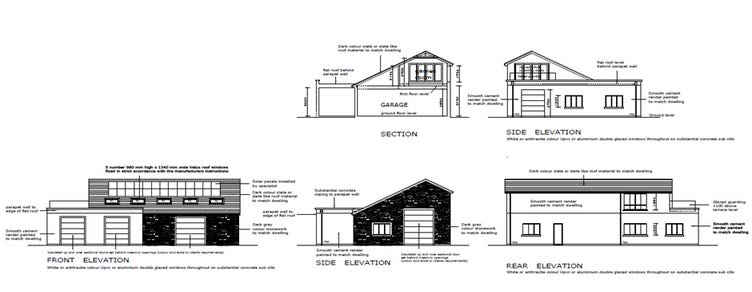
Garages to serve domestic properties are generally accepted as being a reasonable form of development. Indeed the updated Permitted Development Order 2025 makes provision for garages and car ports to be built within residential curtilages with a maximum footprint of up to 6.8 metres by 6.8 metres and an overall maximum height of 4 metres.
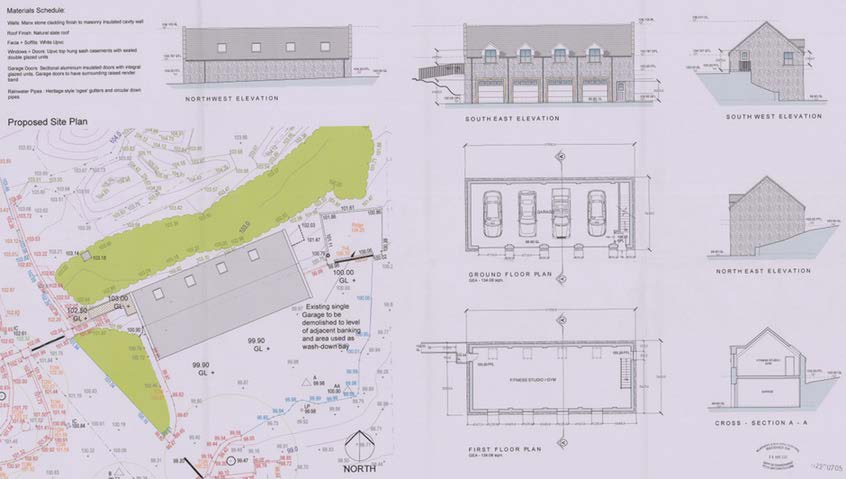
There are also many examples of approval being granted for domestic garage buildings in areas not designated for development which exceed and or differ from the provisions set out by the PDO. Such cases are considered on their merits and on a case by case basis. Below, two cases are set out that are material to this submission.
This application is a relevant material consideration in that it approved a detached garage building of a scale well in excess of what would normally be permitted under the Permitted Development Order. In that case, the garage extended to approximately 273 square metres and included an ancillary room at first floor level, yet was accepted by the Planning Committee as an exception within the countryside. The Officer’s Report makes clear that, notwithstanding its size, the garage was considered acceptable in principle due to its clearly defined ancillary relationship to the main dwelling, the absence of any independent or commercial use, and its siting
within a large and well contained residential curtilage with limited wider visibility. Approval was subject to stringent conditions restricting use, preventing subdivision or separate occupation, removing permitted development rights, controlling materials and colour to mitigate visual impact, and requiring removal of the garage if it ceased to be needed for ancillary domestic purposes. The decision demonstrates that garages substantially larger than those ordinarily allowed by the PDO can be supported where robust controls are imposed and landscape and visual impacts are demonstrably managed. In comparison, this proposal seeks a materially smaller and more discreet garage with an attached room, resulting in a significantly reduced visual impact and a higher overall design quality when assessed against the same policy framework.
Approval was granted for a detached building measuring 10 metres by 12 metres for use as a garage and machinery store within a large curtilage. The building was situated to the rear of the main house and partially screened from public views. It was accepted that a property of such scale required storage for equipment necessary to maintain its grounds. The Planning Officer emphasised that the visual impact was low due to the building’s location, subdued external finishes and use for purposes incidental to the occupation of the main dwelling. The rationale supports the principle that domestic outbuildings for storage and garaging can be justified on land not designated for development, provided that scale, siting and use are appropriate.
The principle of the earlier stand alone ancillary dwelling was problematic because it created an additional residence in the countryside beyond the strict exceptions allowed by Housing Policy 4 and General Policy 3.
By contrast, the current proposal creates no additional dwelling, maintains the existing single dwelling on the site, and provides reasonable ancillary accommodation that any rural household might require.
It is considered that there is no in principle objection to ancillary development within the curtilage, subject to detailed matters of design, impact and ability to control the use.
As described earlier, the design is contemporary and deliberately aligned with the existing dwelling. It is single storey in height with a flat roof, employs a simple
rectilinear form, uses a material palette that matches the main house, and establishes a clear hierarchy in which Woodland Heights remains the primary building on the site.
From any external viewpoint the combined effect will be that of a single, cohesive residential unit with ancillary structures grouped around it. The proposal does not alter the appearance of the house when viewed from the access or wider countryside because it sits behind it, shielded from view. The proposal therefore respects the proportion, form and appearance of the existing property as required by Housing Policy 15 and does not increase its public visual impact, the key test of the policy.
The siting ensures the structure is screened entirely by the existing dwelling and established boundary planting. Views from Ashley Road and the shared access lane will remain unchanged. The open front field remains undeveloped and the building sits within the visual envelope of the existing house.
There is therefore no discernible effect on the openness, character or quality of the surrounding countryside and no conflict with Environment Policy 1 or the wider objectives of the Strategic Plan.
The nearest neighbouring dwelling is The Cottage, over 70 metres away and on higher ground beyond existing planting. The proposal will result in no overlooking, no loss of light and no unacceptable noise or disturbance. The use remains domestic in nature and consistent with existing garden use.
The proposal uses the existing access and driveway. No new access is proposed and there is no increase in the number of dwellings. Parking provision is improved with two covered spaces in addition to existing surface parking. There are no highway safety implications.
The building is located within an existing area of garden and hardstanding. No trees are affected by the proposal. Existing drainage systems can be extended and there is no flood risk.
The revised proposal removes the creation of a new dwelling, relocates development entirely within the residential curtilage, and removes reliance on Housing Policy 14
and Planning Circular 3/91. The proposal aligns with the officer’s guidance and addresses all previously identified concerns.
The proposal is ancillary domestic development within the curtilage of an existing countryside dwelling. It introduces no new dwelling, causes no harm to the countryside, complies with relevant policies and represents a reasonable and proportionate form of development. There are no associated material harms.
The proposed garage and attached room is ancillary to Woodland Heights, confined to the established curtilage, visually discreet, policy compliant and responsive to previous officer concerns. Planning approval should therefore be granted, subject to appropriate conditions restricting ancillary use.
Steven Stanley, MRTPI Uplift Planning Ltd
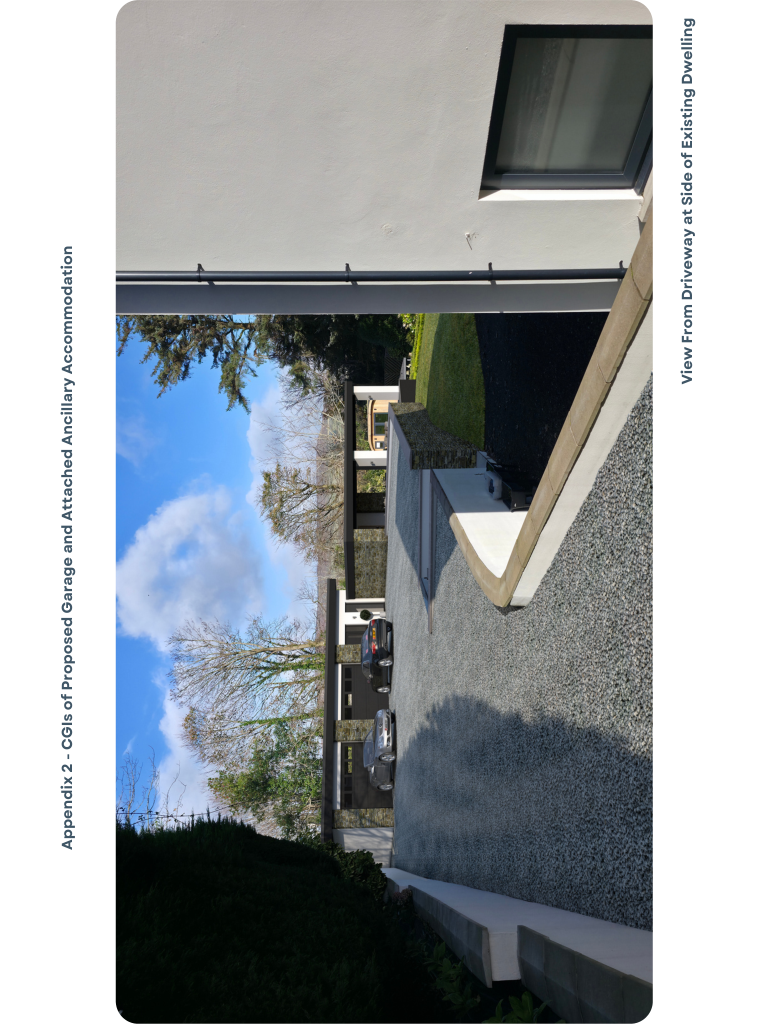
Appendix 2 - CGIs of Proposed Garage and Attached Ancillary Accommodation UPLIFT PLANNING LTD
Appendix 3 - Cited Material Planning Applications
AS-BUILT GARAGE
21/01134/B
16/00398/B
Copyright in submitted documents remains with their authors. Request removal
