Loading document...
Prepared by:
SLR Environmental Consulting (Ireland) Ltd 7 Dundrum Business Park, Windy Arbour, Dublin, D14 N2Y7 SLR Project No.: 501.064836.00001 June 2025 Revision: 01
Revision Record
| Revision | Date | Prepared By | Checked By | Authorised By |
|---|---|---|---|---|
| 1 | 12 June 2025 | AM | TP | TP |
This document has been prepared by SLR Environmental Consulting (Ireland) Ltd (SLR) with reasonable skill, care and diligence, and taking account of the timescales and resources devoted to it by agreement with Corlett Building Materials Ltd. (the Client) as part or all of the services it has been appointed by the Client to carry out. It is subject to the terms and conditions of that appointment.
SLR shall not be liable for the use of or reliance on any information, advice, recommendations and opinions in this document for any purpose by any person other than the Client. Reliance may be granted to a third party only in the event that SLR and the third party have executed a reliance agreement or collateral warranty.
Information reported herein may be based on the interpretation of public domain data collected by SLR, and/or information supplied by the Client and/or its other advisors and associates. These data have been accepted in good faith as being accurate and valid.
The copyright and intellectual property in all drawings, reports, specifications, bills of quantities, calculations and other information set out in this report remain vested in SLR unless the terms of appointment state otherwise.
This document may contain information of a specialised and/or highly technical nature and the Client is advised to seek clarification on any elements which may be unclear to it.
Information, advice, recommendations and opinions in this document should only be relied upon in the context of the whole document and any documents referenced explicitly herein and should then only be used within the context of the appointment.
Basis of Report .................................................................................................................... i
Table 4-1: Native Hedge Mix. ............................................................................................... 6
Appendix 1. Drawing PL07 – Proposed Restoration Plan Rev1
This Landscape, Restoration and Aftercare Management Plan supports the planning application for the extension to the existing Ballaharra Quarry, Peel Road, St. John’s, Isle of Man, submitted in November 2024. The plan was prepared in response to a clarification email received from the Planning Directorate, Department of Environment, Food and Agriculture (DEFA) of the Isle of Man Government, on 30th April 2025.
A number of points were raised in this email, some of which are addressed by this document, as well as a revision of Drawing PL07 Proposed Restoration Plan, originally submitted with the planning application, which can be found in Appendix 1 of this document.
The relevant points addressed by this document and the revised Restoration Plan are as follows. The relevant sections of this report in which these points are addressed are listed in bold, following each point:
“A plan showing protective fencing around the root protection areas of the boundary vegetation to be retained on both phases a 1 and 2 of the development should be submitted
Refer to section 2.2 of this report and Drawing PL07 Proposed Restoration Plan Rev01 in Appendix 1.
“Drawing No. PL07 does not show that existing hedging on the site would be sufficiently protected as the development progresses and I question whether any aftercare proposed would be sufficient to ensure the hedges retention and longevity.”
“I note from Drawing No. PL07 by SLR Landscaping that allow works of restoration are proposed to be carried out as per the details shown on the drawing. The EIA indicates that the site is proposed to be restored to agricultural use but does not advise how this would be achieved. Drawing No. PL07 does not specify finished land levels, proposed fill material (if any); how any water within the quarry area is to be managed, or whether it is to be left as a wetland feature/lake; or, how any drainage of the site post development would be undertaken, implemented and managed to ensure that there was no flooding or groundwater pollution arising from the site post restoration.”
“Furthermore, a full Aftercare Management Plan for the site should be submitted to demonstrate that the aftercare management of the site, and the timings of the works involved, show that when fully implemented, the Plan is robust and effective. I require more details of these elements so that any and all aftercare proposals can be comprehensively considered.”
Refer to sections 3.0, 4.0 and 5.0 of this report.
This Landscape, Restoration and Aftercare Management Plan and the associated Drawing PL07 Proposed Restoration Plan Rev 01 drawing were prepared by Anne Merkle, a Principal Landscape Architect with SLR Consulting Ireland. Anne has over 20+ years’ experience of working for landscape consultancies in Ireland and is a full corporate member of the Irish Landscape Institute, since 2005. In addition to her qualification as a landscape architect, Anne holds a master’s degree in Biodiversity and Land Use Planning and a Technicians Certificate in Arboriculture (Level 3 – UK).
The main objective of the Landscape and Restoration scheme is to screen views into the proposed development, to compensate the loss of some existing hedge/scrub vegetation and to protect all existing vegetation to be retained within the site from damage by the proposed extraction works, as well as to restore the quarry to a beneficial natural habitat afteruse.
The key landscape / restoration actions, to achieve these objectives, are provided in Section
This Landscape, Restoration and Aftercare Management Plan should be read in conjunction with Drawing PL07 Proposed Restoration Plan Rev01 in Appendix 1.
The existing quarry development, as well as the proposed extension area are largely screened in views from the surrounding landscape, by intervening topography and vegetation. Some glimpsed views of parts of the existing quarry / proposed extension area can be gained from a section of the public footpath to the east of the site (part of the ‘Wild West’ walking route) and from a number of locations along Patrick Road south of the River Neb.
In order to augment the existing screening provided by vegetation along the site boundaries and in the wider landscape, as well as compensate the loss of some sections of hedgerows and scrub within the extension area, it is proposed to plant a native hedge along parts of the extension area boundaries.
The northern and eastern boundaries of the proposed Phase 1 extraction area will be pushed towards existing hedgerows, which will provide a barrier and screening. For this reason, no further planting along these boundaries will be required. In contrast to that, the northern, eastern and part of the southern boundaries of the Phase 2 extraction area will be located within pasture fields and will therefore not be adjoined by existing hedgerows / vegetation. It is proposed to plant a native hedge along these boundaries.
The proposed hedge mix consists of native species, which are present in the local area. Aside from visual screening (in particular of views from the public footpath to the east), the native hedge will provide additional functions, such as habitat connectivity and biodiversity enhancement by providing shelter and foraging opportunities for birds, small mammals, and invertebrates.
All vegetation along the boundaries of the existing quarry development and the proposed extension area will be protected and retained for the duration of the proposed development. The vegetation along the western, southern and the majority of the eastern boundaries of the existing development does not require specific protection measures, as no further works are proposed in these areas (i.e. this vegetation is located along the top or on the existing quarry faces, which will not be affected/changed by further works).
Please note that the only sections of hedgerow and scrub vegetation which will have to be removed to facilitate the proposed development are located within the extraction phase 2 area.
To safeguard both the existing hedgerows and the newly planted native hedge, along the extension area boundaries, a post and wire fence will be installed 1 m from the edge of these hedgerows (i.e. on the side of the hedgerows adjoining the extraction area). The fence will be installed prior to the commencement of the extraction works within the extension area, to form a barrier marking the area beyond which no access by machinery / extraction works will be allowed.
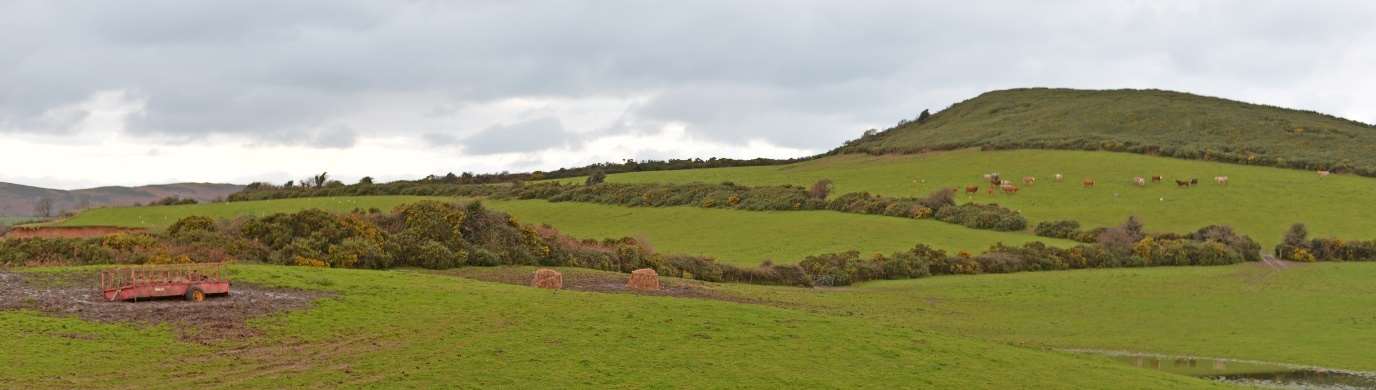
It should be noted that the existing hedgerows along the boundaries of the Extraction Phase 1 area are dominated by gorse, with very few hawthorn / blackthorn bushes present (refer to Photo 1 below) and no larger / mature trees. A greater distance of the fence from the edge of the existing hedgerows is therefore not considered necessary, for the purposes of root protection.
Photo 1: Existing gorse dominated hedgerows along the boundaries of the proposed extension area (note: no tall trees present)
Fence installation will follow standard best practice, ensuring sufficient height (ca. 1.2 m) and tension to provide an effective barrier, while remaining visually unobtrusive within the landscape. The fencing will be routinely inspected and maintained throughout the operational, restoration and aftercare phases to ensure ongoing effectiveness and integrity.
The restoration of the entire quarry area (i.e. the existing quarry extraction area and the proposed extension area) to a natural habitat, by way of natural regeneration, will be promoted by:
Upon completion of these works the quarry extraction area will be left to regenerate naturally with grass, wildflower, and scrub species suited to the site's sandy soil conditions. This approach builds on the natural regeneration already observed in parts of the site that have remained undisturbed for several years. This low-intervention method is expected to promote a self-sustaining mosaic of habitats that enhances biodiversity and aligns with the natural character of the local area.
Please note that the restoration proposals do not include any artificial drainage features, as the site will be worked above the ground water table and all rain falling within the site will naturally infiltrate to ground through the sandy soil.
As well as the post and wire fence along the outer boundaries of the proposed extension area, the remainder of the site boundaries will be regularly checked for the duration of the development, as well as during the aftercare period, to prevent unauthorised access. Any damaged fencing will be repaired, as required, to make the site stock proof. Any gates will be kept locked, when the site is not actively worked and on completion of the restoration works.
The operator will clearly define the management responsibility for the landscape and site restoration works and will ensure that the responsible person has the necessary information and authority to manage the whole landscaping and restoration process. Relevant staff will be briefed on the scheme and will be adequately supervised / controlled.
The landscape / restoration actions described in section 2.0 above will be carried out in two phases, within the timescales described below.
The landscape works will be carried out on commencement of the proposed development and will include
The restoration works will be carried out on completion of all extraction works. As the majority of the existing quarry development and proposed extraction area will be used for the extraction and storage of materials, for the duration of the two extraction phases, it is not feasible to carry out any of the significant final restoration actions at an earlier stage. It is however anticipated that there will be some sections of the site, which will not be disturbed further and that the natural regeneration of these areas will commence while the extraction activities are still ongoing (as is already the case in some areas on the existing quarry floor). Any vegetation that will have established on site, by the time the extraction works are completed, will be incorporated into the final restoration scheme and retained within the site.
All hedge planting will be carried out in the earliest available planting season (November – March), by a suitably qualified, experienced and competent contractor.
All plants will be well-grown nursery stock, in accordance with BS 3936-1:1992 ‘Nursery Stock – Part 1: Specification for trees and shrubs’, to the sizes, species and percentages detailed in Table 4-1 below. All site preparation, plant handling and planting operations will comply with BS 4428:1989 ‘Code of practice for general landscape operations (excluding had surfaces)’. All species will be derived from stock of local provenance, if possible.
All transplants would be notch planted as necessary to accommodate the full root system, whereas container grown plants would be planted using a spear to create a pit, using a twisting motion to prevent smearing. The plug could then be inserted ensuring contact with the sides, with a second insertion of the spear to ensure adequate firming.
All transplants will be individually protected by 0.6 m high translucent plastic spiral guards supported by a single stout cane of 1 m length driven 0.45 m into the ground. Holly (Ilex aquifolium) will be protected by 0.75m high plastic mesh Netlon guard, twice fixed by ratchet ties to 0.32 m x 0.32 m x 0.9 m timber stakes driven 0.45 m into the ground. Alternatively, if the surrounding site is to be managed by livestock grazing the planted areas may be protected by stock and rabbit proof fencing with individual guards omitted.
Hedge to be planted in two staggered rows, with plants 40cm apart and rows 40cm apart (i.e. 2.5 plants per m). Considering the total length of hedge to be planted of 425 linear metres, a total of 1,070 plants will be required. Transplants / Container grown shrubs to be planted randomly with no more than 5 plants of the same species in one group.
Table 4-1: Native Hedge Mix.
| No. | Plant Name | Common Name | Height (cm) | Age/Pot Size | % |
|---|---|---|---|---|---|
| Transplants/Container Grown Shrubs | Transplants/Container Grown Shrubs | Transplants/Container Grown Shrubs | Transplants/Container Grown Shrubs | Transplants/Container Grown Shrubs | Transplants/Container Grown Shrubs |
| 160 | Acer pseudoplatanus | Sycamore | 60-90 | 1+1 | 15 |
| 320 | Corylus avellana | Hazel | 60-90 | 1+0 | 30 |
| 215 | Crataegus monogyna | Hawthorn | 60-90 | 1+1 | 20 |
| 215 | Ilex aquifolium | Holly | 60-80 | 2L | 20 |
| 160 | Salix caprea | Goat willow | 60-120 | 0+1 | 15 |
Both the hedge planting, as well as the restoration activities will be followed by a 5-year aftercare period.
All hedge planting aftercare operations will comply with BS 4428:1989 ‘Code of practice for general landscape operations (excluding hard surfaces)’.
The programme of aftercare will operate for a period of five years commencing from 31 March following completion of the planting works.
Maintenance works for the first three years shall be carried out in accordance with the following programme. Visits shall be spaced at no less than six week intervals and no greater than sixteen week intervals. During years 4 & 5, the number of visits will be reduced to two, removing the summer visit.
| Time of Year | No. of Visits |
|---|---|
| December – March | No visit (Winter) |
| April – Mid June | 1 Visit (Spring) |
| Mid-June – August | 1 Visit (Summer) |
| September – November | 1 Visit (Autumn) |
On each visit, the applicant or their agents shall:
As soon as the plants are considered established and resistant to grazing damage, the spiral guards are to be removed and disposed as appropriate, unless biodegradable guards are used.
For the duration of the 5-year aftercare period, the applicant or their agents will undertake a site inspection at the end of each growing season (e.g. October-November) to monitor whether any of the plants have failed. Replacement planting will be arranged to be carried out within the next planting season (e.g. November-March), by a suitably qualified landscape contractor. Plants of the same species and size, as those originally planted will be used, unless unforeseen reasons for the failure of a specific species are identified. In this case, a suitable replacement species will be sourced.
Once the initial restoration actions are completed (refer to section 2.3), no maintenance visits are required, as the site will be left to regenerate naturally. However, for a period of 5 years, annual monitoring visits will be carried out to ensure that recolonisation by vegetation progresses at a satisfactory pace, that habitats suitable for the site and local fauna develop and to ensure that there no non-native invasive species are present requiring management (refer to section 5.2.1). Should any issues be identified, suitable management actions will be developed and implemented.
It is considered good husbandry that all occupiers of land whether used for agriculture or not make efforts to control injurious weeds / invasive species in order for them not to spread. Furthermore, as part of the habitat management, where an individual plant species dominates an area, it may be beneficial to remove a proportion to allow other species to colonise or be introduced and increase species diversity. The following particularly invasive non-native plants have been identified:
On completion of the restoration works, during the 5-year aftercare period, all areas of the site would be monitored for these plant species on at least a twice yearly basis, during the growing season. Where these plants are identified appropriate measures, specific to the plant species will be taken to control and/or eradicate them. The basic methods of controlling invasive plants are as follows:
Where weeds are to be controlled by the application of herbicides this would be carried out by a certified competent person, according to manufacturer’s instructions. Herbicides will not be used within 10m of ponds, ditches or streams. It is also acknowledged that all waste materials, including weeds, are subject to the Duty of Care and must only be transferred to, and carried by, registered waste carriers.
For the 5-year restoration aftercare period, all site boundaries will be checked during the monitoring visits. Any damaged fencing will be repaired, as required, to make the site stock proof. Any gates will be kept locked.
Further Information Corlett Building Materials Ltd.
SLR Project No.: 501.064836.00001 June 2025
Copyright in submitted documents remains with their authors. Request removal
