Planning Statement In Support Of 24/91228/B For External Alterations And Extensions Including First Floor Extension Over Existing Garage, Replacement Rear Dormer Window, Front Extension With Porch, Rear Pergola, And Changes To External Finishes, 9, Raad Ny Gabbil, Castletown Im9 1Hh
1.0 INTRODUCTION
1.1 This application was validated on 22.11.24 and thus far has been the subject of two comments, that from the Highway Services Division of Department for Infrastructure who indicate that they have no highway interest and from the owners of 8, Raad ny Gabbil. Castletown Commissioners were consulted on 22.11.24 and have so far made no comment on the application. No comments have been received from any local residents.
1.2 The owners of 8, Raad ny Gabbil which sits immediately to the south of the application site, have objected and although their full submission is not yet online, it has been summarised online as: “Unfortunately we object because the extension over the garage is directly adjacent to our child's bedroom window, which will lead to a significant loss of light.”
1.3 This statement sets out further background information and planning policy context relating to the application and provides a justification in planning terms as to why the proposal should be considered favourably.
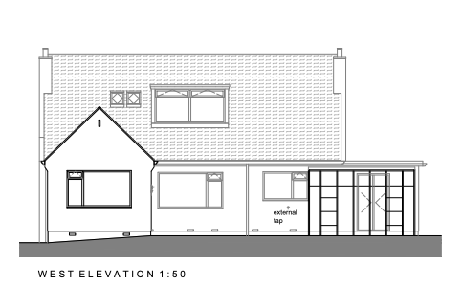
2.0 ENVIRONMENTAL CONTEXT
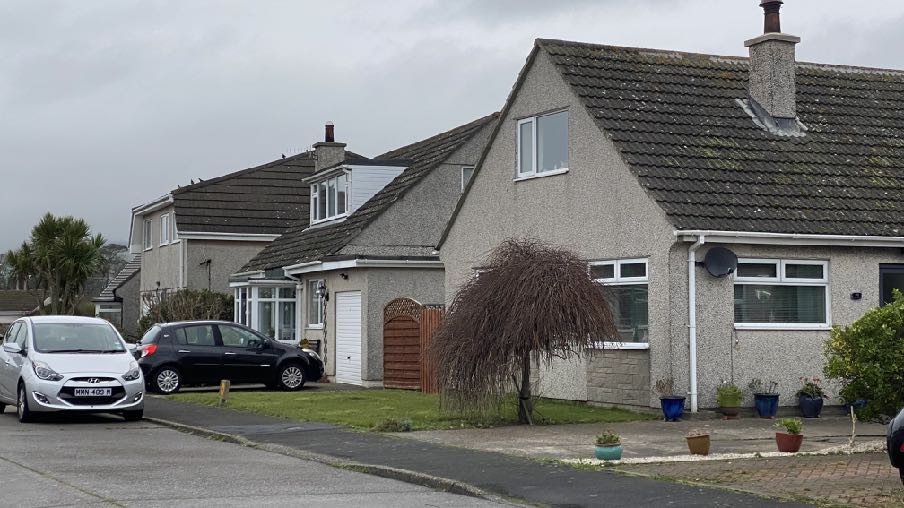
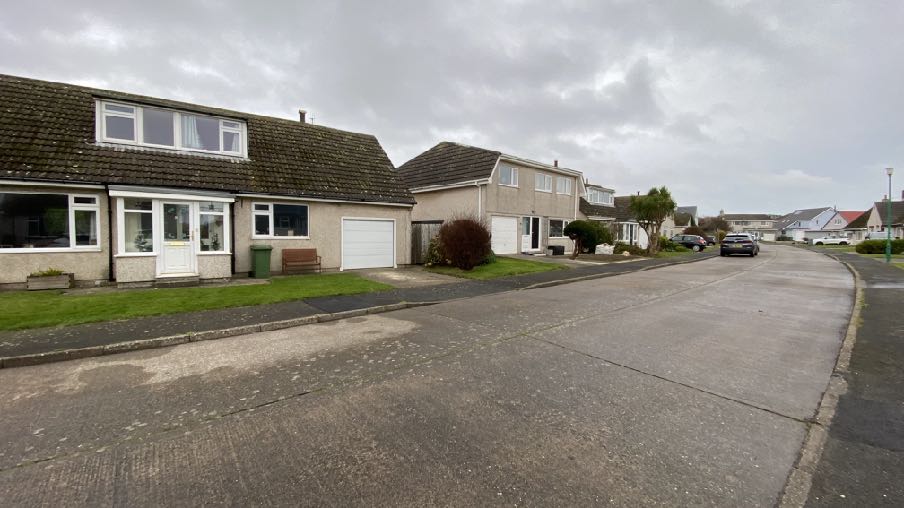
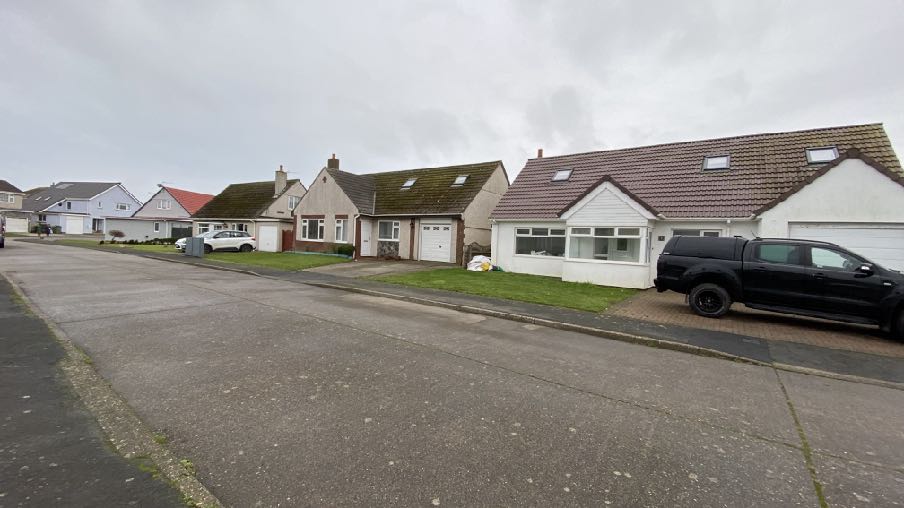
2.1 The site is an established residential curtilage of an existing dwelling which fronts onto Raad ny Gabbil and backs onto Arbory Road. Raad ny Gabbil is a cul de sac which links to Bay Grainagh. The property is one of a number in the cul de sac. These properties are a mix of single storey and dormer bungalows, some with dormers in their front elevations, some in the rear and some with both.
A street-level photograph showing a residential bungalow with a garage and driveway, alongside neighboring houses in a suburban setting.A street-level photograph showing a detached bungalow with a garage and driveway, situated on a residential road with other houses in the background.
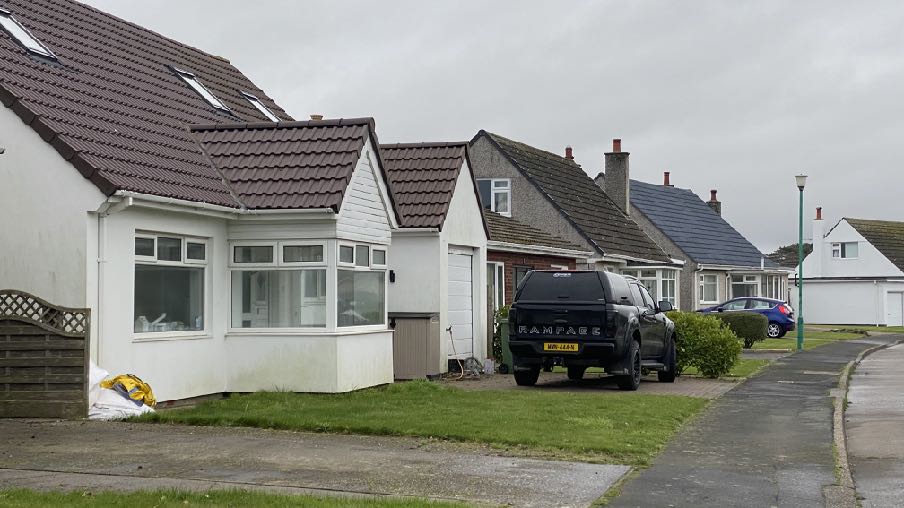
2.2 Many properties have double Roman tiled roofs, some with smooth, flat tiled roofed, most have a pebble dashed finish and some have smooth, painted render. The roofs are different colours - mostly shades of brown but some darker than others, and some are blue and there is a brighter orange/red roof on 1, Bayr Grianagh which turns the corner into Raad ny Gabbil.
A street-level photograph showing a white residential property with a prominent front extension and an attached garage, with a black pickup truck parked in the driveway.A street-level photograph showing a row of residential bungalows, focusing on a white house with an attached garage and a black pickup truck parked in the driveway.
2.3 The property on the opposite corner of the entrance into Raad ny Gabbil has a more modern style, with smooth rendered and painted walling and slate blue double Roman tiles: the property alongside on Bay Grianagh has similar finishes and solar panels on the southern elevation.
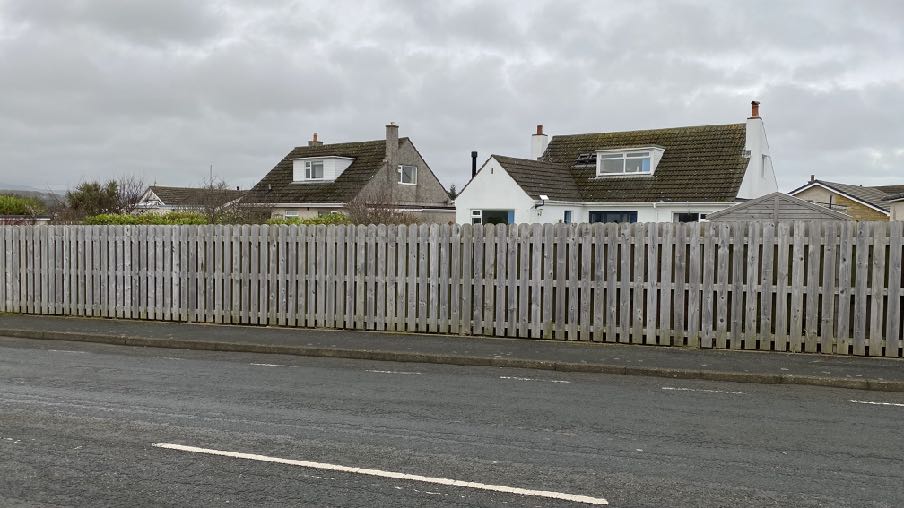
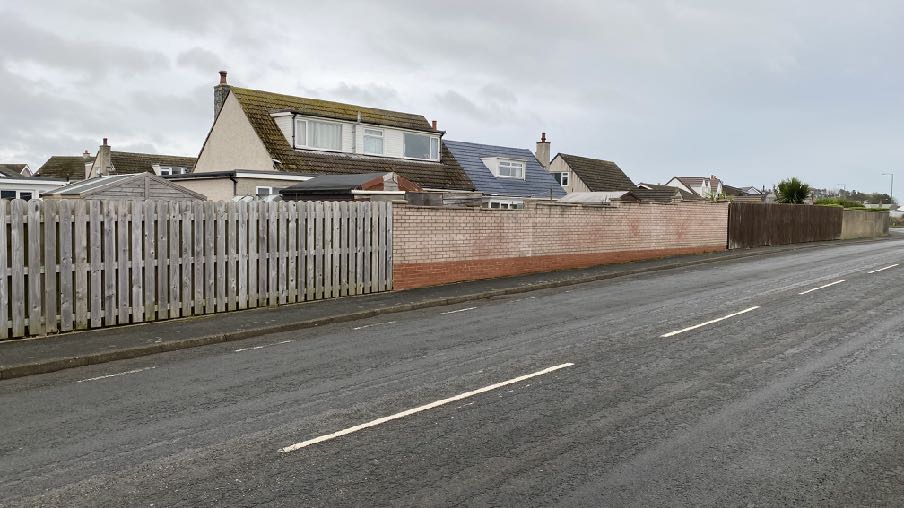
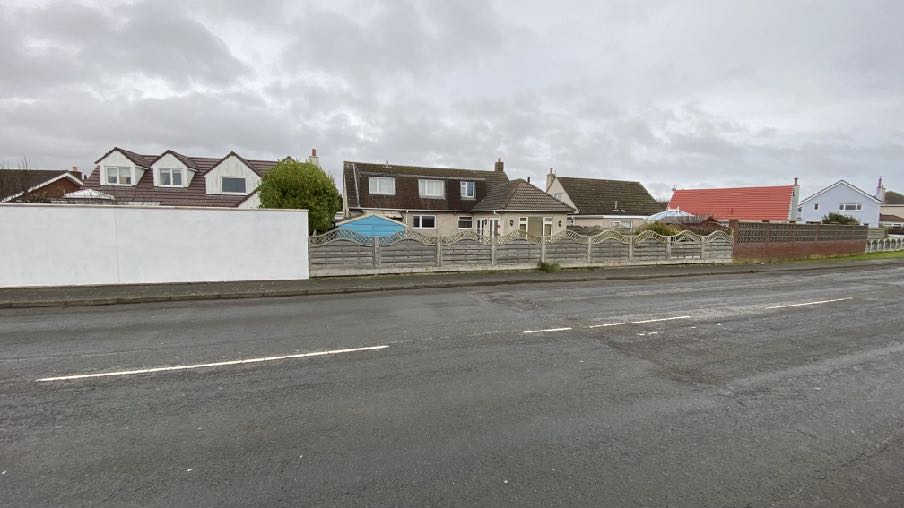
2.4 The properties on the south western side of Raad ny Gabbil back onto Arbory Road with their rear elevations clearly visible therefrom. Like the street scene within Raad ny Gabbil, the rear elevations are very varied with a mix of dormer styles and sizes, some with pitched roofs, many with flat roofs and a variety of widths. Some properties have rear extensions and there is also a variety of roadside boundary treatments - some having rendered walling, others with brick walling and decorative blockwork, some with fencing and a long length of lollipop style vertical fencing towards the northern end of Arbory Road, including the rear of the application property.
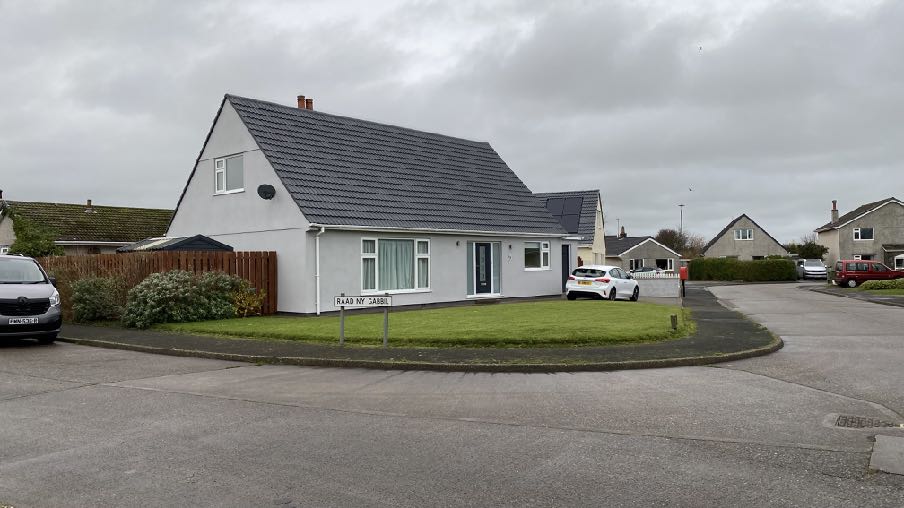
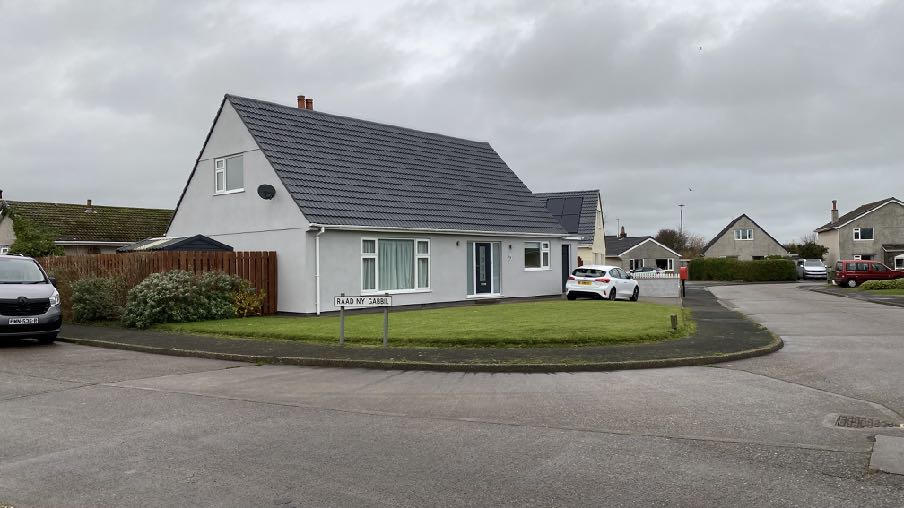
A street-level photograph of a detached white bungalow with a grey tiled roof. The property features a driveway with a parked car and a wooden boundary fence.
2.5 The application property is narrower than its neighbour to the south which has a rear extension, and taller than that to the north, which is a true bungalow. The application property has an existing rear flat roofed dormer, a gable chimney on each side of the house and is finished in dark brown double Roman roof tiles above pebble dashed walls.
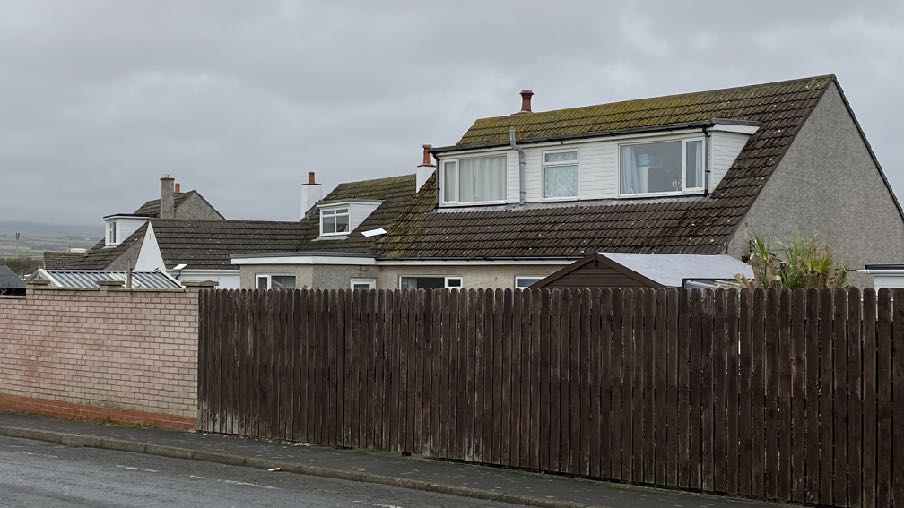
2.6 Number 7, Raad ny Gabbil has a longer dormer than its neighbours.
A street-level photograph showing a residential property boundary with a wooden fence and brick wall, with houses visible behind.
2.7 The property, like many of its neighbours, has a single storey flat roofed extension to the site which accommodates a garage, an area of hard standing in front in which can comfortably accommodate two vehicles.
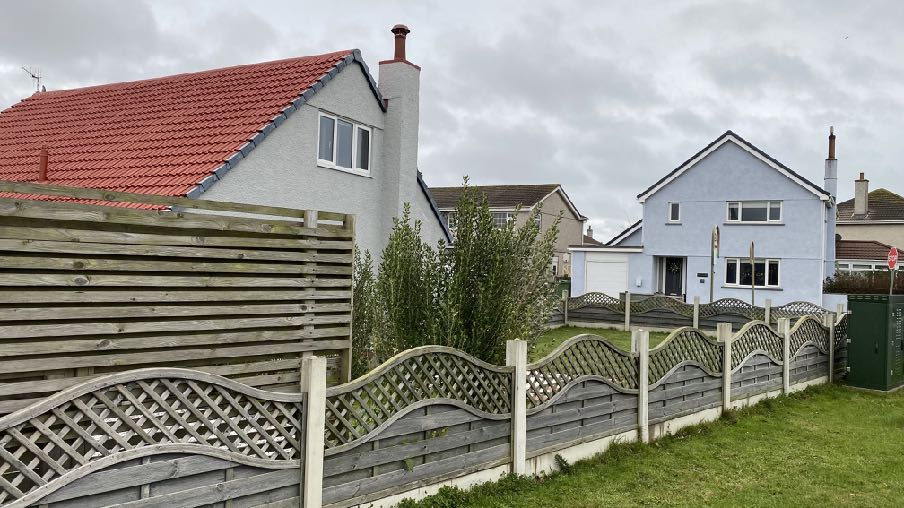
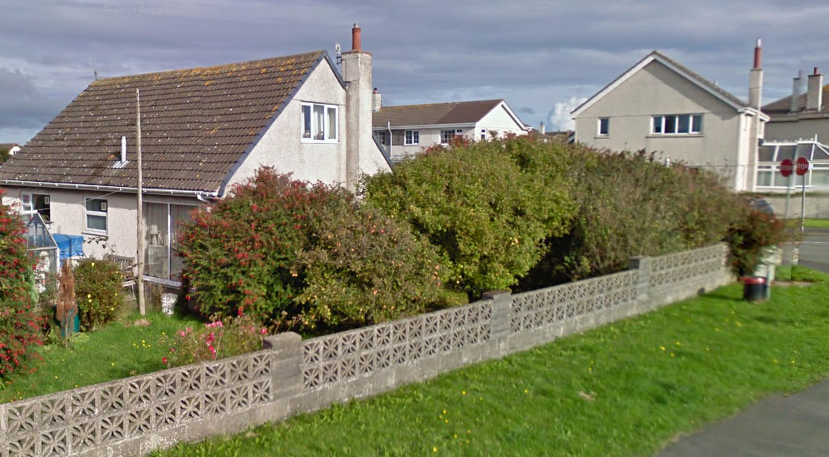
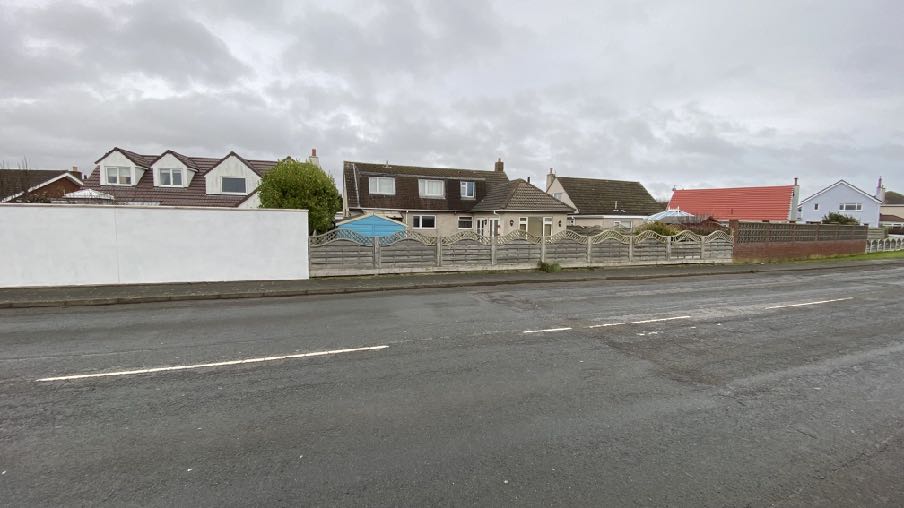
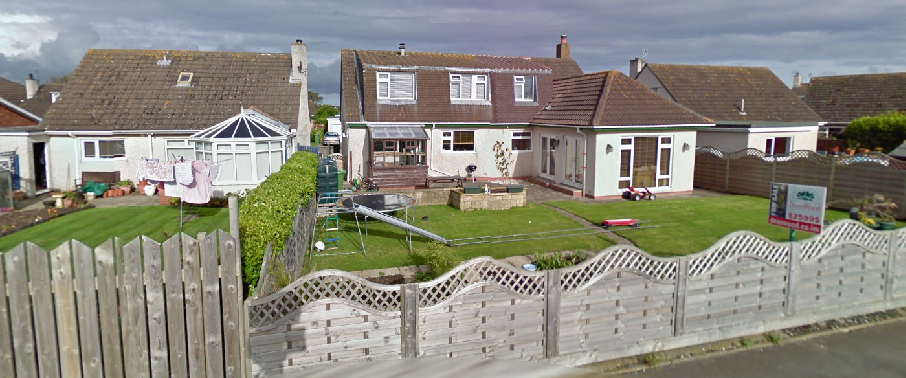
2.8 A comparison of what exists today with the 2010 Google Streetview shows that the area is changing through the modernisation of the properties:
2, Bayr Grianagh 2024 above and in 2010 below
A photograph showing the existing exterior of a detached white bungalow with a grey tiled roof, situated on a street corner with a driveway and wooden fence.
1, Bayr Grianagh and Thie Corneil 2024 above and below in 2010
A street-level photograph showing a residential property with a red tiled roof behind a wooden fence, with neighboring houses visible in the background.A street-level photograph showing a residential property with a tiled roof and chimney, partially obscured by a large hedge and a decorative concrete block boundary wall.
Rear of 1, 2 and 3, Raad ny Gabbil in 2024 above and in 2010 below
A street-level photograph showing a row of residential houses behind a white wall and fence under an overcast sky.A street-level photograph showing a detached bungalow with a rear conservatory and side extension, surrounded by gardens and wooden fences.
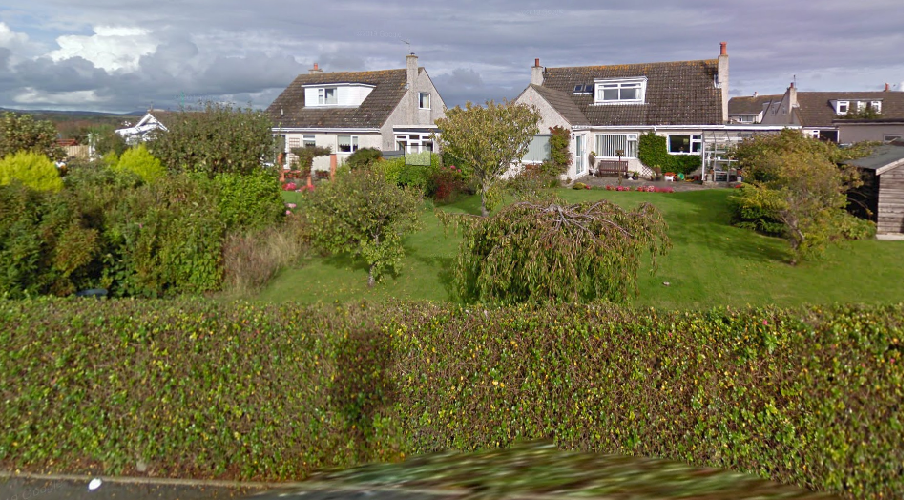
Rear of 8 and 9 Raad ny Gabbil in 2024 above and in 2010 below
A photograph showing a view of two detached houses with gardens and hedges, likely serving as a site context image for the planning application.
2.9 These images show an evolution of some of the properties away from their original character, through changes in external roof and wall finishes, boundary treatments and extensions and alterations and the removal and replacement of some of the things which are indications of the styles and preferences around at the time of their construction.
3.0 PLANNING POLICY CONTEXT
Area Plan for the South (2013) and the Isle of Man Strategic Plan 2016
3.1 The site lies within an area designated on the adopted Area Plan as Predominantly Residential. The site is within the settlement boundary and Castletown is one of two Service Centres - the settlement type second only to Douglas in the Strategic Plan hierarchy - and where “development will be concentrated to provide regeneration and chose of location for housing, employment and services” and where there should be “a range of housing and employment opportunities at a scale appropriate to the settlement” (Spatial Policy 2 of the Strategic Plan). Strategic Policies 1, 2 and 10, Spatial Policy 5, Housing Policy 4 and Transport Policy 10 also direct development towards existing settlements. Strategic Policy 1 also encourages the optimisation of the use of previously developed land, redundant buildings, unused and under-used land and buildings.
3.2 There should, therefore be a presumption in favour of development as set out in General Policy 2 of the Strategic Plan:
Development which is in accordance with the land-use zoning and proposals in the appropriate Area Plan and with other policies of this Strategic Plan will normally be permitted, provided that the development:
(a) is in accordance with the design brief in the Area Plan where there is such a brief;
(b) respects the site and surroundings in terms of the siting, layout, scale, form, design and landscaping of buildings and the spaces around them;
(c) does not affect adversely the character of the surrounding landscape or townscape;
(d) does not adversely affect the protected wildlife or locally important habitats on the site or adjacent land, including water courses;
(e) does not affect adversely public views of the sea;
(f) incorporates where possible existing topography and landscape features, particularly trees and sod banks;
(g) does not affect adversely the amenity of local residents or the character of the locality;
(h) provides satisfactory amenity standards in itself, including where appropriate safe and convenient access for all highway users, together with adequate parking, servicing and manoeuvring space;
(i) does not have an unacceptable effect on road safety or traffic flows on the local highways;
(j) can be provided with all necessary services;
(k) does not prejudice the use or development of adjoining land in accordance with the appropriate Area Plan;
(l) is not on contaminated land or subject to unreasonable risk of erosion or flooding;
(m) takes account of community and personal safety and security in the design of buildings and the spaces around them; and
(n) is designed having due regard to best practice in reducing energy consumption.
3.3 Further guidance is provided both within the Strategic Plan and also within other Department and Government documents on a number of these criteria. In this case, the relevant other documents include the Residential Design Guide. Guidance may also be found within other decisions taken on developments which could be considered comparable or where general principles are established.
3.4 Good design should not, as the Strategic Plan says, represent a “slavish following of past design idioms, evolved for earlier lifestyles can produce buildings which do not reflect twenty first century lifestyles including accessibility and energy
conservation. While there is often a consensus about what constitutes good and poor design, it is notoriously difficult to define or prescribe”.
3.5 The Residential Design Guide goes on to say that
“3.1.2 This document is intended to facilitate good quality design, and an important aspect of that is local distinctiveness.
3.1.3 New residential development should be informed by the best qualities of our existing residential areas. However, this does not mean that all new residential developments should seek to replicate the appearance of older ones, and good quality contemporary design is encouraged.
3.2.1 A residential development should avoid having the same type, height, and density throughout, including avoiding continuous, bland, and uninteresting roofscapes.
5.3.14 The Department recognises that in some instances contemporary design solutions may be appropriate, providing they are of a high standard of design quality, and are of appropriate form, scale, and materials. Examples of more modern finishes include large areas of frameless glazing forming the extension, the use of timber/metal cladding, and a variety of roofing finishes, including sedum, copper, or aluminium.
4.0 Planning history
4.1 The property itself has not been the subject of any previous planning application.
4.2 Neighbouring properties have been subject to applications for alterations:
10, Raad ny Gabbil was the subject of an application for conversion of the garage to living accommodation (03/01762/B), a rear extension (14/00533/B) and a rear conservatory (04/00232/B). These applications were all permitted.
8, Raad ny Gabbil was the subject of applications for a porch (97/01743/B) and alterations and an extension including the replacement of the existing dormer with one which extended further towards the ridge together with a new gable window. These applications were permitted.
4.3 Recent decisions concerning design have emphasised that variety in the streetscene is important. These include 24/00106/B which was refused at appeal for reasons relating to overlooking, but the application had been refused for reasons relating to design and impact on the street scene. The inspector however, disagreed, stating,
“50. Among other things, the Residential Design Guide seeks to encourage creative, innovative and locally distinctive designs that respond to the changing needs of the Island’s communities. At paragraph 1.1.2 it confirmed that it is not intended to stifle creativity or to promote planning by numbers and off-the-peg designs. Rather it looks to provide a supportive context for good quality designs, be they traditional or modern. Paragraph 1.2.3 confirms that all applications will
This image displays a technical architectural elevation drawing labeled 'West Elevation 1:50', showing a two-story house with a pitched roof, windows, and a single-story extension on the right side.The image displays a proposed west elevation architectural drawing of a residential property, featuring a two-storey extension with mixed cladding and a single-storey side structure.
be judge on their own merits, taking account of the likely effect on neighbouring properties and the character of the building or street.”
4.4 She goes on
“52. I saw that there is quite a mix in terms of building size, type and style in the locality of the appear site with no strong or coherent design theme to the stereetscene here...This is not a location therefore, where there is a strong sense of uniformity and consistency in terms of design. Whilst that does not mean that anything goes, it does allow for more flexibility than might otherwise be the case, including a modest, contemporary design approach”.
4.5 22/01294/B was an application for an extension to an existing rear conservatory and a change in material and form of its roof. This was refused by the planning office under delegated authority as the proposal sought to erect a flat roofed extension on a dwelling which has no flat roofed elements. As well, the extension was considered not to reflect the design and character of the existing dwelling in terms of window types, proportions and design. Whilst the external wall finish would match the existing dwelling, the roof finish and design were not considered appropriate and would be contrary to the principles of the Design Guide and suggesting that the proposal sought but failed to replicate the design examples which are given in the Guide for flat roofed extensions.
4.6 The inspector, however, disagreed, saying that “each case must be considered on its merits and with regard to the existing building and the area in which it sits” and went on to confirm that the design and materials would have no harmful impact on the environment nor would anyone seeing the proposed scheme, question “how it came to be”.
5.0 The proposal
5.1 Proposed is a series of works to the existing dwelling to modernise its appearance and thermal efficiency and integrating sustainable practices and optimising the use of the site. The scheme also takes inspiration from the increasing number of modern elements in the vicinity as well as improving the internal layout and comfort for its occupants.
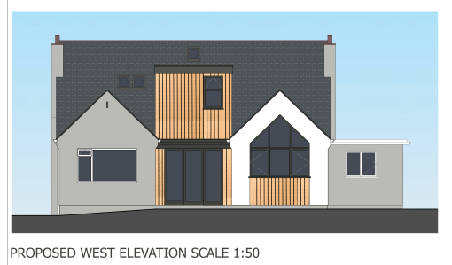
5.2 The scheme proposes to replace the existing front porch with a larger extension, an upward extension of the existing garage - essentially the provision of a pitched roof over it to increase its functionality and enlargement of the existing rear dormer. The provision of the pitched roof over the garage results in the removal of the existing gable window, currently serving a bedroom/study and its replacement with a blank gable on which there are to be installed solar panels.
5.3 In terms of design, the concept involves “drawing inspiration from selective existing features of the property and its surroundings, a modern interpretation is put forward that harmoniously integrates with and positively contributes to the environment” (as stated in the Design Statement submitted with the application) and to move away from the tell tale 1970s finishes and styles to bring the property into the 21st century whilst still retaining the form and proportions of the existing house.
5.4 The replacement of the spar dash with smooth render will not only provide a clean, durable finish but also reflects the finish on a number of other properties in the street. The roof will be re-finished in a standing seam system which is different in texture to the other roofs but will complement the colour scheme in Raad ny Gabbil which comprises a mix of colours and profiles.
5.5 The scheme also proposes to replace the existing rear dormer with a larger one which is taller and wider. It will be finished in dark coloured cladding, as opposed to the existing white cladding and will incorporate simple, vertically oriented windows. The dormer still sits below the ridge and above the eaves and is set in by some distance from both ends of the rear roof plane.
5.6 Photovoltaic panels will be attached to the southern side elevation.
5.7 There will be a single storey rear extension in flat roofed form which will be finished in timber and takes the form of a partly open fronted pergola with closed sides. This will have a flat roof which will sit partly beneath the new extended dormer.
5.8 The extended property will have only one chimney, the existing second chimney being removed as part of the works to the garage.
5.9 No changes are being made to the existing access or parking arrangements within the site.
6.0 Assessment and conclusion
6.1 It is clear from the Department’s guidance and from recent decisions on other applications, that variety and interest in a street scene are positive elements. It is also clear from looking on site at Raad ny Gabbil and considering the extant approval for the alterations of 8, Raad ny Gabbil that the street scene is being modernised with new materials and building forms being introduced and approved and with a moving away from the 1970s feel of the estate.
6.2 What is proposed, we would submit, continues this trend whilst introducing muted and dark colours to minimise the impact of these new features and complementing the surrounding properties and street scene.
6.3 The Residential Design Guide itself states that:
4.10.1 They are unlikely to be supported where they are publically visible, unless they already form a positive characteristic of the property or streetscene.
4.10.4 Flat roofed dormers can appear as clumsy additions to a roof pitch if they are overly long or tall, or if they are as tall as the ridge. Therefore they are only generally appropriate on more modern properties (1960/70’s bungalows) and/or properties where the area is characterised by houses with flat roofed dormers. Finishing the front and cheeks of the dormers in a tile or tile like material can reduce this impact.
6.4 The existing property is a 1970s bungalow and there are flat roofed dormers on the majority of properties in the vicinity. Most recently a replacement, larger dormer on the property immediately alongside has been permitted with a lighter coloured, more eye catching finish and a vertical proportion not generally found in the street scene. Arguably the pitched roofed dormers on the rear of 3, Raad ny Gabbil stand out more than the flat roofed dormers found elsewhere throughout the rear street scene and the use of similar coloured cladding on the dormer as the roof finish on number 2 demonstrates the reduction in impact even for a dormer that occupies a considerable proportion of the rear roof plane of that property.
6.5 The Residential Design Guide also recommends that “4.10.6 Therefore, dormers that would be as wide as the house, and run flush or close to the elevations/roof ridge of the house, will not normally be supported”: what is proposed accords with this advice. The position and scale of the dormer will not appear as a two storey flat roofed annex and the space on all sides will retain its appearance as a dormer. The use of the same material as that of the surrounding roof will minimise its projection from the roof plane and it will project out a very similar distance to the approved dormer replacement at number 8.
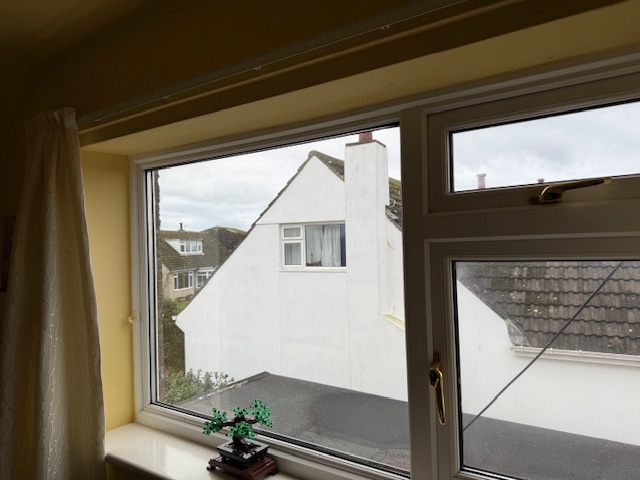
6.6 The orientation of the house results in there not being any significant impact on the privacy of adjacent properties compared with the existing situation and there are to be no new windows in the new gable facing 8, Raad ny Gabbil. The proposal will actually remove an existing gable window facing 8, Raad ny Gabbil, which is currently around 7m from the adjacent property’s first floor bedroom window which is referred to in the objection from number 8.
6.7 The Department’s guidance on how new development may affect the living conditions of those in existing residential properties is very helpful. There are methods of assessment on such impacts as privacy and outlook and in this case, the concern expressed relates not to privacy as there are to be no new windows in the new fabric, but of outlook from the neighbour’s bedroom window.
A street-level photograph showing a row of residential properties behind a boundary wall and fence. The image displays the existing context of the site along a road.
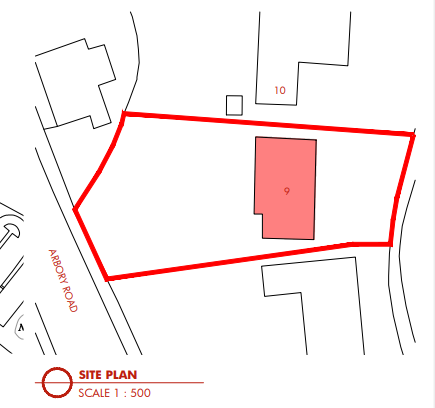
6.8 The Residential Design Guide explains that the impact on existing properties will be assessed having regard not only to the actual physical presence of new buildings and extensions and their proximity to existing properties, but also to the type of room which will potentially be affected. The Guide describes rooms as being ‘primary habitable’, ‘secondary habitable’ and ‘non habitable’ rooms with bedrooms falling with the category of ‘secondary habitable’ rooms. The Guide also requires that attention is paid to whether an existing window which may be affected is a primary or secondary window serving that room. The window in this case which is suggested to be unacceptably affected by the proposed works is the primary window of a secondary habitable room. The window is positioned centrally within the pitched roofed section of that property as shown in red below and in the ensuing photographs and attached detailed plan and elevations reference 100-01..
This image displays a site plan with a red outline indicating the property boundary and a red filled area representing the building footprint on Abbotts Road.
Photograph from the existing bedroom/study of 9, Raad ny Gabbil looking towards the existing gable of 8, Raad ny Gabbil
A photograph taken from inside a room looking out through a white window frame at a neighboring white house with a pitched roof.
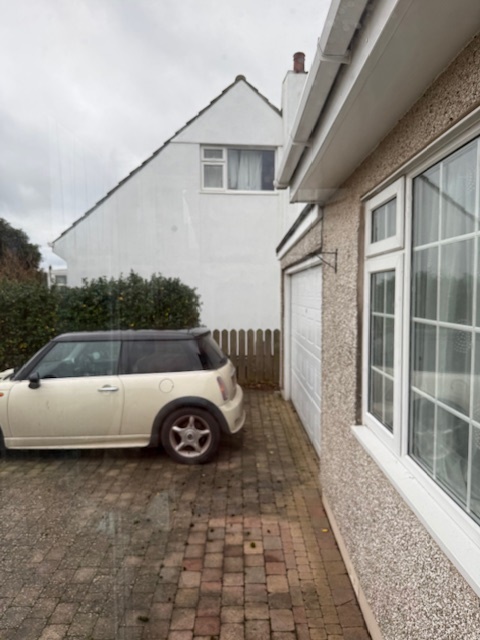
Photograph of the gable of 8, Raad ny Gabbil taken from the front of 9, Raad ny Gabbil
A photograph showing the existing side elevation of a residential property with a paved driveway, a white car, and a garage.
6.9 The Guide then provides a method of assessment which involves a 25 degree line being drawn from a point 2 metres above ground level on the closest wall with a relevant window of the neighbouring building. As can be seen from the site plan above, the proposed works to extend the garage upward do not bring the new taller gable directly in front of that window and considering the slope of the new roof which takes the roof further away from that window, the 25 degree calculation is not being breached.
6.10 In any case, the Guide is clear that [my underlining]:
7.4.2 The positioning, design and scale of an extension/new build dwellings should not be dominant or have an adverse impact on the primary windows of a primary habitable room or on the private garden that may be present in a neighbouring property.
6.11 A bedroom is not considered a primary habitable room for the purposes of determining impact on outlook. As such, whilst we understand that the neighbours are concerned about the impact of the works on the living conditions of their property, we would respectfully submit that out proposal follows and adheres to the guidance provided by the Department in this respect and that what is proposed will not adversely or unacceptable affect the living conditions of those in the adjacent properties.
6.12 We would submit that the proposal accords with all of the relevant planning policy and guidance available and that what is proposed will continue the gradual modernisation of the street scene, introducing further variety and interest as is welcomed by the Strategic Plan and the Residential Design Guide whilst retaining the original basic form of the property.
6.13 The application property is the first of the dormer bungalows one encounters on the approach to the town from the west and as such, the enhancement of the property and incorporation of modern materials and contemporary design is, we feel an appropriate entrance to the town, reducing the impact of the existing white clad dormer feature and distinguishing this from the row of white clad dormers on these first three properties viewed from this direction, noting as well that number 8 has planning approval for the replacement of its white clad dormer with something timber clad and larger.
6.14 The dormer at number 7 is also wider than others in the street scene (see below).
6.15 As the above highlights, what constitutes good and poor design is notoriously difficult to define or prescribe but we would submit the what is proposed reflects the best elements of the existing streetscene which is becoming increasingly contemporary and would introduce a unique element at the entrance to the town which could lead to an enhanced sense of place but complementing what exists and has approval, around it and with no acceptable impact on the living conditions of those in adjacent property, using the standards and advice in the Department’s Residential Design Guide.
Sarah Corlett 04.01.25
A street-level photograph showing a residential house with a large dormer window, viewed from behind a wooden fence and brick wall.
Copyright in submitted documents remains with their authors. Request removal
Source & Provenance
Official reference
24/91228/B
Source authority
Isle of Man Government Planning & Building Control