Loading document...
Thie Ny Crossag, Glen Mona Loop Road, IM7 1HG
Originally from the island, we have moved ‘back home’ to be close to family and to try to give our three children the dream childhood, running free out and about surrounded by hills and coast, that we had. We bought the bungalow having fell in love with the position of it, which is ideal; it is close to my childhood home and my mother, beautiful Maughold scenery and community, wonderful Ramsey and Laxey nearby with transport connections. Our children go to Dhoon School (as did I 30 years ago) and are enjoying the wildness of the field (which is part of the property), the trams, local walks and the wider community of Maughold, Laxey and Ramsey and the whole island.
The bungalow is not big enough for a modern family home. It is dilapidated (see below) and a bit of an eyesore. It needs to be replaced and we wish to build a replacement dwelling that will provide a family home for hundreds of years and be an improvement to the local area. Our plans are outlined below and all reasoning discussed. However, we really feel it important to state that the area in the longer term will benefit from a larger family house here in order to help support the school, the pub, the church, the trams, the buses, everything. We are asking for repositioning of the proposed replacement dwelling for many reasons including so that we as a family can continue to live in the current small bungalow whilst we build adjacent to it. We have positioned the proposed replacement house as close as possible to the existing footprint whilst also gaining in functionality of the layout for car parking/turning off-highway and solar energy on the new building. Importantly the new house has been designed to be clad entirely in stone so that it does not stand out.
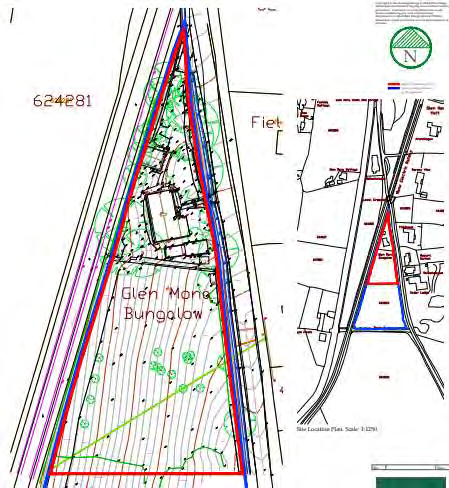
The Site comprises an existing single storey dwelling formerly known as Glen Mona Bungalow which is now to be called Thie Ny Crossag. It is located just off the Glen Mona Loop Road in the parish of Maughold. It is the first house on the right after the MER level crossing as you are travelling southwards. The property deeds consist of a bungalow and surrounds (mainly garage and access), along with an open area of (presumably once agricultural) land, in total (including the house and parking) approximately 2 acres in size. The area edged in blue indicates the entire wider site, with the area affected by the proposals edged in red (“the site”) in the zoomed in map below. These boundaries are only indicative. The site plans and topo plan which are more exact are attached as separate documents.
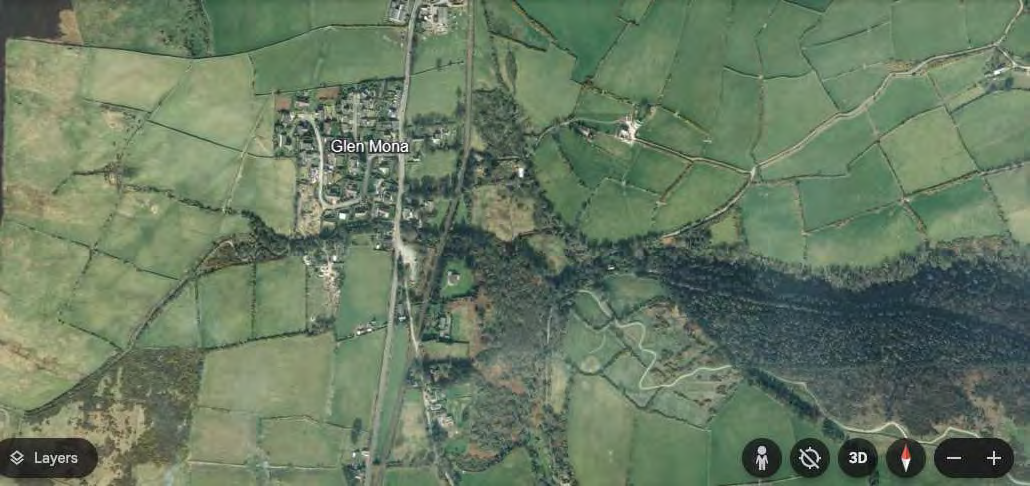
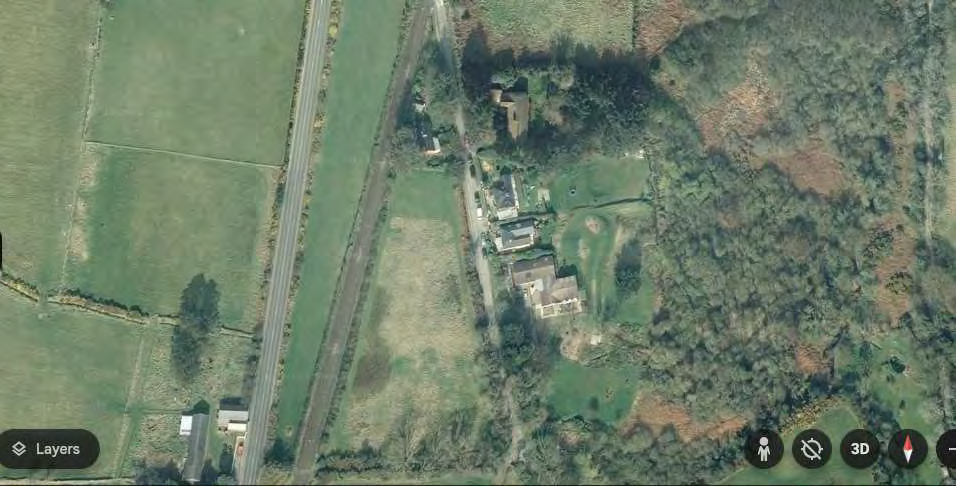
Existing site plan, Drawing no 2023-056-101
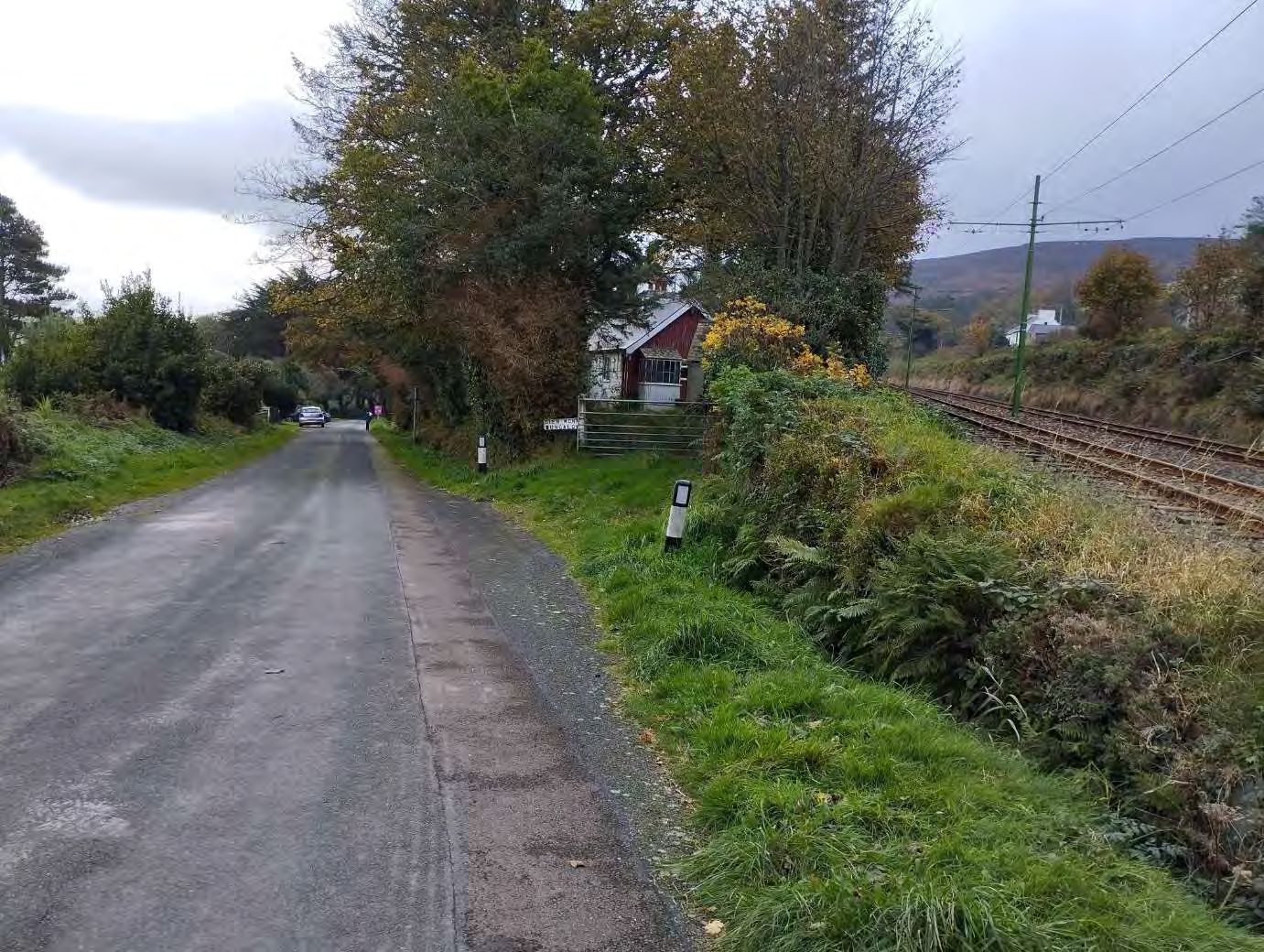
Access – The existing vehicle access is located at the northernmost end of the site, directly onto the parking/yard/garden for the property. There is currently no other garden area other than at that end of the bungalow. At present we have to either reverse in or out or the drive, we cannot turn within the property. Proximity to the MER line is an issue with that regard, as well as the opposite gateway to a field having permission to be turned into a property.
Existing access, to be retained, at the north end of the property. Of note is the MER line to the right, and it is considered important to create more parking and turning within the property boundary rather than adjacent to the MER line. The proposals will facilitate this after the bungalow is demolished.
View northwards toward proposed building area, which is just adjacent (to the south) to the existing building
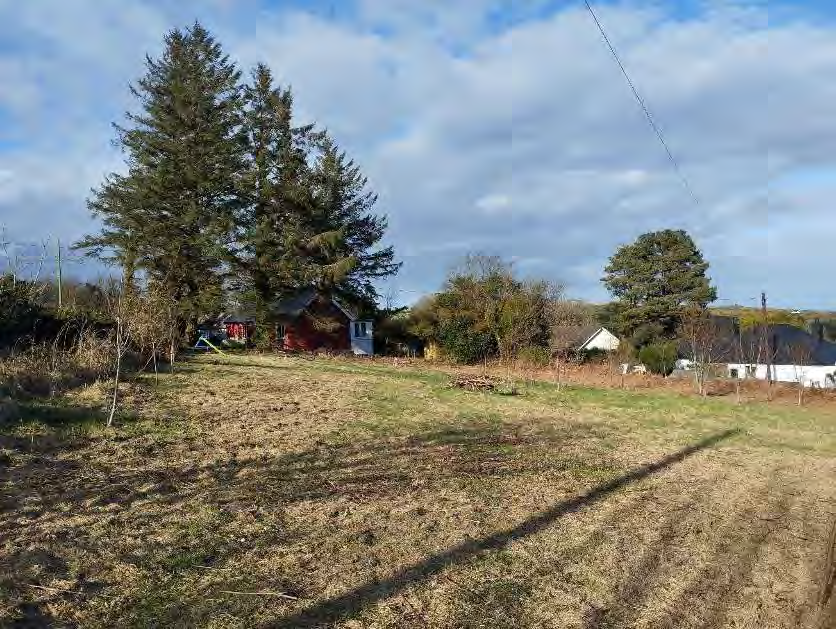
Close up view of area to south of existing house proposed to be built upon along with area immediately south of this as lawn (above photo). This is hardstanding base of previous building (possibly greenhouse we’ve been told), and small greenhouse (unusable, smashed) we have dismantled and hardstanding for former rotten shed also.
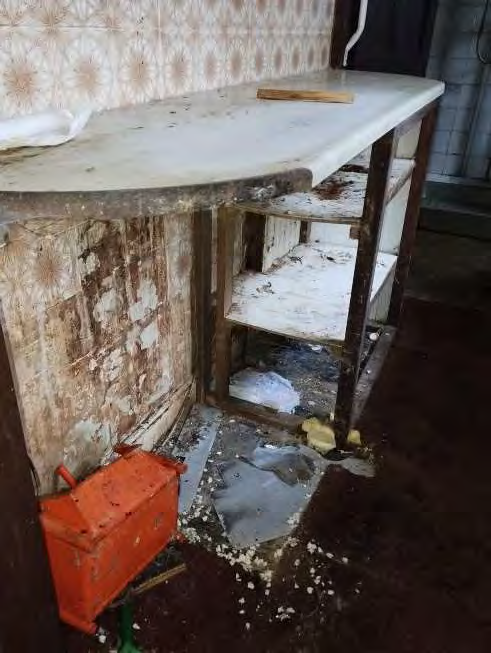
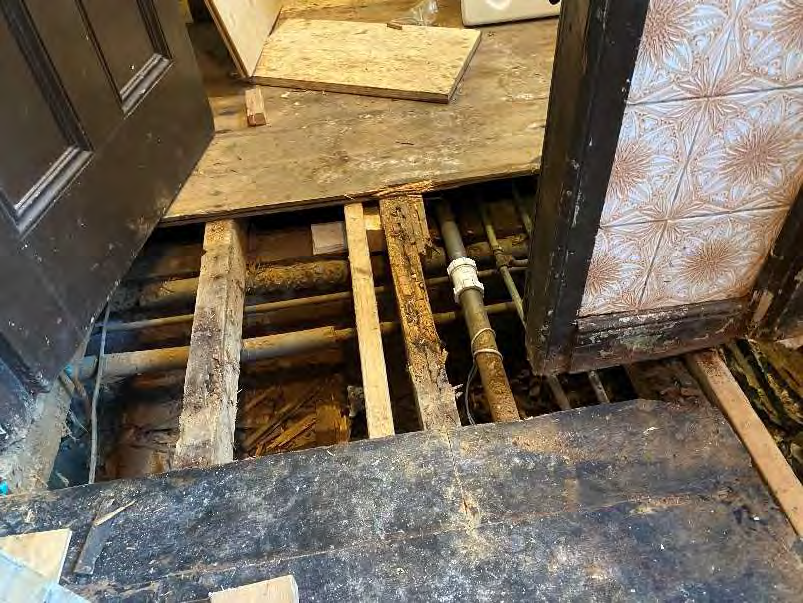
The existing property is a bungalow of unknown age, thought to be approximately 80-100 years. It covers approximately 125m2. The structure is timber with metal corrugated cladding with no insulation. Some of both the timber and cladding is rotten. At the time of purchase of the site by us, the condition of the bungalow was very deteriorated having been empty for a number of years and was in a state of disrepair. The porch was rotten with unusable door and smashed glass. The conservatory roof had lifted, and its floor completely rotted away, with a lot of ivy growth inside it. There were holes into the house directly from the outside and signs of vermin in the house. The interior was very run down / neglected. The photos below were taken when we purchased the house December 2023.
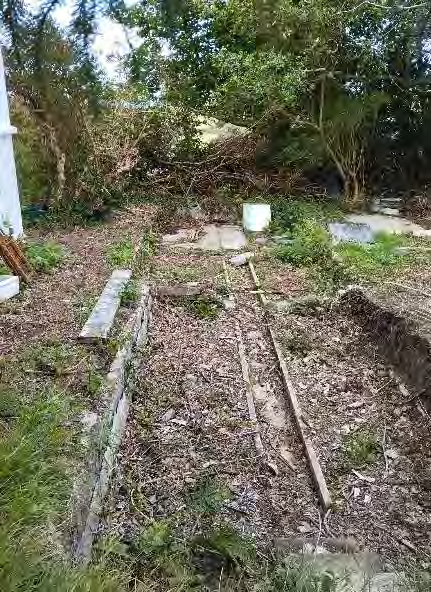
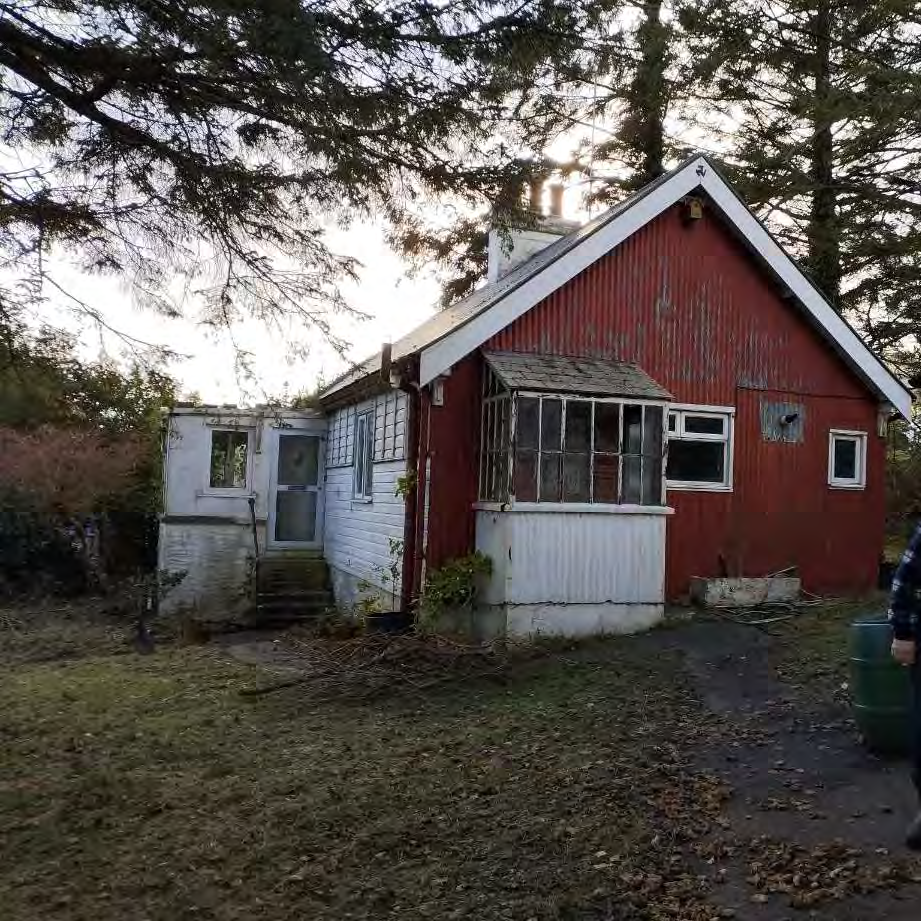
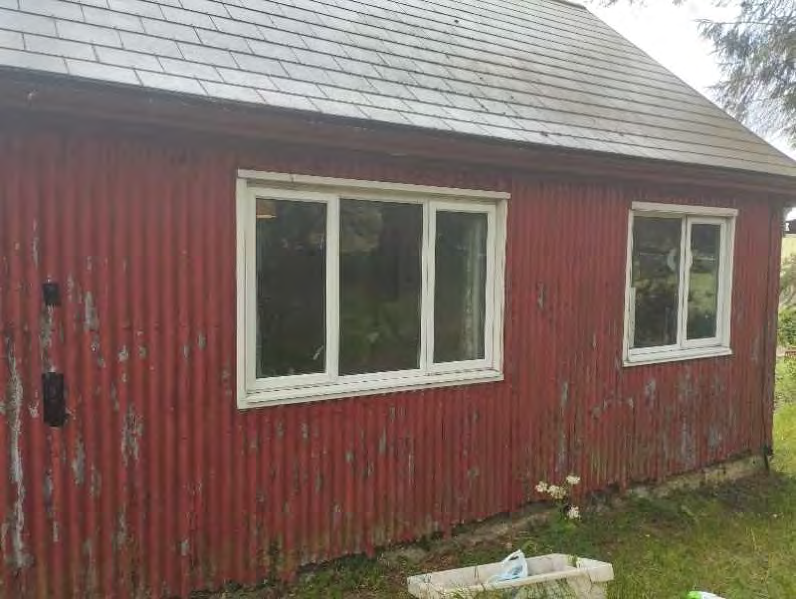
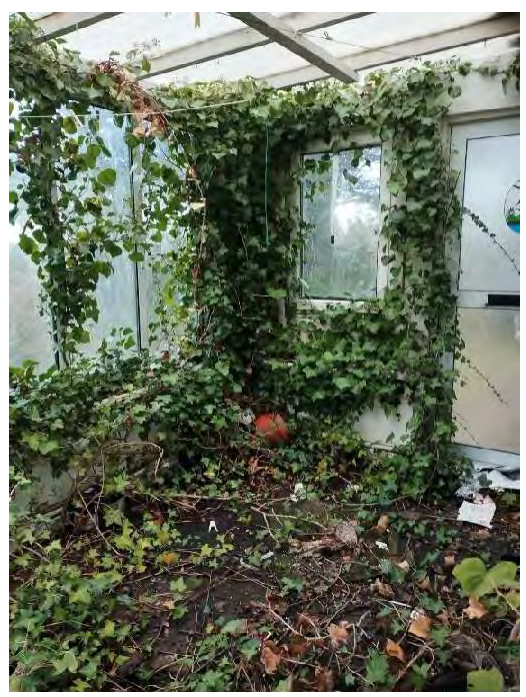
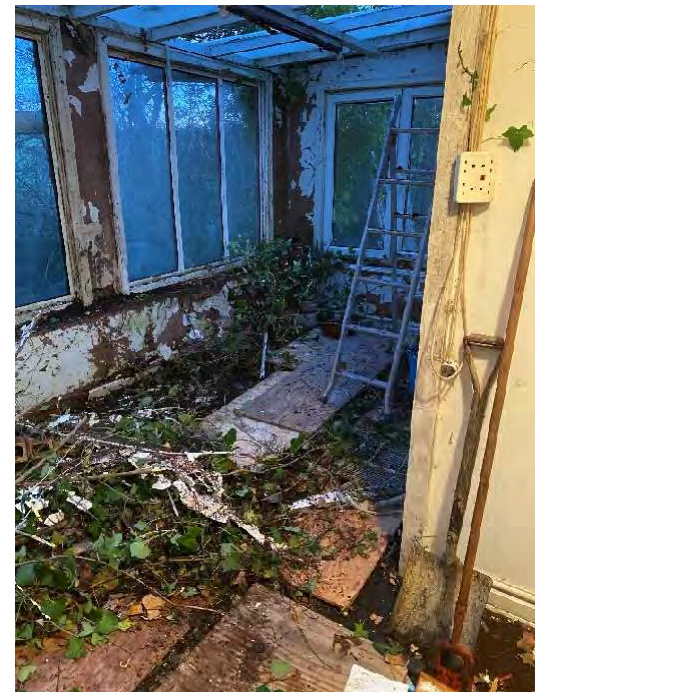
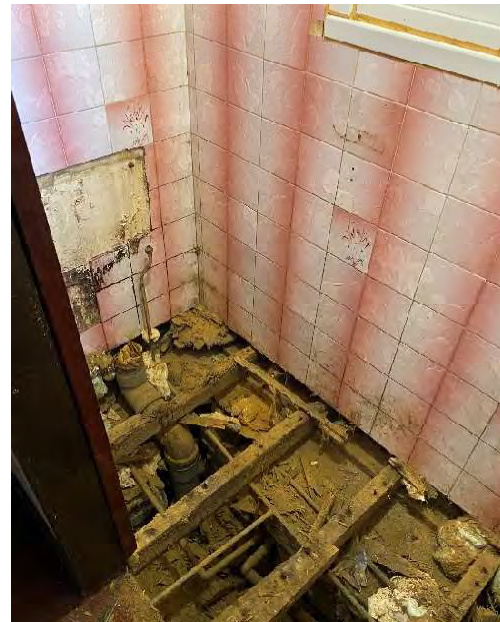
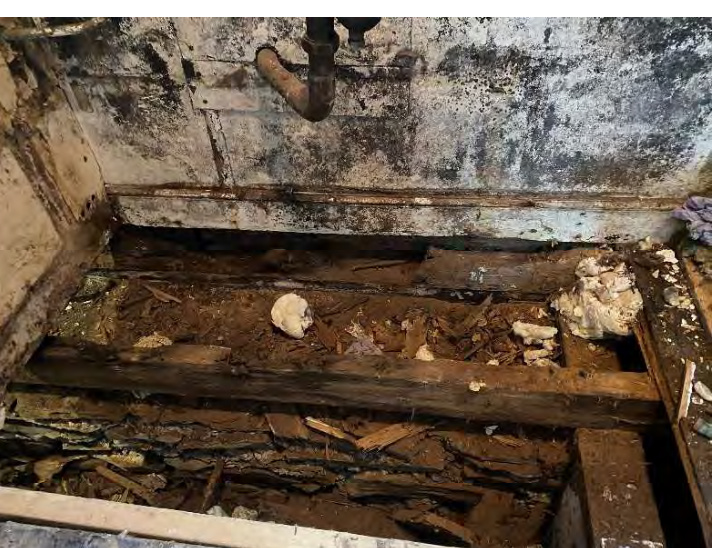
Condition inside the bungalow, including rotting of the frame and floor joists
We have now made the existing dwelling liveable for the short term although it is still actively rotting, and we are fighting damp and mould inside due to the bad state of cladding also, not to mention the cold.
The following applications were found for Glen Mona Bungalow using the Online Search, with their Date of Validation:
19/06/1991, Proposal: Extension of existing porch 04/05/1999, Proposal: Re-roofing of dwelling with new materials 12/06/1990, Proposal: Installation of satellite TV dish 21/09/1987, Proposal: Erection of a garage
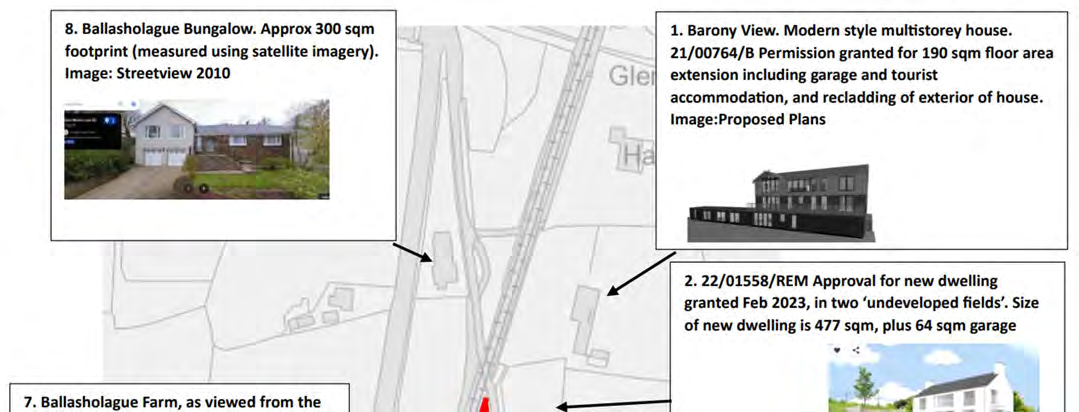
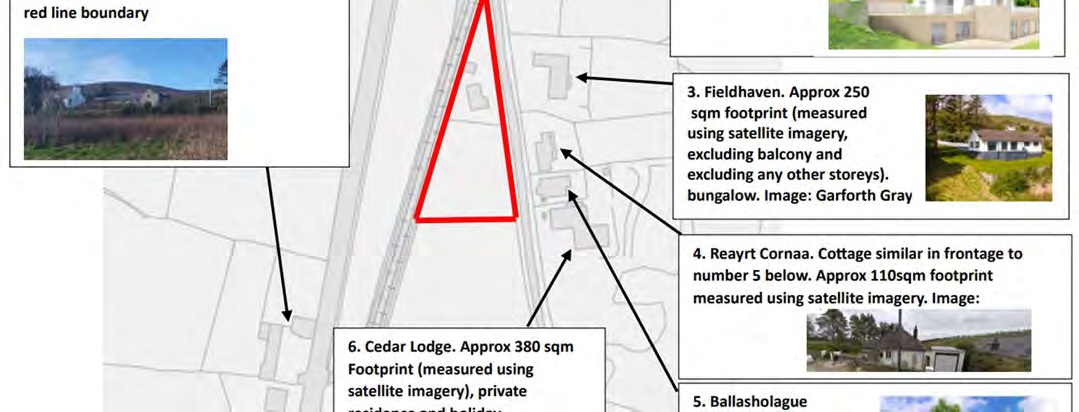
There are other properties along the same section of Glen Mona Loop Road, all detached, varying in size and structure/design. These have been placed on a plan of the Loop Road given below, with the Site outlined in red.
There is a plot with planning permission granted directly opposite the Site gateway access (no. 2) which is of importance since the permission was given for an additional dwelling on two agricultural fields. Notably during an appeal, it was noted that this field was not within the ‘open countryside’ and was seen as infill. This may be relevant to our application, although we are not infilling as such as we are not requesting an additional dwelling within the field but just moving the footprint of the house slightly along.
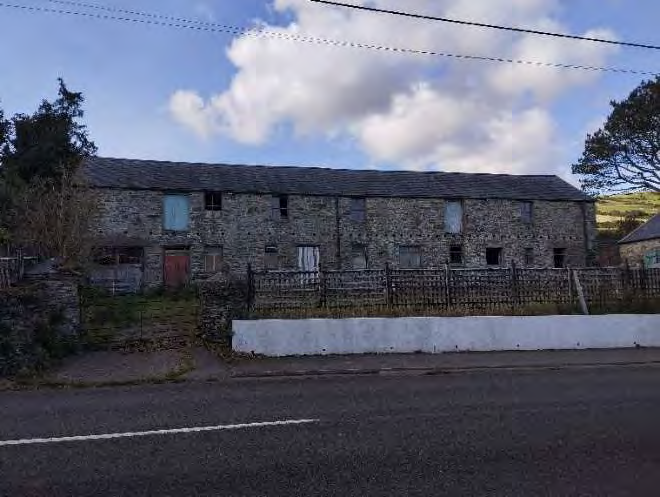
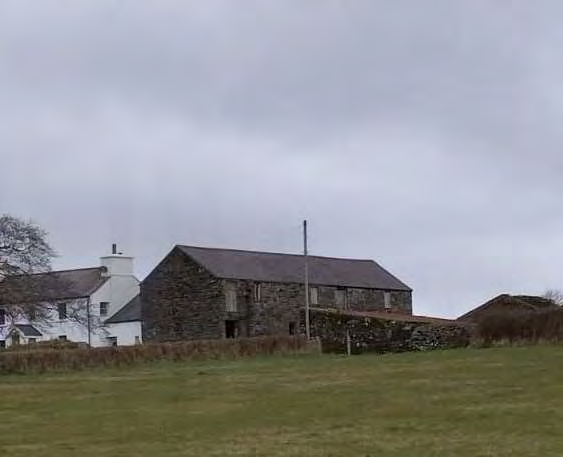
Also of note, there is a stone barn associated with Ballasholague Farm just opposite the far end of the Site on the Main Road, which has provided some inspiration for the style of building for this planning application. See no. 7 on the plan and also photograph below.

Ballasholague Farm Barn opposite the far (southern) end of Glen Mona Bungalow land
Further afield within Maughold and the island there are also other barns from which inspiration has been gained. It is our opinion that a stone-clad barn is attractive and subjectively not as contentious in design/planning terms as a house with large expanses of glazing/ balconies etc.
Barns located in Maughold (Ballaskeig Beg) and Glen Maye (Ballacallin Court)
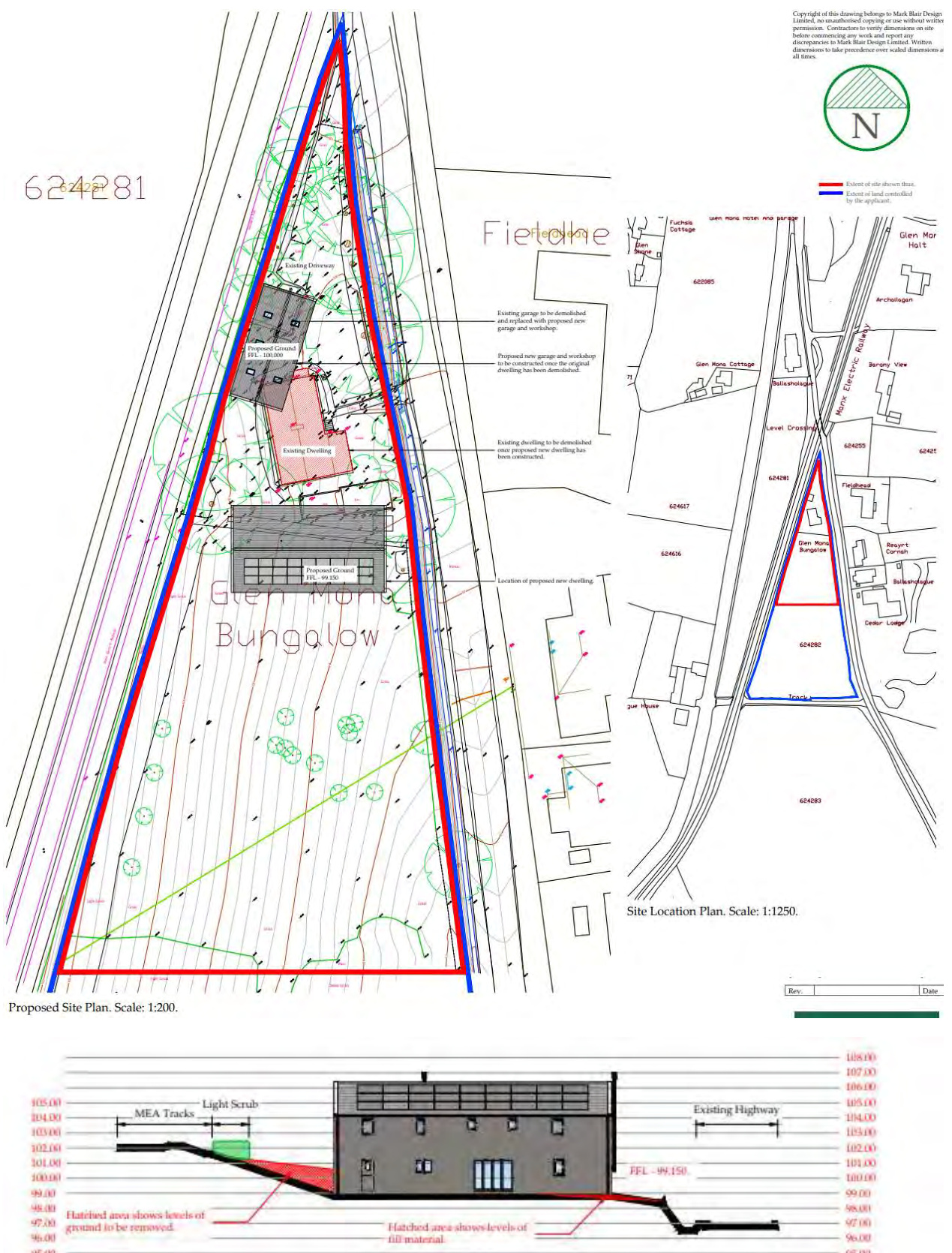
Proposed Site Section. Scale: 1:200.
Proposed elevations, Drawing 2023-056-106
It is proposed to build a replacement dwelling directly adjacent (to the south) of the existing bungalow before demolishing the bungalow. An extension to the garage is also proposed.
It is also proposed to increase the residential curtilage of the property to approximately half way down the field, to encompass the entire application boundary.
The proposed house is approximately 18 x 9.9 m externally, to be entirely clad in stone. Relatively small windows in keeping with a barn are proposed. No modern glazing options are proposed with the exception of some patio rear doors. Windows are to be flush casement mid brown oak effect uPVC.
The proposed replacement dwelling and it’s positioning has been designed taking into account the following points, bulleted for clarity:
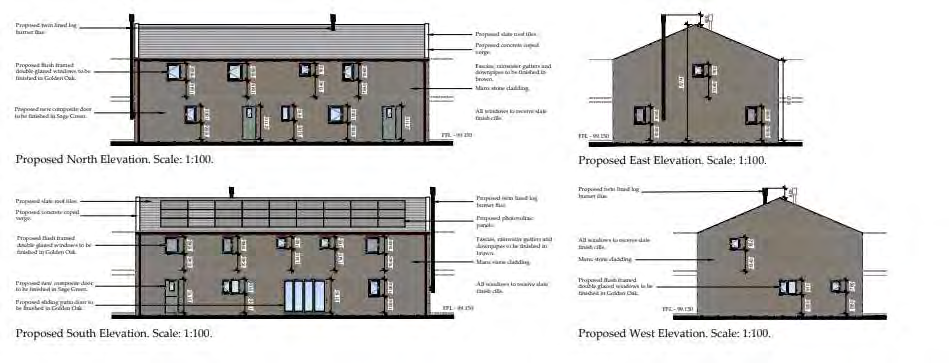
Whilst we understand that the overall increase in floor area exceeds that recognised within policy 14, the considered design of the proposals in terms of character and positive impact on the site and the wider community, and the design of the actual house including stone and slate finishes provides an overall positive impact. It is also notable that the existing bungalow is not dug down into the slope at all and it has a steeply pitched roof such that the extra floor on the proposed building will not greatly add to the height when compared to the existing bungalow, as the proposed pitch is smaller and the positioning overall of the ground floor is lower.
Access
The existing and the proposed both have the same access point from the Loop Road, which is directly adjacent to the Electric tram level crossing. This proximity makes it even more important that there is sufficient space to turn parked vehicles within the site negating the need to reverse in or out of the drive. Overall, in the proposed plan, there is sufficient space to park 2-3 vehicles whilst still leaving room to turn. A photo of the access is given in 2.0.
Trees
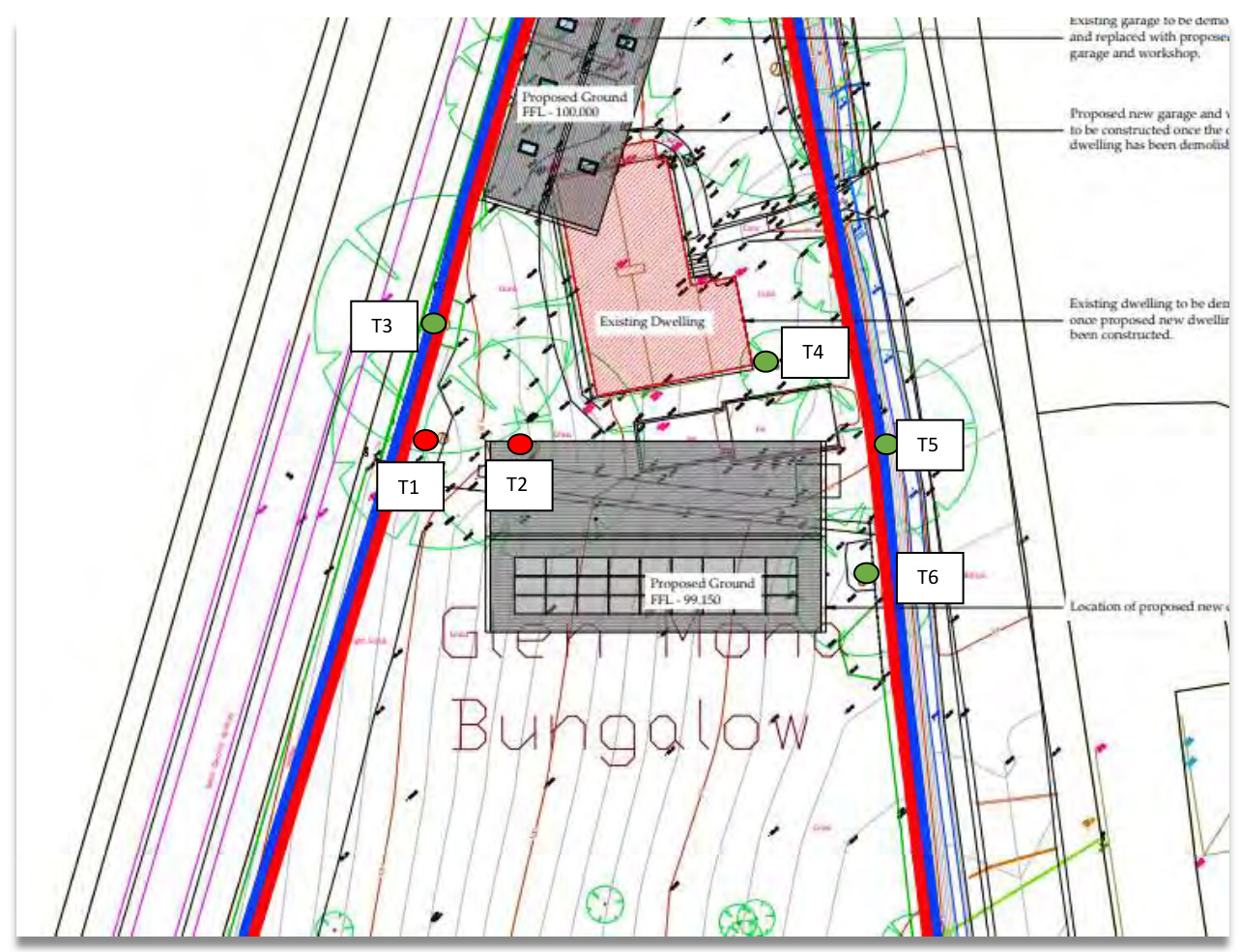
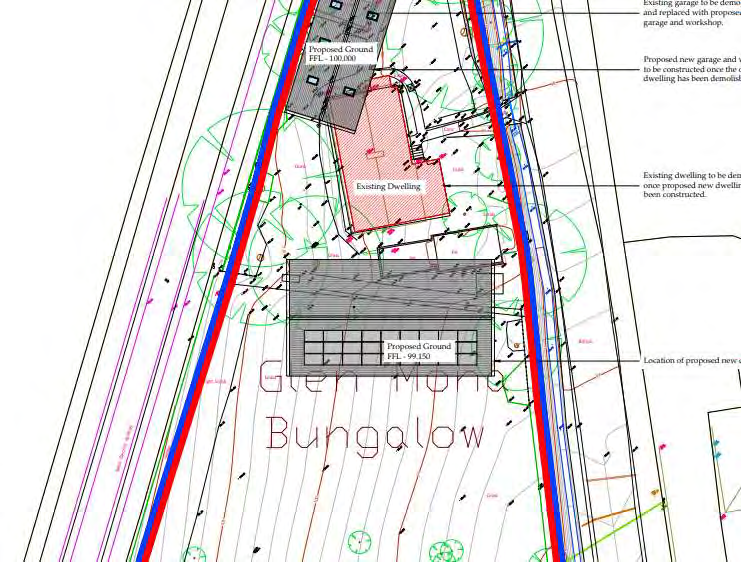
Trees on site are shown on the topo plan as attached separately. Those which may be impacted by the proposed works since they are within 15 m of the new house have been annotated below (T1T5). By moving the footprint of the house away from the majority of the trees (in the northernmost end of the site) the proposals are reducing the potential impact on trees.
| T3 |
|---|
| T4 |
|---|
| T5 |
|---|
| T2 |
|---|
| T1 |
|---|
| T6 |
|---|
Trees in vicinity of the new house T1 and T2 are due to be removed under a licence from DEFA. They are mature cedar trees.
Services
The property is currently serviced by a septic tank to the north of the garage. Due to the slope of the site, a new updated, modern septic tank would need to be installed in a location to the south of the proposed house. Mains electricity and water is already on site.
Layout
The layout of the new dwelling has been designed for our family of 5 plus a bedroom for visiting family from the UK, with 5 bedrooms in total. The main living area downstairs is on the back of the house, and will gain in light from the south due to the orientation of the building largely for solar power, with the house frontage facing the parking and approach/access. The remaining large conifer and deciduous trees will be retained around the parking and garage areas and so the visibility of the house from the loop road through the access will remain limited as it is now.
Garage
The open space inside the garage will be used for storage of batteries (for energy storage), kids and adults bikes, 3 children’s worth of other activities/outdoor gear, wood and other materials, all gardening equipment, workshop area including power tools etc, provisions for vegetable gardening etc. The provision of this space for our family will limit our need for other small sheds, temporary (potentially ugly) storage facilities in our garden.
The garage has been designed to match the house so that it ties in as a site and within the landscape, stone-clad.
Other
We have already liaised with Manx Telecoms and allowed the positioning of a new Fibre overhead line to cross from the west to east over the field out of the way of the proposed replacement dwelling. At the same time they repositioned the existing one also so that it is out of the way of the proposed dwelling too.
We have a licence from DEFA (no 170/24) to fell two of the 5no large cedar trees surrounding the existing dwelling and these will be felled outside of bird nesting season. No other tree felling is required to facilitate the construction of the house.
The position of the proposed house is situated to be behind existing trees such that its view is partially screened from the Loop Road and particularly the properties opposite.
The main view of the house will be from the Main Road above (if you are on a double decker bus mainly). In the long run, we aim to increase the height of the existing western boundary hedgerow which abuts the tramline so that we have more privacy in the garden/field.
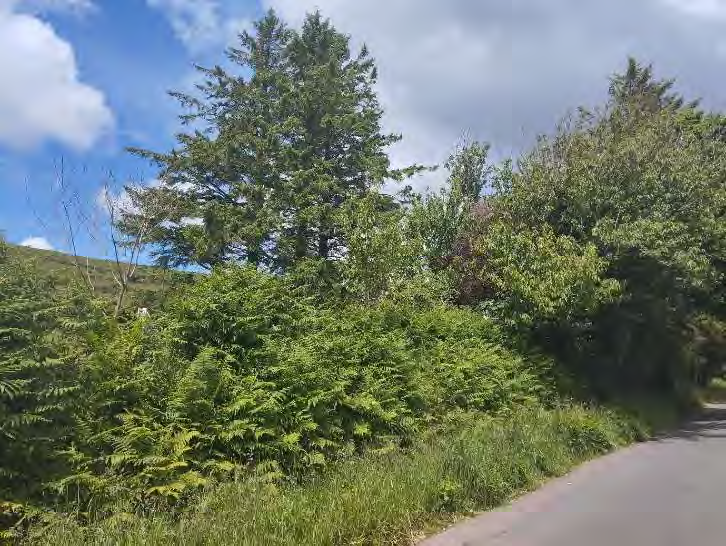
Existing view from Glen Mona Loop Road, taken from between properties numbered 4 and 5 on the plan in section 5. It is our intention to build in the location just west of the boundary trees therefore screening the house from the loop road.
Existing view toward site from Main Road.
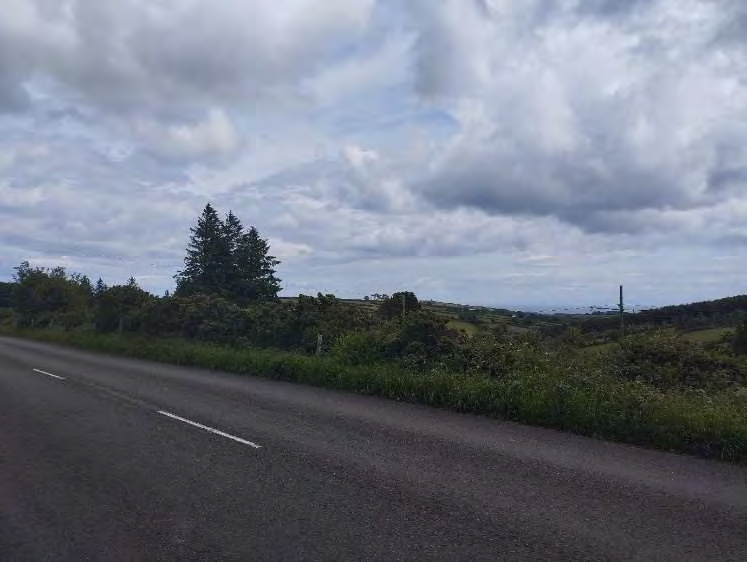
| Approximate location of proposed new dwelling. |
|---|
Photograph taken from “Design and Access Statement (Horncastle Thomas Architects) for Field 624255” (Planning permission granted) – View from Port Cornaa Road showing Fieldhaven as it stands, proposed new dwelling in field 624255 and alterations to Barony View (not completed 21/00764/B), i.e. two of the 3 large white properties on the above are artist impressions. Our proposals would not be particularly visible from this angle, with the position indicated above, and it being a stone clad gable end largely behind tree and boundary shrub cover, and would not be out of place with regard to the sizing of these nearby properties which it is in a cluster with.
Development will not be permitted outside of those areas which are zoned for development on the appropriate Area Plan with the exception of: (a) essential housing for agricultural workers who have to live close to their place of work; (Housing Policies 7, 8, 9 and 10); (b) conversion of redundant rural buildings which are of architectural, historic, or social value and interest; (Housing Policy 11); (c) previously developed land(1) which contains a significant amount of building; where the continued use is redundant; where redevelopment would reduce the impact of the current situation on the landscape or the wider environment; and where the development proposed would result in improvements to the landscape or wider environment; (d) the replacement of existing rural dwellings; (Housing Policies 12, 13 and 14); (e) location-dependent development in connection with the working of minerals or the provision of necessary services; (f) building and engineering operations which are essential for the conduct of agriculture or forestry; (g) development recognised to be of overriding national need in land use planning terms and for which there is no reasonable and acceptable alternative; and (h) buildings or works required for interpretation of the countryside, its wildlife or heritage.
Replacement Dwellings in the Countryside
There are in our countryside many existing dwellings, some of which contribute positively to its appearance and character, and some of which do not. A number of dwellings have been abandoned for many years; their physical remains being a reflection of agricultural and social change across the Island. They form features in the rural landscape which are often not unacceptable in their present state. It is appropriate to encourage change which would result in overall environment improvement, and to discourage change which would not. Where the building(s) concerned are of architectural merit or of local, historical or social interest demolition and replacement will be discouraged.
Housing Policy 12
The replacement of an existing dwelling in the countryside will generally be permitted unless: (a) the existing building has lost its residential use by abandonment; or (b) the existing dwelling is of architectural or historic interest and is capable of renovation.
In assessing whether a property has lost its habitable status(1) by abandonment, regard will be had to the following criteria: (i) the structural condition of the building; (ii) the period of non-residential use(2) or non-use in excess of ten years; (iii) evidence of intervening use; and (iv) evidence of intention, or otherwise, to abandon.
It is important that replacement dwellings should relate closely to the buildings they replace in terms of siting and size, that the resulting visual impact is appropriate for the countryside, and that existing stone and slate are re-used.
Housing Policy 14
Where a replacement dwelling is permitted, it must not be substantially different to the existing in terms of siting and size, unless changes of siting or size would result in an overall environmental improvement; the new building should therefore generally be sited on the “footprint” of the existing, and should have a floor area(1), which is not more than 50% greater than that of the original building (floor areas should be measured externally and should not include attic space or outbuildings). Generally, the design of the new building should be in accordance with Policies 2- 7 of the present Planning Circular 3/91, (which will be revised and issued as a Planning Policy Statement). Exceptionally, permission may be granted for buildings of innovative, modern design where this is of high quality and would not result in adverse visual impact; designs should incorporate the re-use of such stone and slate as are still in place on the site, and in general, new fabric should be finished to match the materials of the original building. Consideration may be given to proposals which result in a larger dwelling where this involves the replacement of an existing dwelling of poor form with one of more traditional character, or where, by its design or siting, there would be less visual impact.
It is unlikely that permission will be given for permanent replacement of dwellings which were never intended to have a permanent residential use, such as chalets and other structures built of materials for only temporary or seasonal use. 15
Applicants’ Comments
Having read the planning policies and understanding where our proposals lie outside of them, we understand that our proposals have been driven by important factors that should be taken into consideration. Our overriding desire for renewable energy sources to power our home (hence large requirement for south facing roof) and the increased need for garage storage space for the batteries for such, increased parking and turning area required to improve safety and access to highway and improvement in housing quality and style given the former house is in such disrepair and with no insulation etc, are primary factors. Secondary, we want to contribute to the local community, have a
young family to integrate into the school etc whilst keeping them under at their new home (the site) during the house build and retaining the rural nature of the property and site.
The proposed location of the new dwelling is partially just within the adjoining ‘agricultural field’ (field number 624282). The nature of this field is not agricultural nor has it been in anyone’s living memory who we have spoken to around Glen Mona. It had only been accessed from within the bungalow as there was no other field access other than one wide enough by foot from the bungalow. We have since reinstated an old gateway at the southwestern end which was buried deep in bramble to give access to Manx Telecoms and to enable us access (by foot) to Ballasholague tram stop and other footpaths / cycle opportunities for our boys, from that end of the wider site.
The land has been regularly mown at times and left to over grow at others. There has been tree planting undertaken by former owners, who apparently liked attracting birds to feed etc there. They also had three benches there; it was used as a garden. We are proposing to use an area outside of the rear doors laid to patio and then have some use of the site extended curtilage as a garden beyond, as otherwise there is a lack of usable garden space since the north end of the site is access and parking. Again, the importance of this as being used as a family home is accentuated with regard to this.
We also need to position the new septic tank within the field, away to the south of the new house within the newly extended curtilage in order to utilise the slope.
The area for which we are applying permission to extend the curtilage to was already easily identified as was less overgrown and now is regularly maintained through strimming/mowing.
We wish to retain half the field as non residential to further protect the rural nature of the area, even in the knowledge that permission has been granted for removal of agricultural restrictions on the fields opposite (i.e. we could potentially have asked for the whole field as residential, but aren’t asking for this).
The existing property has NO insulation. The proposed property will meet all expected standards in this regard and have upvc windows double glazed. Of course, the desire for our energy to be largely solar, with some wind (on the garage) (and battery storage) based will greatly improve the overall sustainability of the site. By our nature, we enjoy salvaging, recycling, reusing etc and will endeavour to source as much as possible like this during the building process.
We will be carefully dismantling the existing property in order to salvage and reuse anything deemed salvageable, and giving items away locally that we cannot use ourselves in the garage build. Likewise the foundations from the current bungalow will be utilised within the new garage proposals. Any concrete will be used for hardcore for the garage area or hardstanding areas. Stones would be reused within landscaping also where possible. Wood from within the roof will be reused.
One of the joint applicants, Amy Dunderdale, is an Ecologist with Ecology Vannin.
The proposed footprint of the new house is partially on hardstanding (thought to be footings of an old greenhouse) including previous greenhouse and half rotten/ fallen down shed, and partially on
the field. The position has been chosen for many reasons, one of which being impact on ecology. This end of the field closest to the existing house has been kept as lawn in the past and is being managed as lawn by us. This area (the application site) had some bracken encroachment on the eastern edge. We have been regularly mowing and eradicating through natural means the bracken, in order to have more lawn space for the boys to play and to stop further encroachment by bracken. We are regularly cutting the grass within the red line boundary to maintain a short sward.
Further from where we want to position the house, but within the area we wish to extend the residential curtilage to, there are scattered immature Prunus trees within the grassland. These are proposed to be retained.
The eastern boundary of the field in the proposed new residential section had tree stumps where trees had been cut down. It also has some garden shrub species present including buddleia and hebe. We have replanted some blackthorn from within the field along this boundary to provide some privacy and to protect the rural nature of the low road and surroundings (i.e. to screen any of our belongings on display etc from being visible). We have also bought and planted Hawthorn from Manx Native Trees here and within gaps on the western boundary. The boundary will be retained and unaffected by the proposed construction. The semi-mature trees shown on the topo plan adjacent to the east end of the proposed dwelling will be retained and protected during the works.
The western boundary of the field is cut by the MER and appears to be largely ivy, hawthorn and holly, and will be retained and unaffected by the proposed works.
Within the wider site (i.e. whole field), outside of the proposed site, there are areas of neutral grassland (once modified), a large area of blackthorn scrub, large area of brambles, large amount of wild raspberries, scattered ash and scattered sycamore saplings. There are some mature ash within boundaries along with hawthorn, holly, sycamore and some stands of Hardy Fuchsia. These will all be retained.
We have just planted (March/April 2024) a small orchard with native and locally sourced fruit trees from Manx Native Trees along with Hawthorns which we have used to infill some boundaries and 2no rowans which have been planted as part of a longer term tree planting plan to enhance the ecology of the site and replace any ash which may not be standing in the future.
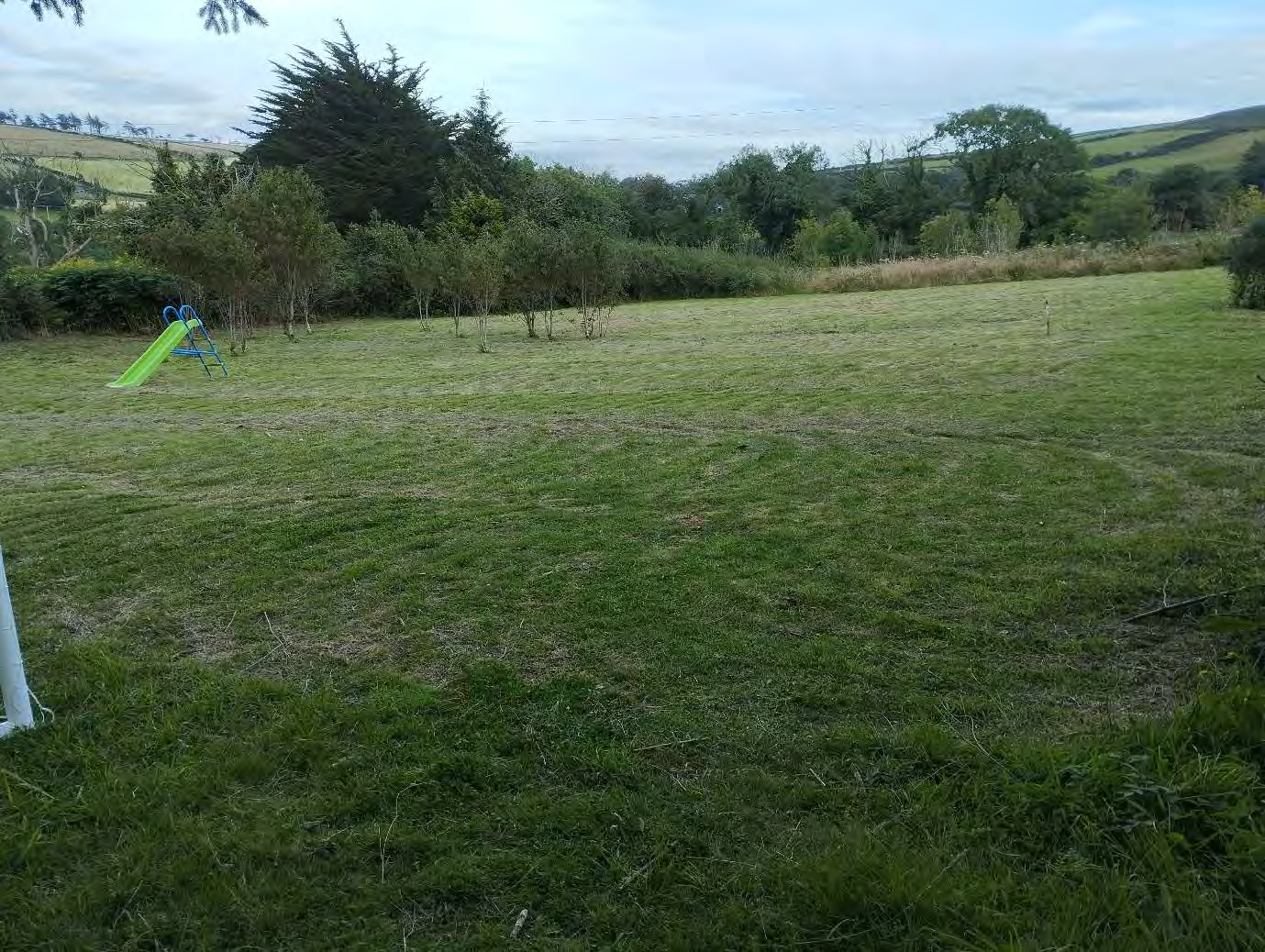
Current red boundary field area showing closely mown, with varied structure of field (wider site) beyond, taken August 2024
Steps we are taking to protect, minimise disturbance of and enhance ecology at the site and within the wider boundary are bulleted below:
We feel it is important to acknowledge that a large number of potential other buyers/owners of this field may have just flailed the whole agricultural field. We absolutely love the different elements/habitats of it and want to see more wildlife and, more importantly in the long run, instil an interest in and love for the ecology in our children.
Precautionary Working
Although their presence is deemed unlikely and the site is being managed to discourage them at present, the following points will be followed in order to safeguard all wildlife in particular lizards and frogs:
We intend to use at least some stone walling in the new garden areas which could enhance the site for frogs and lizards post construction, along with increased wildlife friendly planting.
We wish to provide some examples of case studies or similar applications that have been approved in Maughold in recent years. Quite a number of applications have been given permission that we believe are relevant here as follows and we wanted to draw your attention to them.
Rhenab Cottage, 19/01011/B: Permission was granted for demolition of an original old Manx cottage and its replacement not on footprint, albeit for different justifications (damp and proximity of old cottage to the road).
Ballasaig Cottage, 22/00025/B: Erection of proposed replacement dwelling, together with extension to existing residential curtilage. Permission was granted to demolish an old character Manx cottage and replace with much larger new dwelling off-footprint.
Field next to Barony View 22/01558/REM, permission for new (not a replacement) large dwelling given on agricultural fields opposite the entrance access to our bungalow.
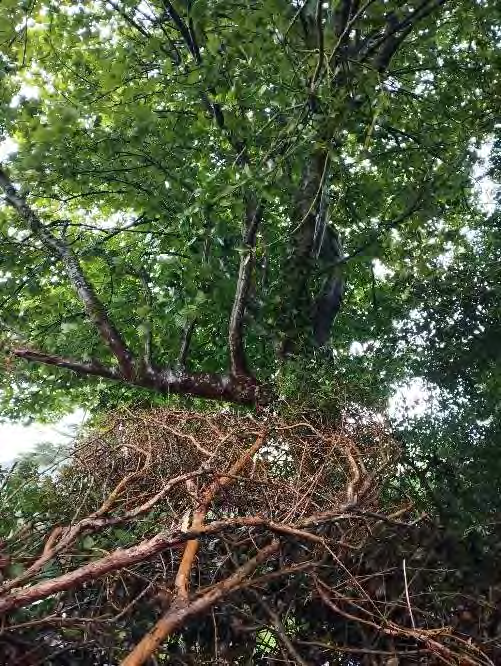
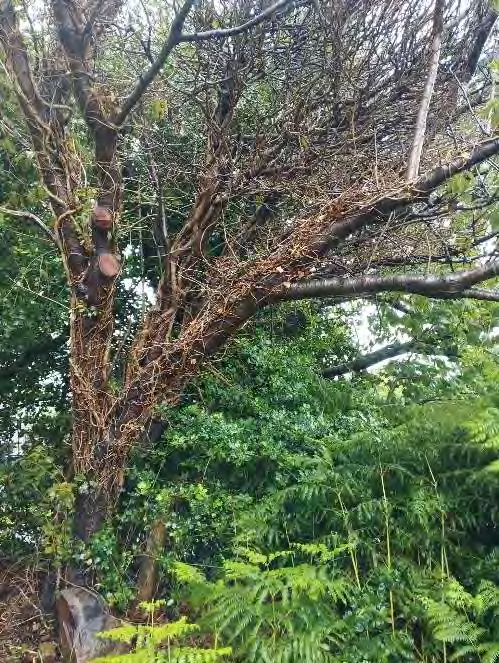
‘T4’ is a hardy fuchsia, can be retained
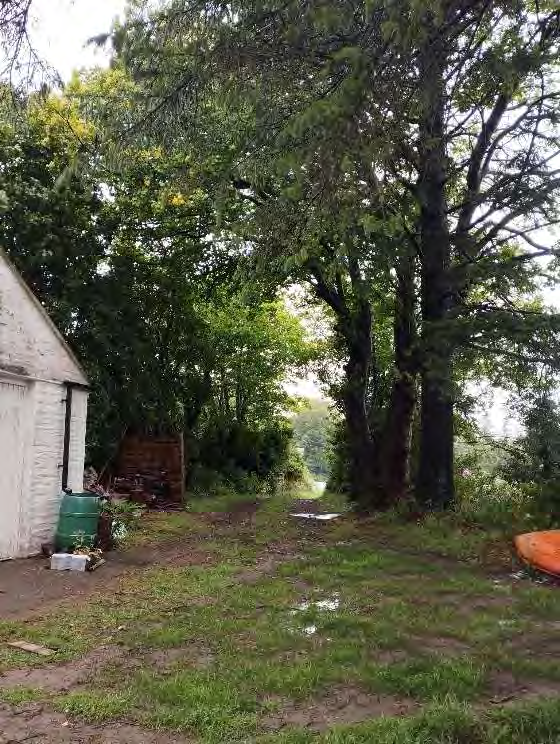
Existing area to north of house looking towards drive/parking, surrounded by trees, proposed to be retained and not impacted by the proposals
Copyright in submitted documents remains with their authors. Request removal
