Loading document...
Colby AFC sports ground Colby Isle of Man IM9 4LR
DEPARTMENT OF INFRASTRUCTURE
DATE: 30th August 2012
PREPARED BY:
Paul Hadfield Cable & Wireless
CABLE & WIRELESS REFERENCE:
Colby AFC
Cable & Wireless Communications Second Floor, 14, Athol Street, Douglas, Isle of Man, IM1 1JA T +44 (0)1624 692200 www.suresw.com
Cable & Wireless is a 11-AUG-2012
Cable & Wireless Communications Second Floor, 14, Athol Street, Douglas, Isle of Man, IM1 1JA T +44 (0)1624 692200 www.suresw.com
Cable & Wireless Isle of Man Limited incorporated in the Isle of Man with Company Registration No. 0046212 641 Registration No. 000 5665 08 Cochrane, 11A, Geller, St. Hebburn, D & Galling F 91 E, 317 0565 5Mile, T & Sants, 11B, Geller Registered office: PU Box 166 11B, Geller, One Circular Road, Douglas, Isle of Man, IM9 4 2NZ
As a licensed Mobile operator, Cable and Wireless (C\&W) loM Limited constantly are striving to deliver a high quality mobile experience for all our customers.
The C\&W mobile Radio Access Network consists of a number of sites that have a combination of equipment, such as panel antennas that provide the mobile coverage and transmission dishes that connect the site back in to the wider telecommunications network.
C\&W will endeavour, whenever possible, to install our equipment on existing infrastructure or radio transmitters. Where this is not possible and it is necessary to introduce additional telecommunications infrastructure onto the Island - our supporting statements will justify both why the infrastructure is required and demonstrates that the best possible available site has been identified. Our aim is always to minimise the visual impact of our expanding Radio Access Network.
This supporting statement will also help explain the decisions which led to the specific location being chosen and what alternatives were discounted.
(As stated in the 2009 loM Council of Ministers Report - GR No 20/09)
The introduction of mobile technology has brought many benefits in the ability to contact the Emergency Services in emergency situations such as road traffic accidents and the reporting of crime. This is particularly relevant in rural areas where there may be no access to fixed-line telephone services.
With widespread use of mobile phones, we are no longer dependent on landlines and help can be secured via mobile phones. There is a large volume of evidence in the medical literature that the eventual outcome of many serious medical conditions is dependent on the rapidity with which expert care is secured; e.g., heart attack (the survival and the extent of the damage is related to the delay between the onset of symptoms, and administration of clot-busting drugs - the shorter the delay, the better the outcome). Similarly, there is a "one hour rule" for major accidents - best outcome is obtained if the victim receives expert care within the first hour of a major accident. The list of conditions for which rapid treatment determines the outcome is expanding: e.g., stroke - a condition which has been added to the list. Since many of the emergencies arise in unpredictable situations mobile phones have literally saved lives.
Mobile phone technology has facilitated communication; it is no longer necessary to wait for a worker to return to their office to contact that person. This shortens time delays and decision making. It would be difficult to quantify the indirect economic benefits but the fact that modern day business is highly reliant on mobile phone technology provides ample testimony to the economic benefits.
An issue which is self-evident is that mobile phones have improved the quality of life, removing barriers to communication. Mobile phone calls and 'texts' (SMS messages) are extensively used in social situations and many teenagers of today cannot imagine a life without mobile phones.
Mobile phones also provide reassurance for parents and carers by helping them to maintain contact as required with their children. Again, it is difficult to quantify the benefits of this but it is likely to enhance the quality of life of all those involved.
In summary, the benefits from mobile phone technology are:
Direct: Emergency situations Indirect: Economic benefits Improving quality of life
To improve our 3G (UMTS) mobile infrastructure in the South of the Island, C\&W proposes to install two lightweight antenna panels on the floodlight towers recently constructed around the Astroturf pitch at Colby AFC's sports ground.
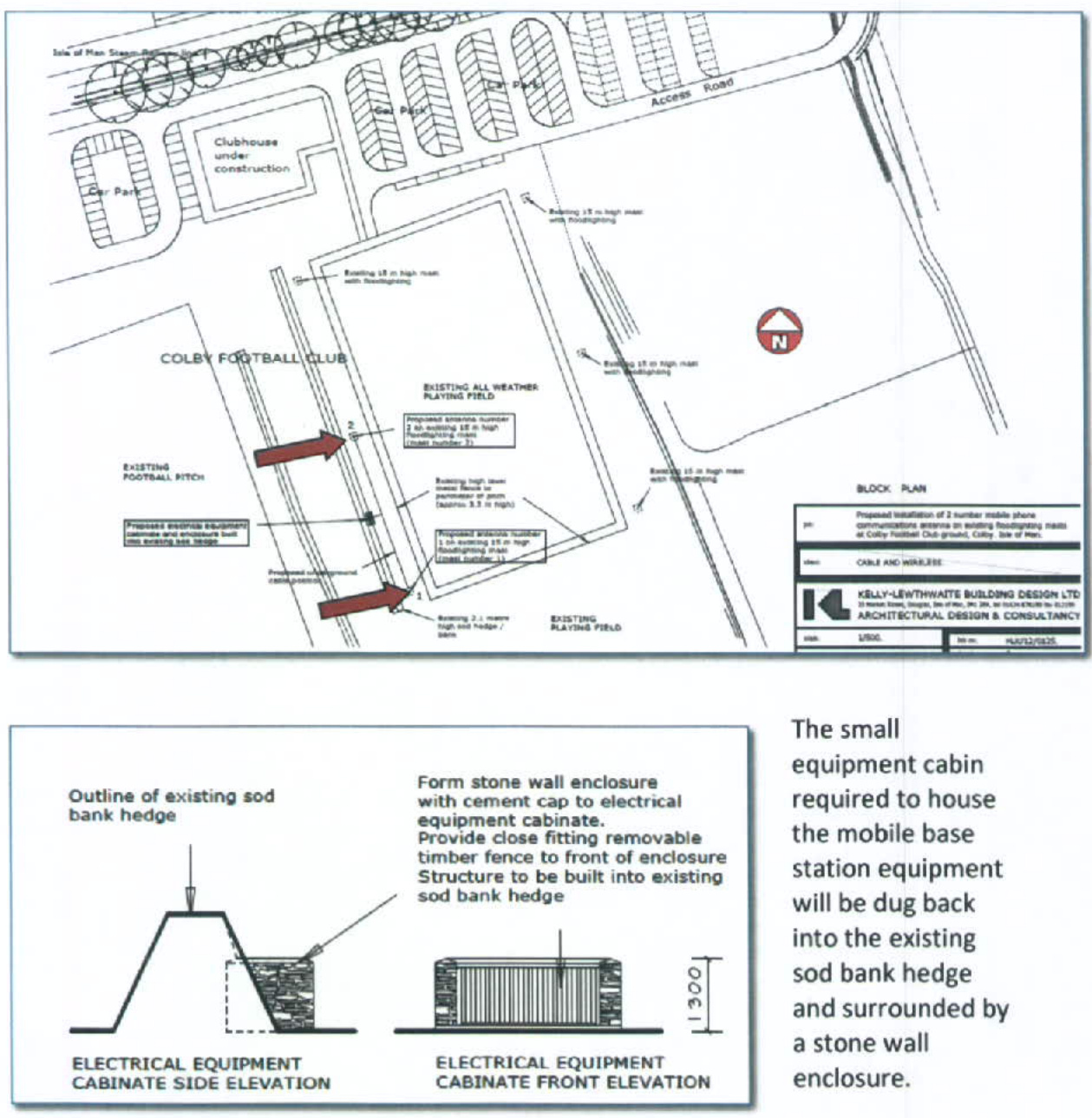
To support the mobile antenna installation there will be a 30 cm diameter microwave transmission dish and a small equipment cabin by the side of the sports pitch.
Our proposal will have very little visual impact to the existing floodlight towers due to the size of the antennas; the equipment will also be painted to match the existing structures. The equipment cabin will be dug into a grass embankment surrounded by a stone wall enclosure as per the site drawings.
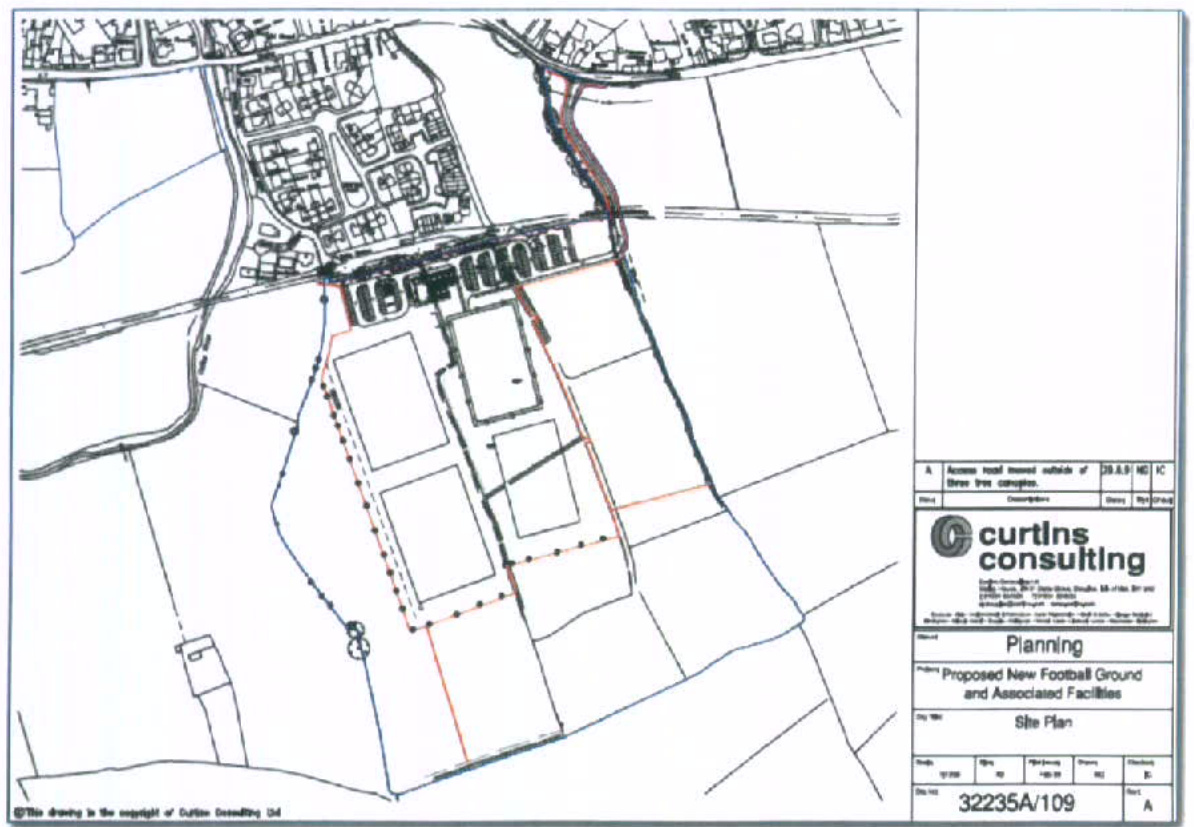
The newly constructed Colby AFC sports ground (09/00340/B) consists of 4 sports pitches, clubhouse and parking area. As shown in the drawing below the Astroturf pitch has good separation from residential properties.
{{image:57333}} The Astroturf pitch has six, 15 metre high floodlight poles already installed around the pitch. This picture was taken from the North East corner of the Astroturf pitch.
The two floodlight poles to be used to mount the antennas are in the South Western corner of the pitch and indicated in the site drawing below.
The small equipment cabin required to house the mobile base station equipment will be dug back into the existing sod bank hedge and surrounded by a stone wall enclosure.
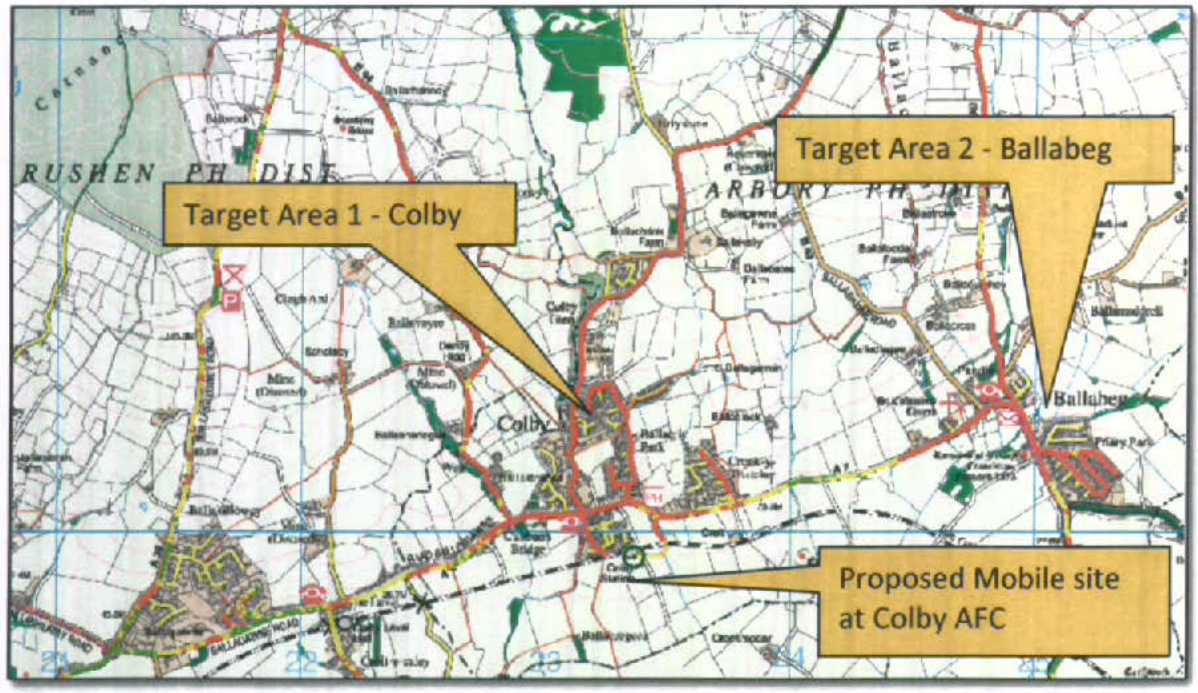
There is a current need to improve the C&W 3G (UMTS) mobile coverage around the villages of Colby and Ballabeg. This improved coverage will support voice and HSPA mobile data services benefiting both local residents and local businesses.
The data in the map below is from a 3G coverage survey completed early 2012. The red lines on the map show areas of poor indoor coverage.
C&W currently has no other telecommunication installations in the local area that can provide the required infrastructure. Also due to the scenic nature of the local area and costal facing we accept that this is not a suitable location for a standard telecommunication tower.
Other sites reviewed and discounted included: Balladoole Quarry, Colby Glen Hotel, Ballakilpheric and Colby Train Station. These were discounted due to visual impact of a mobile tower and close proximity to residential properties.
As a result of our planning exercise we consider that a radio base site at Colby AFC Sports ground provides best compromise of distance from residential buildings, minimal visual impact and location in terms of our target areas for improved mobile service.
This proposal has been discussed with Mr Ian Brooks at Planning \& Building Control.
This is our first planning application for this proposed site.
This site has been designed in accordance with the current mainland UK Cellular operator's guidance for both Occupational \& Public ICNIRP compliance. A signed ICNIRP certificate is enclosed with this application.
Estimated Electro-magnetic (EM) level = less than $0.5 \%$ of ICNIRP limit
1) Isle of Man Government Statutory Boards, Offices \& Agencies Plans 2006-2009. Volume 3.
Page 25 under Communications Commission Aims \& Objectives Section: Objective: Social inclusion - to enhance access to services for the whole population: "We will enforce universal service obligations by telecoms operators with significant market power. They must provide telephone services throughout the Island," 2) Isle of Man Government Statutory Boards< Offices \& Agencies Plans 2005-2008. Volume 3 Page 20, under Communications Commission Aims \& Objectives Section. Objective; The built Environment -,to reduce the visual impact of telecommunications and radio infrastructure on the Island's landscape. "We will encourage increased mast sharing by broadcasters, under the Radio Masts Regulation Act Limitations". 3) The Town and Country Planning Act 1999.
Page 101"A balance must be struck between the need for new, evolving communications systems to satisfy residential and business demand and the impact that the necessary infrastructure will have upon the environment. Measures which may help to achieve a satisfactory balance will include a presumption against visually intrusive
masts in sensitive landscapes, the encouragement of mast sharing by different operators, and the removal of redundant infrastructure. Exceptions to this policy would need to demonstrate a strategic national need, which cannot be otherwise secured by mast sharing or alternative locations."
Cable and Wireless believe the installation complies with the Islands Policies above.
As stated by the IoM Government there are tangible benefits of an improved mobile service for residents and local business. These include communicating in 999 emergency situations, generally improving quality of life and providing infrastructure for local businesses. In addition to voice, e-mail and SMS services many local businesses also use mobile data for their card payment machines.
The Colby AFC's sport ground provides an excellent location for a mobile base site in terms of our target areas for improved coverage and having good separation from residential properties.
Additionally by using the existing floodlight towers our proposed mobile installation will have very little visual impact to the sports ground or the general views of the area.
Copyright in submitted documents remains with their authors. Request removal
