Proposed Redevelopment of 27- 28 North Quay Douglas for Kelman Ltd
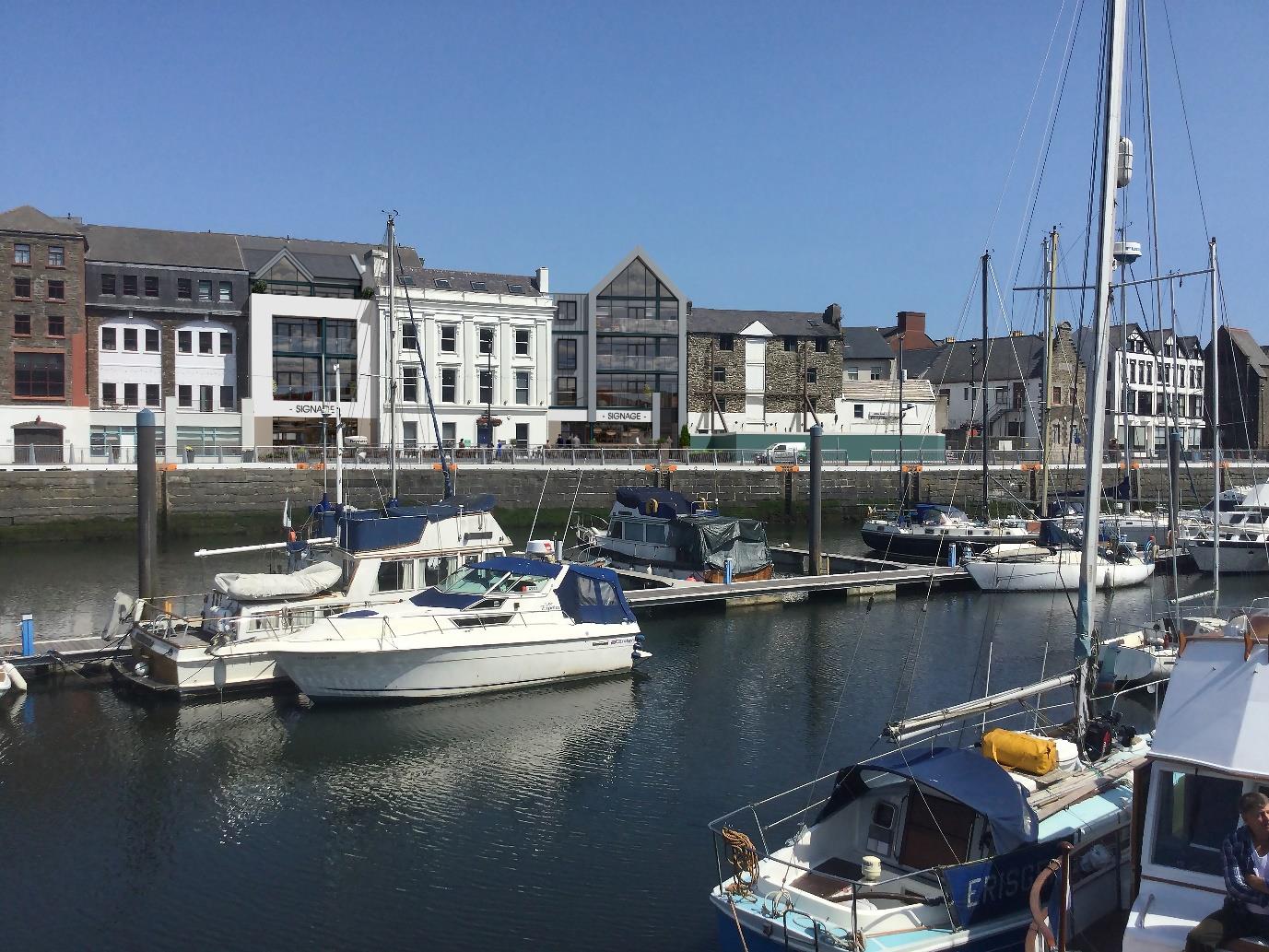
A photograph showing a harbor scene with several boats moored in the water and a row of multi-story commercial and residential buildings along the waterfront in the background.
Design + Access Statement + Planning Assessment
SAVAGE + CHADWICK Chartered Architects
CONTENTS
1. INTRODUCTION
2. DESIGN CONCEPT
3. PLANNING POLICY FRAMEWORK
4. ACCESSIBILITY AND ACTIVE TRAVEL
5. BENEFITS OF THE DEVELOPMENT IN CONTEXT
6. CONCLUSIONS
Appendices
1 Introduction
1.1 Kelman Ltd own nos.22-28 North Quay Douglas. This site is in a key position in one of Douglas’ most attractive waterside areas. Following the semi pedestrianisation of this area some years ago a number of Bar and Restaurant businesses have established themselves making the area popular as a destination at lunchtimes and evenings. Many of these buildings have, through conversion or redevelopment, found a use for their upper floors as residential or tourist accommodation as the view over the harbourside marina is an attractive one.
1.2 The application site consists of a number of buildings that have fallen into disuse. A former jewellery shop and outdoor clothing company business closed some time ago leaving these buildings empty and unused. There is however one building – Merchant’s House (no.24) – which has been converted extended and refurbished and until recently was used as offices.
1.3 The site sits within the North Quay Conservation Area and nos. 27/28 North Quay are included on the Protected Buildings Register(RB289)
1.4 An application to redevelop the whole site (with the exception of the retention and conversion of Merchants House) was refused on 28th September 2022. (22/00148CON + 22/00149/GB). The refusals were appealed and the appeals inspector recommended that the original decision be upheld. This recommendation was accepted by Defa on 8th January 2024. The principal reason for the refusal(s) was the proposed demolition of the registered buildings
1.5 A number of structural assessments of the existing registered buildings were undertaken by Curtins Consulting Engineers and Structura Consulting Engineers on behalf of the applicant. These studies shaped design decisions for the above applications as they indicated the registered buildings were in a very poor and unsafe condition. Other than necessary essential repairs those buildings (27 and 28 North Quay) remain unchanged since the appeal decision was upheld.
1.6 Kelman then recommissioned Savage + Chadwick to devise a further mixed use scheme for the majority of the site (22- 26 North Quay) which again consisted of ground floor leisure units – in the form of Restaurants and Bars – and upper floor apartments. As the future of the registered buildings remained uncertain due to their poor condition and without a safe method of retention and conversion, these buildings were excluded from that application until a safe, practical and economically feasible solution was found for them.
1.7 This application (25/90441 and 25/0442/CON) was approved at committee on 11th June
No Appeal was raised.
1.8 This did not solve the issue of nos. 27/28 North Quay (the registered buildings) however. A further scheme has consequently been produced which seeks to convert and restore 27 North Quay. This proposal includes the insertion of a steel frame internally to support both existing external walls and new floor structures as this major structural insertion is seen as the only way to safely address the serious structural issues that exist. This conversion comes at a considerable cost, which in is prohibitive to development.
1.9 No 28 North Quay which is a much smaller building and has equally serious structural issues is not considered viable for conversion. The structural insursion necessary would leave very little useable floor area and the cost would not just be prohibitive but unjustifiable in correlation to the very limited space available after conversion.
1.10 The site is named within the Isle of Man Government register of unoccupied urban sites (UUS 30) collated for the Area Plan for the East planning process, listing the site as mixed use. The site therefore qualifies for support funding from the Island Infrastructure Scheme. Funding for this scheme ended on 30th June 2025. Meetings have taken place with the Department of Enterprise who administer this scheme, prior to the 30.06.2025 date and they confirmed funding can be made available for the works to 27 and 28 North Quay subject to their standard terms and planning consent.
1.11 This funding has enabled Kelman to seriously consider the proposal as detailed in the current planning application. Whilst the financial feasibility is, at best, marginal the available funding prevents the scheme from making a significant loss.
1.12 Following this advice a series of meetings have taken place with the planning case officer and the conservation officer. The scheme has been developed following their advice and the outcome is considered an acceptable proposal for both applicant and planning authority.
2. The Design Proposal
2.01 The previous refusals (22/00148CON/22/00149/GB) for redevelopment of both the registered buildings contained exhaustive structural arguments from five sets of structural engineers. We see little value in repeating these arguments for and against retention, other than to state that none of arguments for retention established a likely cost or safe method of conversion.
2.02 No 27 North Quay is a former warehouse building of four storeys. It is in a poor state of repair. It should be noted that nos 27 and 28 were in a poor state of repair when Kelman purchased them and the planning department subsequently registered them. Nos 27 and 28 also have significant structural issues. In the case of no.27 this involves significant movement and torsion of the rear wall.
2.03 Kelman obtained the advice of three structural engineers independently and all came to the same conclusion. In order to safely retain the buildings, it will be necessary to lift in and locate an internal steel frame to both support the existing stone walls (replacing the external raking shores) and replacement floors. It is necessary to replace the floors as they are incapable of accepting current loading requirements and are in poor condition. The ground floor will also need to be raised to achieve the recommended flood level.
2.04 It is proposed to re point (and partially re build where necessary) the existing stone walls and restore the external appearance to that captured by a number of historic photographic records. Although the building will be stabilised by the structural insertion it is proposed to leave the external steel Patrisse plates holding the tie rods (to be removed) to retain a record of the historic stabilisation methods that have taken place.
2.05 Internally the building will be converted to accommodate a bar/restaurant unit at ground first and second floors and an apartment at third floor. The third floor apartment will be set into the roof space where the original roof trusses will be retained and restored. New heritage rooflights will be used to assist with daylighting the residential unit. On the lower floors the poor daylighting opportunities within the existing building are not such an issue for the bar/restaurant unit.
2.06 The existing fenestration to the building will largely retained, with new insertions being limited to a larger opening for the restaurant at ground floor and some altered opening sizes to the rear elevation. The vertical goods doors at each floor level will be re purposed as glazing.
2.07 The roof covering will be removed to allow the steel frame to be lowered between the trusses and then the existing slate covering reinstated.
2.08 Internally the building will have to be insulated and plasterboard lined to achieve the current required U values. The roof re build will incorporate the necessary insulation content.
2.09 The rear elevation will be rendered in its entirety as the stonework is in poor condition and the elevation has been extensively altered over the years.
2.09 No 28 North Quay is a two storey unit that at various times appears to have been used as both a public house and a shop. This unit has previously been identified, by all structural engineering inspections, as being in a very poor condition. In addition, the building fabric and existing openings have been extensively altered from the original building. The further issue with converting this building is the limited floorspace it would yield due to a narrow triangular plan and 500mm thick stone walls. This thickness would increase when necessary wall insulation is added.
2.10 In assessing all of these factors and taking into account no profit is available after conversion (even with grant assistance) we have advised Kelman Ltd that their only option is to demolish this unit and rebuild it.
2.11 The replacement four storey unit contains two uses. On the ground floor a small retail unit is planned, allowing the historic retail use to be continued. On the upper floors a single townhouse (with it’s entrance located directly from North Quay) and a roof terrace on the third level is envisaged.
2.12 The building design is deliberately modern to contrast with the registered building adjacent., using a combination of vertical timber-like boarding and render. Whilst taller than the existing building the height remains lower than the existing warehouse of no.27.
2.13 A combination of additional floor area and sustainable use proposals should enable the proposal for no.27 to be a viable construction with the proposed grant assistance available.
2.14 Externally. Although the external frontage to the north quay is constrained to a degree by a delivery bay adjacent nos.27/28 there is still space to create outdoor seating. We would achieve this in the same way that 22- 26 North Quay proposes – a raised removeable deck to enable level access to the buildings and the recommended flood level to be achieved for ground floor(s). As previously noted, the ground floor level of no 27 will have to be raised.
2.15 Regarding sustainability and renewable energy. The following measures are proposed;
• High performance building fabric and energy efficient lighting, services and equipment.
• Passive design measures to reduce energy demand for heating, cooling, ventilation and lighting.
• ASHPs for hot water production (apartment + town house)
• ASHP’s (DX Type) to provide heating and cooling to the ground floor retail and bar/restaurant units
• Roof mounted PV linked to required apartments and communal to ensure Part L Building regulations compliance.
• MVHR ventilation through-out
• No fossil fuels utilised
• Point of use electric water heaters (retail unit)
2.16 The proposed energy strategy above is considered consistent with the IOM policy framework and when implemented, the scheme will provide an efficient and low carbon development
2.17 A high level of air tightness is proposed and a level in the order of 5m3/h/m2 is targeted for the ground floor units, and 3m3/h/m2 for the apartment and townhouse, meaning that air infiltration between the internal and the external environment will be largely controlled, and space heating demand further reduced.
2.18 The proposed MVHR units for the flats will be located in a service cupboard in each respective residential unit. As with the ASHP each unit has two ducts which run from the internally mounted fan unit to the back façade of the building, again terminating at small discrete louvres colour matched to the external wall finish.
2.19 Any external condensers required for the ground floor units can be located on the largely hidden high level flat roof at the rear of the no.28 new build with routes identified for tray work between the external and internal units. Each ground floor unit could require 1.5m2 floor area for the external condensers and currently with the estimated PV areas there is sufficient area available for these units. The PV panel positions are indicated on the elevation drawings.
3. Planning Policy Framework
3.01 The buildings which comprise the application site all lie within the North Quay Conservation Area which was introduced in 1990 as well as others within Castletown, Laxey and Onchan as exceptions to the provisions of the Town and Country Planning (Permitted Development) Order of that year and with the Conservation Area legislation proper only being introduced in 1999 through the Town and Country Planning Act, 1999 which provides that:
“(1) The Department shall determine which parts of the Island are areas of special architectural or historic interest, the character or appearance of which it is desirable to preserve or enhance and shall by order designate such areas as conservation areas. This does not, however, denigrate the historical importance of these buildings.”
3.02 Numbers 27 and 28 (Newson’s Trading Building) are Registered (RB 289). The question then exists - is the harm caused by the loss of no.28 North Quay compensated for by the sympathetic retention and conversion of no 27 North Quay? Our view is that of the two buildings no.27 is the more important architecturally and historically and that 28 has been so extensively altered, internally and externally with new materials, that the loss of 28 is justified.
POLICY General
3.03 The site lies within an area designated on the Area Plan for the East adopted in 2020 as Mixed Use - “7. The Quayside” and within the town’s settlement boundary. The whole site lies within an area at risk of tidal flooding with the rear of the buildings and rear lane at high risk of surface water flooding according to the national flood risk mapping. There are no trees, Registered or otherwise, on the site.
3.03 Both of the properties comprising the application site are Registered (Newson’s - 27- 28) and the site lies within the North Quay Conservation Area (unlike some Conservation Areas, there is no Character Appraisal) both of which invoke policies and proposals in the Strategic Plan and Planning Policy Statement 1/01 - Conservation of the Historic Environment of the Isle of Man - which aim to protect the historic and architecturally important fabric of the Island including changes of use thereof. These policies are Strategic Aim, Strategic Policy 4, Environment Policies 32, 33, 34 and 35 and the PPS. There are also policies which presume against the demolition of a Registered Building and of any building which contributes positively to a Conservation Area (Environment Policies 30 and 39 and PPS RB/6) and against the removal of any Registered Building from the Register (Environment Policy 31). Strategic Policy 5 and Environment Policy 42 promote development which makes a positive contribution to the environment and Environment Policy 43 generally supports the regeneration of run-down urban areas although encouraging the re-use of sound, built fabric rather than its demolition.
Strategic Plan
3.03 The Strategic Plan also contains policies which protect the environment generally and the living conditions of those who live in an area - General Policy 2 b, c and g and Environment Policy 22.
3.04 For Classes 1.1 and 1.3 Uses, the Strategic Plan encourages such development to be within settlements in accordance with the sustainable policies listed above. For Class 1.3 food and drink, does not have policies which specifically deal with this other than Community Policy
4 and the preceding text which clarifies the importance of public houses as well as local shops, which is set out below: as such, the policies which relate to retail have been included in the assessment of planning policy here.
“10.8 Retention of Existing Local Shops and Public Houses The loss of facilities such as neighborhood shops in towns and or village shops and public houses reduces customer choice and can also necessitate people travelling further to meet their needs. This is a particular problem in rural areas where village shops, post offices and public houses can be central to village life. It would be preferable to retain viable facilities, or those that can be made viable and where a change of use or re-development is proposed developers will be expected to show evidence of attempts to market the property as a business in these areas.
Community Policy 4: Development (including the change of use of existing premises) which involves the loss of local shops and local public houses, will only be permitted if it can be demonstrated that the use is no longer commercially viable, or cannot be made commercially viable.”
3.05 Douglas is identified in the Strategic Plan’s settlement hierarchy as the main employment and service centre for the Island (Spatial Policy 1). There are many policies which promote sustainable development and the best use of existing sites (Strategic Aim, Strategic Policies 1, 2, 9 and 10, Spatial Policy 5, Housing Policies 2 and 4, Business Policies 9 and 10, Transport
Policy 1). Paragraph 5.9 states that in Douglas and the East the focus of development will continue to be in and around Douglas with continued regeneration particularly around the Promenades and Quayside (both Conservation Areas) to create further housing, employment, retail and leisure opportunities and Douglas Harbour’s strategic role as one of the principal gateways to the Island will be protected and enhanced along with the distinctive character of the various settlements.
Business Policy 1 encourages “The growth of employment opportunities throughout the Island…provided that development proposals accord with the policies of this Plan” and Business Policy 9 explains that “The Department will support new retail provision in existing retail areas at a scale appropriate to the existing area and which will not have an adverse effect on adjacent retail areas. Major retail development proposals will require to be supported by a Retail Impact Assessment(1).”
3.06 Business Policy 10 states that “Retail development will be permitted only in established town and village centres,” with some exceptions which are not relevant to the current application.
3.07 The Strategic Plan acknowledges the value of sustainable tourism and its historical importance to the Island (paragraph 9.5.3, Strategic Policy 8).
3.08 Car parking is required by the Strategic Plan to be provided (Transport Policy 7) although Appendix Seven explains that “Most shopping facilities in established centres do not have on site parking provided due to the intensive form of development and their location off the main highway, often in pedestrianized streets” with particular reference to Castletown, Ramsey, Peel and Douglas and goes on to state that it is “impractical” to require on-site parking for either staff or customers in such locations although it must be feasible for retail developments to be serviced. It also states that it is essential that there are sufficient areas of public car parking either in car parks or on street and that adequate controls are in place for these spaces to be available to those who need them. The previous application(s) 148 + 149 did not require a parking provision from DoI Highways.
3.09 Appendix Seven also states that these standards may be relaxed in some circumstances, specifically referencing development which would secure the re-use of a Registered Building or a building of architectural or historic interest; where it would result in the preservation of a sensitive street scene, where is it otherwise of benefit to the character of a Conservation Area and where it is within a reasonable distance of an existing or proposed bus route and it can be demonstrated that a reduced level of parking will not result in unacceptable on street parking in the locality.
3.10 Sites known or thought to be at risk of flooding will need to be accompanied by a Flood Risk Assessment (Environment Policies 10 and 13 and Appendix 4). A flood risk assessment accompanies this application
3.11 Developments of 8 “dwellings” or more on land zoned for residential development or in predominantly residential areas will normally be required to provide 25% of its units as affordable housing (Housing Policy 5). Approvals 25/90441 and 25/0442/CON provided 8 apartments and a commuted sum for a 25% provision was proposed by DOI Housing and
accepted by Kelman Ltd. This application proposes two further residential units – an apartment and a townhouse. This provision however falls below the threshold of 8 units or more.
3.12 Area Plan for the East The Area Plan Objectives are:
i. To allocate land as both general allocations and Strategic Reserves to ensure sufficient development opportunities for the lifetime of the Plan to support a diverse and growing economy.
ii. To ensure that in the East’s urban spaces, people come first and adequate space is provided for active and healthy lifestyles, attractive design and high quality living.
iii. To create an urban environment that is more responsive to changes in new and emerging working, living and retail patterns.
iv. To identify and celebrate the historic urban environment so that it retains an active and productive role in contemporary life.
3.13 Its Desired Outcomes are:
i. New development will be of a scale and density which makes efficient use of the land available.
ii. There will be a general uplift in the quality of design for new build schemes, conversions and extensions in the East which will respond sensitively to and enhance their local context.
iii. New buildings will be situated and designed so as to maximise their energy efficiency and reduce the need for energy consumption.
iv. An intelligently-designed, well connected public realm will ensure usable, safe and attractive spaces that people want to spend time in and move through.
v. There will be greater recognition of the contribution the East’s historic value to the local and visitor economy and to the quality of life on the Island.
vi. The long term future of valuable heritage assets will be assured by creative reuse.
3.14 The reference to Douglas and The Quayside in the Strategic Plan at paragraph 4.5 above is repeated twice in the Area Plan at paragraphs 2.4.1 and 3.2.3 with further reference to the regeneration at paragraph 13.2.4. Specific mention of this Mixed Use area is made at paragraph 9.10.19 with a particular Mixed Use Proposal:
Mixed Use Area 7 – The Quayside area has undergone regeneration on its northern side which has enhanced the area as a destination for people visiting restaurants and bars. On its southern side, industrial uses in older warehouse type buildings predominate. Redevelopment of the southern side to complement the quayside as a whole is to be encouraged. The Quays are also strategic freight corridors and maintaining access for commercial vehicles, including HGV’s, must be considered in any proposed development.
Due to the former industrial uses of South Quay, significant site preparation including decontamination may be required.
Town Centre – Mixed Use Proposal 7
There will be a presumption in favour of food and drink and other leisure-type uses on North Quay.
3.15 This goes on to provide specific recommendations for South Quay:
There will be a presumption in favour of the comprehensive re-development of the southern side of the quay, including the potential re-positioning of the highway of South Quay between Old Castletown Road and Fort Anne Road, for new uses in the following categories: • Tourism • Offices • Food and Drink • Leisure • Reception and function venues • Business hubs/share-service offices • Residential uses at first floor level and above.
3.16 The Area Plan makes reference to the Retailing Study Report of 2009 where it recommends that the majority of any new retail floorspace should be distributed primarily to town centre or edge of centre locations in Douglas - for example, Stand Street and the existing shopping core of Douglas Quayside with every opportunity taken to open up existing and proposed linkages between the central core shopping area and Waterfront which is taken as the Promenades and Quayside.
3.17 Specific reference is made to redevelopment at paragraph 6.8.3:
Existing and new development can exist side by side, even with some visual differences presented by old and new building styles. New development should not seek to mimic existing development but be of its own time. Such innovation is crucial and with good precedent: some of the Island’s best architectural examples emerged from the building design competitions of the Edwardian era.
Urban Environment Proposal 3 Development proposals must make a positive contribution to local character and distinctiveness. Traditional or contemporary approaches may be appropriate, depending upon the nature of the proposal and the context of the surrounding area.
3.18 Flooding, and particularly flooding in the vicinity of the application site is mentioned within the Area Plan at paragraph 5.20.1 and Natural Environment Recommendation 3 which states The Department’s support for further investigation and consideration of the impacts of flooding on key economic, infrastructure, environmental and social receptors and recognize areas, including Douglas Harbour, as being at high risk both now and in the future.
Residential Design Guidance
3.19 This is a document which sets out guidance on how the impact of new development on existing properties may be measured and assessed.
Planning History
3.20 There are a number of relevant planning applications which should be taken into consideration when assessing this proposal.
3.21 The site itself has been the subject of a number of applications, the most recent and relevant of which is:
27-28, North Quay was the subject of 18/01333/GB and 18/01334/CON for refurbishment and conversion of existing building to form cafe bar/restaurant at ground and first floor, with business hub/club on upper floors above and 22/00148CON + 22/00149/GB which sought to demolish both registered buildings to create bar/restaurant at ground floor and apartments on the upper floors.
Compliance With Policy
3.22 The application demonstrates:
i. that the proposed replacement building has an acceptable impact on the character and appearance of the area and which preserves or enhances the character and appearance of the Conservation Area
ii. that the proposal will not have an adverse impact on highway safety: parking standards in Appendix Seven clearly set out when exceptions may be made and include town centre locations and sensitive street scenes and it is also relevant that the buildings are located in an area where the highway authority have put great significance on pedestrian movements, all of which are in favor of any proposal which does not provide the required car parking.
iii. that the proposal will have an acceptable impact on the living conditions of those in nearby residential properties - both in terms of the physical impact of the new building and also any impact from any change of use
iv. that the site will itself not be detrimentally affected by surface water or flooding and that it will not adversely increase the risk of flooding of other property and a Flood Risk Assessment will need to accompany the application.
v. that the apartment and town house have an acceptable outlook and amenity, parking (car and/or bicycles) and safe and convenient access to bin storage - effectively according with Housing Policy 17.
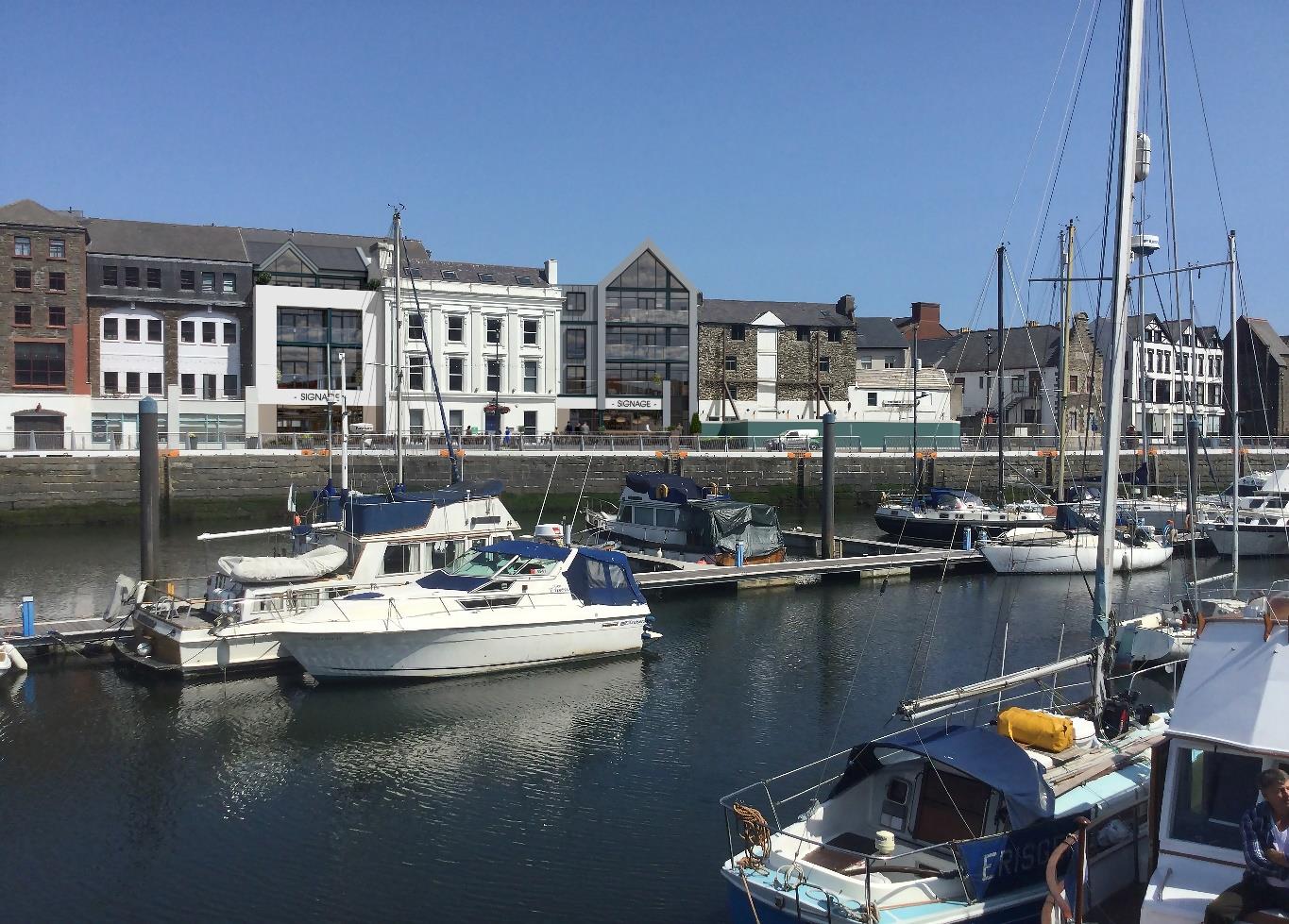
VIEW FROM SOUTH QUAY
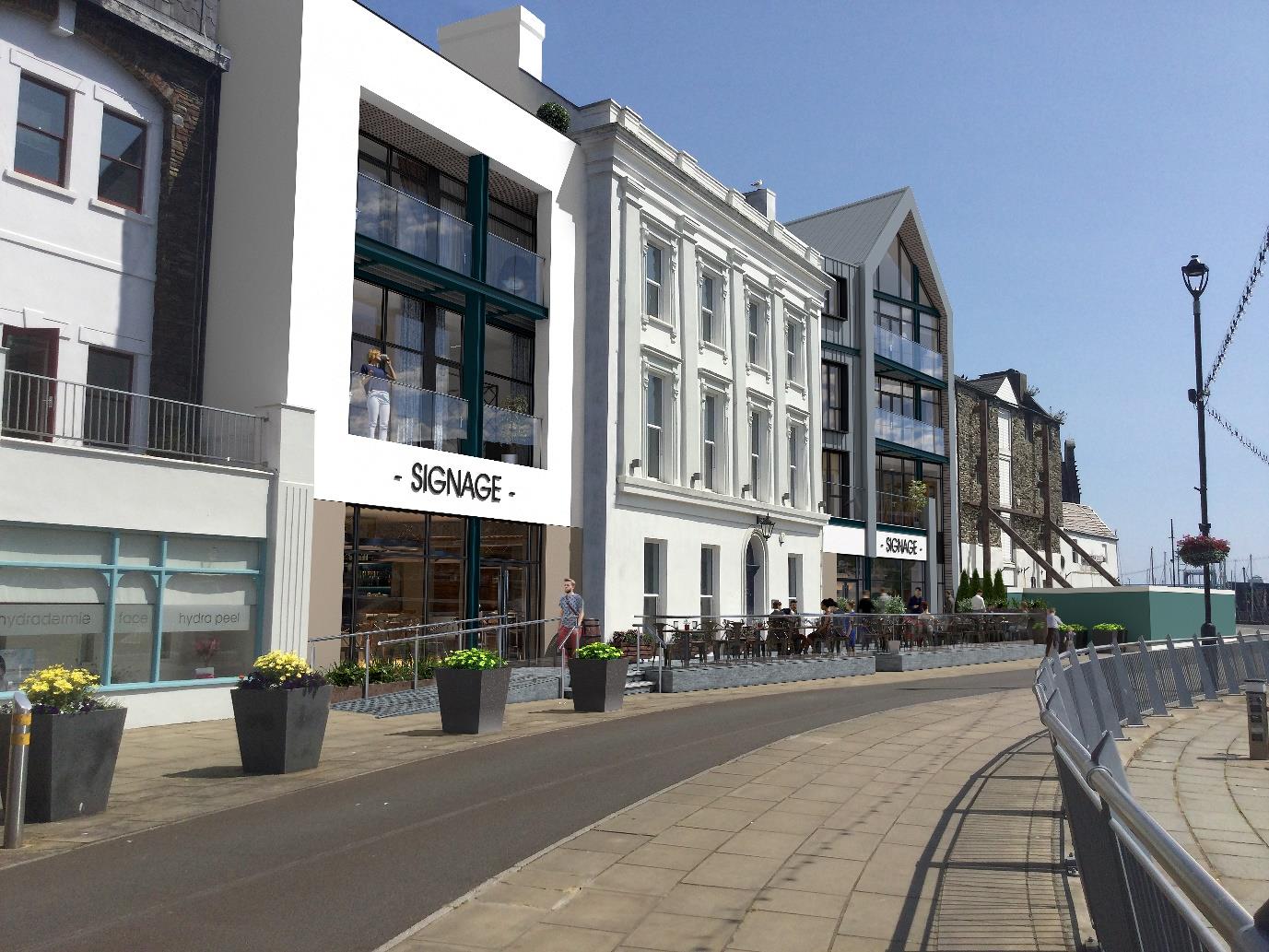
VIEW FROM NORTH QUAY
A sunny photograph of a harbor scene featuring docked boats and a row of mixed-use commercial and residential buildings along the waterfront.A photorealistic 3D rendering of a proposed street scene showing mixed-use buildings with retail on the ground floor and residential above, indicated by placeholder signage.
4.0 Accesibility And Active Travel
4.1 Each apartment + townhouse entrance and the bar/restaurant and retail unit entrances have level thresholds provided by a stair/ramp access located on the pedestrian area externally. Half the proposed ground floor levels are already set by Merchants House which is raised above external ground level by 275mm. The remaining half of the site has ground floor levels set marginally lower to reflect site topography. All ground floor levels have been discussed with JBA Consulting who have prepared a flood risk assessment as part of this submission.
4.2 The external proposals have been discussed with DoI Highways and a solution found that allows the above criteria. The raised terrace will be a modular construction, capable of being dismantled at any time to allow access to any hard surface paving or services below. Highways have confirmed that the proposals can be supported.
4.2 Following a meeting with the Borough of Douglas it was agreed that each block of apartments would have its own suitably sized cycle storage accessible on the ground floor. As such the approved cycle store access for the proposed apartment in no.27 has been increased by three spaces. The proposed townhouse also has provision for three spaces In addition, each block would have bin storage suitably sized for waste disposal and recycling with access from the apartments at ground floor and access for collection at the rear. Furthermore, each leisure unit would have similar waste storage accessible internally and waste collection delivery access for all units provided from the rear. The likely occupancy of the restaurant unit has been given as requested to Douglas waste disposal services and it has been indicated that
as commercial waste is a pay by collection – increased frequency will be requested via demand.
4.3 Douglas City also confirmed at this meeting that the open space provision required by the Isle of Man Strategic Plan is not required as the residential units are less than ten in number.
4.4 As the proposed number of residential units is less than the threshold the 25% affordable housing contribution is not applicable.
4.5 The site is located in the heart of the town centre and is only a short walk to bus stops, ferry terminal and the steam railway train station. The main shopping street and town centre supermarket are also a short walk away. Existing and proposed bars and restaurants are literally on the doorstep of the application site.
4.6 In the extended lobby to the apartment entrance and the townhouse entrance we have provided cycle storage to encourage that use.
4.7 For all of the above reasons no car parking is provided as part of this development as it is potentially redundant. Should people wish to have a car parking space for their apartments or use a car park to visit the bars and restaurants then Shaws Brow Car Park facility is only a short walk away where contract and public parking spaces are available.
5. Benefits Of The Development In Context
5.1 Physical Context
5.1.1 The North Quay and Quayside area is one of Douglas key urban attributes along with its two-mile promenade. The development of the marina has kick started a number of quayside developments such as Quay West and a major apartment block of 38 units on 3139 South Quay. In addition, the area has benefitted from the semi pedestrianisation of the North Quay with bars and restaurants enjoying outdoor seating areas that previously would have been unavailable before this initiative.
5.1.2 This development will address the final section of the site owned by Kelman Ltd and bring a large part of the North Quay currently empty and unused back to life by the provision of active frontages and residential occupation.
5.1.3 In addition the proposed mix of retention and sympathetic redevelopment will produce a scheme which positively contributes to the architecture of the North Quay Conservation Area and enhances it.
5.2 Social Context
5.2.1 The Isle of Man has continued to grow in recent years thanks to the influx of financial and digitally based businesses that have taken advantage of its offshore status. These companies have had to import staff from the UK and further afield to utilize the necessary skill sets of certain individuals required by their business. The Island can be easily ‘sold’ to such people by its beautiful environment and countryside, however it’s indoor leisure offer has been harder to sell by comparison with the facilities generally available to UK residents. The number of indoor leisure offers are however growing, and the provision of yet another modern bar and restaurant facility proposed within this application can only reinforce that growth. These units are also more likely to attract restaurant chains who will be more receptive to long leases if purpose-built premises are being offered. The benefits to the local community and the local area also apply, where the North Quay as a night out destination will become even more attractive.
5.2.2 Many town centres struggle with upper floor use as retail and leisure offers are the primary driver in these locations and people are unwilling to live in an apartment without outlook in an urban environment. The North Quay has the advantage of an attractive outlook over a marina in a south facing direction and consequently the provision of a further apartment of this quality within this environment will provide no difficulty with sales. Similarly the provision of a two bed townhouse with its own entrance and outside amenity area will be suitable for a couple or small family. The residential use then provides a balance of occupation with leisure units ensuring the development remains consistently vibrant 24/7. The provision of large quality apartments and housing where people want to live close to their workplace will not only benefit local people but those referenced in 5.2.1 above who are looking to come to Island to live and work.
5.3 Economic Context
5.3.1 A purpose-built bar restaurant unit + a small retail unit will generate employment opportunities for at least 12 – 15 people locally and the business and individuals will all pay taxes. The provision of these facilities will also generate spending for local people and tourists. Some years ago, the IOM Government began an initiative to use the North Quay as the TT ‘Hub’ for Douglas to spread the leisure and entertainment offer further than the promenade. This initiative failed because it was premature, as not enough outlets and variety of outlets existed to provide a draw. This development of 22-28 North Quay as a whole will help grow the area as a destination and help enable an attractive tourist promotion of the quayside.
5.3.2 The investment for this development is significant and the construction industry is one of the largest sectors of the Isle of Man economy. It is a difficult site to develop and there are easier sites to develop on green fields and suburban environments. Willingness to develop this site should therefore be regarded as an opportunity not only to boost the construction economy but to provide Douglas with an economic generator in both the short and longer terms.
6 Final Conclusions
6.1 This application offers the regeneration of a significant part of the North Quay.
6.2 The demolition of the existing registered building within the site (no.28) is justified for the reasons given and the harm is more than offset by the sensitive retention and restoration of no.27 – a building in very poor condition indeed. The replacement building is considered an acceptable solution, offering a modern contrast with the retained registered building – no.27.
6.3 This application complies with all other relevant planning policies.
6.4 This application is a sympathetic and considered design solution that will contribute to and enhance the character of the conservation area.
6.5 This application will have physical, social and economic benefits to the Douglas Town Centre and wider Island economy. It is the last portion of a visible, valuable site on the North Quay and represents a significant opportunity for Douglas town centre which should not be underestimated or missed. APPENDICES A JBA Flood study
Copyright in submitted documents remains with their authors. Request removal
Source & Provenance
Official reference
25/00788/CON
Source authority
Isle of Man Government Planning & Building Control