3. Significance of Impact on Vitality and Viability of Centres...........................................................19
4. Review in Terms of Retail Planning Policies..................................................................................30
5. Summary and Conclusions ...........................................................................................................36
Appendices
Appendix A: Shopping Surveys – June 2022
Appendix B: Extracts and Analysis of 2018/19 Isle of Man Household Income and Expenditure Survey
Executive Summary
This Retail Impact Assessment sets out supporting information for the proposed redevelopment of the Airport Garage (including the existing small Spar unit) in Ballasalla, to provide a significantly larger Spar store, an additional retail unit as well as space for light industry and related facilities. The proposed new Spar would be operated by Mannin Retail – an Isle of Man company and, as such, this would maximise the benefit for the local Isle of Man economy.
The proposed development is for:
• A new Spar foodstore of 613 sq m GFA (internal) and net sales area of 485 sq m NFA.
• A second small retail unit of 89 sq m GFA
• Additional non-retail uses.
The information provided in this statement includes:
• A full Retail Impact Assessment of the proposed development identifying the effects of the proposed development on both local village retail floorspace in Ballasalla and also on the vitality and viability of Castletown, Port Erin, Port St Mary and Douglas town centres. The assessment demonstrates that the proposed development will not have a significant adverse effect on the vitality or viability of any of these centres nor on shops within Ballasalla.
• An assessment of retail deficiencies and the need for the proposed development within Ballasalla. This identifies that there are both substantial quantitative and qualitative retail deficiencies within Ballasalla/Malew and, furthermore, the extensive new housing development located to the east and north of the village further increases the importance of providing additional new retail floorspace to meet the needs of the rapidly expanding local population.
• The proposed development will significantly reduce the high levels of expenditure leakage from the local area which is currently directed to shops in Douglas and Port Erin and, to a more limited extent, to Castletown. Reducing very high levels of expenditure leakage will have additional important planning and environmental benefits:
o it will reduce the number and length of car journeys undertaken for shopping purposes;
o it will significantly reduce carbon emissions thereby supporting sustainable development;
o it will improve competition and choice for the benefit of Ballasalla residents;
o it will provide important supporting services for the village which is identified in both the Strategic Plan and Area Plan for the South as an important location for development and expansion;
o it will provide additional local employment opportunities and economic benefits;
o it will utilise an existing long established retail location.
The proposal is identified to be in accord with the aims, objectives, vision and values of the IOM Strategic Plan, Area Plan for the South and IOM Retail Sector Strategy.
1. Introduction
1.1. This Statement sets out supporting information for the planning application submitted by Mannin Retail, for the redevelopment of the existing Airport Garage Spar, including land to the side and rear currently used as a coach depot, for a new Spar foodstore.
1.2. The following information is provided in this Statement:
• The remaining parts of Section 1 sets out a brief description of the proposed development.
• Section 2 provides a retail impact assessment of the proposal. This includes an assessment of retail need/deficiencies in Ballasalla and Malew parish.
• Section 3 assesses the significance of impact on Ballasalla and village/town centres potentially affected by the proposal.
• Section 4 reviews the proposal in terms of the policies set out in the IOM Strategic Island Plan, Area Plan for the South and the IOM Retail Sector Strategy.
• Section 5 provides a summary and conclusions.
Description of Proposed Retail Development
1.3. The proposal comprises a proposal for the re-development of the existing Airport Garage Spar and adjacent builders’ yard including the demolition of existing buildings and the construction of a new Spar foodstore, an additional small retail unit, two light industrial units and additional jet wash/valeting services together with parking and service access.
1.4. The floorspace of the proposed retail units comprises the following: Proposed Spar
• Net (internal) sales floor area – 485 sq m NFA
• Gross (internal) floor area – 613 sq m GFA
1.5. The proposed foodstore would be operated by Mannin Retail as a “Eurostyle” Spar foodstore. This store provides local top-up shopping requirements that assists in meeting the needs both of nearby residents, staff working at Balthane IE close to the site, and those passing the site (travelling to/from the airport and Castletown). In addition to the retail of convenience goods, a local butchers, deli together with a limited area for hot drinks and snacks – this latter function is ancillary to the retail operation of the unit.
1.6. Although the foodstore would be large convenience-format/small supermarket size the store with suitable car parking provided it is anticipated that a significant proportion of shopping trips to the store would be walk-in custom from nearby residents and from those working in the Balthane Industrial Estate which is located very close to the proposed store. It is also anticipated that a significant proportion of trade would be from pass-by trips for those travelling to/from the airport, the industrial estate as well as those living in the South travelling past the store. Additional Unit
1.7. A second small retail unit is proposed with 89 sq m GFA. At this stage no operator is confirmed for this unit and it has, therefore, been assumed for the purpose of this Retail Impact Assessment that 50% of the floor area would be for convenience goods and 50% for comparison goods.
Gravis Planning – July 2024
Employment
1.8. The proposed new store would provide employment for approximately 18 staff additional to existing employees, roughly two thirds of whom would be full time and the remainder part time plus employment in the additional units proposed in the development – details are provided in the Design Statement for the development. This would all be new employment based at the store. This will provide a modest but significant contribution to sustaining and improving employment in the local area. Further local employment will also be generated as a result of construction and maintenance of the store. Full details of the employment and economic benefits of the proposal are included in the Design Statement submitted with the application.
2. Retail Impact Assessment
Introduction
2.1. This statement provides an assessment of the potential impact of the proposed development in terms of:
• Impact of the proposed development on existing retail centres and locations; and
• Assessment of the extent to which the proposal addresses both quantitative and qualitative retail need/deficiencies.
Information Sources
2.2. The last comprehensive assessment of retail provision and turnover within the Isle of Man was that undertaken for the IOM Retail Sector Strategy Evidence Base (“RSS-EB”) (Peter Brett Associates) undertaken in June 2013 which was based on surveys undertaken in 2006/07 and 2012. This information is, however, relatively old and therefore Graviss Planning have updated this information as follows. Floorspace
2.3. Surveys have been undertaken in June 2022 of retail and retail service floorspace within all centres potentially affected by the proposed development. Centres surveyed were: Ballasalla; Castletown; Port Erin; Port St Mary; Colby and other villages in the south; and Douglas town centre/out of centre retail areas. The results of the surveys are set out in Appendix A.
2.4. The June 2022 surveys have followed the categorisation of retail and service units in accordance with the current Goad classification of units. This is set out in the Appendix A schedules. It is, therefore, difficult to compare numbers of units with those identified in the ESS-EB which was based on a different, but undefined, classification of units. This difference is apparent in the identification in the ESS-EB of ca. 50 no. “convenience units” in Douglas town centre in 2012 whereas, from surveys undertaken by Gravis using Goad classifications the number of convenience goods shops in Douglas town centre has never been close to this level.
2.5. Floorspace of large units has been identified through the examination of planning application/appeal records. Available Expenditure and Turnover
2.6. The RSS-EB used information from 2006/7 IOM Household Income and Expenditure Survey which can no longer be considered to be a reliable evidence base for retail assessment purposes. The most recent survey information is available from the 2018/19 Household Income and Expenditure Survey and this has been used for identifying available expenditure for convenience, general comparison and bulky goods – this information is set out in Appendix B.
2.7. The estimate of existing turnover of retail floorspace is identified through combining available expenditure data with expenditure patterns. The only survey that provides this information is that set out in the 2013 RSS-EB from surveys undertaken in 2012. Since 2012 there have only been limited significant changes in retail floorspace in the Isle of Man and so, in general, it has been assumed that the expenditure patterns identified in that survey remain valid. However, there are two important factors that need further consideration - the role of internet based retail spend (this is the dominant component of what retail planning refers to as “special forms of trading” or SFT) and the role of expenditure leakage to the UK.
Special Forms of Trading: Internet Sales
2.8. At para 4.14 of the RSS-EB it was suggested that, in 2012, SFT sales in the IOM were higher than in the UK (in fact, higher than forecasts for the UK in 2029). It is considered that the RSS-EB is inaccurate in this observation and that IOM SFT usage was, in fact at that time, quite close to that found in the UK. Examination of RSS-EB Tables 3-6 and 3-7 imply that the share of SFT for convenience goods was in the region of 2-4% and Tables 3-10 and 3-11 imply SFT for clothing and footwear to be approx. 16-18% and for bulky goods 8-9%. The latest estimates from Experian indicate that, in 2012, the corresponding UK figures were 4.9% for convenience goods and 13.5% for all comparison goods (unadjusted for in-store sales, adjusted figures are 1.5% and 10.1% respectively). On this basis it is reasonable to adopt the same growth forecasts identified in the Experian retail Planner 21 (Jan 2024) for the UK to the IOM. These forecasts identify significant future growth in internet sales/SFT over the foreseeable future. Leakage to the UK
2.9. The RSS-EB identifies that a significant proportion of expenditure for general comparison goods, a limited proportion for bulky goods and no convenience goods sales are directed to shops and centres in England. Given the limited change in retail provision in the IOM since 2012 it has been assumed that this proportion will remain constant in future years for the purpose of the RIA. Expenditure and Population Growth
2.10. Economic output and GDP growth over recent years has been severely affected by the effects of the pandemic and other external factors. For the years preceding the pandemic GDP growth in the IOM was significantly lower than previously but maintained average growth of 2.9% per annum (2011/122019/20). This growth is slightly higher than recorded in the UK. On this basis adopting UK expenditure growth forecasts per capita (as published by Experian) are likely to slightly underestimate expenditure growth in the IOM. The effect of this will be to underestimate turnover growth and overestimate potential adverse retail impacts – therefore this worse-case approach has been adopted in this RIA.
2.11. Between 2016 and 2021 the IOM experienced a marginal growth in population of 0.9%. Therefore, again consistent with a worse-case approach, this RIA has assumed no change in IOM population from 2021 onwards.
2.12. For the proposed development the primary catchment area is identified to comprise the parish of Malew. This PCA has, unlike most parts of the IOM, experienced significant population growth between 2016-2021, indeed Malew had the highest population growth of all locations in the IOM over this period. This growth is expected to continue primarily as a result of the development of the large housing sites at Ballasalla. The future population of the catchment area is therefore based on housing completions at this development. Base & Test Years and Price Base
2.13. All prices have been updated to June 2022 prices using the June 2022 IOM Inflation report. The base year for the assessment in 2024 and test year, corresponding to first full year of trading, as 2027. Proposed Store Floorspace and Turnover
2.14. The floorspace of the proposed development was described in Section 1 of this Statement. The net additional floorspace is based on:
• The demolition of the existing small Spar store.
• The proposed new Spar would retail 100% of convenience goods.
• No deduction is made for the limited area (approx. 15 sq m) net floorspace used for café/hot or cold food and drink takeaway (ancillary to the retail use of the unit. This means that the
• For the second retail unit it is assumed that 50% of floorspace would be for convenience goods and 50% for comparison goods.
2.15. The turnover of the Spar unit has been based on the 2023 Retail Rankings for Spar UK. Based on this UK figure the turnover of the proposed new store is set out in Table 2.1. The final part of this assessment considers both higher and lower sales density figures as sensitivity tests (see para 2.39 and Table 2.10 below).
2.16. The proposed foodstore will redevelop the existing small Spar. Therefore, when assessing retail impact concern is with the net additional floorspace and turnover resulting from the proposal. This is as follows:
• Net additional Gross (Internal) floor area = 557 sq m GFA
• Net additional sales floor area = 436 sq m NFA (all convenience)
• Net additional convenience turnover = £3.37m per annum
.
Catchment Area, Turnover and Market Share
Catchment Area and Population
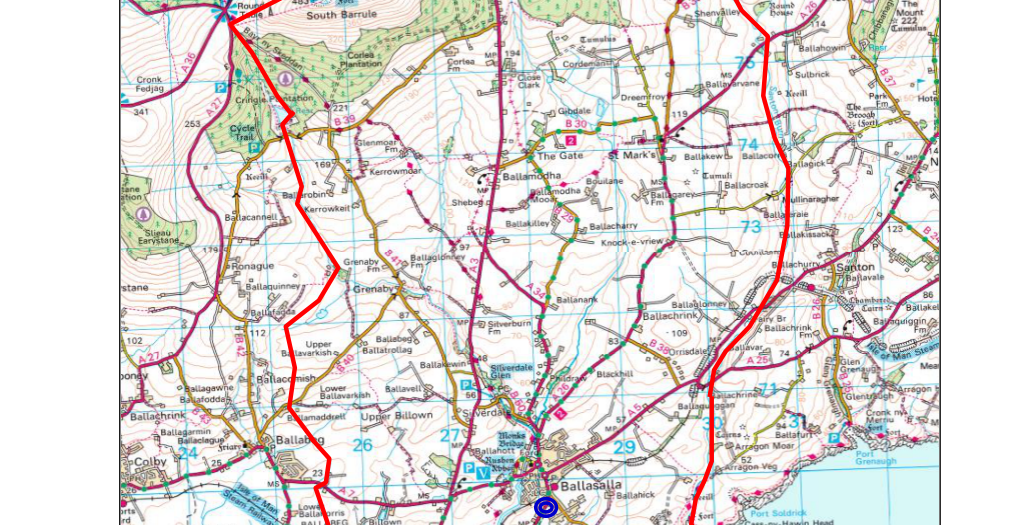
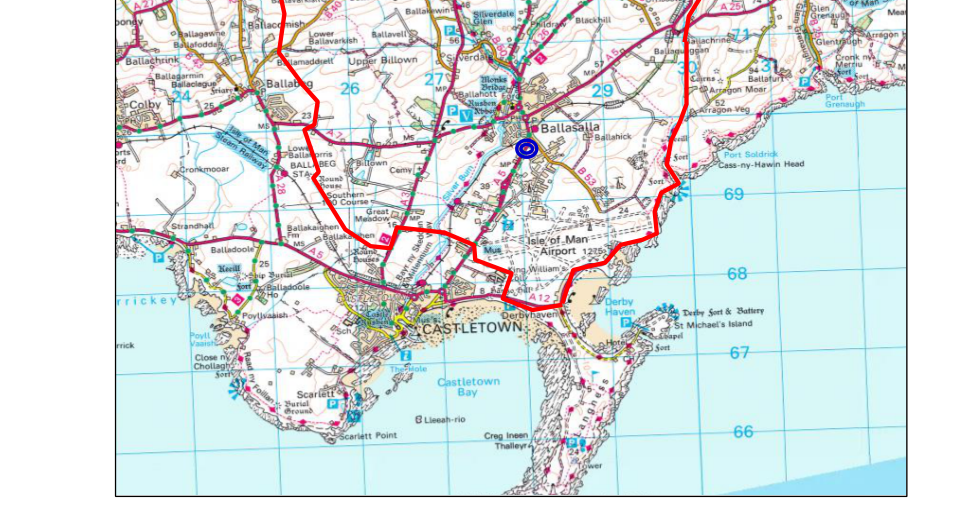
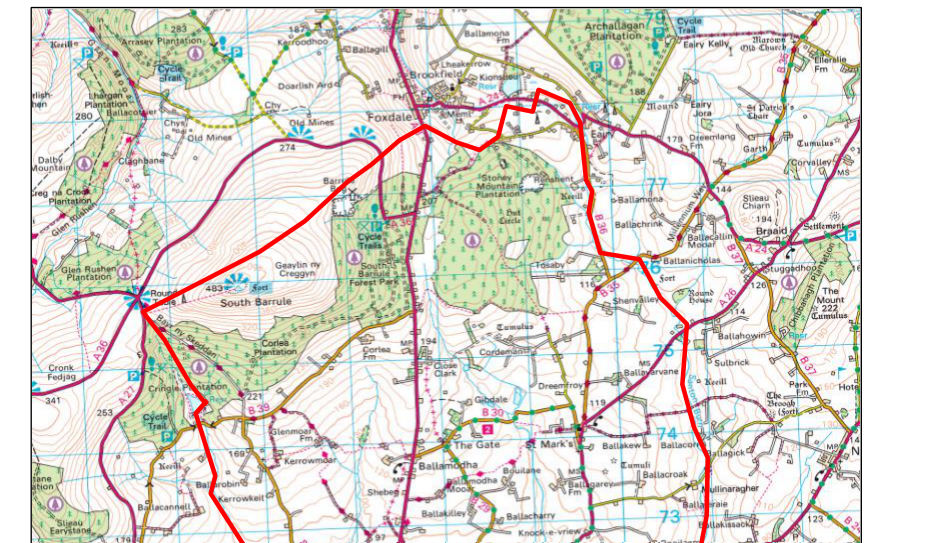
2.17. The format of the proposed store is aimed at serving a local catchment – essentially the village of Ballasalla and its rural hinterland. For the purpose of this assessment the catchment area has therefore been identified as Malew parish although areas immediately to the east and west of Castletown (Langness and Scarlett) would not be expected to form part of the catchment area for the proposed store. The location of the store and the catchment area is identified in Figure 2.2.
Table 2.1: Proposed Development Floorspace And Turnover
2. Average sales density identified for Spar at £8259 psm for convenience goods - from Retail Rankings 2023 for Spar UK
Figure 2.2: Proposed Store Catchment Area
A topographical map showing a site location near Ballasalla with a red boundary line and a blue marker.A topographical location map of the Isle of Man showing the southern region near Castletown and Ballasalla, with a red boundary line and a blue marker indicating the site location.A topographic location map showing a specific site outlined in a thick red boundary line, surrounded by roads, forests, and nearby settlements like Foxdale and South Barrule.
Available Expenditure for Convenience Goods
2.18. As noted above up-to-date estimates of available expenditure have been derived from the 2018-19 IOM Household Income and Expenditure Survey. The survey results and allocation of expenditure to retail goods categories is provided in Appendix B. Both expenditure growth per capita and growth in SFT have adopted the latest Experian forecasts for the UK. These assumptions are identified in Table 2.3.
2.19. The key factor in the identification of population growth is the progress with the Reayrt Mie housing development by Dandara. It has been assumed that occupation of units continues at the rate
Table 2.3: Catchment - Resident Population And Expenditure
2022 Prices
YEAR
POPULATION
Rate Per Head Total £m Rate per Head Total £m<br><br>AVAILABLE EXPENDITURE Convenience Goods Comparison Goods
1 MALEW Parish population 2021 from Isle of Census report 2021 Part i Table 2.1
2 Malew Parish population for 2022 and 2026 based on 2021 population + 43 units sold per annum at "Reayrt Mie", Ballasalla:
- development commenced Sept 2019
- units sold at June 2022 = 119 equates to ca. 43 units per year (119/2.75 = 43.27 pa)
- average household size for new build = 3 persons
- 2030 based on total 410 units completed at av hhold size of 3
3 Malew Parish population for 2024 based on 2016 population + 282 units (sold) at "Reayrt Mie", Ballasalla
4 Base available expenditure from 2018/19 Household Income & Expenditure Survey Dec 2019 Appendix 1 Convenience and Comparison categories from Experian Retail Planner 21 Jan 2024:
Convenience Gen Comp Bulky Goods Av Hhold Expend P/W £96.66 £112.17 £48.25 An Hhold Expend PA £5,040 £5,849 £2,516 Av Hhold size (2019) = 2.24. 2016 Census = 2.28; 2021 Census = 2.22. Av Hhold Expend Per person per annum (gross SFT)
5 Inflation (Jan 2019-June 2022) for convenience and comparison goods from IOM Inflation report June 2022 Table 3. Conv = Groups 01 & 02. Comparison = Groups 3, 5, 9 & 12
Convenience Goods = 8.9% Comparison Goods = 7.2%
6 SFT assumed to be the same as UK (as reported and forecast in Retail Planner 21, Jan 2024, Appendix 3) It is noted that the IOM Retail Sector Strategy Evidence Base suggests that survey info from 2012 for the IOM indicates SFT rates in the IOM to be significantly higher than UK. Current estimates of SFT rates in UK published by Precisely indicate this to be incorrect: Convenience Goods = RSS Evidence Base Tables 3-6 & 3-7 imply SFT rate in IOM in 2012 of approx 2.5%.
Corresponding figure for UK in 2012 was 4.9% unadjusted, 1.5% adjusted Comparison Goods = RSS Evidence Base Tables 3-6 & 3-7 imply SFT rate in IOM in 2012 of approx 15.2%. Corresponding figure for UK in 2012 was 13.5% unadjusted and 10.1% adjusted
7 Expenditure Growth assumed to be in line with Experian Retail Planner 21, Jan 2024, Appendix 4a
achieved since development commenced in Sept 2019 to Summer 2022 (i.e. at 43 units pa with an average household size of 3 persons).
2.20. Table 2.3 identifies the current (2022) available expenditure for convenience goods (in 2022 prices) to be £6.72m in 2024 increasing to £7.61m in 2027. Available expenditure for comparison goods rises from £10.24m in 2024 to £14.48 in 2027. Growth to 2030 is also identified which takes into account the completion of development of the Reayrt Mie site.
2.21. The assessment assumes that 100% of trade draw to the store would originate from residents living within the catchment area. A significant proportion of trade to the existing small Spar originates from pass-by traffic. As a result this assumption (i.e. that all trade originates from within the catchment) results in a slight over-estimate of retail impact on local shops. This assumption is, therefore, consistent with the adoption of a worse-case approach to assessing impact. Existing Retail Floorspace and Turnover
2.22. Floorspace within the PCA and centres potentially affected by the development have been identified from survey in June 2022 and from planning application records. As with the RSS-EZ the estimate of turnover has been derived from the IOM expenditure data from the 2018-2019 household survey and apportioning expenditure to centres in accordance with the 2012 expenditure survey. For this exercise it is necessary to identify total IOM retail expenditure for the base and test years. This is set out in Table 2.4 and uses the same growth and SFT assumptions set out in Table 2.3 for the PCA.
2.23. It should be noted that Table 2.4 identifies expenditure gross of SFT – this is because the ESS-EB identified both expenditure to SFT and leakage to England as part of the expenditure distribution tables.
2.24. Table 2.5 summarises estimates of existing retail floorspace and turnover in the catchment area and in Ballasalla, Castletown, Port Erin, Port St Mary and Colby as well as Douglas. The only existing shops within the PCA are those located in Ballasalla.
TABLE 2.4: ISLE OF MAN - RESIDENT POPULATION AND EXPENDITURE 2022 Prices
YEAR
POPULATION
Rate Per Head Total £m Rate per Head Total £m<br><br>AVAILABLE EXPENDITURE Convenience Goods Comparison Goods
Notes:<br><br>1. Floorspace and turnover from IOM Retail Sector Strategy - Evidence Base updated from Surveys undertaken July 2022
Notes:<br><br>1. Floorspace and turnover from IOM Retail Sector Strategy - Evidence Base updated from Surveys undertaken July 2022
Notes:<br><br>1. Floorspace and turnover from IOM Retail Sector Strategy - Evidence Base updated from Surveys undertaken July 2022
Notes:<br><br>1. Floorspace and turnover from IOM Retail Sector Strategy - Evidence Base updated from Surveys undertaken July 2022
Notes:<br><br>1. Floorspace and turnover from IOM Retail Sector Strategy - Evidence Base updated from Surveys undertaken July 2022
Notes:<br><br>1. Floorspace and turnover from IOM Retail Sector Strategy - Evidence Base updated from Surveys undertaken July 2022
Convenience
Gen Comp
Bulky Goods
Castletown Port Erin Port St Mary Douglas Douglas Rem Supermarkets
Castletown Port Erin Port St Mary Douglas Douglas Rem Supermarkets
Expenditure Share
Expenditure Share
Expenditure Share
Castletown Port Erin Port St Mary Douglas Douglas Rem Supermarkets
Castletown Port Erin Port St Mary Douglas Douglas Rem Supermarkets
£0.04m £0.07m £0.00m £0.19m £0.36m
2.0%<br>3.0% 1.0%<br><br><br>63.0%
0.1% 0.8%<br><br>6.8% 40.2%
Total IOM Expenditure
Convenience
Gen Comp
BG
2024 2027
2024 2027
£206.97m £211.44m
£282.37m £294.83m
£109.81m £114.66m
Tesco, Lake Road - floorspace from Inspectors Letter appeal decision AP14/0006
Estimated turnover for principal settlements from Tables 3-16, 3-17 and 4-3 of IOMRSS Evidence Base:
Gravis Planning – July 2024 9
Spar Isle of Man Redevelopment of Airport Garage, Ballasalla Retail Impact Assessment
2.25. Table 2.6 shows that the very limited convenience provision within the catchment area (i.e. in Ballasalla) results in an extremely high level expenditure “leakage” to stores outside the catchment. Tables 3-6 and 3-7 of the RSS-EB show that, for the zone in which Malew is located (Zone 4 of the study) this expenditure is directed as follows:
• Main food shopping: 33% to Tesco, Douglas; 50% to Shoprite (now Tesco), Port Erin; 4% other Douglas town centre; and 3% Shoprite (now Tesco), Castletown.
• Top-up shopping: 18% Tesco; 18% Shoprite (now Tesco), Port Erin; 7% Castletown (Co-op and Shoprite/Tesco) and 9% Douglas town centre.
2.26. Given that Malew is in the northern part of Zone 4 (which also includes all parts of the south excluding Castletown – see RSS-EB Table 1-1) it is reasonable to assume that Malew will have slightly higher proportions of expenditure directed to Douglas (and possibly Castletown) and a slightly lower proportion directed to Port Erin shops.
2.27. Table 2.6A identifies that that current convenience expenditure leakage is £5.59m per annum i.e. equivalent to 83% of available expenditure. Table 2.6B shows that the quantum of leakage will increase to 2027. Expenditure leakage rates for comparison goods are even higher with only a minimum level of expenditure retained within Malew parish.
Table 2.6: Expenditure Flows In Catchment Area
2022 Prices
TABLE 2.6A: EXISTING 2024
TABLE 2.6B: 2027 WITHOUT PROPOSED DEVELOPMENT
Convenience Goods
Comparison Goods
Available Expenditure<br><br>Turnover<br><br>Retention<br><br>Leakage (£m)<br><br>Leakage (%)
2.28. Trade diversion estimates have been based on a consideration of each of the following factors:
• Distance between competing stores and proposed development (i.e. extent of over-lapping catchment areas).
• Size of competing store.
• Similarity of retail goods.
2.29. Table 2.7 summarises estimated trade diversion to the proposed foodstore as a percentage of the turnover of the proposed store and total trade diversion. Due to the very limited existing retail provision within the catchment area, and the fact that this only caters for top-up shopping needs and none for main food shopping requitements, only 4% of the net additional convenience turnover of the proposed development would be diverted from local shops. It should be recognised that, of course, a significant proportion of the turnover of the proposed development is accounted for with the closure of the existing Spar store. In gross terms, therefore, out of the total development turnover of £4.25m (see Table 2.1) £0.88m is from the existing Spar (to be demolished) and a further £0.13m diverted from existing local shops. In gross development terms, therefore, diversion from existing local shops is £1.01m i.e. nearly one quarter of the total retail turnover of the development.
2.30. In net additional turnover terms, 60% is assumed to be diverted from shops in the South (predominantly from Castletown and Port Erin) and the remainder (40%) would be diverted from shops within Douglas – the majority of this from the Tesco superstore at Lake Road.
2.31. It is important to note that trade diversion assumptions are not measures of impact, they simply identify the quantity of trade diverted from competing locations to the proposed store whereas retail impacts are calculated by comparing this trade diversion to the turnover of existing centres. Quantitative Retail Impacts
2.32. Combining the information from Tables 2.4 and 2.7 allows the calculation of retail impact on shops within the South and Douglas. This is shown in Table 2.8.
2.33. Table 2.8 provides three measures of potential retail impact:
• The first is the percentage reduction in turnover that would result from the proposed development in 2027 compared to the current position in 2024 – this is shown in column E. This takes into account both the direct trade diverted from existing locations to the proposed store together with an allowance for changes in turnover in existing shops/centres that would arise as a result of changes in population and available expenditure. This assumes that existing shopping patterns from residents within the catchment effectively remain the same between 2024 and 2027.
• The second measure (column F) compares the position in 2025 with the proposed development compared to 2027 without the proposed development (i.e. ignores the effects of expenditure growth between 2024 and 2027). This shows a similar pattern of retail impacts to that shown in column E.
• The third measure is a consideration of convenience goods sales densities that would arise with the proposed development (column G). This shows that these residual sales densities will remain healthy for existing shops.
PORT ST MARY Convenience Co-op<br><br>Others<br><br>All Convenience Goods Comparison
£0.37m £0.25m<br><br>£0.62m £0.69m
£0.38m £0.25m<br><br>£0.63m £0.72m
-£0.05m £0.00m<br><br>-£0.05m £0.00m
£0.33m £0.25m<br><br>£0.59m £0.72m
-11% +2%<br><br>-6%<br><br>+4%
-13% +0%<br><br>-8%<br><br>+0%
£4,602psm £4,613psm
£1.31m
£1.36m
-£0.05m
£1.31m
-0%
+4%
COLBY Convenience<br><br>DOUGLAS TOWN CENTRE Convenience Comparison
£0.33m<br><br>£7.61m £188.37m
£0.34m<br><br>£7.78m £196.68m
£0.00m<br><br>-£0.25m<br>-£0.09m<br>
£0.34m<br><br>£7.53m £196.60m
+2%<br><br>-1% +4%
+0%<br><br>-3%<br>-0%<br>
£6,130psm<br><br>£12,609psm
£195.98m
£204.46m
-£0.34m
£204.12m
+4%
-0%
DOUGLAS REMAINDER Convenience Tesco, Lake Road<br><br>Tesco, Victoria Road
£36.24m £13.91m
£37.14m £14.24m
-£0.90m<br>-£0.25m<br>
£36.24m £14.00m
-0% +1%
-2%<br>-2%<br>
£14,035psm £10,864psm
Gravis Planning –July 2024 13
2.34. In summary the impacts identified are as follows: Ballasalla
• In overall terms the development will result in a substantial increase in retail turnover within Ballasalla:
o +230% (i.e. substantial increase in turnover) for all goods taking into account changes between 2024 and 2027
o +189% for all goods comparing 2027 with the proposed development and 2027 without development.
• If one only considers existing shops within Ballasalla (i.e. without the proposed new foodstore):
o +2% (i.e. increase in turnover) turnover for all goods taking into account changes between 2024 and 2027
o -10% for all goods comparing 2027 with the proposed development and 2027 without development
2.35. In other words, when one only considers the existing shops, the loss of trade diverted to the larger Spar foodstore is less then the additional trade generated by the significant population increase that occurs within the village between 2024 and 2027. Castletown
• -2% (i.e. loss of trade) for all goods taking into account changes between 2024 and 2027
• -5% (i.e. loss of trade) for all goods comparing 2027 with the proposed development and 2027 without development.
Port Erin
• -1% (i.e. loss of trade) for all goods taking into account changes between 2024 and 2027
• -4% (i.e. loss of trade) for all goods comparing 2027 with the proposed development and 2027
without development. Douglas Town Centre
• +4 (i.e. increase in turnover) for all goods taking into account changes between 2024 and 2027
• -0% (i.e. less than 0.5% loss of trade) for all goods comparing 2027 with the proposed development and 2027 without development.
2.36. Impacts on Port St Mary and Colby zero or close to zero. Development Impact on Retention and Leakage of Expenditure
2.37. Table 2.9 identifies the impact that the proposed development would have on expenditure retention within the PCA/Ballasalla in 2025. This shows that convenience expenditure retention increases to 55% of total available expenditure (i.e. a net increase of £3.00m turnover locally) whereas the increase in retention for comparison goods is very limited – increasing to 4% of available expenditure (a net increase of £0.09m).
Table 2.9: Catchment Area - Retention And Leakage - 2027 With Proposed Development
2022 Prices
2027
Convenience Goods
Comparison Goods
Available Expenditure<br><br>Turnover<br><br>Retention<br><br>Leakage (£m) Leakage (%)
2.38. The reduction of leakage from Ballasalla will result in a significant net increase in retail employment locally and, through reducing car journeys to shops elsewhere, this will result in significant sustainability benefits. This level of convenience expenditure retention is consistent with the format of the proposed foodstore which will cater for top-up shopping trips from local residents and passby trips.
Sensitivity Tests
2.39. Table 2.10 Presents a series of sensitivity tests to identify how retail impacts on the principal centres in the South would vary if assumptions about proposed development turnover and trade diversion assumptions were altered. The following tests are set out in Table 2.9:
1. Test 1: Central Case (as described above)
2. Test 2.1: Increase the proposed development turnover by +25% (i.e. to £10,324/sq m for all goods in 2022 prices)
3. Test 2.2: Decrease the proposed development turnover by -25% (i.e. to £6,194/sq m for all goods in 2022 prices)
4. Test 3.1: Increase the trade diversion from Douglas (i.e. Tesco and the town centre) to 50% for convenience goods and 100% for comparison goods with pro rata reductions elsewhere.
5. Test 3.2: Decrease the trade diversion from Douglas (i.e. Tesco and the town centre) to 30% for convenience goods and 100% for comparison goods with pro rata increases elsewhere.
2.40. The implications of these sensitivity tests for assessing the significance of retail impact are addressed in Section 3 below.
2027 with Dvpt v 2027 with Dvpt v 2027 with Dvpt v 2027 with Dvpt v 2027 with Dvpt v 2027 with Dvpt v 2027 with Dvpt v 2027 with Dvpt v 2024 without Dvpt 2027 without Dvpt 2024 without Dvpt 2027 without Dvpt 2024 without Dvpt 2027 without Dvpt 2024 without Dvpt 2027 without Dvpt
1. Central Case +5% -8% +230% +189% -2% -5% -1% -4%
2. Change Development Turnover 2.1: Increase Turnover by +25% +3% -10% +281% +234% -3% -6% -2% -5% 2.2: Decrease Turnover by -25% +7% -6% +179% +144% -0% -3% -0% -3%
3. Amend Trade Diversion Assumptions
3.1: Increase Trade Diversion from Douglas +7% -7% +231% +190% -1% -4% -0% -3% to 50% convenience goods
3.2: Decrease Trade Diversion from Douglas +4% -9% +228% +188% -2% -5% -2% -5% to 30% convenience goods
Range of Results +4% to +7% -6% to -10% +179% to +281% +144% to +233% -0% to -3% -3% to -6% -0% to -2% -3% to -5%
Gravis Planning –July 2024 16
Spar Isle of Man Redevelopment of Airport Garage, Ballasalla Retail Impact Assessment
Retail Deficiencies
Quantitative Deficiencies in Catchment Area: Impact on Expenditure Leakage
2.41. The quantitative retail analysis set out above shows that, for the catchment area of the proposed store as a whole, there is a substantial net leakage of convenience expenditure from the Ballasalla/Malew area. This confirms that there is a substantial quantitative retail deficiency for convenience goods retailing. Table 2.6 shows that, at present, 83% of expenditure on convenience goods generated from residents within the catchment area “leaks” to locations outside the catchment – equivalent to almost £5.6m per annum and that this will increase to £6.3m per annum. If one considers the situation in 2030, that is following the completion of Reayrt Mie (but not allowing for Crossag Farm) the this leakage would increase to £7.4m. The proposed new Spar foodstore will have a noticeable effect in reducing this leakage and help address this quantitative need/deficiency.
2.42. Increased retention of expenditure within the local area will have significant employment and environmental benefits:
• Retention of spend will increase retail employment opportunities for local residents in Ballasalla.
• It will reduce travel to other locations resulting in significant reductions in journeys made and carbon emissions associated with these journeys (particularly for those made by private car) supporting overall environmental sustainability in line with the broad environmental objectives of the Strategic Plan.
Quantitative Deficiencies: Meeting the Needs of a Growing Population
2.43. Ballasalla is experiencing rapid population growth as a result of the development of planning consents 19/00137/B and 21/01262/B (both Dandara – Reayrt Mie) which provide 410 predominantly family housing units. Assuming an average household size of 3 persons (in the first phase of the development there were an average of 3.1 bedrooms per dwelling) this equates to
+1230 population which generates £3.00m additional available expenditure for convenience goods within Ballasalla. It is noted that 21/01262/B includes provision of two small retail/service units with a total floor area of 131 sq m GFA. These two units are restricted to Class 1.1 Shops or Class 1.3 Food & Drink uses. On the assumption that only one of these units would be for a convenience format store the turnover from this unit would be ca. £0.3m, i.e. only about 10% of the available expenditure generated by the new housing. This figure is reliable in that the small size of the unit would only serve top-up convenience spend (typically 20-25% of total convenience expenditure) and a significant proportion of this top-up spend would be directed to other shops elsewhere.
2.44. Taking these factors together the major new housing allocations would generate ca. £2.7m net unserviced retail expenditure. This development alone therefore accounts for approximately 80% of the convenience turnover of the proposed development.
2.45. This assessment does not take into account any additional housing development – for example the Crossag Farm site is a 13.0ha site allocated for housing as Site 2 in the Area Plan for the South. Development of this site will result in available expenditure generated by additional population in new housing sites exceeding the convenience turnover of the proposed foodstore.
2.46. It is noted that planning permission was granted for a new Shoprite store on the site of the Whitestone Garage (20/01446/A – subsequently extended by 23/00774/B). Having discussed this proposal with IOM Enterprises, now that Shoprite is no longer trading as a retail operator, IOME have stated that it is no longer the intention for the company to implement this consent. This has, therefore, not been included in this analysis.
Gravis Planning –July 2024
Qualitative Deficiencies in the Catchment Area
2.47. There is minimal retail provision within the catchment area. Within Ballasalla only three small convenience shops have been identified and there are no modern foodstores present in the area supporting any main food shopping. The nearest significant foodstores are in Port Erin and Castletown. These factors indicate a significant qualitative retail deficiency within the catchment that would be addressed, in part at least, by the proposed development.
3. Significance of Impact on Vitality and Viability ofCentres
3.1. Table 2.8 identified the percentage impact of the proposed development on the retail turnover of existing shops and centres and Table 2.10 demonstrated how these impacts would vary for the principal retail centres in the South as a result of changes to the key retail impact assessment assumptions. Ballasalla Village Shops
3.2. As would be expected the highest direct percentage impacts of the proposed development (i.e. in 2027 with and without the proposed development) would be on the three existing local shops selling convenience goods within the village. Table 2.8 identifies the impacts to be as follows:
• Convenience goods shops:
o Impact comparing 2027 turnover with proposed development and current turnover:
+2%
o Impact comparing 2027 turnover with proposed development with turnover in 2027 without proposed development: -10%
o Residual sales density after impact: £7617 psm
• Comparison goods shops:
- Impact comparing 2027 turnover with proposed development and current turnover: +17%
- Impact comparing 2027 turnover with proposed development with turnover in 2027 without proposed development: nil
3.3. The key issue for assessing the significance of these impacts is the effect that the rapidly growing local population has on available expenditure generated locally and the amount spent in local shops. The Reayrt Mie development, with 410 housing units (planning consents 21/01262/B and 19/00137/B), represents a substantial increase in Ballasalla’s population. This will have a direct impact on the turnover of existing shops. Table 2.8 shows that, even with the proposed development, the turnover of these existing shops will be higher than is currently the case. The Area Plan for the South also allocates additional major housing land in Ballasalla at Crossag Farm which, if/when this is brought forward, will further increase population, expenditure and turnover in local shops – this additional housing has not been factored into the assessment.
3.4. Linked to this, Table 2.8 column G shows the impact that the combination of the existing housing development and proposed new Spar would have on the turnover rates of existing shops – this is estimated to increase from an average £7500 psm at the present time to £7639 psm – i.e. an increase in overall sales densities even with the proposed new foodstore. Conclusion
3.5. The RIA demonstrates that, for the local shops distributed around Ballasalla, the proposed development will not affect their vitality or viability – any trade diverted to the proposed new store is more than exceeded by the increased turnover in these shops arising from the rapid increase in population in the village.
Castletown Town Centre
Town Centre Health Check
3.6. Castletown town centre is a small-mid sized town centre with approximately 51 retail and retail service units and total retail floor area of 3307 sq m GFA (excluding retail services). The principal convenience goods shops are the Tesco and Co-op foodstores. The RIA, using the RSS-EB and up to date expenditure data, estimates the current turnover of the town centre as £9.4m convenience goods and £6.0m comparison goods.
3.7. In terms of the centre’s vitality and viability the RSS-EB noted the following for Castletown in 2012/13:
• Castletown is the ancient and historic capital. As a result, it has several tourist attractions including: Castle Rushden, Old House of Keys, The Nautical Museum and the Old Grammar School.
• The town centre is attractive reflecting both the effect of Caste Rushden and the pedestrianised streets. The castle dominates the town centre with the small shopping streets situated adjacent to it.
• Callow’s Yard/The Courtyard is a mixed development scheme. At the time of the RSS-EB (2013) three units were vacant.
• The RSS-EB identified 9 convenience units, 14 comparison goods units and an “adequate” range of retail services.
• In 2013 6 units were vacant (half of these were located in Callow’s Yard) totalling 761 sq m floorspace – a vacancy rate of 11% by number.
3.8. Table 3.1 sets out a summary of the current vitality and viability of Castletown town centre.
Table 3.1: Castletown Town Centre Indicators of Vitality and Viability – 2022
Mix and range of uses
Castletown town centre is focussed around Market Square and Castle Rushen and includes sections of Castle Street, Arbory Road and Malew Street. The July 2022 survey identified the following units:
• 5 convenience goods shops • 13 comparison goods shops • 27 retail service units • 6 vacant units The town centre has a range of additional (non-retail) services and facilities including:
• Fire Station
• Policy Station
• Town Hall/Commissioners' Office
• Church
• Castletown Youth Centre • Education Centre • Castle Rushen
• Dentist
• Old House of Keys • Market Square - summer entertainment/facilities • Nautical Museum • Harbour Commissioners Multiple Representation Within the centre three retail goods shops were identified as multiples (17%) which is above average for a centre of this size. Rental values and yields No information is available for rents and yields.
Vacancy rates
In July 2022 6 units were vacant which is a vacancy rate of 12% - although no vacancy rates are available for the whole of the IOM it can be noted that this rate is close to/marginally below the UK average vacancy rate at the present time.
Accessibility
The town centre has a high level of accessibility with much of the town residential areas within easy walking distance, bus services passing through Market Square with on- and off-street parking available.
Physical environment
The environmental quality of the centre is very high with numerous historic buildings as well as the nationally important Castle Rushen which forms a focus for the town centre as well as numerous Registered Buildings within the town centre. The physical environment and streetscape of the town centre has been improved in recent years and is of a very high quality. Although traffic is permitted in town centre streets this is relatively limited and of low speeds and has limited impact on pedestrian amenity. The proximity of the town centre to the River and harbour also adds to the quality of the centre.<br><br>
3.9. In overall terms it is considered that the vitality and viability of the town centre is high – this reflects the high sales densities within the centre, especially for convenience goods, the range of additional services available within the town centre and the very high environmental quality of the town centre.
Retail Impact
3.10. Retail impacts from the proposed development are identified to be as follows:
• Convenience goods shops:
o Impact comparing 2027 turnover with proposed development and current turnover:
-6%
o Impact comparing 2027 turnover with proposed development with turnover in 2027 without proposed development: -8%
o Residual sales density after impact: £9800-£11500 psm
• Comparison goods shops:
o Impact comparing 2027 turnover with proposed development and current turnover:
+4%
o Impact comparing 2027 turnover with proposed development with turnover in 2027 without proposed development: nil
• All goods:
o Impact comparing 2027 turnover with proposed development and current turnover:
-2% (sensitivity test range: -0% to -3%)
o Impact comparing 2027 turnover with proposed development with turnover in 2027 without proposed development: -5% (sensitivity test range: -3% to -6%)
3.11. From the above the direct impacts in 2027 would be limited and cumulative impacts, taking into account changes between 2024 and 2027, would result in turnover being only marginally lower than are currently found in the town centre. The greatest adverse impacts are on the existing Co-op store in the town centre (-9% direct impacts). Taking all of the above factors into account the proposed development at Ballasalla would not affect the vitality or viability of Castletown town centre.
Port Erin Town Centre
Town Centre Health Check
3.12. Port Erin is identified as a Service Centre in the IOM Strategic Plan. Although it has only a slightly greater total number of retail/retail service units as Castletown the total retail floorspace is significantly larger. In total there are 70 retail and retail service units and total retail floor area of 5778 sq m GFA (excluding retail services). The principal convenience goods shops are the Tesco and Co-op foodstores. The RIA estimates the current turnover of the town centre as £15.9m convenience goods and £9.8m comparison goods.
3.13. In terms of the centre’s vitality and viability the RSS-EB notes the following:
• Port Erin is the principal convenience retail centre in the South.
• The RSS-EB identified 10 convenience units, a broad range of comparison retailers (17 units are identified in the RIA) and an “wide” range of retail services.
• In 2013 3 units were vacant – a vacancy rate of 5% by number.
• The town environment is described as “fair” but some shop units are in a poor condition whereas other buildings, especially along the waterfront have been or were being refurbished.
3.14. Table 3.2 sets out a summary of the current vitality and viability of Port Erin town centre. Table 3.2: Port Erin Town Centre Indicators of Vitality and Viability – 2022
Mix and range of uses
Port Erin town centre is focussed within the area bounded by Station Road, the Promenade, Bay View Road and Bridson Street. The July 2022 survey identified the following units:
• 5 convenience goods shops • 25 comparison goods shops • 35 retail service units • 5 vacant units The town centre has a range of additional (non-retail) services and facilities including: • Rushen Exhibition & Visitor Centre
• Library
• Commissioners' Office
• Churches (3) + Halls
• Clinic
• Fun Directors (2)
• Fire Station
• Dentist
• IOM Govt Offices • Railway Station • Railway Museum
• Vet
• Erin Arts Centre
Rental values and yields
No information is available for rents and yields.
Vacancy rates
In July 2022 5 units were vacant which is a vacancy rate of 7% although no vacancy rates are available for the whole of the IOM it can be noted that this rate is well below the UK average vacancy rate at the present time.
Accessibility
The town centre has a high level of accessibility with much of the town residential areas within easy walking distance, bus services passing through the town centre and easy access to the railway station.
Physical environment
The environmental quality of the centre is mixed with a range of attractive older buildings within the town centre. A key attraction of the centre is its location adjacent/above the beach which is an important attractor for much of the year. In addition the terminus of the steam railway is located within the town centre together with a railway museum. Cars have access to most parts of the town centre and, in certain parts, these can affect pedestrian amenity and the quality of the townscape.
3.15. In overall terms it is considered that the vitality and viability of Port Erin town centre is high – this primarily reflects the range of retail shops, retail services and additional services within the centre as well as high sales densities and low vacancies.
3.16. Retail impacts from the proposed development are identified to be as follows:
• Convenience goods shops:
o Impact comparing 2027 turnover with proposed development and current turnover:
-4%
o Impact comparing 2027 turnover with proposed development with turnover in 2027 without proposed development: -6%
o Residual sales density after impact: £9300-£10900 psm
• Comparison goods shops:
o Impact comparing 2027 turnover with proposed development and current turnover:
+4%
o Impact comparing 2027 turnover with proposed development with turnover in 2027 without proposed development: nil
• All goods:
o Impact comparing 2027 turnover with proposed development and current turnover:
-1% (sensitivity test range: -0% to -2%) o Impact comparing 2025 turnover with proposed development with turnover in 2027 without proposed development: -4% (sensitivity test range: -3% to -5%)
3.17. From the above the direct impacts in 2027 would be limited and cumulative impacts, taking into account changes between 2024 and 2027, would result in turnover being only marginally lower than are currently found in the town centre. The greatest adverse impacts are on the existing Co-op store in the town centre (-7% direct impacts). Taking all of the above factors into account the proposed development at Ballasalla would not affect the vitality or viability of Port Erin town centre. Port St Mary
Town Centre Health Check
3.18. Port St Mary centre is significantly smaller than either Castletown or Port Erin . In total there are 20 retail and retail service units and total retail floor area of only 648 sq m GFA (excluding retail services). The principal convenience goods shop is the Co-op convenience store. The RIA estimates the current turnover of the town centre as £0.62m convenience goods and £0.7m comparison goods. Retail and retail services units are focussed on Station Road/Bay View Road. Its small size would suggest that Port St Mary centre is better described as a local rather than town centre.
3.19. Table 3.3 sets out a summary of the current vitality and viability of Port St Mary centre. Given the small size of the centre the concept of town centre vitality and viability has limited applicability to Port St Mary centre. However, the centre appears to be functioning and serving the local community well.
3.20. Retail impacts from the proposed development are identified to be as follows:
• Convenience goods shops:
o Impact comparing 2027 turnover with proposed development and current turnover:
-6%
o Impact comparing 2027 turnover with proposed development with turnover in 2027 without proposed development: -8%
o Residual sales density after impact: £4600 psm
• Comparison goods shops:
o Impact comparing 2027 turnover with proposed development and current turnover:
+4%
o Impact comparing 2027 turnover with proposed development with turnover in 2027 without proposed development: no impact
• All goods:
o Impact comparing 2027 turnover with proposed development and current turnover:
+4%
o Impact comparing 2027 turnover with proposed development with turnover in 2027 without proposed development: -0% (less than -0.5%)
3.21. From the above the direct impacts in 2027 would be limited and cumulative impacts, taking into account changes between 2024 and 2027, would result in turnover being higher than are currently found in the centre. Impacts on the Co-op would not affect the viability of this store.
Table 3.3: Port St Mary Centre Indicators of Vitality and Viability – 2022 Mix and range of uses Port St Mary centre is focussed on Bay View Road/Station Road. The July 2022 survey identified the following units: • 2 convenience goods shops • 5 comparison goods shops • 12 retail service units • 1 vacant unit The town centre has a limited range of additional (non-retail) services and facilities including: • Town Hall/Commissioners Office
• Churches (2)
• Nursery
• Clinics (2)
Multiple Representation Within the centre two retail goods shops were identified as multiples (40%) which is high for a centre of this small size. Rental values and yields No information is available for rents and yields.
Vacancy rates
In July 2022 1 unit was vacant which is a vacancy rate of 5% although no vacancy rates are available for the whole of the IOM it can be noted that this rate is well below the UK average vacancy rate at the present time.
Accessibility
The town centre has a good level of accessibility with much of the town residential areas within easy walking distance and bus services passing through the centre.
Physical environment
The environmental quality of the centre is high with a range of attractive older buildings within the centre. Cars have access through the centre but have limited impact on either pedestrian amenity or accessibility.
Douglas Town Centre
3.22. Table 2.8 also identifies impacts on shops in Douglas town centre and also the two principal foodstores located outside of the town centre – the Tesco superstore at Lake Road and Tesco (former Shoprite) at Victoria Road. Although Table 2.8 identifies minimal impacts on the town centre it is appropriate to also consider the vitality and viability of the town centre.
3.23. In terms of the centre’s vitality and viability the RSS-EB noted the following:
• Douglas is the capital of the Isle of Man and the main retail centre.
• The town centre has the largest range of multiples on the Island.
• The RSS-EB identified “over 50 convenience units”. The RSS-EB does not define what is meant by “convenience units” but it is evident that this must differ significantly from that used in Goad surveys – Goad surveys have been undertaken on a regular basis of Douglas town centre and the highest number of convenience units identified in these surveys was only 25 units (in
1995) with lower numbers identified since that date. The 2022 survey by HPL using Goad definitions is 17 units which is only one less than identified by HPL in 2009.
• The number of comparison goods shops is not identified but 131 retail services were identified in the RSS-EB.
• In 2012 35 units were vacant.
3.24. Table 2.14 sets out a summary of the current vitality and viability of Douglas town centre. Table 3.4: Douglas Town Centre Indicators of Vitality and Viability – 2022
Mix and range of uses
Douglas town centre covers an extensive area and the Area Plan identifies 7 distinct character areas: Villa Marina; Promenade; Strand Street; St Georges; The Fort; Maritime Gateway; and The Quayside. Outside the defined town centre there is also a continuous retail frontage along Bucks Road that is, in reality, a functional part of the town centre.
The July 2022 survey identified the following units:
• 17 convenience goods shops • 97 comparison goods shops • 220 retail service units • 30 vacant units The town centre has a wide range of additional (non-retail) services and facilities including: • Army Reserve Centre
• Library
• Vaccination Hub
• Green Centre
• Health Club
• Govt Offices
• Employment Services Training
• Clinics (2)
• Douglas Town Centre Management • Night Clubs (2) • Douglas Borough Council • IOM Chamber of Commerce
• Library
Multiple Representation
Within the centre 28 retail goods shops were identified as multiples (25%) which is about average for a centre of this size.
Vacancy rates
In July 2022 30 units were vacant which is a vacancy rate of 9% - although no vacancy rates are available for the whole of the IOM it can be noted that this rate is below the UK average vacancy rate at the present time.
Accessibility
The town centre has a high level of accessibility with numerous bus services passing through the centre linking to all parts of the IOM, a railway station as well as having the ferry port within the town centre.
Physical environment
The environmental quality of the centre is mixed with a range of attractive older buildings and registered buildings within the town centre. Certain areas are, however, less attractive such as the extensive surface level parking in the Lord Street. A key attraction of the centre is its location adjacent to the beach and also the Quayside area which has benefitted from significant environmental improvements. Strand Street is pedestrianised and has also benefitted from improvements. High levels of traffic are experienced along Victoria Street which can detract from pedestrian amenity and accessibility.
3.25. In overall terms it is considered that the vitality and viability of Douglas town centre is mixed. Vacancies are lower than found in the UK and there is a good retail offer. However, one might expect a higher number of multiple operators within the principal centre within the Island and the range of non-retail services is potentially limited compared to UK town centres of comparable size.
3.26. Retail impacts from the proposed development are identified to be as follows:
• Convenience goods shops:
o Impact comparing 2027 turnover with proposed development and current turnover:
-1%
o Impact comparing 2027 turnover with proposed development with turnover in 2027 without proposed development: -3%
o Residual sales density after impact: £12,600 psm
• Comparison goods shops:
o Impact comparing 2027 turnover with proposed development and current turnover:
+4%
o Impact comparing 2027 turnover with proposed development with turnover in 2027 without proposed development: -0%
• All goods:
o Impact comparing 2027 turnover with proposed development and current turnover:
+4%
o Impact comparing 2027 turnover with proposed development with turnover in 2027 without proposed development: -0%
3.27. From the above the direct impacts in 2027 would be minimal and cumulative impacts, taking into account changes between 2024 and 2027, would result in turnover being significantly higher than are currently found in the town centre.
3.28. It is therefore concluded that the proposed development would have no effect on the vitality or viability of stores within Douglas town centre or elsewhere in the town. Retail Assessment- Summary and Conclusions
3.29. A full assessment of the retail impact of the proposed development has been undertaken. This has considered the market area that would be served by the proposal, existing retail floorspace and turnover, the proposed development turnover, trade diversion and has used different measures of retail impact. The assessment has also considered the vitality and viability of retail centres/shops affected by the proposed development. The principal findings of the assessment are:
• The proposed development would not affect the vitality or viability of any retail centre within the Isle of Man nor adversely affect the viability of local retail facilities located in Ballasalla.
• It has been demonstrated that there is a significant retail need for the proposed development. This reflects the high level of existing retail leakage, especially for convenience goods, from Ballasalla. In addition, the village has a rapidly growing population and the proposal will meet the needs of new residents.
• Reducing expenditure leakage will result in important environmental and economic benefits for the local area and reduce carbon emissions thereby supporting sustainable development.
• The proposal will provide a new modern retail facility within a local area that has no modern retail units; and it would support walk-in trade in an area particularly from the nearby residential development.
4. Review in Terms of Retail Planning Policies
4.1. This Section assesses the proposed development against retail and town centre policies contained within the IOM Strategic Plan, The Area Plan for the South and the IOM Retail Sector Strategy. The Design statement provides a review of the proposal in terms of the full range of policies and proposals set out in the development plan and other material considerations. IOM Strategic Plan
Spatial Strategy
4.2. Ballasalla is identified as a Service Village in the Strategic Plan however the Spatial Strategy identifies that the village has an important role in the South - para 5.8 states:
The aim of the CENTRES, LINKS and GATEWAY approach is to give a strategic focus to future development and achieve balanced growth on the Island by developing:
…a network of local centres in the south with new development focused on the regeneration of existing centres but recognising the growth potential around Ballasalla and the Airport Gateway.
4.3. Although para 5.11 refers to the role of housing, employment and leisure opportunities in Castletown, Port Erin and Port St Mary, the Area Plan for the South (APS) has directed the majority of new housing development not to these three Service Centres but, instead, to Ballasalla. In total the APS identifies 18 predominantly residential and mixed use sites with a total area for housing (including mixed use) of 49.7ha, however, the two sites in Ballasalla total 32 ha i.e. 64% of the total land allocated for new housing development in the South1. Any consideration of the spatial policy set out in the Strategic Plan needs to be considered in the context of the importance of Ballasalla as the principal location for residential development in the South which accounts for a large majority of all new housing allocations in the South. Spatial Policy 2
4.4. Spatial Policy 2 states that:
4.5. In considering the relevance of this policy to the current application it is essential that the policy is read in its own terms and in the context of the Area Plan for the South:
• The policy is, primarily, a basis for the preparation of Area Plans in that, in giving effect to the direction of new development, it is for the Area Plans to identify the boundaries for development.
1 Housing and mixed use sites are sites 1,2,3,7,8,9,12,13,14,1,6,17,18,19,20,21,22,23,& 25 – total area 49.69ha. Ballasalla sites are sites 2 & 3 – total area of 32.0 ha.
• The plan does not say anything about the relevance of the policy for proposals in locations other than the Service Centres. Although the policy aim is, in the first instance, to the Service Centres, it does not indicate that proposals outwith the Service Centres will be considered contrary to the spatial strategy.
4.6. These factors are critical. Although the IOM Planning System is separate from that found in the UK it does, nonetheless, draw heavily from the principles established in the UK planning systems. In this regard the Supreme Court decision Tesco Stores v Dundee City Council 2012 is important in that this confirms the principle that the interpretation of policy must be based on the plain English reading of that policy – it is not up to the decision-maker to impose his/her own interpretation on that policy if it is contrary to the plain meaning set out in the text.
4.7. In this context it can be seen that both the Spatial Strategy in the Strategic Plan identify a particularly important role for Ballasalla in support new development in the South and the APS gives effect to this by allocating the large majority of all new residential to development in the South to Ballasalla and not to the Services Centres of Port Erin, Castletown and Port St Mary. It is clear therefore, that the provision of new retail services, on a site that has an established retail and commercial use, is consistent with and supports the Spatial Strategy. It follows that the proposal does not conflict with, but supports, Spatial Policy 2. Benefits of the Proposed Development
4.8. Regardless of the above it is also clear that the proposed development has substantial benefits that also need to be considered:
• The proposal helps to address a substantial need for additional convenience floorspace in Ballasalla to support both the existing population of the village and the ongoing new housing development in the village.
• The proposal will reduce the need to travel for local residents to undertake shopping. At present most residents travel to Port Erin and Douglas for most of their food shopping requirements. This proposal reduces the need to travel resulting in reduced travel time, journey distances and substantially reduces carbon emissions associated with these journeys. This is a major sustainable development benefit.
• The proposal re-uses an existing developed site. This results in environmental improvements in the local area and minimises demand for new greenfield development. This also provides an important sustainable benefit.
• The proposal will provide significant new local employment opportunities and economic benefit for the village. This is in accord with Business Policy 1.
• The proposal significantly improves competition and choice for local residents which is identified as an important “value” in the IOM Retail Sector Strategy.
Business Policy 9
4.9. This policy states:
4.10. The proposed development is designed to serve the village of Ballasalla and its rural hinterland (effectively Malew parish). Although the village has a small number of shops these are not concentrated in a single location and it would not be reasonable to consider that there is an
established existing retail area within the village. It is, therefore, not possible to comply with this policy to provide retail that will meet the needs of the village. In this sense it is accepted that the proposal does not comply with the strict wording of this policy. However, as noted above, the result of this is that Ballasalla does not have adequate retail provision to meet its own needs resulting in residents having to travel to Port Erin and Douglas to meet food shopping requirements. This continuation of this situation, quite apart from the fact that this conflicts with the adverse environmental and sustainable aims of the Strategic Plan, is in conflict with the Spatial Strategy and with the Area Plan for the South which identifies the importance of the growth of Ballasalla.
4.11. In this context there is a clear need for significant new convenience retail floorspace within Ballasalla. In an ideal situation this would be located in the heart of the village as close as possible to shops located at the junctions of Douglas Road/Main Road or Main Road/Bridge Road (identified as a mixed use area in the Area Plan), however, there are no potential sites or premises in these areas that would be able to accommodate a significant new retail unit. The current site is an established retail location, is located within the urban area of the village, benefits from public transport access and is within easy walking distance of much of the village and the Balthane Industrial Estate.
4.12. In terms of the requirement for a Retail Impact Assessment this has been set out in Section 2 of this Statement. This confirms that the proposal will not threaten the vitality or viability of any existing retail locations. Business Policy 10
4.13. This Policy states:
4.14. The Area Plan for the South does not identify a village centre in Ballasalla although it does identify a mixed-use area extending along Main Road between Bridge Road and Douglas Road. As noted above there are no potential locations in this area capable of accommodating a significant new retail proposal capable of addressing the convenience goods shopping needs of the village and its rapidly growing population.
4.15. In terms of the wording of the policy it is accepted that the policy does not allow for any possible exceptions to the policy apart from those identified in Business Policy 5. However, the same comments apply as identified for Business Policy 9 that:
• there are no suitable sites/premises within the mixed-use area of the village;
• the proposed site is within easy walking distance of much of the existing village, new housing areas and the Balthane Industrial Estate;
• the proposal will substantially reduce the excessive levels of expenditure leakage currently leaving the village for stores in Douglas and Port Erin;
• the proposal will reduce the need to travel resulting in very important reduction in carbon emissions supporting sustainable development; and
• the proposal uses a long-established retail site which also supports sustainable development aims.
• The proposal significantly improves competition and choice for local residents which is identified as an important “value” in the IOM retail Sector Strategy.
Strategic Plan Retail and Related Policies – Conclusions
4.16. Taking into account both the specific wording of policies, the importance of development in Ballasalla supporting development in the South, the lack of alternative options within the village, the pressing need to address the substantial leakage of expenditure from the village, and lack of adverse retail impacts arising from the proposed development, it is concluded that the proposed development is strongly supportive of the aims and objectives of the retail and town centre policies of the IOM Strategic Plan. Area Plan for the South
4.17. The principal function of the Area Plan is to identify development proposals that are in accordance with the policies and objectives of the Strategic Plan. Those that are relevant to the current application are sites for residential development set out in Residential Proposal 3:
• Site 2 Crossag Farm 13 ha residential site. The nearest parts of Site 2 are located within 200m of the application site.
• Site 3 south east of Ballasalla between Douglas Road and Balthane IE – 19 ha. This comprises the land granted planning permission for housing for 410 residential units located within easy walking distance of the application site.
4.18. The application site is located within the settlement boundary of the village and the area is located within land identified as “buildings or land for civic, cultural or other use”. IOM Retail Sector Strategy 2013
4.19. Much of the Retail Sector Strategy (RSS) is concerned with a review of the condition of retailing within the Isle of Man and a wide range of practical actions which have limited relevance to the development of a proposed new unit (for example recommendations in relation to marketing and staff training etc). There are, however, aspects of the overall RSS Vision and Values are relevant to the proposed development. RSS Vision Statement
4.20. The RSS Vision Statement states: “To promote competitive and accessible retail and leisure environments in our town centres, which offer choice and convenience for consumer’s, improve the economy and enhance resident’s quality of life”.
4.21. The Vision Statement therefore supports the focus of retail to be within the Island’s town centres. However, one of the reasons given for this is that town centres should be the locations for offering choice and convenience for consumers, improve the economy and enhance residents’ quality of life. In the case of Ballasalla, despite being a significant size and experiencing very rapid population growth, the village does not have a centre. Furthermore, as demonstrated in previous sections, the village has a minimal retail offer with the result that existing provision fails to provide choice and convenience and, as a result, the quality of life for local residents (insofar as affected by easy access to shopping) is undermined. Residents are forced to travel to Port Erin and Douglas to undertake their principal food shopping trips (or have home delivery) because there is no choice available locally.
4.22. The current proposal provides some redressing of this imbalance and, through providing local competition and choice, the proposed development will provide a significant enhancement of Ballasalla residents’ quality of life. In this way the proposed development supports the overall Vision of the RSS. Competition and Choice
4.23. The RSS identifies four interconnected “values”, two of which are directly relevant to the proposed development which are: supporting variety and competition; and developing the indigenous retail sector.
4.24. In terms of competition and choice the RSS states “Identifying and enabling opportunities for existing retailers and those not yet represented to develop formats which can adapt to changing retailer requirements in Douglas and other central areas is critical”.
4.25. Having reviewed the future growth of Ballasalla (including the recent approval of application 21/01262/B for an additional 128 houses at Ballasalla) Spar have identified the need to enhance its existing retail provision that would assist in meeting the needs of a community of the size of Ballasalla. The format supports both local top-up shopping as well as catering to a significant passby trade.
4.26. At a more general level Ballasalla has minimal choice for local residents. The village has two other small convenience-format stores that serve limited top-up functions and no main-food shopping requirements. As a result, there is an extremely high level of expenditure leakage. Section 2 has demonstrated that the proposed development will, to a significant degree, address this issue and will provide an important extension to the choice and competition for food shopping to Ballasalla residents. Developing the Indigenous Retail Sector
4.27. The RSS emphasises the economic benefits of supporting indigenous Isle of Man retailers. The benefits identified in the RSS include that:
• local retailers can potentially tailor their retail offer more closely to the requirements of local residents (para 3.27);
• locally owned businesses retain a greater percentage of profit on-Island, generating more benefit through its investment and purchasing effects locally (para 3.32);
• it supports a diverse retail offer distinct from that seen in many UK centres (para 3.29); and
4.28. As a locally owned business, Mannin Retail is an important part of the indigenous retail offer within the Isle of Man. The business provides an Island-wide retailer offering a wide mix of products in its various types of outlets, ranging from the Spar-branded convenience chain to fuel forecourts and instore Post Offices. In total the company has 20 local stores which are at the heart of Island communities from our towns to small villages.
4.29. Strictly speaking the operator for a foodstore is not a planning consideration since planning permission is normally granted for a proposed use and not an operator. However, in this instance, it is a fact that the operator would be Mannin Retail which is an indigenous Isle of Man retailer and approving the development of the current proposal will support this “value” identified in the RSS. Accessibility
4.30. The RSS identifies accessibility for the shopping public as a critical issue (para 3.43) and it recognises that the private car is the transport mode of choice for shopping trips (para 3.44). The RSS sets out advice for supporting accessibility in town centres but it is important also to recognise the importance of improving access to shopping which will reduce the need to travel significant distances for basic shopping requirements. The proposed development will significantly enhance accessibility for food shopping in Ballasalla. RSS Conclusions
4.31. The current proposal for a foodstore, even though it is not located within a defined town centre, is supported by and supports the Vision and Values of the RSS. This reflects the fact that the store would significantly improve accessibility to, and competition and choice for, Ballasalla residents for food and related shopping requirements. Furthermore, the applicant is a local Isle of Man retailer and the RSS emphasises that this results in significant benefits for the local economy and character of shopping on the Island and, as a result, strongly supports the promotion of maximising local retail ownership.
4.32. In conclusion the proposed development supports, and is supported by, the IOM Retail SectorStrategy.
5. Summary and Conclusions
5.1. This Retail Impact Assessment sets out supporting information for the proposed redevelopment of the Airport Garage, including existing small Spar unit, in Ballasalla to provide a significantly larger Spar store, an additional retail unit as well as space for light industry and related facilities. The proposed new Spar would be operated by Mannin Retail – an Isle of Man company and, as such, this would maximise the benefit for the local Isle of Man economy.
5.2. The proposed development is for:
• A new Spar foodstore of 613 sq m GFA (internal) and net sales area of 485 sq m NFA.
• A second small retail unit of 89 sq m GFA
• Additional non-retail uses.
5.3. The information provided in this statement includes:
• A full Retail Impact Assessment of the proposed development identifying the effects of the proposed development on both local village retail floorspace in Ballasalla and also on the vitality and viability of Castletown, Port Erin, Port St Mary and Douglas town centres. The assessment demonstrates that the proposed development will not have a significant adverse effect on the vitality or viability of any of these centres nor on shops within Ballasalla.
• An assessment of retail deficiencies and the need for the proposed development within Ballasalla. This identifies that there are both substantial quantitative and qualitative retail deficiencies within Ballasalla/Malew and, furthermore, the extensive new housing development located to the east and north of the village further increases the importance of providing additional new retail floorspace to meet the needs of the rapidly expanding local population.
• The proposed development will significantly reduce the high levels of expenditure leakage from the local area which is currently directed to shops in Douglas and Port Erin and, to a more limited extent, to Castletown. Reducing very high levels of expenditure leakage will have additional important planning and environmental benefits:
o it will reduce the number and length of car journeys undertaken for shopping purposes;
o it will significantly reduce carbon emissions thereby supporting sustainable
development; o it will improve competition and choice for the benefit of Ballasalla residents; o it will provide important supporting services for the village which is identified in both
the Strategic Plan and Area Plan for the South as an important location for development and expansion;
o it will provide additional local employment opportunities and economic benefits; o it will utilise an existing long established retail location.
• The proposal is identified to be in accord with the aims, objectives, vision and values of the IOM Strategic Plan, Area Plan for the South and IOM Retail Sector Strategy.
Copyright in submitted documents remains with their authors. Request removal
Source & Provenance
Official reference
24/00896/B
Source authority
Isle of Man Government Planning & Building Control