Loading document...
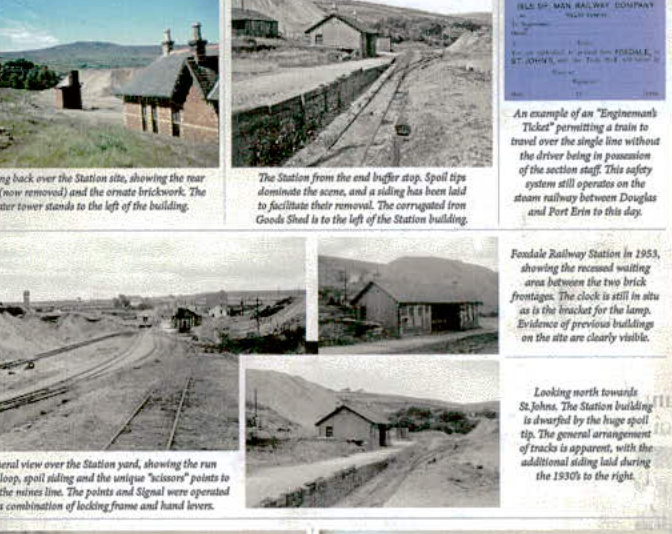
The railway station building at Foxdale was opened in 1886. Built by John Glass, of Kilerch, Scotland, this form also provided an identical building at the St. John's end of the line, two and a half miles away, and the wooden building at the only intermodal station, "Waterfalls," at Ballamen, (Lower Foxdale).
Facklitas would, upon opening, have included a bocking office, providing jobs for a Station Master and ticket clerk/assistant, with a back office storeworm, general seating room, ballet room, and toilets. The interior was panelled in vertical wooden plumbing and boonest thorn fireplaces for heating. A corrugated Iron Goods Heel stood behind and drove the station, on the sliding leading up into the Mises area.
The original ornate red brickwork with yellow quotes has now been restored in places, but more modern brickwork replaces the inter wooden partition that was a feature of the building when new. Granite was a low platform with brick edging, served by a single line with a rust-tested loop.
The station is now home to the Foxdale Heritage Centre and opens its doors to the public at various times during the year. Within is a wonderful collection of artefacts of life around the Foxdale area. If you visit inside the building, look up at the ceiling. It is easy to make out the original layout of the rooms.
On the left hand side, over inside the building, but originally outside under the inset canopy, the ticket window is still in place. The last train ticket was sold from June over 100 years ago. The station was altered at various times to provide living or office accommodation after the failure of the mines, railway business, thereafter, being carried out from the good's compartment of the Foxdale line carriage.
The area now occupied by the Foxdale Primary School was once the site of a large spoil heap from the mine. A temporary siding was built into this area to assist with the removal of this spoil, which was mostly used in the construction of the playing fields, which now form the basis of the National Sports Centre in Douglas. A further spoil heap rose up behind the station. The spoil heaps were removed, mostly by rail, in the 1930s. Further use of Foxdale spoil was made during the construction of the WWI airfields at Jorby and Andress.
Beyond the station building, there was a small brick construction in similar style to the station, its top of which was the water tank for the locomotives, and leading off the main line, via a set of points, was the entrance to the goods yard with its peculiar scissors crossing. A further siding ran up behind the Station building and crossed the road (Mises Road) into the mine area itself at a gradient of 1 in 12. The ore was loaded into into the wagram for Ramsey via St. John's. There was no set truck plan for the area inside the Mises boundaries, with rails and sleepers being moved around according to the areas being worked.
In common with the other stations on the Isle of Man, Strain Railway, Foxdale was protected by a simple post and auto signal. In points and siding, being operated by a combination of locking frame and hand levers.
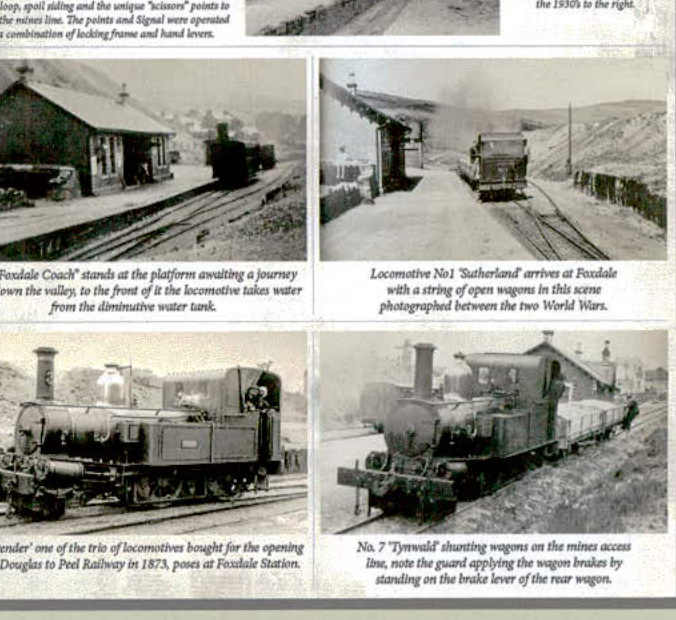
Passenger trains to Foxdale from St. John's were almost exclusively worked by a locomotive and a single carriage. The dedicated carriage supplied for the line. The Foxdale Couch, services to this day and can be seen in operation on the Douglas to Port Elsh Line. On occasion, the Tyreedd Day, the service would be augmented by additional coaches, as required to cope with the increased traffic.
From Opening until 1985, the locomotives of the Mann Northern Railway ran up into Foxdale. They were 56.4 - "Ransery" and 50.2 - "Northern", both built in 1879 by Sharp Stewart and Co., and 50.2 - "Thornhill", built by Boyer Peacock and Co. The 50.4 - "Calabresi" was bought especially for the Foxdale line by the Mann Northern, and was used to hold the heavy mineral trains or open wagrass to Ramsey Quayside, returning with loads of coal to power the mines equipment. "Calabresi" still services in use on the steam railway today, while "Thornhill" is now privately owned. The two Sharp Stewart locomotives were both scrapped by the railway in the early 1900s.
From 1903 until the closure of the line, the selection of locomotives was expanded to include the fleet of Boyer Peacock tank engines of the Isle of Man Railway Company. It is reasonable to assume that any one of the 11 could have made the journey up to Foxdale, but most likely the service would have been taken by one of the smaller engines from the 1-9 series.
{{image:224124}} {{image:224125}} {{image:224126}} {{image:224128}} {{image:224129}}
Copyright in submitted documents remains with their authors. Request removal
