Loading document...
TO SUPPORT A REGISTERED BUILDING CONSENT APPLICATION FOR MINOR AMENDMENTS TO APPROVED APPLICATIONS AT
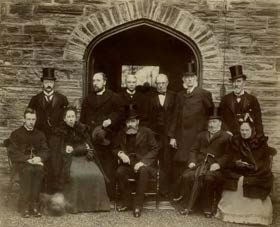
Figure 1. Bishop Straton (back row, second from left,) Mrs Straton (Emily Jane, née Pease, front row, second from left), the Lieutenant Governor the 5th Baron Henniker (front row, seated centre), the Bishop’s Chaplain the Rev. Henry Barlow (?)(front row, far left) and others at Bishopscourt after its restoration in 1895 after the fire of 1893.
RK/6296 10a Rev A March 2023
Planning Statement For proposed amendments to approved applications at Bishopscourt Kirk Michael, Isle of Man IM6 2EZ
Contents
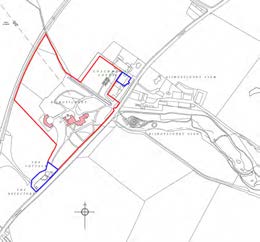
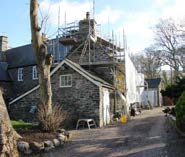
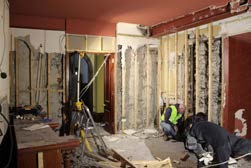
Figure 3. The restoration of Bishopscourt in progress in February 2023.
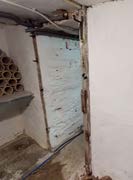
Permission has been granted to install two new doors into the existing openings to the wine and beer cellars in the West Wing. An overlooked survival is part of the timber frame and latch slot of a missing gate of unknown age, presumed to be mid-Victorian or earlier. It is assumed that this was a slatted picket gate of a kind common to the store-rooms of English country houses. The applicant proposes to restore the frame and latch slot and to re-instate the missing gate and the missing frame on the other side, basing the design on historical examples. The approved new door into the Wine Cellar (22/00328/CON) will still be accommodated and arranged in such a way that it does not interfere with the gate.
Figures 4. and 5. The surviving gate frame and latch slot in the Wine Cellar.
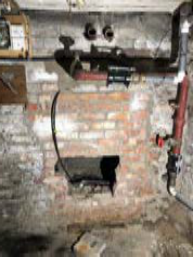
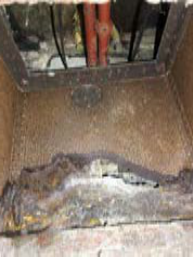
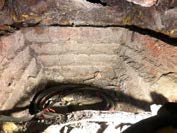
The approved removal of modern floor finishes in the West Wing corridor link to the main house has revealed a dry, stone culvert covered by slate lintels. This seemingly fed into a water cistern hidden behind the boiler room wall, where it was fitted with a cast iron tank – of which only the upper section remains – and a stepped brick bottom. At some point this was accessed and the fittings were partially removed before the cistern was walled up again with modern brickwork. It is conjectured that this culvert and cistern relate to the surviving culvert takes water from the Glen and feeds it via the Chapel undercroft into a culvert running the length of the basement corridor, cooling the cellars or that it related to an early heating provision.
It is proposed to retain the culvert in the West Wing corridor, re-instating any slates which have been lost and preserving it beneath the approved floor finishes. It is also proposed to clean out and conserve what remains of the cistern and remove redundant modern services, and to rebuild the modern brick wall between it and the boiler room.
Figures 6. and 7. The cistern seen from the boiler room; the remains of the cast iron tank within.
Figures 8. The cistern seen from the boiler room; the remains of the cast iron tank within.
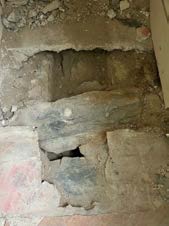
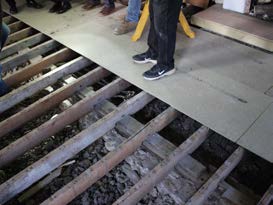
In application 22/00328/CON approval with conditions was granted for the restoration of the timber floor boards in Drawing Room G.01 and the general reservicing of this room and the introduction of underfloor heating. Removing the floorboards has revealed that the joists are resting on old sections of joinery recycled from elsewhere. Henning Shulz and Paul Croft of Lincoln Conservation have made an initial inspection of the timbers and believe them to be 17th century at the latest and very likely a good deal older. Analysis is ongoing, but at first glance they show signs of high status tooled work and joints, some paint remnants and ends suitable for their having been jointed as rails and stiles. It is conjectured at this stage that they formed part of a scheme of wall panelling or else a panelled dividing wall. Given the rebuilding of the Tower (at least twice) during the 18th century by Bishops Wilson and Mason and in the 19th Century by Bishop Murray, it is conjectured that these were placed here during one of those phases of restoration, resting on a low stone wall so as to support later floor joists. One has decayed beyond its structural life while the others show some signs of damage but are otherwise intact.
It is proposed to conserve the intact timbers in place with analysis and advice from Lincoln Conservation. In order to aid their conservation, it has been decided to forgo the approval for underfloor heating in this room. Once the environment of the timbers has been made suitable for their ongoing survival, the old floor boards will be replaced over them and the joists they support.
Figures 10. The central line of historical timbers supporting the Drawing Room floor joists.
Figures 11. Tooling on one of the shaped timbers, with a joint cut out on one side. Figures 12. A lip and tooling detail on one of the timbers. Figures 13. An historical timber against the wall is in an advanced state of decay.
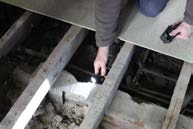
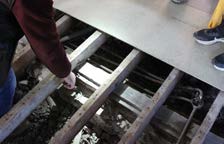
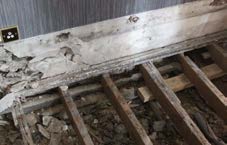
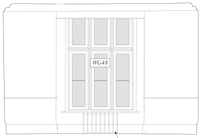
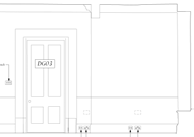
In application 22/00328/CON approval was granted to remove modern plasterwork and finishes from the Drawing Room. The installation of the approved new historical cornices requires a timber beam across the bay window in order to continue the rational run of the cornice without hitting the Window G48 in the bay. It is proposed to install a beam with beaded edges to make this possible.
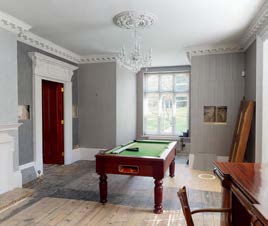
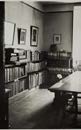
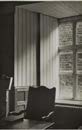
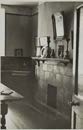
The modern library panelling is a very high quality arrangement installed by a previous owner in the 1990s. It is, however, out of keeping with the rest of the ground floor rooms in the Tower and Hall restored by Bishop Straton between 1893 and 1895 and the applicant proposes to replace it. Approval has already been granted for its removal, and that of the modern plasterboard behind The library as it existed at least between 1895 and 1956 featured some tongue-and-groove panelling, a picture rail and simple book shelves. The picture rail survives in part and it is proposed to conserve this and to reproduce the missing sections.
It has recently been brought to our notice that alterations to Peel Cathedral include the removal of the fireplace and panelling in the vestry, apparently dating to 1912. This removal has received registered building consent and the necessary faculty permission and will proceed regardless of work at Bishopscourt. The Peel Cathedral authorities have offered the vestry panelling and fireplace to Bishopscourt, and the applicant proposes to re-use them in the Library as fabric which is more sympathetic to the house and its history. The link would, moreover, underline historic links between Bishopscourt and Peel Cathedral, which include Peel Cathedral’s (formerly the parish church of Kirk German) having succeeded the Chapel of St Nicholas at Bishopscourt as the cathedral of the diocese. The ecclesiastical quality of the panelling and fireplace and their close date to Bishop Straton’s restoration also render them an appropriate addition. It is assumed that the Library at Bishopscourt has occasionally been used as a vestry, on account of the Chapel not having one. If the Peel Cathedral vestry panelling does not cover the whole of the Library then additional sections will be made up to match.
In addition, new plasterboard and either paint or wallpaper will be installed. Historical wallpapers have been found behind the modern plasterboard and it is proposed to conserve these with specialist advice. It is proposed to build out the new plasterboard stud walls on the north-west and south-east walls, preserving the original fabric behind and creating a void for fan-coil units but chiefly allowing for the hiding of a large steel beam which was found behind the modern library joinery and which is supporting the tower wall above.
Figure 17. The Library in the 1940 or 1950s, photographed by Matthew Hannah.
Figure 18. The Library in 1957.
Figures 19. and 20. The fireplace and tongue-and-groove panelling from Peel Cathedral’s vestry, dating to the Cathedral’s restoration in 1912. Note picture rail.
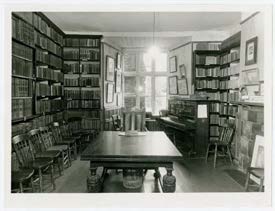
Figure 21. The recently removed panelling in the Library, installed in the 1990s.
Figure 22. The library with modern panelling removed in February 2023. Note the modern steel beam supporting the stone wall of the tower above. The date of its installation is unknown.
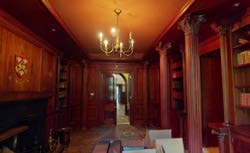
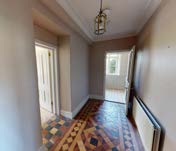
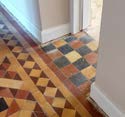
A riddle has been solved regarding the mismatch between the dust-pressed geometric tiles in the Corridor off the Great Hall and the line of the old walls. The tiles are apparently coeval with the lost geometric tiles in the Great Hall and the surviving ones in the Porch, dating to Bishop Straton’s restoration of 1893-1895. Like the Great Hall, analysis of paint stratigraphy shows that the walls of this Corridor were painted terracotta to match those of the Great Hall. The exposed margin of mortar at the edge of the room seems to indicate that there was half-height panelling to this corridor, also matching that surviving in the Great Hall. The depth of that surviving panelling would perfectly cover the gap between tiles and wall. Furthermore, the radical proposed plans of 1974 (unexecuted) note that the fireplace in the Great Hall had at least survived until then, although receipts from the 1925 renovation show that it may have been blocked up at that date. It is obvious that when the fireplace was removed from the Great Hall the gap in the panelling was replaced with panelling of the same design yet with slightly wider panels. It is likely that these panels were removed and re-used from the neighbouring Corridor. The panelling in the Corridor may have been removed by 1974 as it is not noted on the plan, although it is noted in the Great Hall. It is proposed to re-instate the panelling in the Corridor, returning the four panels used to cover over the place in the Great Hall where the fireplace had been and matching the rest of the panelling to this remnant.
Figure 23. Corridor G.08 today, with its panelling missing.
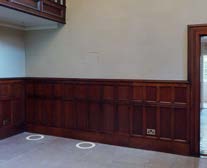
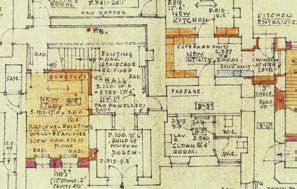
over by matching panelling with five bays of wider proportions than the rest of the Great Hall, apparently re-used from the neighbouring Corridor.
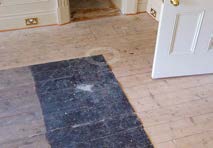
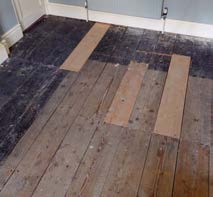
The timber floors throughout the house are a mix of old and modern boards and plywood in various conditions. Approval was granted in registered building consent application 22/00328/CON to take up, restore and re-lay these floors. It has become apparent that the historical joists are in many places bowed and the floors are therefore uneven. The applicant proposed to correct this by fixing timber furrings to the tops of the historical joists, so that when the restored boards are re-layed they may achieve consistent floor levels in each room.
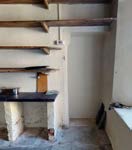
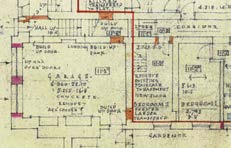
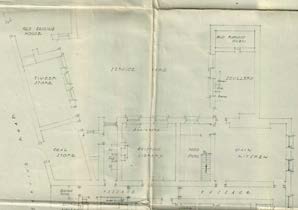
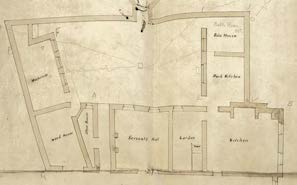
There is a blocked door between Larder G.15 and Sitting Room G.16, formerly the Servants’ Hall in 1857 and later, sometime after 1879 and until 1948, a library for the ordinands of the Theological College (which closed in 1943.) During the period in which the West Wing housed the Theological College there was a clear demarcation on plan of the spaces serving the Bishop and his family, the servants (including maids) and kitchens and the young ordinands and the College principal, the three spheres being defined separately. It is assumed that the blocked opening between two of these spheres dates from Bishop Crigan’s mysterious wing (1784-1813), for which illustrative evidence is lacking but for which documentary and physical evidence survives, and which was built on account of the dilapidated state in which he found Bishopscourt. The house was described as dull and Georgian, and was swallowed up by Bishop Powys’s neoTudor improvements in the 1850s and 1860s. The peel stone threshold matches that of the adjacent door between the Larder and the Great Kitchen. The applicant proposes to unblock the existing opening and to re-instate a door to match one of the historical doors adjacent to it.
Figures 29. and 30. The blocked opening as seen from the Larder and from the Sitting Room, formerly the Servants’ Hall and then the Theological College Library.
Theological College Library.
The Great Kitchen has not been used as a working Kitchen since Bishopscourt was sold by the diocese into private hands in 1979, but as an extra Dining Room. The 1974 proposed plan notes an Aga in the larger of the two fireplaces and schedules it for removal. Before then, this room had been the main working Kitchen for the house since at least 1857, although it was possibly also the Kitchen when it formed part of Bishop Crigan’s house (1784-1813.)
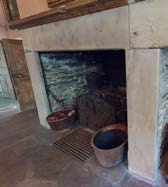
With assistance from SPAB-accredited experts Osborne Restoration, the original purpose of the two empty fireplaces has been confirmed by studying the remains of each and comparing them to other properties of similar status. The first, larger fireplace, with a large grille and ashpit beneath it, held a roasting-grate for the roasting of meat upon an open fire. This was a medieval method of cooking which was retained (with improved equipment) in country houses even after the advent of more efficient closed ranges in the 18th century; well into the 19th century the status of large, open-roasted joints of meat meant that roasting-grates were common in important houses with large households. There is evidence, in the notching on the timber mantle-shelf, that a spitjack and hastener were installed to turn the joint before the fire. The dimensions of the larger fireplace are similar to surviving roasting-grates.
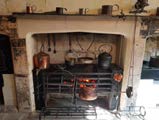
The second, smaller fireplace (housing a modern, defunct wood-burning stove) was a closed cooking range of a type developed in the 18th century and refined throughout the 19th and early 20th centuries, initially using wood and later coal. Because of the greater efficiency and control of cooking on a closed range, these were installed alongside the roasting grates for everyday cooking. They had closed ovens with doors suitable for baking and usually a small open fire which could be used for smaller roasts such as poultry. Later, they oven incorporated small boilers. There is evidence for a closed range of this type given that the dimensions match those of standard 19th century ranges and there are traces of black-leading on the stone fireplace surround
– essential daily maintenance for these ranges. There is also anecdotal evidence that the first private owner of Bishopscourt attempted to restore the closed range but failed in this endeavor and had it removed.
The roasting grate and closed range were used at Bishopscourt in conjunction with an even higher status method of cooking in the form of the large baking oven which was constructed on the north side of the Scullery and demolished in 1948 when that whole wing was truncated by 2.4m, presumably after years of disuse. Baking ovens were a great convenience but expensive to build and use, and were a feature of the kitchens of the gentry – those who could not afford them would send their loaves and cakes to be baked at the baker’s.
Studying builders’ receipts in the Manx Museum archive has revealed that in 1925 the new Bishop Thornton-Duesbury modernized the house, building the engine room and wiring the house for electricity, improving drainage and upgrading bath rooms and correcting damp problems. He also upgraded the kitchens: it appears that the large roasting grate had already been replaced by a closed range and that this was in turn replaced in 1925 by a ‘Triumph’ range. The other, smaller range was retained and survived into the 1980s. Additionally, a freestanding Beeston Boiler was installed alongside the ranges but this crowded arrangement was found to be unsatisfactory and this was moved to the Scullery, where it replaced a copper water cylinder heated by the larger range. The work was undertaken by J. Henry Cubbon of Douglas.
With the assistance of Osborne Restoration it is proposed to re-instate the lost 18th/19th century roasting-grate and lost 19th century closed range in their original positions, as working pieces of kitchen equipment with their attendant installations and accessories such as spit-jacks and hasteners. Permission has already been granted for the restoration and re-lining of the existing flues. Osborne Restoration has restored numerous historical kitchens in house museums and private houses.
Figure 34. The Great Kitchen in 1991 after the removal of the Aga from the larger fireplace and the closed range from the smaller fireplace.
Figure 35. The Great Kitchen in 2021 – redecorated but in a similar condition.
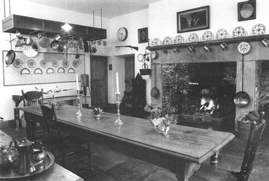
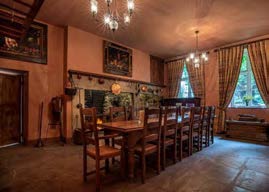
Figures 36. and 37. The large fireplace which contained a roasting-grate, a closed range, a 1925 ‘Triumph’ Range and latterly an Aga, and the smaller fireplace which contained a closed range (or a series of them) from the 19th century until the 1980s.
Figure 38. A similar arrangement of roasting-grate (left) and closed range (right) restored by Osborne Restoration in a house in Great Pulteney Street, Bath.
Figures 39. and 40. A roasting-grate by Osborne Restoration with accompanying spit-jack fixed to the wall above, as notches in the mantle-shelf show was done at Bishopscourt; a closed, cast-iron range restored by Osborne Restoration.
need to fire up the Great Kitchen ranges.
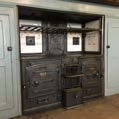
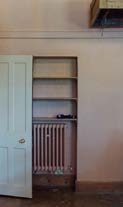
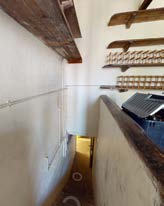
A doorway between Great Kitchen G.14 Larder G.16 is assumed to be coeval with the blocked door between the Larder and the former Servants Hall explained previously. This opening is also believed to date from Bishop Crigan’s house (1784-1813) and possibly to pre-date the staircase in the Larder which leads to the cellars. It is apparently blocked up with a single layer of modern bricks. It contains modern shelves and a radiator. The embrasure thus formed was not recorded in the 1857, 1948 or 1974 plans. The applicant proposes to unblock this opening and to install a fixed door to match the historical doors adjacent, to underline a rare survival from the Crigan layout.
Figures 44. and 45. The blocked opening between the Great Kitchen and the Larder, seen from both sides.
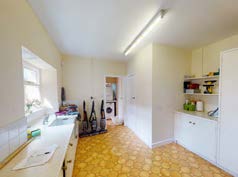
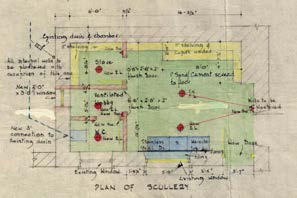
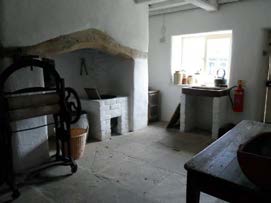
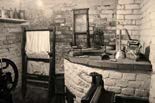
The Scullery G.19 has changed drastically since 1948, when planning permission was granted to Bishop Taylor after the closing of the theological college for the demolition of the old baking oven. In 1958 permission was granted to Bishop Pollard for the internal alterations which created a separate lavatory and store room at the north end of the room, the existing arrangement. Presumably in 1948 new drainage was laid where the baking oven had stood, as this is noted in 1958 as existing. Unfortunately, no existing drawings are provided and it is difficult to know what other features were removed in 1958, although the sink was replaced with new stainless steel and the floor – presumably stone flags worn with much use – was replaced with cement screed, although this in turn appears to have replaced concrete laid in 1948. The baking oven door removed in 1948 and blocked up was unblocked in 1958 and made into a small window. It is presumed that all historical features within the scullery were lost during this period. We have been advised by Osborne Restoration that a Scullery serving a household as large as Bishopscourt’s very likely contained a wash copper separate to the surviving one (estimated to be late 19th/early 20th century) in the Wash House, for the heating of water for washing dishes and the hand-filling of baths. We believe this may have been in the corner behind the Great Kitchen chimney stack, on account of the strange build-out there and the great width of the chimneystack, which contains six flues and can account for this facility. We also have documentary evidence (described above) that the scullery was the location of a copper hot water cylinder heated by the larger of the Great Kitchen ranges and that the cylinder was replaced in 1925 by a more efficient Beeston boiler. There is evidence of a partially blocked flue between the larger kitchen range and the scullery. The boiler and the cylinder most likely superseded a traditional brick-built wash copper, like that installed in the Wash House in 1925.
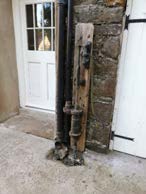
Osborne Restoration has also advised us that the old pump in the Kitchen yard (unconnected to any water supply and placed there after 1979 as a curiosity) bears every resemblance to standard scullery pumps of the 19th century and was originally installed inside the building.
In order to restore the Scullery to something approaching its pre-1948 condition the applicant proposes to replace the cement floor with stone (a new timber floor and replacement historical windows have already been granted approval), to re-instate a 19th century sink and draining boards on piers, to restore and re-instate the pump from the yard within the Scullery (approval has been granted for its restoration in the Yard, where we now understand it does not belong) and to rebuild a traditional wash copper connected to what is believed to be its original flue.
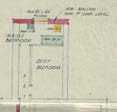
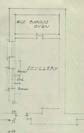
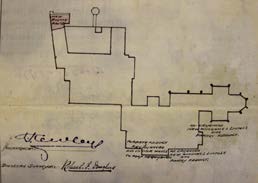
Baking Oven as a secondary structure within, here not drawn but it’s location marked in red on the second plan.
Scullery, but in older plans there appears to have been a dividing wall.
water.
Figures 52. and 53. Examples of brick-built wash coppers with masonry chimneys, a form suggested by the building out of the chimneystack in the Bishopscourt Scullery.
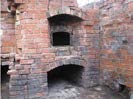
Figures 54. and 55. Examples of 19th century brick-built baking-ovens with arched, cast-iron doors and a fire chamber below. This was often covered with a loose wooden cover to reduce the air supply and allow the fire to smoulder. The size and form of the proposed replacement window is to follow the shape of the cast iron oven doors above.
having to fire up the cooking ranges or interfere with kitchen work.
Our current understanding of the development of the Wash House wing is as follows: the former wash house and wood house were built as a single storey building at an early date and the ground levels around them were subsequently raised – there is evidence for this in the low floor level of the Wash House and the low level of the drains in the West Wing Yard. By the completion of Bishop Powys’s improvements in 1857, a first floor with three bedrooms had been added on top of this single storey structure – there is evidence for this when examining the change in the quality of the masonry, and in Powys’s building receipts in the Manx Museum Archive, which refer to three bedrooms being constructed to make up for the three bedrooms lost when he demolished Bishop Murray’s Chapel. The 1925 building receipts and correspondence show that the Engine House was built onto the end of this building by Bishop Thornton-Duesbury, for the purpose of housing a new Crossley paraffin engine to provide the first electricity at Bishopscourt. The Engine House was built by the firm of Kelly Brothers – formerly joiners and church furnishers – and the electrical installation was undertaken by V.A. Bellamy & Co. of Douglas. By the time of the 1948 alterations the Engine House is already labelled as ‘old’, not on account of the structure but because the engine became defunct when Bishopscourt supplied with mains electricity. It has been a store room ever since. Although a modern concrete floor has been poured over its original floor, the cement footing of the engine survives.
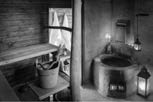
Approval has been previously granted to restore this room as a studio with a new timber floor. The applicant proposes to re-instate what was most likely a stone floor similar to the surviving floor in the neighbouring Wash House, while preserving the footing and pipework of the engine so that it can be seen. Additionally, it is proposed to install within the existing bounds of the room a sauna and a steam room, both facilities detailed in a traditional and sympathetic manner so as to be in accord with the historical character and rusticity of the former Engine Room. The steam room will incorporate a detail which allows the engine footing to be seen below it. Internal shutters will provide the necessary thermal insulation between the windows and the sauna and steam room.
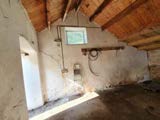
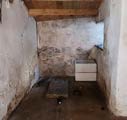
Figures 60. and 61. Present state of the former Engine Room, including the engine footing on the right.
Figures 62. and 63. It is possible to design saunas and steam rooms in an historically sympathetic manner and out of materials suitable to an historic building.
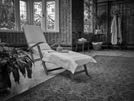
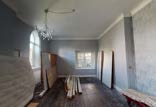
In the interior condition survey submitted with the registered building consent application for the restoration of the interiors of the main house, two modern skirting boards with inappropriate profiles were not noted in Tower Bedroom 1.01 and Tower Bath Room 1.02. The applicant proposes to remove these and replace them with new timber skirtings copied from historical skirtings elsewhere in the house.
Figure 64. Modern skirting board in Tower Bedroom 1.01
A dividing stud wall with an open arch has been approved for Dressing Room 2.04. as part of application 22/00328/CON. The applicant proposes to modify this arrangement, replacing the proposed arch with a timber door to match adjacent historical examples. The framed glazed panel revealing the historical structure of the Tower at the entrance to this room will be affected by the proposed new door approved in the aforementioned application. The applicant proposes to reframe and re-glaze the opening, maintaining the visibility of the historical building materials.
Figures 65. and 66. General view of Dressing Room; framed section of Tower wall.
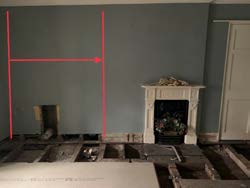
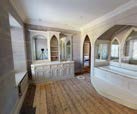
The removal of modern sanitaryware in Bath Room 2.02 has revealed that to the left of the fireplace the original form of the room has been obscured behind modern plasterboard. The applicant proposes to remove this plasterboard and restore the original shape of the room. There is historical wallpaper hidden within the space, presently under expert analysis. It will be conserved and protected when the room is redecorated.
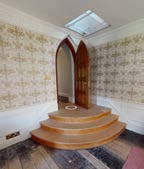
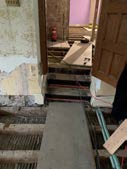
Bedroom 2.05 is shown in a plan of 1955 as being divided into a passage, a bedroom (fireplace extant) and a bath room (fireplace lost but approved for reinstatement in 22/00328/CON.) Steps leading from the lost corridor to the surviving Tower landing are shown on this plan and these stone steps have been uncovered by the removal of the modern steps and platform during the restoration of the floor boards. The applicant proposes to restore these uncovered steps and not to put back the modern timber steps and platform. This would also involve removing the modern door and frame and restoring the opening as an open arch, without changes to its form.
Figures 69. and 70. The door and steps from the Tower landing into Bedroom 2.05 before and after the removal of the modern steps.
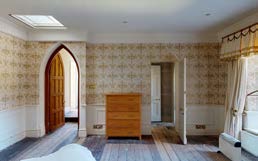
The lost fireplace in the Great Hall and the reinstatement of its flue and chimney was approved in applications 22/00328/CON, 21/01414/GB and PA 21/01416/CON. It has become apparent that the removal of the fireplace and flue also involved the removal of part of the wall on the second floor in Bedroom 2.05, which in its depth contained the flue. The applicant proposes to re-instate the missing wall so that the room can be restored to its previous regular form (even without the partition walls which divided it into a bedroom, bath room and corridor) and to allow for extra depth for the re-instatement of the approved flue.
Figure 71. The west wall of Bedroom 2.05, the stepped back section of which shows the extent of the wall demolished some time after 1955.
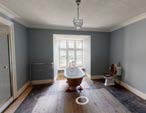
The replacement of the timber floor boards in second floor Bath Rooms 2.03 and 2.08 with stone floors was approved in 22/00328/CON, along with the re-use of the boards elsewhere in the house. This change will also necessitate the strengthening of the existing timber joists in these two rooms. It is proposed to do this with the advice of the project’s structural engineer.
Figures 72. and 73. Bath Rooms 2.07 (left) and 2.03 (right)
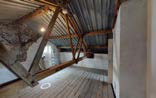
Attic 2.10 is accessible via a ladder-staircase and is currently the only functional attic in the West Wing which can be used for storage or services, having a floor laid over the joists. Attics 2.11 and 2.13 are completely inaccessible for maintenance or use. Attic 2.13 is visible through a hole in the wall from 2.14 but inaccessible. Attic 2.13 is accessible via a small hatch in the ceiling below.
As part of the general reservicing of the building approved in application 22/00328/CON, space needs to be found for plant and other equipment which is discreet and makes the least possible intervention into the historical fabric of the building. The inaccessible attics in the West Wing are a good place for these installations. In the south range of attics, the applicant proposes to make a new opening between Attics 2.10 and 2.11, and between 2.11 and 2.12, strengthen the existing joists to support equipment and lay a new floor over these where it is believed that there is none. In the north range of attics, the applicant proposes to enlarge and adjust the hatch into Attic 2.14 and to enlarge the existing opening between Attics 2.14 and 2.13 so that a person may safely pass through it. The joists are to be strengthened and new floors laid as for the other attics. It is proposed to board over the insulation between the rafters in all the West Wing attics. New insulation throughout the West Wing rooves was approved in applications 21/01414/GB and PA 21/01416/CON. These works are to take place with methodologies from the project engineer.
Figure 74. Attic 2.10 in the West Wing, the only accessible attic in that part of the house.
As part of the general reservicing of the building approved in application 22/00328/CON, the Tower attics 3.01 and 3.02 are to in part contain plant and equipment. The applicant proposes to strengthen the joists in these attics with the advice of the project’s structural engineer in order to ensure the safety of these new installations. The general rearrangement of the Tower attics and their re-roofing to restore their pre-1958 appearance were approved in applications 21/01301/GB and 21/01300/CON.
Figure 75. Tower Attic 3.02
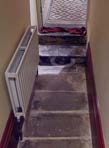
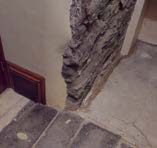
In application 22/00328/CON approval was granted to re-instate the c.1895 geometric tiled floor which was removed from the Great Hall G.05, and to restore the surviving geometric floor tiles in the Ante Chapel G.21, Corridor G.08 and Lavatory G.09. Approval was also granted to replace the modern, ceramic tiled floors and cement floors in West Wing Corridors G.11, G.12, G.13, G.28 and Lavatory G.27 with stone floors as this was believed to have been the last historical floor material to have been removed from them. That flagstones were in fact the earliest floor material in this corridor has been confirmed by the discovery of fourteen square metres of pale flagstones at the west end of the West Wing corridors. These had been screeded over and covered with modern tiles – it is possible that these replaced Victorian geometric tiles but if that is the case, none have survived. It is thought that the flagstones are not from the Isle of Man but were an expensive addition either to Bishop Crigan’s late 18th century house or to Bishop Powys’s 1857 renovation and expansion of this wing. It is proposed to conserve and restore the flagstones which have been found in the West Wing corridors and re-instate similar flagstones where they have been lost.
It is also now suspected that the slate floor in Chapel Corridor G.03 is a modern replacement dating to the same period after 1979 when the tiles in the Great Hall were replaced with York stone, given their wide joints and points of concrete infill. Approval is now sought to replace this modern slate with dust-pressed geometric tiles, too, as the likely most recent historical floor. The slate steps at the door into the Ante Chapel appear to be much older and are to be retained and restored.
This re-instatement of tiles would mean a continuous finish of late Victorian floor tiles of various patterns from the Chapel, through into the Great Hall and through into the short corridor and lavatory.
Figures 76. and 77. The modern slate and cement floors in the Chapel Passage G.03, and the much older slate steps into the Ante Chapel.
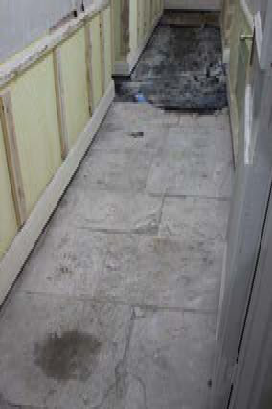
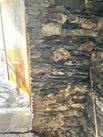
Approval has been requested in a separate planning application for the narrowing of the Wood House doors to their original width. Approval is here sought for the building out in Manx Stone of a section of walling to support the existing chimneybreast on the first floor above, thought to date from Powys’ alterations of 1857 and which is inadequately supported on the wall between the Wood House and the Wash House. This lack of support may have contributed to the instability of the chimney, which was pulled down and rebuilt in brick after 1948, and after 1979 pulled down altogether. The stone chimney has been approved for re-instatement and this buildout is requested by the engineer to ensure the structural soundness of the restored fabric.
Figure 80. Corner of Wood House where proposed Manx stone build-out will support the historical chimneybreast above.
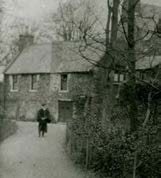
Figure 81. The Wash House and West Wing in an undated photograph presumed to date from the late 19th century. The support for the chimney beside the wood house door – seen here faintly – was inadequate from the first but can be corrected to aid its re-instatement.
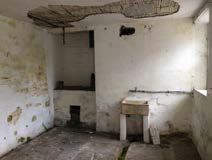
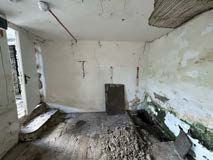
The internal walls of the Wash House are suffering from chronic damp. We hope to correct his on the south-west wall through proposals in a separate application to install a land drain outside the Wash House. Amanda White of Lincoln Conservation has advised us on the restoration of the internal finishes: this is modern alkyd paint over limewash and lime render on the south-west wall, and cement render on all other walls. The Wash Copper and its brickwork date to 1925 and are also painted in modern alky paint. The lime render and lime wash on the south-west wall is too decayed to be able to save, and it is proposed to remove it and replace it with new lime render. It is also proposed to alleviate the damp in the rest of the room by removing the modern cement render and replacing it with lime render. The modern alkyd paints on the wash copper are to be removed so that it can be fully restored to working order in place. The brickwork and the new lime render are then to be finished in limewash, permitting full breathability of the materials in this room to avoid further damp ingress and build-up. The lathe and plaster ceiling is to be restored in line with the approval given for the restoration of all the ceilings in the building.
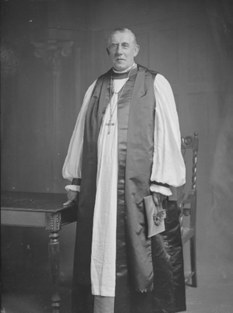
Figure 84. Bishop Thornton-Duesbury has been overlooked as a contributor to Bishopscourt but during his short tenure (1925 until his death in 1928) he overhauled the drainage and sanitary provision in the Episcopal Palace, built the Engine House, laid on electricity, undertook remedial works to the south-east facades of the Hall and Tower, modernised the Kitchens and built the present main gate posts. He was a Manxman. His son, the Rev. Canon Julian Thornton-Duesbury was Headmaster of St George’s, Jerusalem in the 1930s and succeeded his colleague the Rev. John Taylor as Principal of Wycliffe Hall, Oxford – Taylor was his father’s successor-but-one as Bishop of Sodor and Man.
Copyright in submitted documents remains with their authors. Request removal
