Loading document...
In terms of archaelogical potential, it is likely that an archaelogical investigation would reveal little given that the building occupies most of the site. The small associated external space was disturbed when the extension and access path was constructed in the mid 1980s.
DESCRIPTION Location + Setting A modest building, the former Police Station is located opposite Castle Rushen and its entrance at the junction of Castle Street and The Quay, adjacent to the harbour in Castletown, ancient capital of the Isle of Man. Occupying a small plot the single storey building is attached to the two storey former Post Office (Derby House) and adjacent to two storey dwellings alongside the quay.
STATEMENT OF SIGNIFICANCE Designations
The former Castletown Police Station is number 27 on the register of protected buildings as well as being within the Castletown Conservation Area. These designations are official recognition of the high heritage significance of the building and the importance of its setting.
The police cells and main building were linked by a mono pitch polypropylene roof which covered the former yard. The extension is constructed in brck cavity walls with a concrete roof; the north elevation of the extension, facing the harbour, has been clad in stone, reflecting the material (though not the coursing) of the main part of the building. Although largely set back from the road this side elevation is partially visible from the quatyside. This extension is of poor quality construction, below modern standards, and is in poor condition.
The evidential significance in terms of archaeological potential is therefore considered to be low.
Little documentary evidence survives - Baillie Scott's archives were twice destroyed by fire and whilst he published plans, these were of his housing projects. No planning applications noting changes were made until 1985 and whilst photographs exist of the exterior of the building, none are evident of the interiors.
Historical value concerns the ways in which past people, events and aspects of life can be connected through a place to the present. It might also be assessed in the particular local context of the town or village in which the building is located.
A foil the castle entrance opposite, the building is an important part of the townscape.
The evidential significance in terms of documnetary potential is therefore considered to be low.
The Police Station was in continuous use from 1901 until the Police relocated in 2017. The historic value of the building lies predominantely in terms of the role it has played in the social history of Castletown, giving it a clear sense of identity.
The building consists of a main entrance area, off of which are two offices for an Inspector and Sergeant. The entrance area leads to a corridor serving as access to police cells, shower room and disabled persons toilet in a converted former cell; with interview room; kitchen and toilet in the flat roofed extension to the east.
The former Police Station itself has the potential to tell us more about the decorative detailing through analysis of the surviving fabric in tandem with careful removal of modern false ceilings.
Designed by the internationally renowed Arts and Crafts architect Mackay Hugh Baillie Scott, the purpose built former Police Station dates from circa 1901.
The evidential significance of the building in terms of historic building archaeology is considered medium.
The historical value of the building is considered high. Evidential Value
Despite alterations over time, the orginal layout is clearly legible. Elements of note include the stone arches in the entrance area; the exposed ceiling joists and knealers to the same area; and the Arts and Crafts timber boarded, ledged and braced doors with decorative studs and strap hinges . Intrusive elements include services such as power points, conduit and radiators.
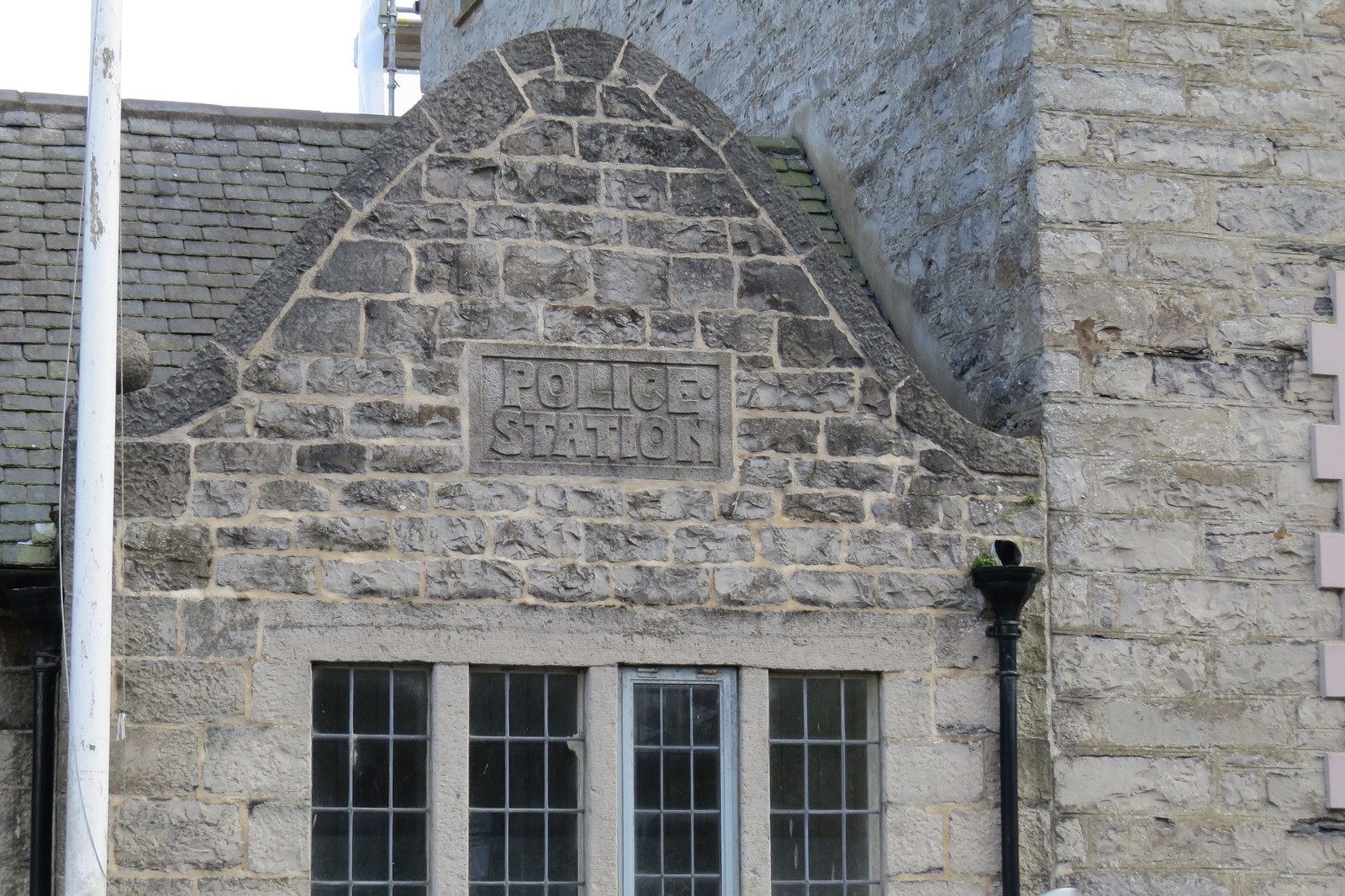
The original section of the building is constructed of solid limestone elevations under a steeply pitched slated roof with a tall stone chimney stack adjacent to a conical turret addressing the corner, two curved Dutch gables projecting above eaves level. A flat roofed section at the rear covers barrel vaulted police cells. A shallow mono-pitch polypropylene roof covers the former yard connecting the main building to the cells.The plot is bounded by both stone walls and stone elevations to adjacent properties.
Evidential value comprises the potential of a place to yield evidence about past human activity. This can be gleaned from archaeological, architectural, artefactual or documentary evidence.
Communal value centres on the importance of a place to the people who use, experience and value it. Therefore, it is important to consider the public perception of use of the site and translate this into an understanding of communal value.
The evidential value of the former Police Station lies in its potential to provide further information on the building and its setting which may enhance understanding and contribute to its heritage significance.
The communal value is considered to be high. The building was designed and operated as a police station, supported by a workforce, for 116 years. The building's use has, until recently, been to further the social well being or social interests of the community. A focal point providing some public access and in continued usage until 2017, its social value gives it a clear sense of identity, belonging and place, retaining its historical relevance.
The 1985 extension is fitted out in using off the shelf door blanks, ironmongery and joinery items and a low quality kitchen and sanitaryware.
Although altered, the former Police Station does retain the majority of its original spaces and details.
The building has been altered internally and a rendered cavity brick wall, flat roofed interview room/ kitchen extension was added in 1985. The alterations included creating an access from the quay in the abutting stone boundary wall.
The registration document, dated 1984, describes the building (no 27 on the register of protected buildings) as:
"....an example of the architect out of his normal context.." Conservation Area
The aesthetic value of a building or landscape refers to the ways in which people draw sensory and intellectual stimulation from a place and its architectural quality.
Designed by internationally renowed Arts and Crafts architect, Mackay Hugh Baillie Scott, the original exterior form and materials that the building are constructed from are distinctive and of good quality.
The (former) Police Station is included within the Castletown Conservation Area, designated in 1990.
An idiosyncratic form which draws inspiration from Castle Rushen opposite, the building contains elements and details that appear in Baillie Scott's residential projects, for which he is better known. The semi-circular arched timber ledged and braced doors with decorative studs and strap hinges are particularly noteworthy.
Elements of the design also reflect details of his prize-winning entry for the 1901 Darmstadt Haus eines Kunstfreundes (House for an Art Lover) competition, later published in his book, Houses and Gardens (1906). The competition entry combined many of the architectural ideas that he had developed over the previous decade. Acccording to Diane Hiagh (Baillie Scott, The Artistic House; 1995), the work was judged favourably for its interior spaces but 'the jury had more doubts about the external elevations, whosw forms were clearly derived from the single tower and gable on the police station in Castletown on the Isle of Man'.
The former Police Station occupies a prominent corner position opposite Castle Rushen and immediately surrounded by roads with the harbour to the north and castle to the west. The ground slopes downwards from the south west corner to the north east gate by approximately one metre.
In any case, the police station is important as an example of Baillie Scott's work outside of the residential sector. The plot is bounded by both stone walls and stone elevations to adjacent properties. Despite subsequent alterations to accommodate services and modern methods of policing, there are no comparable buildings on the Island.
The setting of the former Police Station has improved of late with, opposite on the north side, the refurbishment of the former Social Security Office to a coffee shop and formation of an associated external landscaped and seating area, formerly car parking.
There is the potential to improve the aesthetic quality of the building through removal of the rear extension and reversing the internal alterations.
The aesthetic quality of the building is considered to be high. Detractors
The main building is constructed of solid limestone elevations under a steeply pitched slated roof with a tall stone chimney stack adjacent to a conical turret addressing the junction of Castle Street and The Quay. Two curved Dutch gables project above eaves level facing each road and both street elevations contain an entrance door with a curved head. The elevations contain vertically proportioned leaded windows with stone mullions. At the rear of the property is a flat roofed section over barrel vaulted police cells.
There are a number of features that detract from the heritage value of the building. These features are considered to be intrusive and some offer the oportunity for considered enhancement.
These include:
In the late twentieth century various alterations occurred, the most significant being a flat roofed kitchen/ interview room extension to the east connected to the police cells.
©
a r c h i t e c t s + d e s i g n e r s r c h i t e c t s + e s i n e r s ISSUE 29/06/2022 ISSUE 21/09/2021
21/09/2021
Statement of significance @ A3 Planning Statement 1.50 @ A3 Site Plan 1.50 @ A3
Copyright in submitted documents remains with their authors. Request removal
