BISHOPSCOURT MANSION HOUSE BISHOPSCOURT KIRK MICHAEL PLANNING AND HERITAGE STATEMENT RK/6296 September 2021
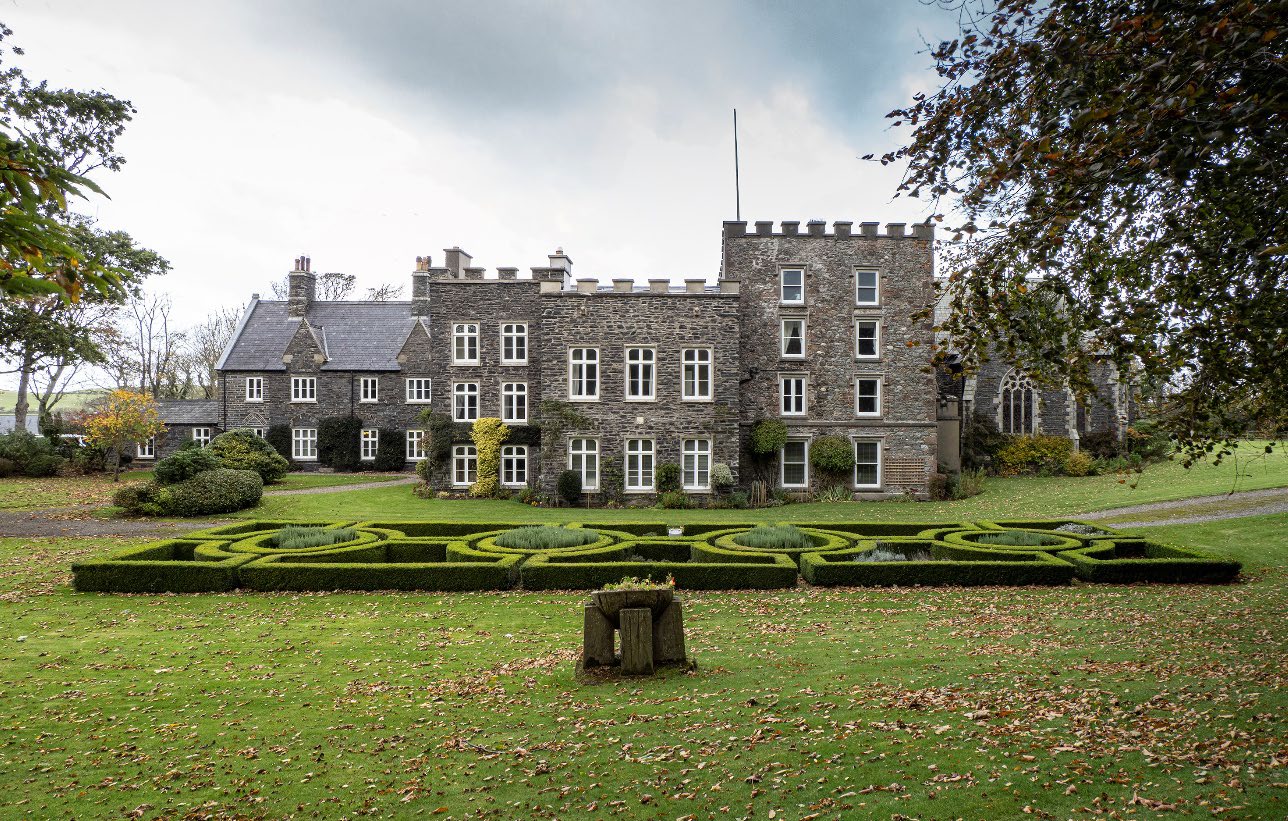
A wide exterior photograph of a large, historic grey stone manor house featuring crenellated rooflines and formal box hedge gardens in the foreground.
Planning & Heritage Statement For Proposed replacement of roof slates over the roofs of Bishopscourt Mansion House, Bishopscourt Kirk Michael, Isle of Man IM6 2EZ
Contents
1.0 Introduction & Site Context page 03
2.0 Historic Background page 04
3.0 Planning History page 05
4.0 Description page 05
5.0 Proposals and Justification page 05
6.0 Conclusions page 07
1.0 INTRODUCTION & SITE CONTEXT
1.1 This planning and heritage statement has been prepared for the purpose of supporting a registered building application for the replacement of the roof slates at Bishopscourt Mansion.
1.2 The application is submitted by ADAM Architecture, acting as Agents for the Applicants, Mr and Mrs Giroux.
1.3 This document aims to explain the methodology and justification for the proposals in design and heritage terms, and should be read in conjunction with the application drawings by ADAM Architecture.
1.4 Bishopscourt comprises the principal mansion associated with the Bishops of Sodor and Man and, with a collection of associated structures, including utilitarian outhouses, as well as the Chapel to the north east side of the group, is designated a Registered Building by the Isle of Man Government (RB No. 1, 23rd May 1983). The Estate is located to the north west side of the Main Road (A3) leading north from Kirk Michael to Ramsey and close to the west coast of the island in a relatively open landscape close characterised by agricultural enclosures, pastures, woodlands and scattered dwellings.
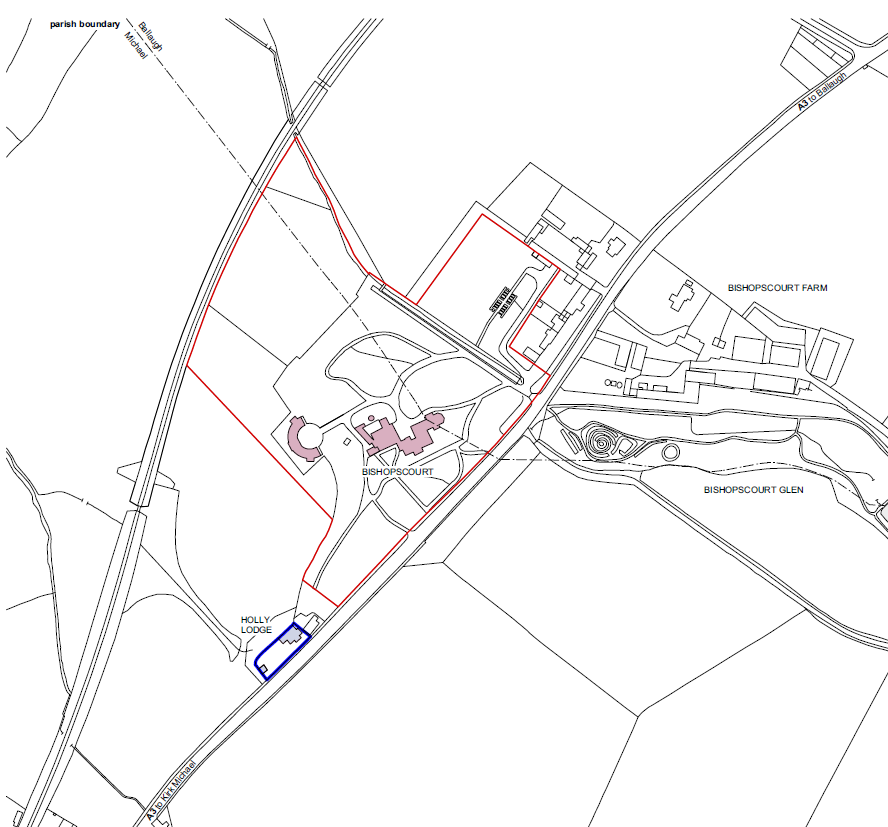
Above: Existing site plan showing the location and context of Bishopscourt
1.5 Bishopscourt is a Registered Building (Isle of Man Government, Code MH/H/R/A, RB No. 1, 23rd May 1983) comprising the principal mansion house and the ‘buildings contiguous therewith’. It is located beyond the boundaries of
A black and white site location plan showing the application site 'Holly Lodge' outlined in blue, situated near 'Bishopscourt' and major roads.
the nearest Conservation Areas, including Kirk Michael to the south (designated 2006) and Glen Wyllin Conservation Area (also designated 2006); and the Ramsey Conservation Area (Planning Amendment Order, 1992), albeit at some distance to the east. Each is beyond the scope of the subject site, and their setting is not affected.
Historic Background
2.1 The extant structures at Bishopscourt constitute an exceptional group of buildings, including the main house, and the Chapel of St Nicholas, the former private chapel to the Bishop of Sodor and Man designated a procathedral in 1895 (until 1979 when the house was sold), and which, on initial inspection, collectively appear to date outwardly from the 17th to the 19th and up to the late 20th centuries, although the original peel tower, much altered and ‘domesticated’, will retain 14th century fabric.
2.2 Segments of the principal structure suggest a style which is redolent of these defensive towers in Cumbrian style built to withstand unrelenting border raids, infused with an eccentric fusion of Scottish Baronial architectural vigour and the unadorned vernacular form. If there is a distinctive heterogeneity in the historic demographic of the island characterised by a mingling of populations from Scotland, Ireland, and England, then Bishopscourt represents their collective aesthetic input, alongside the patronage of a succession of episcopal tenants, some more determined contributors than others to the form of the building; others apparently never even visited, considering the island ‘barbaric’.
2.3 The historical evolution of the site at Bishopscourt is elaborate in its complexity – and significantly transformed from its inception in the 13th century as a timber edifice, of which no obvious trace survives. Its 17th century form would have resembled a structure similar to the extant Yanwath Hall in Cumbria, although there have been multiple changes to the external form and interior aesthetics, especially post-1893 fire at Bishopscourt, which ‘completely gutted the central portion of the interesting historic building… [it] appears to have originated in the Bishop’s study, in which were stored valuable and historic Church documents and records which have been destroyed.’ Early views of Bishopscourt of the mid-17th century by Daniel King prepared post-surrender of the Isle of Man during the Civil War ‘formed a visual supplement to a written report commissioned by the Lord Mann, Thomas, Lord Fairfax appointed by Parliament in the place of James Stanley, 7th Earl of Derby, staunch Royalist’ and confirm substantial modifications to a structure which is labyrinthine in its complexity, chronology, and surviving elements.
2.4 Despite alterations in the latter part of the 20th century, it remains a building of ‘extreme historical importance… founded as the seat of the official church on the island by Bishop Symon who died in 1247’ despite the loss of the broader Estate, including Bishop’s Glen and Bishopscourt Farm, as well as part of the walled garden which was ‘sold for building land.
3.0 Planning History
5.1 Registered building consent (Reference 21/00367/CON) and Planning approval (Reference 21/00366/GB) have been granted for works regarding the replacement of the 'Tower' roof and the re-slating of the 'Hall' roof along with associated items. The areas affected by these applications have been outlined in red on the drawings enclosed to this application.
4.0 Description
4.1 Bishopscourt is a Manx stone building with modern timber framed windows and slate roofs. The roofs are pitched and, in the Tower and Hall, concealed behind tall crenelated parapets. The parapet copings are generally modern concrete copings. The Tower roof structure and covering is relatively modern, as described above; the Hall roof covering is thought to date from the 1980s; an unappealing mixture of new and reclaimed slate.
4.2 ADAM Architecture have carried out a survey of the condition of the existing roof slates and a summary of our findings is as follows:
With the exception of the chapel roof, the majority of the roofs are covered in a mix of grey and heather coloured slates and of mixed quality. This is the result of years of targeted repairs, to varying degrees of care and attention towards the history of the building. An illustration of the current ratio of the gray/heather slates can be found on the ADAM Architecture existing drawing 6296 PL175 enclosed to this application.
From the analysis of the existing roofs, and on the basis of further discoveries in the historic fabric of the building that we will detail further down in this document, we believe that the original slates used at Bishopscourt, and the predominant one even in the current roofs, are the Penrhyn Heather slates.
The roofs of the chapel are covered in Westmoreland Green slates, laid in diminishing courses.
5.0 Proposals & Justification
5.1 The current application seeks permission to renew the roof coverings on all the roofs over the Mansion house, to install new and reclaim Penrhyn Heather slates, matching the colour of the original slates. It also seeks permission to change the specification of the replacement slates over the Tower and Hall roof to Penrhyn Heather, to match the original and in light of the most recent survey and analysis.
5.2 The previous applications submitted for the re-roofing of the tower proposed to use natural grey slates to match the existing. The difficult task of assessing what the existing colour is has been challenging indeed, and the overall current mix of old/faded/replacements/modern slates is deceptive. There is indeed a mix of slates on the existing roofs of the house, with small portions re-roofed in grey slates in modern times, particularly on the Hall roof, plus a number of repairs and replacements that have been carried out using grey slates. However, the applicants believe that the evidence discovered during the latest survey work, with the additional access granted by the employment of a hoist, supports the argument that
the predominant and original slates used on the roofs of Bishopscourt is the Penrhyn Heather slate.
5.3 On the basis of our visual inspection on site, we have carried out an evaluation of the percentages of heather vs grey slates on the roofs, illustrated on ADAM Architecture drawing 6296 PL175, included in this application. Despite the numerous interventions, it is possible to see that the Penrhyn Heather slate is still prevalent in the majority of the roofs, and should therefore be used as the foundation for any future intervention to the roof coverings.
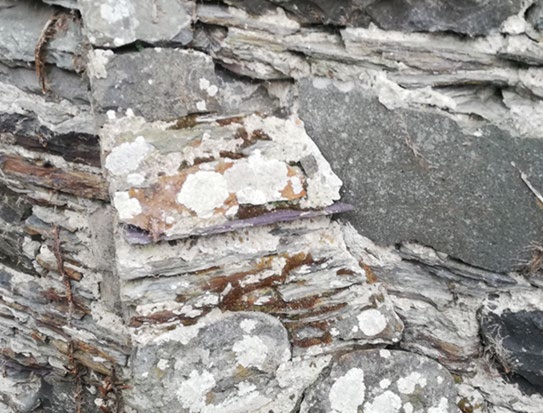
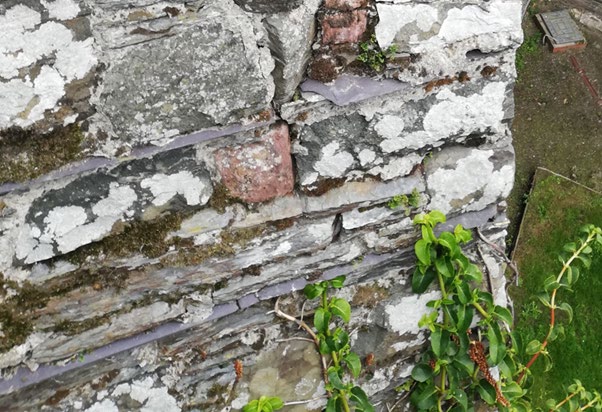
5.4 During our close inspection of the walls of the peel tower. slates used for coursing the stone walls were discovered. These slates, which have preserved their original colour due to their less exposed location on the oldest walls of the complex, offer compelling evidence that the slate used in the building of the tower was indeed the Penrhyn slate or something of a similar tone.
02. Above: Coursing slates on the peel tower
Close-up photograph of weathered layered stone masonry with lichen growth and a distinct repair patch.
03. Above: Coursing slates on the peel tower
5.5 It is also worth noting that, in the Kirk Michael Conservation Area Character Appraisal of 2006, it is acknowledged that the prevalent slate used for the buildings in the area is “Welsh blue slates”, so the choice of Penrhyn slate would also be sympathetic with the character of the Conservation Area.
6.0 Conclusions
6.1 These proposals have been considered in relation to the appearance of the property and its setting. We believe the current state of the roofs at Bishopscourt is detracting from its historical relevance.
6.2 The choice of natural slate will ensure a gradual aging process to the replacement roofs, so that in time the new slates will naturally blend in with the existing reclaimed slates. This will ensure the visual perception of the house will not be dramatically altered from the current condition, but the historic accuracy will have been restored and the building will have regained the striking appearance it deserves.
A close-up photograph of weathered slate or stone masonry with significant lichen growth and climbing vegetation.
Copyright in submitted documents remains with their authors. Request removal
Source & Provenance
Official reference
21/01160/CON
Source authority
Isle of Man Government Planning & Building Control