Loading document...
SEAVIEW | proposed barn and manege
1.01 This Design Statement has been prepared as part of an Application for Detailed Planning Approval to create a barn and manege for private use by the owners of Seaview, Oak Hill, Braddan, on land adjacent to Seaview; it is intended to supplement the information contained in the submitted drawings and help clarify the reasoning behind the design. 1.02 Pre-application advice was sought from, and provided by, Senior Planning Officer Sarah Corlett; Miss Corlett's assistance during the application process is gratefully acknowledged. 1.03 The extent and topography of the application site is indicated on drawing number 170/002; it has an area of just over half a hectare and falls 8.0 m from west to east.
There is a public right of way to the north of the site, separated from the site by a Manx sod bank, approximately 2.0 m high. To the west and east are fields in the same ownership as the application site, with both fields being accessed from the application site and used to keep horses, and each housing field shelters.
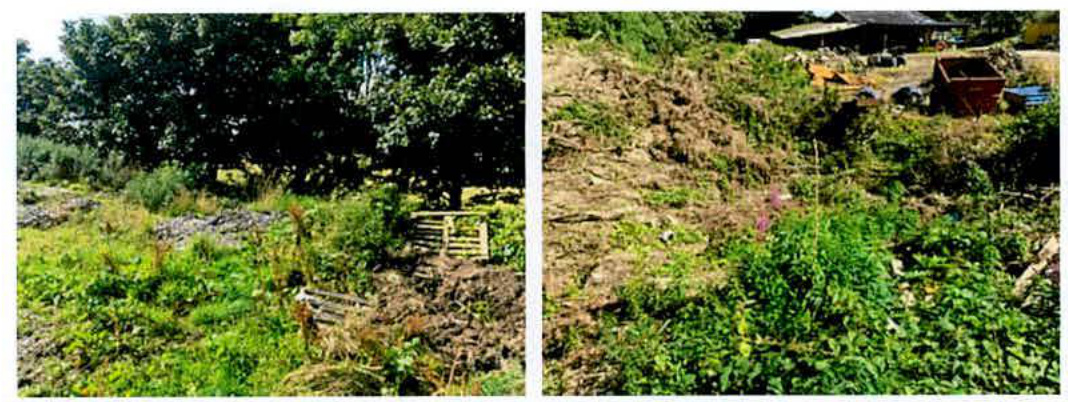
To the south is a large storage shed with attached covered storage areas that house equipment used to tend to the substantial surrounding land tract owned by the Applicants. 1.04 The application site has not been maintained or tended to in any material way for some considerable time; as a consequence, it is unkempt and severely underutilised, as indicated in the photographs below.
1.05 The proposals therefore aim to bring this area of land back to a viable use that will considerably improve its appearance and create other benefits noted elsewhere in this Design Statement.
2.01 The application site lies within an area designated as an Area of High Landscape or Coastal Value (AHLV) in the 1982 Development Plan. 2.02 Environment Policy 2 of the Isle of Man Strategic Plan 2016 (the 'Strategic Plan') therefore applies and it is considered that the proposed development would not harm the character and quality of the landscape, for the reasons set out in Section 3.00 Design. 2.03 Further, whilst the location for the development may not be deemed to be essential, there are certainly considerable benefits to the proposals being located where they are, again for the reasons outlined further in Section 3.00 Design. 2.04 As the proposals are for equestrian purposes, Environment Policies 19, 20, and 21 also apply to the Application. 2.05 With regard to EP19, the proposals would not create a loss in local amenity (the land is in private ownership) nor high quality agricultural land (Class 1 or Class 2, but the land is designated as Class 3 or Class 4 in the Agricultural Land Use Capability map). Further, as the proposals are strictly for private use, to keep and exercise the horses currently kept on the fields to the east and west, there would be no increase in traffic generated as a consequence of the proposals being implemented. 2.06 With regard to EP20, again as the proposed facility is for private use, and for a small number of horses, it is not considered that it comprises a 'large scale equestrian development' and, therefore, it is not at odds with this policy. 2.07 With regard to EP21, as outlined later in Section 3.00 Design, it is considered that the siting, design, size, and function of the proposals are in no way detrimental to the character and appearance of the countryside in this local context. Further, the proposed form of the barn strictly reflects its use as a barn, with materials to match that form and use, and with a single leaf fair faced block wall up to a height of 1800 mm . 2.08 Overall, therefore, it is considered that the proposals do not contravene any of the relevant planning policies contained in the Strategic Plan.
3.01 The Clients' Brief dictated the size of the proposed barn and manege to accommodate their horses; the former needs to be , and the latter . 3.02 The location of the site, being adjacent to Seaview, is beneficial in terms of environmental sustainability in that it substantially reduces the number of vehicle journeys required when tending to the horses, which must be undertaken twice daily as a minimum. 3.03 A site analysis was completed to assess where the two separate elements should be located on the site and what their relative positions should be. {{image:184837}} 3.04 In order to set the proposals down into the existing landscape as much as possible, the barn and manege have been positioned as far east as possible to take advantage of the natural topography of the site, being at its lowest towards the eastern boundary. 3.05 As the prevailing wind is from the west, the barn has been located to the west of the manege in order to provide protection from the wind; the barn itself is protected by avoiding openings in its west elevation. 3.06 With the intention of ensuring that the overall facility can be serviced adequately, and the existing farm track, access to the field to the east, and the storage shed can continue to be utilised fully, the proposals have been located towards the northern boundary of the application site. This helps ensure that the proposals do not interfere, or conflict, with the surrounding land uses.
3.07 To avoid the need to remove spoil from the site, the levels of the barn and manege have been set to allow the ground to be profiled by cutting and filling, using the existing material to create level platforms; the surplus material would be used to reinforce the existing Manx sod bank to the north, to make it more robust and taller, so as to provide greater privacy from the public right of way to the north. 3.08 The 'cutting' element of the remodelling exercise again helps set the proposals 'down' into the existing landscape, thus reducing any adverse visual impact. 3.09 The proposed barn is only 300 mm taller to the ridge than the existing storage shed to the south, with the intention that it will sit comfortably in its context and form part of the existing group of buildings. 3.10 The barn is to be constructed using a single skin of fair faced blockwork up to a height of 1800 mm above which is vertical timber boarding, stained to match the colour of the corrugated fibre cement sheet roof. The form and materials of the building are intended to reflect the building's specific purpose, as required by EP21. 3.11 Being an open space, it is considered that the manege will have no negative visual impact and it is not to be artificially lit; the only artificial lighting is task lighting, mounted on the barn, as indicated on drawing number 170/020, to ensure safe movement around the building in poor natural light conditions. This lighting has been specified to avoid light spill, and to direct the light onto the working area only. 3.12 Access to the proposals will be along the existing lane from the A25 and, as previously noted, there will be no increase in traffic requirements as the facility is only for private use by the Applicants, who currently primarily house their horses in the fields immediately to the east and west of the application site, which are serviced from the existing lane access via the application site. 3.13 A Tree Survey and Report, dated 21st July 2017, a copy of which has been submitted with this Application, was commissioned by the Applicants to confirm the location and status of the existing trees on the application site and what effect, if any, the proposals might have thereon. 3.14 The report records that there are 26 trees on the site and concludes that 4 of these should be removed in any event as they are Category ' U ' (as defined in Table 1 of BS5837:2012) and, as such, are unsuitable for retention. 3.15 Of the remaining 22, the report concludes that the proposals would not affect 7 trees, so these could viably remain in place. 3.16 Of the remaining 15 trees (that would be affected by the proposals), 10 are classed as Category C trees, which are defined as trees of low quality and described as:-
Unremarkable trees of very limited merit or such impaired condition that they do not qualify in higher categories. Trees present in groups or woodlands, but without this conferring on them significantly greater collective landscape value; and/or trees offering low or only temporary/transient landscape benefits. Trees with no material conservation or other cultural value.
Consequently, it is considered that their removal is not detrimental to the tree population, particularly if replacement trees are planted elsewhere on the Applicant's land (see Clause 3.20 below). 3.17 The remaining 5 trees are all sycamores, the seeds and leafs of which are poisonous to horses, so their removal would be beneficial for the welfare of the horses, particularly as they will be regularly turned out in the manege in order to restrict grazing, in accordance with good practice (it is also noted that 6 of the other trees to be removed are sycamores). 3.18 In terms of visual impact, it is considered that the removal of the trees would not materially affect the same as there are other, substantial, lines of mature trees between the application site and adjacent residential properties. Visually, the public right of way to the north of the site is substantially protected by the existing 2.0 m high Manx sod bank, which will be made even more substantial during the ground remodelling exercise. 3.19 The Tree Survey and Report notes at Clause 2.2 of the Arboricultural Impact Assessment in Appendix 3 that, in respect of the removal off the trees noted, 'the visual impact from outside the site is deemed to be low'. 3.20 For the avoidance of any doubt, the Applicants confirm that they are happy to retain Manx Roots Limited as consulting arborist to advise on the preparation and implementation of a schedule of replanting which follows BS8545:2014 to help mitigate the loss of the existing trees.
4.01 Taking cognisance of the foregoing, it is considered that the proposals should be approved because they:- (i) Materially comply with the relevant policies in the Isle of Man Strategic Plan 2016 (Environment Policies 2, 19, 20, and 21) (ii) Would naturally sit in the context, and become part, of the existing group of buildings (iii) Would not harm the character and quality of the area (iv) Would not have a negative visual impact on the countryside; indeed, it is considered that the proposals would be an improvement over the current, unkempt, state of the land (v) Would not create additional traffic over and above what exists (vi) Would bring this area of land back into a viable and productive use that is complementary to the surrounding land uses (vii) Would be beneficial in terms of environmental sustainability by substantially reducing the number of vehicle trips required to regularly and frequently tend to the horses.
Copyright in submitted documents remains with their authors. Request removal
