Loading document...
Ellis Brown ・ 12 Strathallan Cresent ・ Douglas ・ Isle of Man ・ IM2 4NR Telephone: +44 (0) 1624621375 Email: [email protected] Online: www.ellisbrown.im
Miss A Morgan Planning Officer, Planning and Building Control Directorate, Department of Environment, Food and Agriculture, Murray House, Mount Havelock, Douglas, Isle of Man IM1 2SF
10 DEC 2015
Dear Abi
Please find enclosed Daylight Assessment Report for the above as requested. The enclosed report indicates that there is little effect on the neighbouring properties and certainly within accepted parameters as set out by the Building Research Establishment and legal precedence.
It should be noted that I have referred to UK legislation in the absence of any guidance or legislation on the Island in this matter.
If you require any further clarification or would like to see the full sketchup model and assess other times and dates please do not hesitate to contact me.
Yours sincerely,
Mark Pearce
Received Amended 10.12.15 DEFA, PLANNING AND BUILDING CONTROL DIVISION Town and Country Planning Act 1999 Date and Office Initials Decision Appeal
15101057
Ellis Brown • 12 Strathallan Cresent • Douglas • Isle of Man • IM2 4NR Telephone: +44 (0) 1624 621375 • Email: [email protected] • Online: www.ellisbrown.im
PA 15/01089/B
ALTERATIONS, ROOF AMENDMENTS CREATION OF A MEZANINE FLOOR AND ERECTION OF A THREE STOREY REAR EXTENSION TO PROVIDE LIFT AND STAIR ACCESS TO OFFICES DAYLIGHT ASSESSMENT FOR 3, 4 AND 7 ATHOL STREET DOUGLAS
Received Amended 10.12.15 DEFA, PLANNING AND CUILDING CONTROL DIVISION Terrestrial Country Planning Act 1999 Date and Officer Initials 10 DEC 2015 BEST OF ENVIRONMENT FOOD AND AGRICULTURE
Reprinted 10/01089/B
Report prepared by
Mark Pearce
BA (hons) DIP Arch RIBA
Date: 9th December 2015
Directors: M. Pearce, BA(Hons) Dip Arch RIBA | P. Tyreman, BA (Hons) ACIAT • Registered in the Isle of Man • Company Registration Number: 018491B
There is no legislation on the Isle of Man which grants any right to light whether on a domestic property or commercial property.
All the guidance notes available, which are UK publications, are concerning light to dwellings and do not consider commercial properties in this regard.
A Right of Light is protected in England and Wales under common law, adverse possession or by the Prescription Act 1832.
Where a case is brought regarding a loss of light, (not generally sunlight) the accepted percentage that may be lost without penalty is between and as measured by the Waldram Diagram.
The Guide to Legal Rights of Light states below an alternative method of calculation:
'The '50:50 rule' is generally accepted as the appropriate way to measure light levels for rights of light cases. The 50:50 rule involves calculating the percentage of a room's area which can receive adequate light. The calculations are typically undertaken at a working plane 850 mm above the floor. A point on the working plane is considered adequately lit if it can receive at least of the total illumination received from the sky. An injury is generally deemed to be caused where the area of a room receiving light from at least of the sky is reduced to less than .'
Where a loss of light exceeds measured at the centre of the room then the loss may become actionable in UK Law. There is no equivalent legislation in the Isle of Man.
The publications used in the preparation of this assessment are as follows: The code Birmingham City Council A Guide to Legal Rights of Light Building Research Establishment - Site layout planning for daylight and sunlight: a guide to good practice (BR 209)
In summary the guidance offered in the various publications and the Building Research Establishment guidance concerns the 45 degree rule as a method to aid the design of buildings but is not the only method available. However where this method is utilised it assures that the building has been designed to allow for an accepted loss if any, of light to the affected window or windows.
The rear extension has been designed in accordance with 'the 45 degree code' guidance notes from Birmingham City Council (Appendix A) and the BRE Publication 'Site layout planning for daylight and sunlight: a guide to good practice (BR 209)' with reference to number 4 Athol Street Douglas.
The rear of number 7 Athol Street Douglas faces South East and is demonstrated in two different methods and three dimensional graphic illustrations to show that any affected windows will not be affected to more than of the light being received. The orientation of the rear of number 6 is a factor to be considered as the direction of the Sun is a significant factor in this situation.
In reality the light being received into the windows to the rear of Number 7 Athol Street Douglas will be greater than they presently enjoy due to reflected light from the proposed extension. The angle of the sun in the afternoon will be such that it will be reflected from the white or cream coloured cladding into these windows.
Notwithstanding the reflected light aspect of the design, the 3 dimensional model shows that the sunlight will not be significantly affected at anytime of the year. A sun angle calculation utilising the following website: http://suncalc.net/\#/54.1497,-4.4811,18/2016.03.09/10:02 , also demonstrates that the sun will not be obstructed during the working hours of the office.
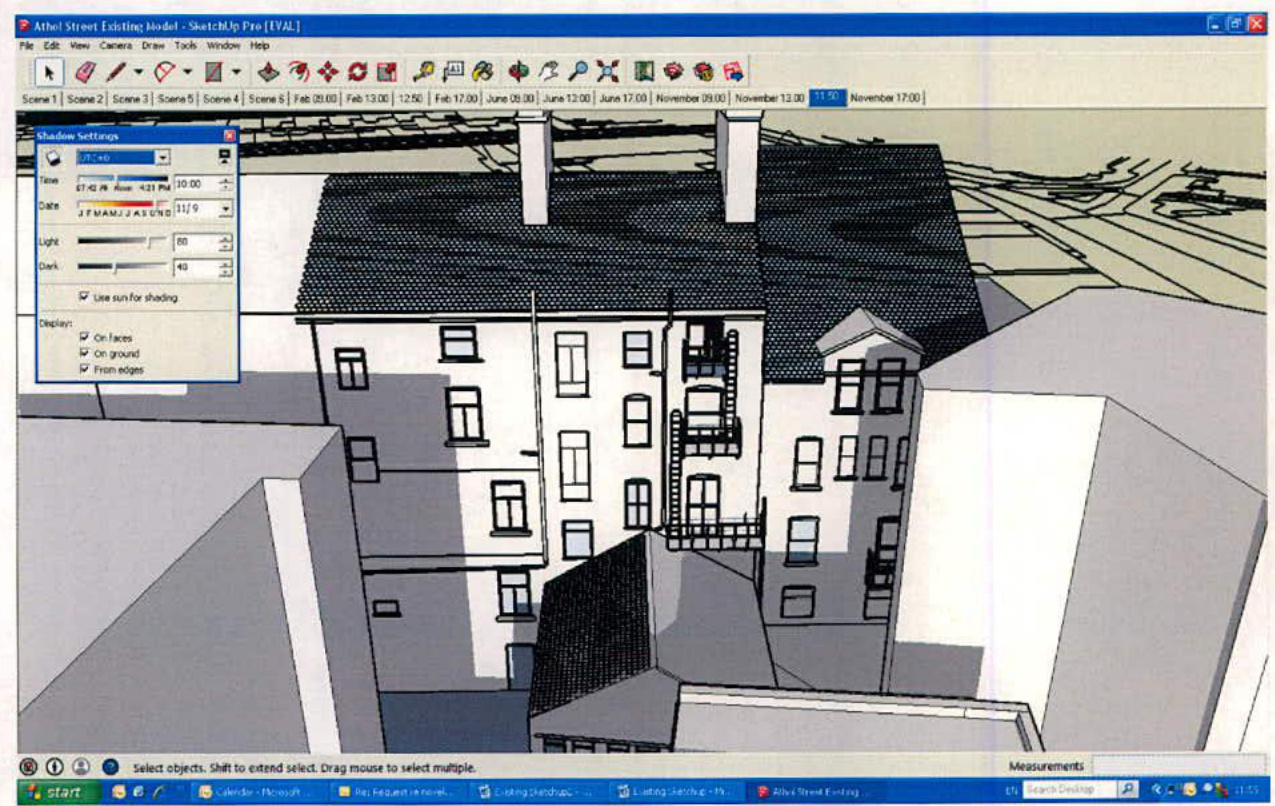
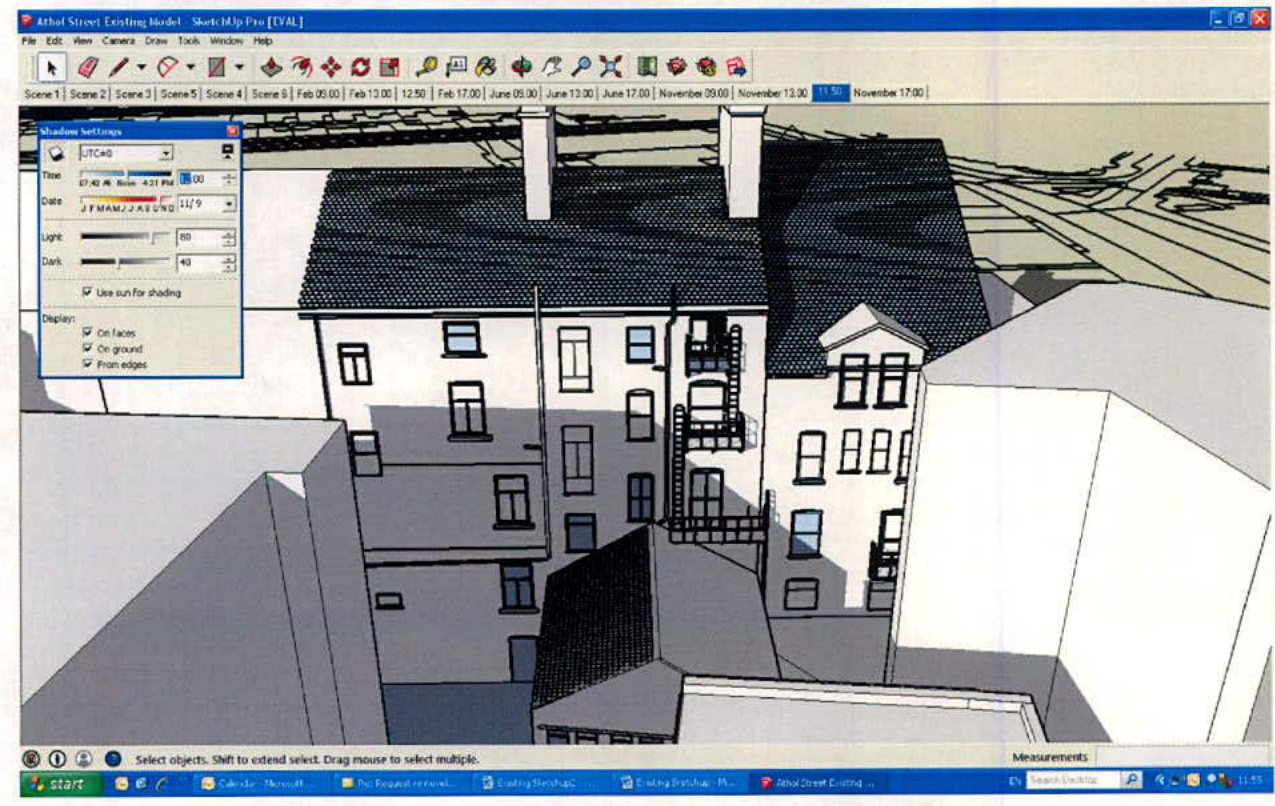
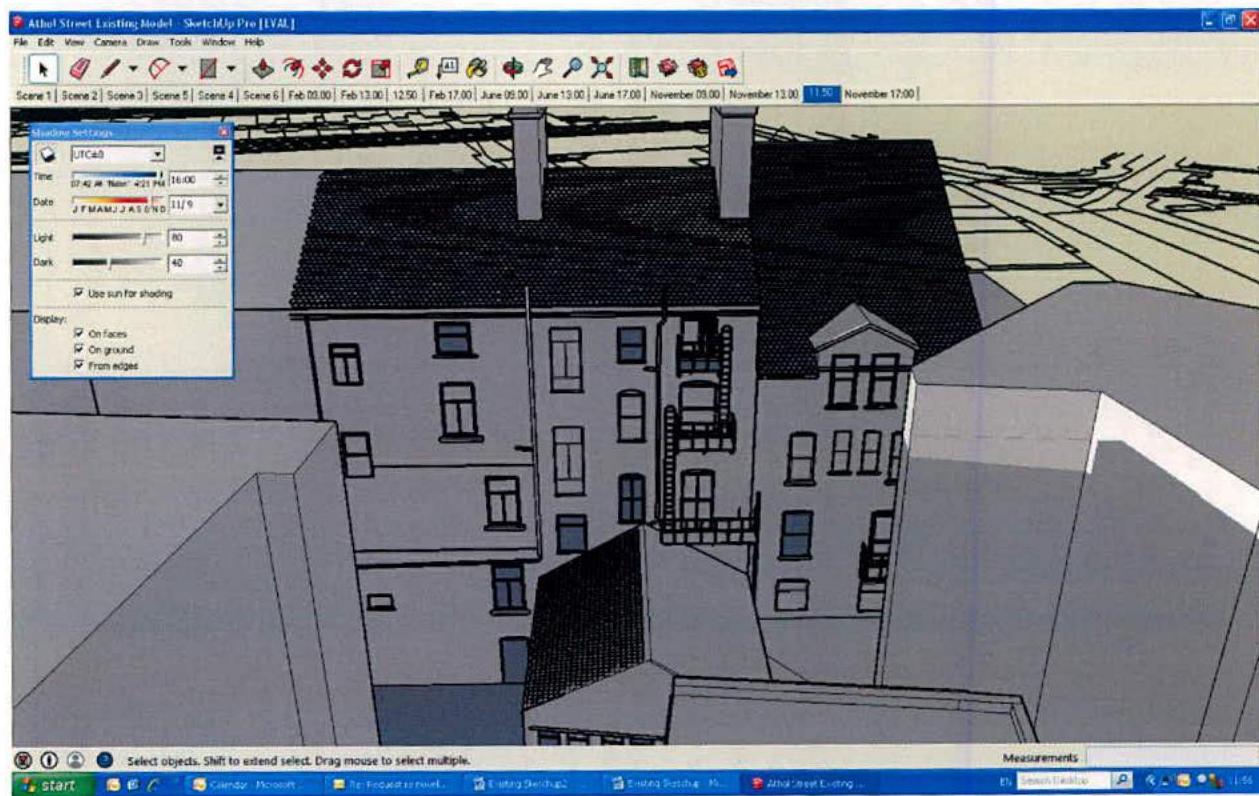
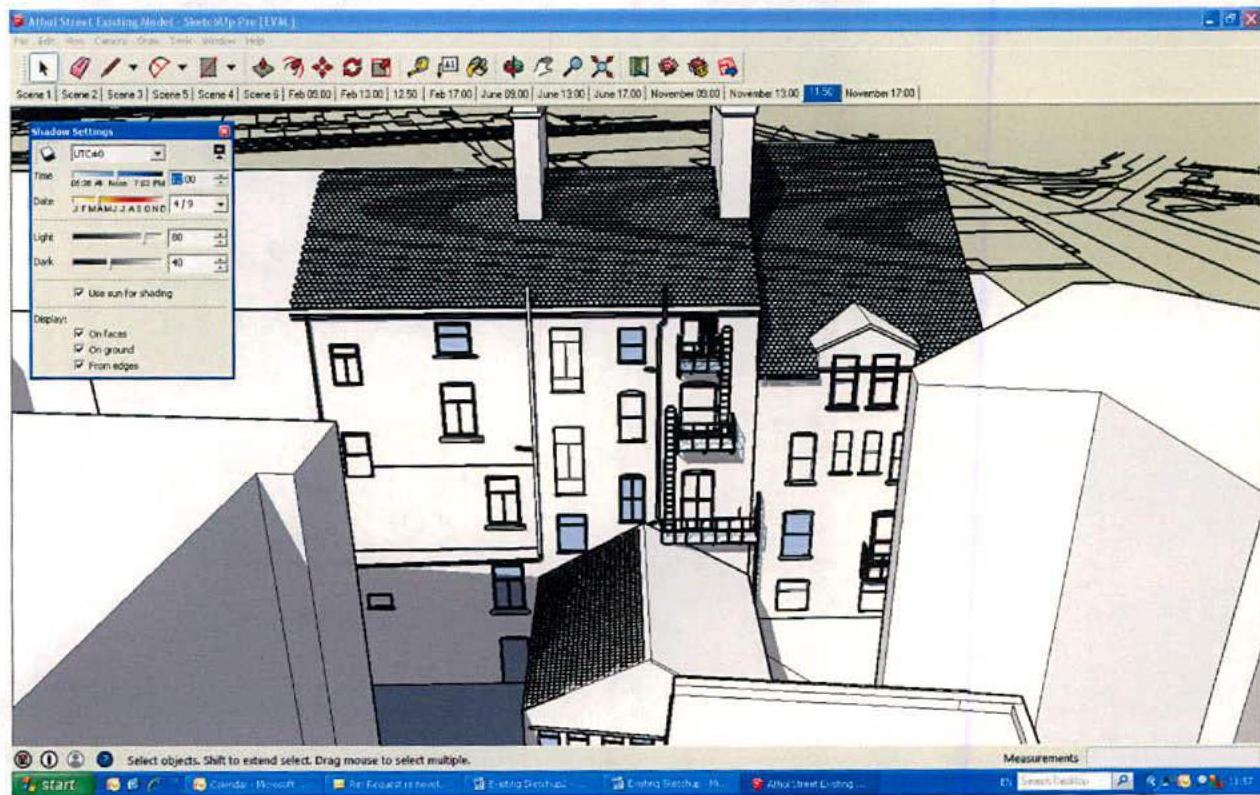
Illustrations have been attached here on the 9th November 2016, 9th April 2017 and 9th July 2017 in both the sketchup model and www.suncalc.com which demonstrate the affect that the proposed extension has on the neighbouring properties.
The following study has been carried out using Sketchup models of the existing and proposed scheme to show the impact that the new proposed scheme for an extension to the rear of number 5 will have on the neighbouring properties. The model has been geo located and any date or time can be modelled to demonstrate that the impact on these neighbouring properties is within acceptable guidelines, notwithstanding that legislation does not exist on the Isle of Man in this respect.
We have used the Building Research Establishment publication 'Site layout planning for daylight and sunlight: a guide to good practice (BR 209)' together with 'the code' from Birmingham City Council dated March 2006 in the preparation of the design of the extension and its impact on number 4 Athol Street Douglas, together with guidance notes from various rights to light publications as stated. The extension to the rear of number 5 Athol Street Douglas has been set out so as to be behind a 45 degree line drawn from the rear line of the property and taken from the centre of the window of number 4 Athol Street.
There is no new obstruction directly in front of the windows at Number 4 Athol Street. Number 4 Athol Street Douglas is overshadowed by many of the existing buildings both to the sides and immediately adjacent to the rear of the property. Notwithstanding this the criteria used was to project a 45 degree line from the centre of the worst case scenario, (window) in accordance with the
guidance notes. This dictated the design of the extension from the initial concept stage. The extension is behind this line.
The lower window to the rear of number 4 Athol Street is already obscured by the existing rear annexe to number 5 Athol Street, therefore the ground floor window nearest the extension to number 5 Athol Street was used to formulate the design.
As can be seen on the scheme plans this adopted method brought about the shape of the proposed roof to the extension at ground floor level to create the mezzanine in accordance with these guidelines.
The angle of the sun whether through clouds or not will have an effect on the light being received and whilst there is no right to direct sunlight, in this case it demonstrates clearly that the light being received to the rear of number 7 Athol Street is unaffected or increased during working hours of the office.
Sunlight is not affected from 9.00am for most of the year and is unobstructed by the extension through to the afternoon when existing buildings affect the rear of all the buildings to Athol Street. In all cases after 10.30am there is no obstruction from the extension whatsoever. It should be noted that the new extension will reflect light into the windows of Number 7 Athol Street after approximately 10.30am increasing the light into the building.
A typical working day is 9.00 am to 5.30 pm . Therefore the amount of direct sunlight is affected only of the working day. This is balanced by the increased light afforded during the afternoon from the reflection off the new extension.
Please see Illustrations attached showing the situation on the 9th November 2016, 9th April 2017 and 9th July 2017 in both the sketchup model and www.suncalc.com which demonstrate the affect that the proposed extension has is minimal.
SKETCHUP MODEL OF SITE AS EXISTING
9th November 2016 10:00 Hours
9th November 2016 12:00 Hours
9th November 2016 14:00 Hours {{image:7193017}} 9th November 2016 16:00 Hours
9th April 2017 10:00 Hours {{image:7189290}} 9th April 2017 12:00 Hours
Copyright in submitted documents remains with their authors. Request removal
