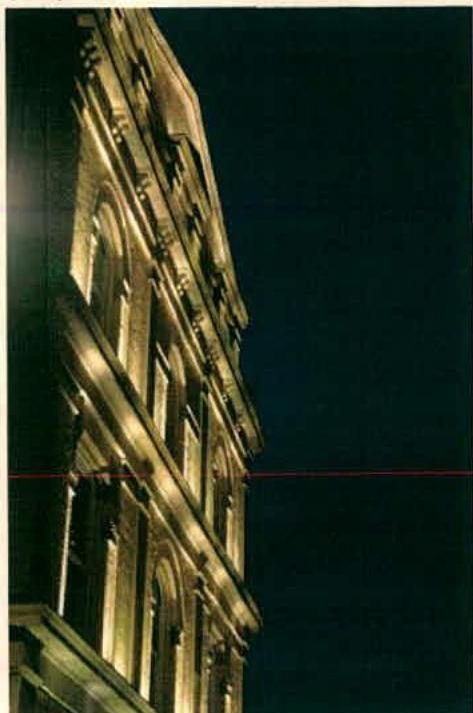
This design has been put together in co-operation with project designers with the aim to produce a comfortable scene which also enhances the historical features of the centre of Castletown. The design has been co-ordinated with the proposed regeneration works to not only work as an individual feature but to fit seamlessly into the regeneration design in order to enhance the regeneration improvements proposed.
A night-time photograph showing the illuminated facade of a multi-story stone building, highlighting architectural details with artificial uplighting.
Using the latest in LED (light emitting diode) technology, the products have been specified to enhance the illuminated subjects. This can be achieved through selecting the right colour temperatures for the illuminated subject and the correct optical assemblies to ensure light spillage is prevented.
With great experience in the field of external architectural lighting we have been able to receive comments such as;
"The compact, cubical formed, LED luminaires would be unobtrusive during daylight. The choice of units, and their careful disposition, would avoid light spillage beyond the building, including upwards, but would bring the building itself, its form and architectural features, to life after dark. This would enhance the appearance of the Conservation Area and its commercial character. Of itself and as an indication of investor confidence it can be expected also to help further the regeneration of Lower Douglas and its Key Sites."
Alan Langton - Planning Inspector (Jubilee Buildings Planning Application)
Taking the uppermost care to place lighting in unobtrusive positions whilst allowing the lighting to produce the optimum lighting effect, we believe that the lighting planning applications are sound and will undoubtedly benefit Castletown into the future.
Cabling
When cabling on the facade of a building the cabling is to be of minimal profile (cross section).
The cabling runs are to be concealed within the contours of the building facade to minimise the visibility of cabling.
Colour temperature
When illuminating the materials on the facade of a building we recommend using a colour temperature of 3000 degrees Kelvin, this is typically known as warm white. This is the most suitable colour temperature for architectural illumination as it emphasises the colour of the building materials. This colour temperature is the same as the previously specified for the Isle of Man Bank and TSB Bank already passed and part of the same project.
Beam angles and beam width
When illuminating the facades we break the facade up into elements that are individually illuminated to ensure that no individual luminaire has to illuminate a large area and subsequently become uncontrolled. By placing the luminaire close to the facade we can control the light and ensure that the light is confined to the facade rather than spilling light into unwanted areas.
{{image:164335}} {{image:164336}}
Copyright in submitted documents remains with their authors. Request removal
Source & Provenance
Official reference
15/01208/GB
Source authority
Isle of Man Government Planning & Building Control