Loading document...
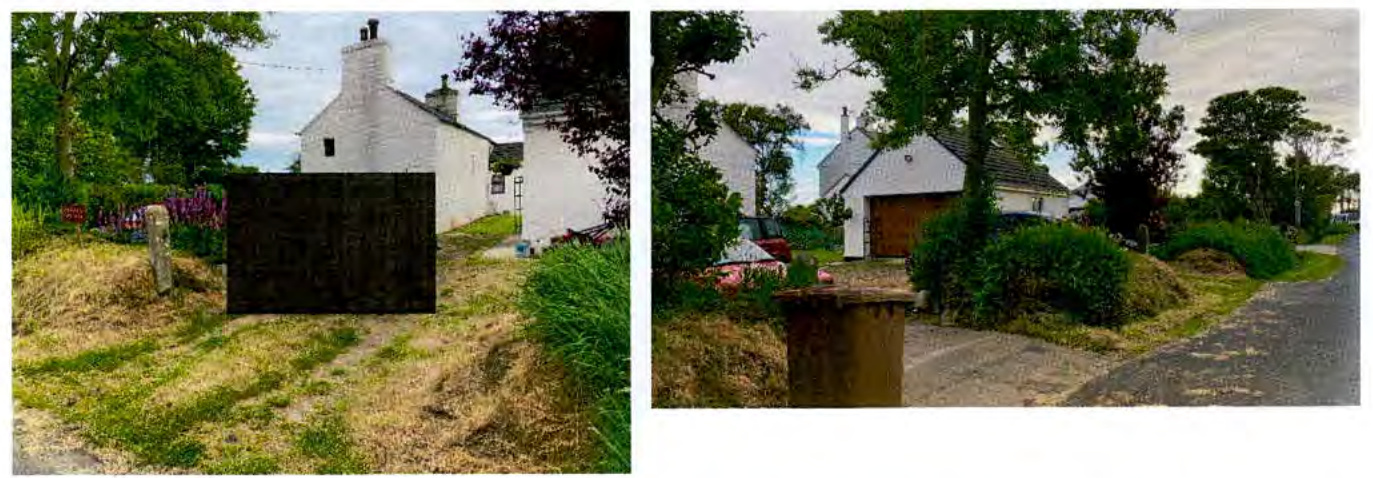
Ballachrink Croft, Ballacorey Road, Bride, IM7 4AW
1.1 This site lies on the southern side of the Ballacorey Road (C14) which links the two Ramsey to Andreas roads - the A9 to the west and A10 to the east. Ballachrink Farm lies across the road at the end of a long farm lane, to the north, which does not appear to be the principal access to that farm at the present time. 1.2 Immediately to the east of the site is Phoenix Cottage, a dwelling built as a replacement for an earlier property, under 08/01700/B. The original building on this site was a single storey outbuilding which gained permission for conversion to a dwelling under 07/01802/C but this was not implemented and instead permission was sought and granted for a replacement building under the 2008 application. That original building had a floor area of around 78 sq m and the approved replacement dwelling a total floor area of 190 sq m . This property has some traditional elements a five window arrangement on the first floor within a 12 m long frontage, a width of 6.7 m and with a 30 degree pitched roof and chimneys at each end. A detached garage sits in front of the dwelling. This property is raised up above the road level, to prevent the flooding issues experienced with the lower floor level of the original buildings, by 620 mm . The entrance to the application site sits 270 mm higher than the entrance to Phoenix Cottage.
1.3 To the east of this is Curlew Cottage, a much smaller, older property which sits at right angles to the road and with a newer garage sitting in front of it to the west. {{image:150967}} 1.4 The application site has a frontage to the road of 30 m widening to nearer 36 m further into the site, and a depth of 60 m .
1.5 The site previously accommodated a Manx cottage which sat in the north western corner of the site. This building had a main two storey core footprint of 11.3 m by 5.6 m with an additional 20 sq m of single storey extensions on the roadwork side and an overall floor area 146 sq m although this is referred to as being 138 sq m according to the planning officer's report for 06/00114/B. The dwelling had a garage/outbuilding to the east further back on the site which had a footprint of approximately 5 m by 6 m . The cottage was not an orthodox version of a vernacular cottage, the front elevation having three stacks and three relatively widely spaced windows across the first floor frontage and single storey porch across some of the ground floor frontage. 1.6 It is also understood that the property suffered significantly from flooding from the road and contained a water pump in the basement to get rid of the water which entered the dwelling from the road, due to it sitting lower than the road and indeed the field to the west is currently higher than the residential part of the site. 1.7 Below are images from a previous planning application on the site, of the original dwelling on the site.
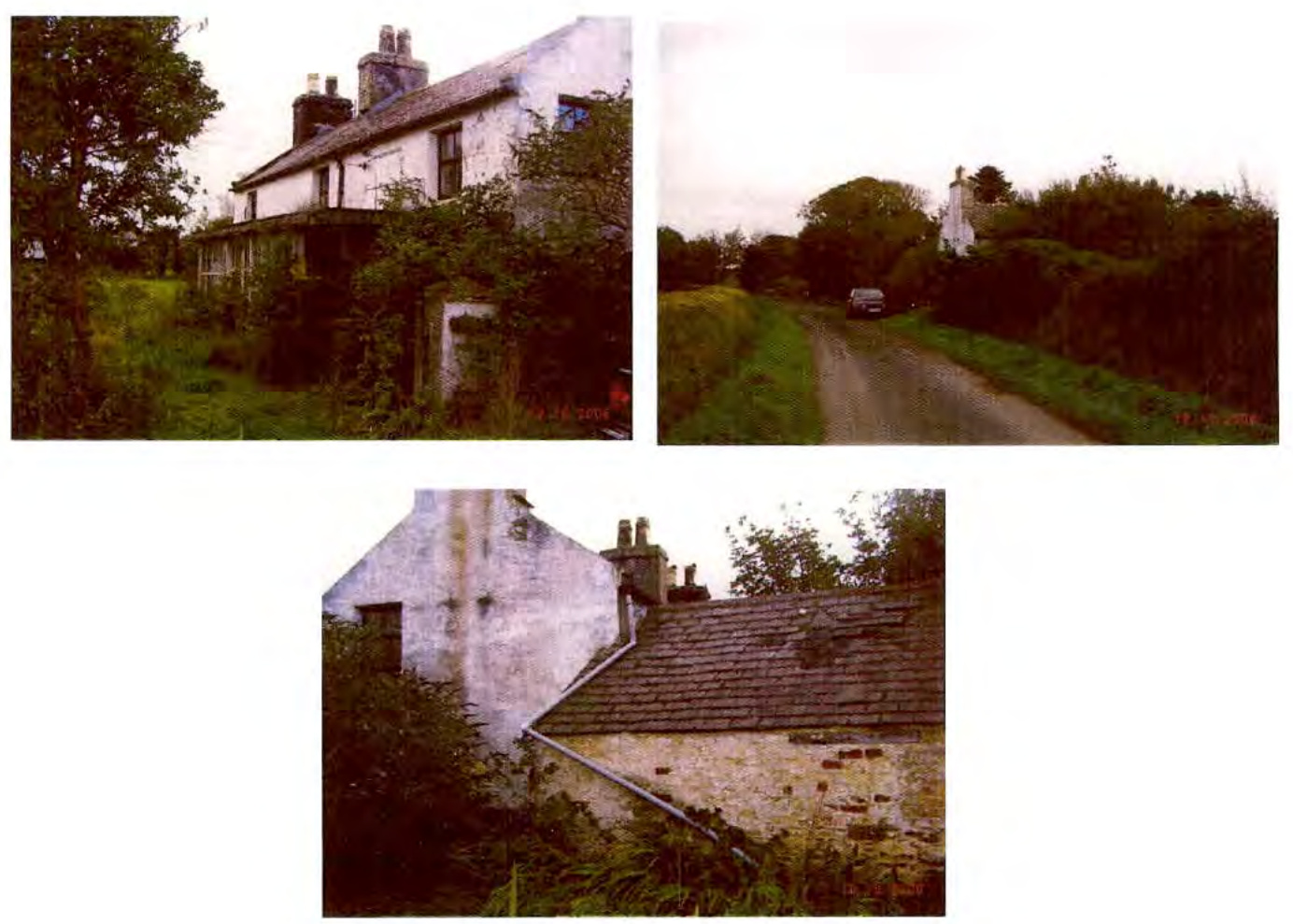
2.1 Planning approval was sought a number of times for the replacement of the original cottage. Some applications were refused - 02/01804/B and 06/00114/B for reasons relating to the increase in size (06/00114/B proposed a dwelling which had a footprint of 311 sq m) and concern about the safety of the access. Success came later in 2006 with the approval of 06/01375/B - modified under 09/00150/B - for a four-bedroom dwelling contained within a traditionally designed main front elevation but with a two-storey core of 12m by 8m depth with a rear two-storey outrigger of a further 6m by 4 and a single-storey sunlounge 6m by 7.5m and with a detached garage. This dwelling was to be 9.7m to the ridge. This property would have been 288 sq m and 97% larger than the original cottage.
2.2 Following the granting of planning approval under 06/01375/B and 09/00150/B for the replacement of the dwelling, the existing cottage was demolished and foundations dug and laid for the approved dwelling which was in a similar position on the site but moved back 6m further into the site. There is correspondence on the 2009 application file which discusses whether that application was commenced. Further correspondence has been obtained which confirms that the Department was content that work could continue on the development and no correspondence has been received since then to indicate that this position has changed.
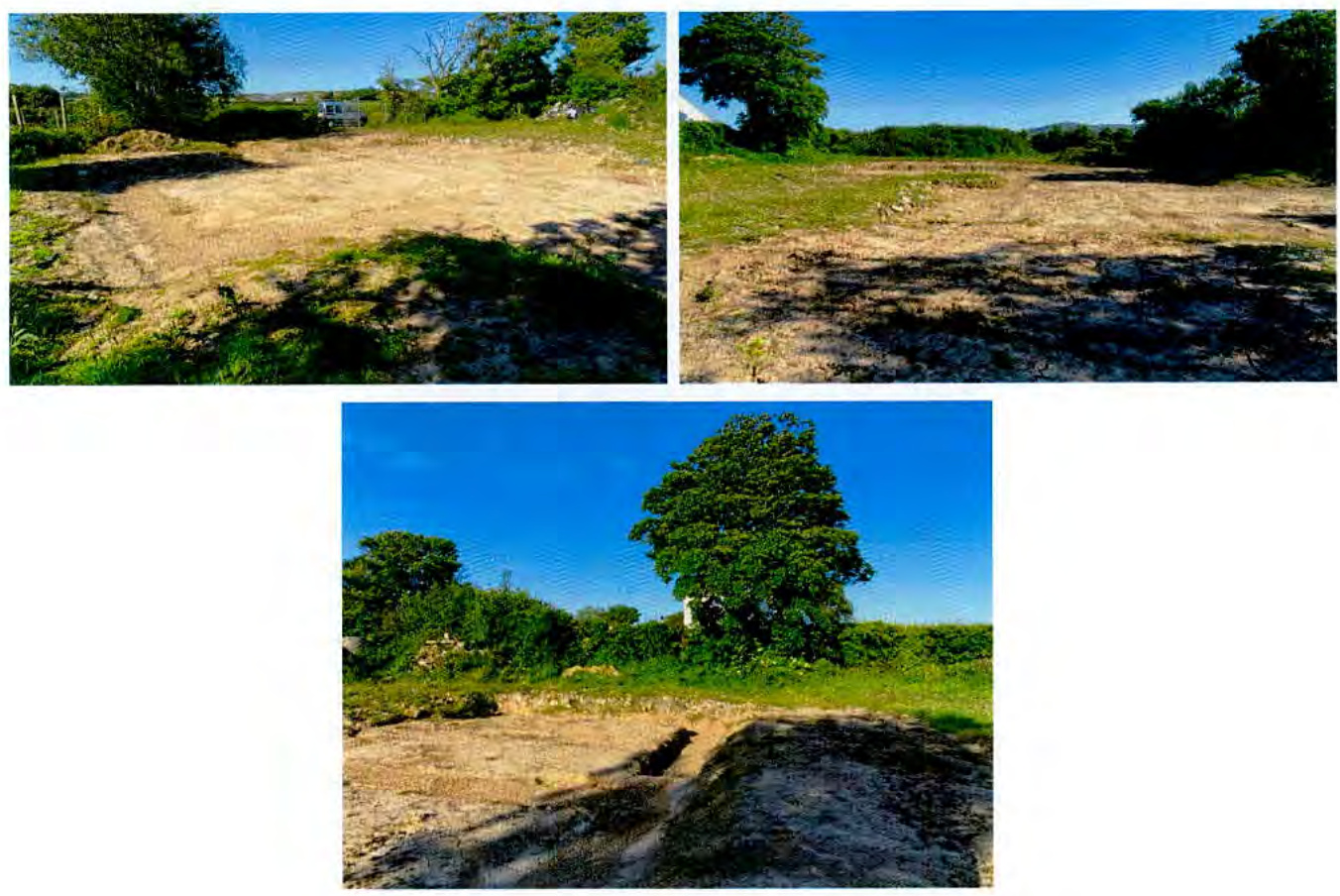
2.3 The site currently looks like this:
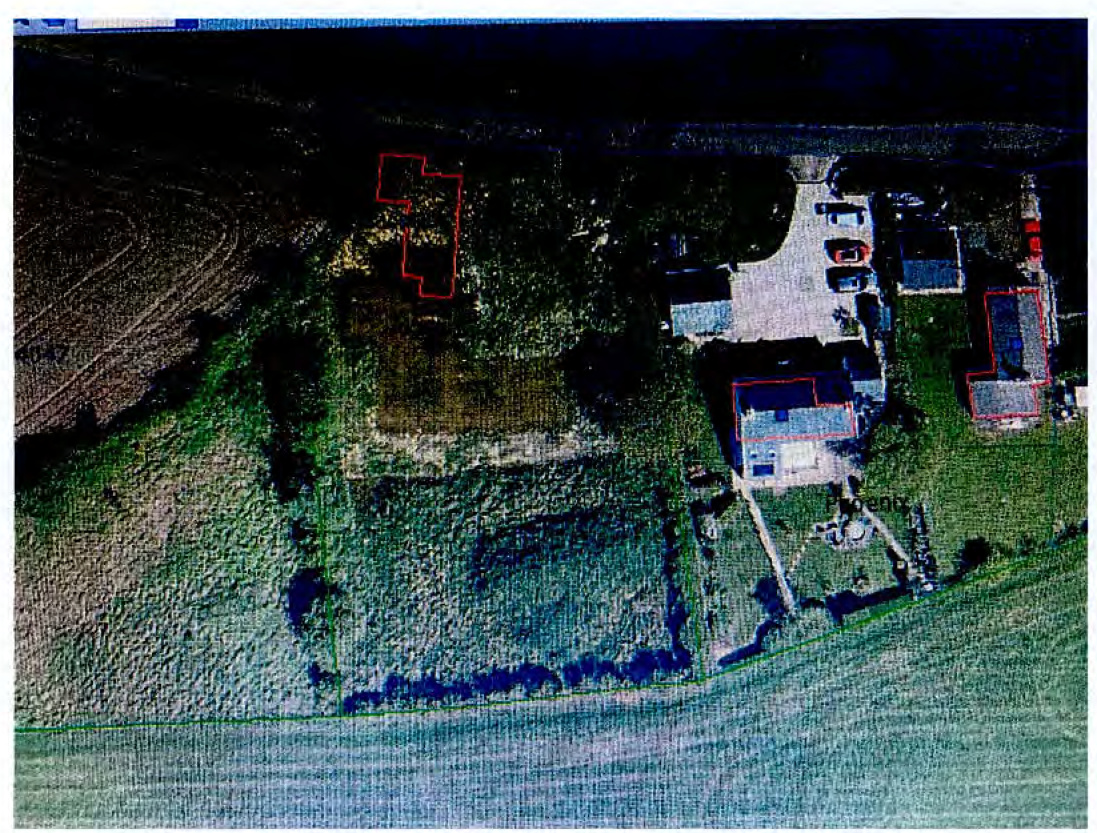
2.4 The concreted foundations can clearly be seen on these photographs and on the Government's Digital Survey Aerial Photograph which shows in red the outline of the original cottage on the site (see below).
2.5 Foundations have now clearly been not only dug but also concreted - works which would require planning approval as they represent engineering operations and without being associated with the approved redevelopment of the site, would not be considered acceptable on this site. Furthermore, it would not be possible for the site to be reverted back to agricultural use or used as
open space as it is, with the concreted foundations. As such, we believe that the 2009 approval has been implemented and remains capable of being continued and completed. 2.6 09/00150/B was essentially the same property as was approved under 06/01375/B but with variations on the window arrangement, an increase of 500 mm in the height and a change in the roof detail in the side outlet. The Planning Officer noted at that time that "the site effectively represents the curtilage of an existing dwelling in the countryside". These are the approved plans which also include a detached garage:
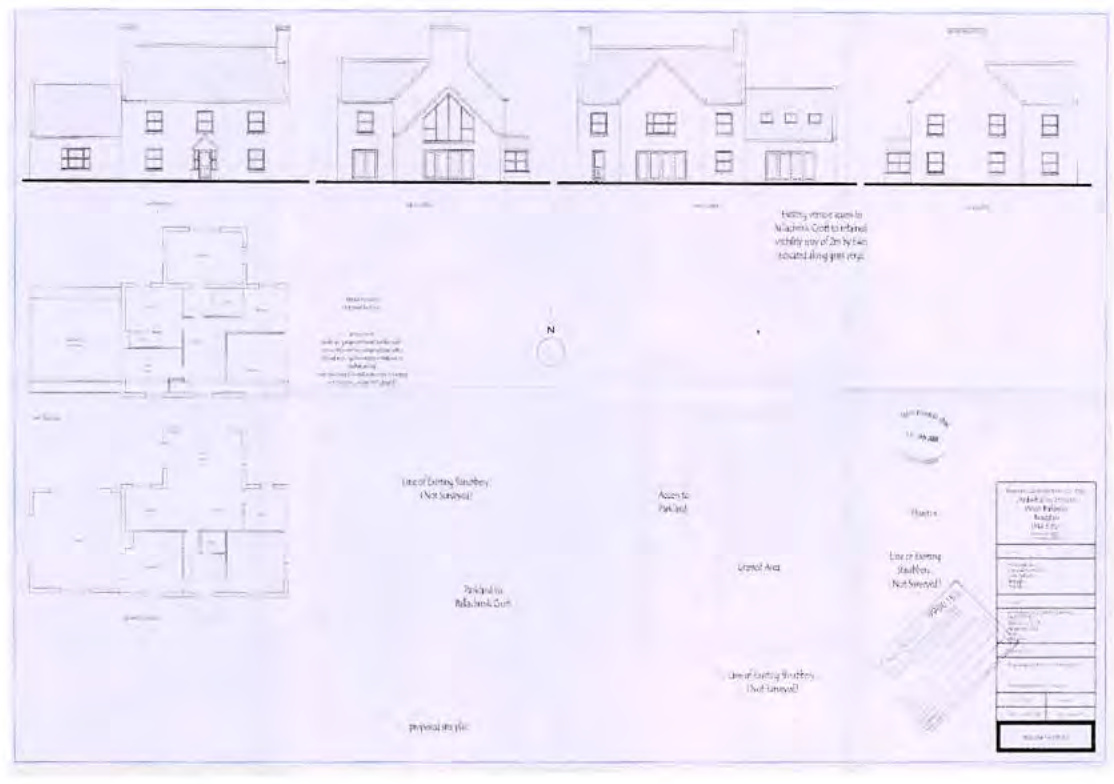
3.1 We have agreed to purchase the plot but would prefer not to proceed with the approved plans. The reasons for this are: I. We do not want such a large dwelling (floor area or height) II. We believe the location of the dwelling does not make maximum use of the available sun and passive heat and light: the main expanse of roof plane on the approved scheme for solar panels faces east and the only south facing plane is one side of the rear annex with vegetation to the south west of the proposed dwelling which would inhibit sun getting to this area of roof III. We do not believe that, with respect, the approved scheme would achieve a truly traditional property given the depth of the dwelling ( 8 m ) and resultant height, compared with the recommended width ( 5.5 m ) in Planning Circular 3/91 - Design of Residential Development in the Countryside IV. Whilst the original dwelling on the site was located in this general position (and Housing Policy 14 generally requires that any replacement is on the footprint of the existing), the original house has long gone and any historical association of a dwelling in this part of the site has become much less relevant. Given the orientation and position of Phoenix Cottage and most other properties along the Ballacorey Road, we believe that a dwelling at right angles to and close to the road as approved would now appear incongruous and unduly intrusive V. We believe that the orientation is less neighbourly than it could be and has more of an effect on the outlook and privacy of Phoenix Cottage VI. The position of the dwelling is very close to the western boundary of the site, possibly impracticably so for construction and maintenance and it blocks the existing access to the land alongside which is in the same ownership. This land is referred to as "Parkland" in the approved plans but is effectively an agricultural field that we would wish to use for growing vegetables and fruit and introduce a bee hive. The access to this as approved is within the rear garden and if the garage is built as approved there would be very limited width for agricultural vehicles to get from the field onto the road. The position of the house as approved would render this field landlocked and make less likely its use for agriculture. The position would also threaten the longevity of the existing self seeded trees in this corner of the site and prevent any significant planting and replanting in between the house and the road. 3.2 We would also like to construct a three vehicle garage between the house and the road, in keeping with the position of the garaging for both Phoenix Cottage and Curlew Cottage but where the garage is finished in timber (locally sourced if possible) and with a dark coloured, sheeted roof. We prefer this style and finish to materials to match those of the main house to reduce its impact and sit more naturally into the hedging to the rear and side. The hedge to the rear of the proposed garage is substantial and we have no intention of reducing this and this should screen much, if not all of the garage from the outlook of Phoenix Cottage although it should be noted that the building directly behind it is that property's garage. 3.3 Our intention is to use the field alongside to grow vegetables and fruit which we would consume and sell locally. This will require the use of agricultural equipment (tractor, rotavator, plough, ridgers, seed drill, fertiliser spreader, potato spinner) and storage space for the produce. We have estimated the required size to be 4.1 m by 9.2 m with an eaves height of 2.4 m and 4 m to the ridge, which we hope is large enough for the required equipment but not too large to be intrusive or take up too much valuable growing space. This building will be a simple, green sheeted structure or possibly finished in timber cladding and which could easily be removed if no longer required or used for agricultural purposes and we would be happy to accept a condition to this effect.
4.1 The site lies within an area where the adopted development plan is the Town and Country Planning (Development Plan) Order 1982. Here, the two existing dwellings and the application site lie just to the west of an area of High Landscape Value and Scenic Significance so are within an area which is not designated for a particular purpose and where development is generally discouraged, as set out in Environment Policy 1 and General Policy 3 of the Strategic Plan. The erection of a dwelling on this site would not be acceptable were it not to be a replacement for a former dwelling and it is critical that the site benefits from an implemented planning approval for this $(09 / 00150 / B)$. 4.2 It is important, therefore, that the development accords with the relevant policies of the Strategic Plan and any other material considerations as the Town and Country Planning Act states at Section 10(4). In this case, we believe the material considerations are the previous approval which we believe is still capable of being implemented and the Government's Climate Change Mitigation Strategy 2016-2020. 4.3 Development of rural dwellings is guided by Housing Policies 12, 13, 14, 15 and 16 with HP12 setting out when houses may be replaced, HP13 providing guidance on if and how they may be renovated if they may not be replaced, HP14 providing direction on how dwellings may be replaced and HPs 15 and 16 providing advice on how and when existing dwellings may be extended. General Policy 2 sets out general standards which should be applied to all new developments. 4.4 Whilst applications for replacement dwellings in the countryside should almost always start with HP12, in this case not only is the original house no longer there, in none of the previous applications on this site was the Department of the view that it was not appropriate for replacement, the reasons for refusal relating to the size of the replacement dwelling, and highway safety, not the principle, and indeed, planning approval being extant for the erection of a replacement dwelling (09/00150/B). 4.5 The most appropriate Strategic Plan policy to be applied here is therefore Housing Policy 14:
Where a replacement dwelling is permitted, it must not be substantially different to the existing in terms of siting and size, unless changes of siting or size would result in an overall environmental improvement; the new building should therefore generally be sited on the "footprint" of the existing, and should have a floor area(1), which is not more than $50 \%$ greater than that of the original building (floor areas should be measured externally and should not include attic space or outbuildings). Generally, the design of the new building should be in accordance with Policies 2- 7 of the present Planning Circular 3/91, (which will be revised and issued as a Planning Policy Statement). Exceptionally, permission may be granted for buildings of innovative, modern design where this is of high quality and would not result in adverse visual impact; designs should incorporate the re-use of such stone and slate as are still in place on the site, and in general, new fabric should be finished to match the materials of the original building.
Consideration may be given to proposals which result in a larger dwelling where this involves the replacement of an existing dwelling of poor form with one of more traditional character, or where, by its design or siting, there would be less visual impact. 4.6 The proposed dwelling would not be built on the footprint of the original cottage, and will be further from it than the approved dwelling. The floor area measured externally of the ground and first floors of our proposed dwelling would be $236 \mathrm{sq} \mathrm{m}-61 \%$ larger than the original cottage (the approved dwelling was $97 \%$ larger than the original cottage). We have not included the floor area of any roofspace as, despite the inclusion in our scheme of a permanent staircase to the attic, this space is created through using the available area within the roof without artificially raising the
eaves or increasing the pitch and also, the approved scheme had the same amount of available roofspace but the layout did not show any utilisation of the attic space but such could have been created without the need for planning approval, should that scheme have been implemented. HP14 suggests that attic space should not be included and the definition of attic is a space or room inside or partly inside the roof of a building. Our proposed dwelling will therefore be smaller than the approved scheme and 1 m less tall. We believe that the relocation of the dwelling to be in line with Phoenix Cottage, utilising the foundations already dug for the garage and sunroom on the approved scheme, and with the appearance and size as proposed will result in an environmental improvement and complies with HP14 for the following reasons: A. The house will reflect the position and character of Phoenix Cottage but not be identical thereto B. The new position will allow for the installation of effective solar panels on the rear of the house which faces south C. The new position will allow agricultural access to the field alongside so it can be effectively used for its most appropriate purpose D. The new position will reduce the impact on the outlook from within Phoenix Cottage E. The proposed location will enable a more spacious public view into and through the site towards the south west into the agricultural field and towards North Barrule and Snaefell F. The new position will allow more effective landscaping at the front of the site G. The new location will enable more sensitive resolution of the potential flooding issue, building up the site to an appropriate level but some 27 m from the road where the increase in level will be less obvious. The proposed house is intended to be raised above road level by the same amount as is Phoenix Cottage. 4.7 In terms of General Policy 2, we believe the character of the area and the amenities of those in neighbouring dwellings are preserved by our proposal and in some cases, improved over what has approval. There is adequate car parking and provisions for access (which have already been approved in the earlier applications) are acceptable and safe. 4.8 Other Strategic Plan policies which are relevant here could include Environment Policy 3 although the proposal does not require the felling of any tree nor any threat to the future of any retained tree. We sought the advice of the Forestry, Amenity and Lands Directorate prior to submitting the application and the Arboricultural Officer advised the removal of a sickly sycamore on the front boundary close to the boundary with Phoenix Cottage and another tree slightly further
along the frontage, which is dead and the introduction of new trees in their place: we would like to introduce a fastigate rowan either side of the entrance with wild cherry and crab apple beside, also
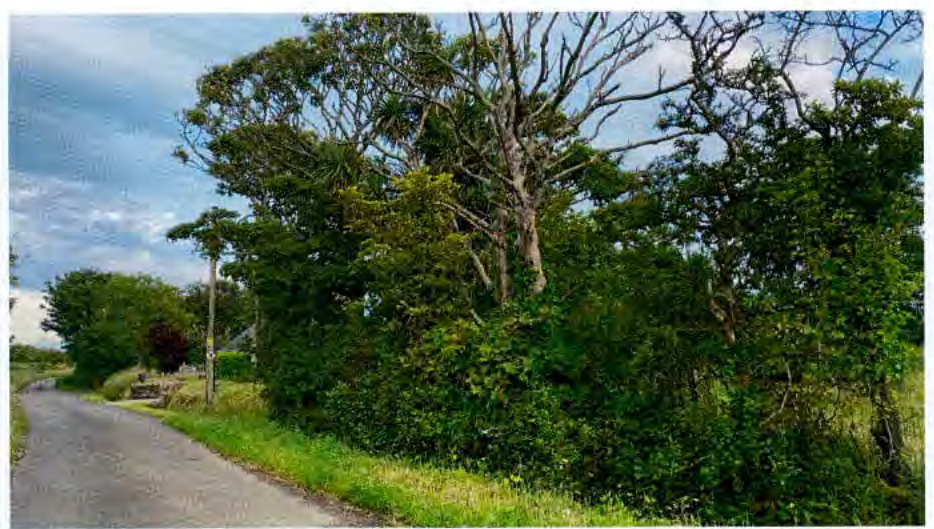
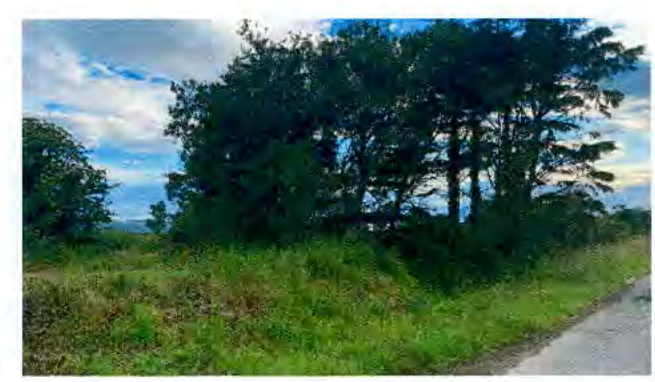
hedge (having regard to Planning Circular 1/92), with native roses in between to create a natural roadside boundary which provides privacy and screening for the proposed buildings and food for birds. Judicious pruning of the hawthorn trees around the boundary, was also recommended possibly removing the willow on the western boundary with the field and underplanting the hedges with new elder, hawthorn and blackthorn. There are young but large sycamores on both of the side boundaries which will be retained and once the surrounding hawthorn on the western boundary have been managed, the sycamore on this side will visually match that on the eastern side between the proposed dwelling and Phoenix Cottage.
Willow and leylandii in the north western corner of the site
4.8 Environment Policy 4 protects ecology (also referred to in GP2). We have consulted with the Ecosystems Policy Office of DEFA on the most appropriate way of landscaping the site and constructing the building. We have, as a result, incorporated native species of trees and shrubs into our intended landscaping of the site (dog rose and Sherard's downy rose with rowan, crab apple, wild cherry, blackthorn, hawthorn and elder to complement the existing elder and hawthorn on the site - all subject to availability). We also propose to create a pond feature in the front garden also advised by DEFA which will encourage additional wildlife and introducing marsh marigold, creeping Jenny, purple loosestrife, snake's head fritillary and yellow iris as recommended on the Manx Wildlife Trust website and again subject to availability. We intend to try and incorporate bat nesting and/or hibernation boxes within or onto the house (southern or eastern elevation) and will install house martin, starling, house sparrow and/or blue/great tit nest boxes on the northern elevation of the house. We understand that there are records of pipistrelle in the vicinity and there is a local dub and plenty of trees so expect (and hope) that bats are present in the area (the owners of Phoenix Cottage suggest that there are bats here). We also hope to incorporate some areas of wilderness which are allowed to develop naturally which we will cut in August and February/March as recommended by the Ecosystems Policy Office. We were delighted to see that the owners of Phoenix Cottage are keen supporters of the local wildlife with significant numbers of bird feeders and nest boxes and we would like to continue this and complement the facilities that they are already providing.
4.10.1 We believe that our chosen design and location will have an improved visual impact on the area, reflecting the character, orientation and general design of Phoenix Cottage and being further back on the site, will have a reduced impact on those passing the site who will have a view into and through the site, which they would not have if the approved scheme were implemented. Whilst the approved dwelling had a frontage of a relatively traditional length, a traditional impact is only achieved if the other proportions of the building also reflect traditional proportions. In this case the approved frontage was 12 m but the depth of 8 m - far deeper than the 5.5 m recommended in the design guidance, resulting in a building which was taller and more bulky than the traditional cottage.
4.10.2 Our preferred scheme which elongates the frontage of the building by a further 1.7 m over and above the frontages of the approved scheme and Phoenix Cottage, results in a frontage which can accommodate a traditional arrangement of vertical windows which is shown in Planning Circular 3/91 but with a five bay arrangement which we believe is balanced and proportionate, and also similar to Phoenix Cottage as is the depth of the house (front to back). 4.10.3 We did consider designing something contemporary with perhaps full height glazing and modern materials - stone, metal and a sheeted roof. However, we concluded that this would not sit comfortably in this context and whilst a modern approach can work well in the countryside, this tends to be where the building is seen on its own and can make a statement: we feel that in this case it is more important to fit in with the surroundings than to stand out. We also considered having a stone faced building. However, due to the proximity of the Ballacorey Brickworks historically further west, we believe buildings would have originally been brick or rendered brickwork and as such, a stone faced building would be out of place, particularly as the majority of dwellings along Ballacorey Road are rendered, as are the two closest dwellings to the site. 4.10.4 We also considered a three bay frontage and something with a shorter frontage however, this would likely result in a rear annex, like that of the original and approved dwellings, which would be more likely to have an effect on the outlook from Phoenix Cottage: as proposed, the building is almost in line with this neighbouring property (slightly in front) and where the proposed house may well not be visible at all from within Phoenix Cottage, certainly not from the windows in the rear elevation, and with the two storey element sufficiently far from the neighbour to prevent overlooking of their rear garden, helped by the large sycamore on the boundary between the two properties. 4.10.5 The approved scheme was to have a frontage which was 1 m longer than is recommended in the rural design guide which led to a property which was slightly unbalanced and/or not quite in the correct proportions. We considered recreating the three chimneyed appearance of the original cottage but where the original Ballachrink Croft benefited from the patina of age and an established context, to build something new with such strange proportions and features we felt would look contrived and wrong. We have found uPVC framed sliding sash windows which have a timber texture and which incorporate "run through" horns which are part of the outer vertical frames rather than being stuck on features under the upper sash and we would like to have the outer faces of the frames coloured in Chartwell green (see enclosed brochure information). The roof will be finished in natural slate and the walls in painted render. We did consider gable verges but considering the number of properties in the area which don't have them and the possibility that they would add a modern and new character to the building, we have opted to omit them and have a more simple end to the roof. 4.10.6 Our proposed garage should be screened from view by the proposed frontage planting but in any case will be designed and finished to compliment the rural location, using dark coloured sheeting for the roof and timber for the walls and doors, using locally sourced timber where possible (see attached images for the type of building we would like to build). 4.10.7 The proposed agricultural building will also be screened from public view by new tree planting of native species and finished in dark green external sheeting or timber cladding.
4.11.1 As stated above, we believe that our proposal will be more neighbourly than the approved scheme. We approached the owners of Phoenix Cottage and Curlew Cottage prior to submitting the application and made them aware of and provided copies of our plans and they both advised that they had no objection to our plans. We hope this is still the case. We also consulted the owner of the adjacent field to the west and explained our plans and again, there appeared to be no objection to what we wanted to do.
4.12.1 The development does not necessitate the felling of any trees or the removal of any vegetation. However, in order to improve the appearance and ecological value of the site, we intend to remove dead and dying trees on the frontage and a willow further back on the western boundary, and to replant and reinforce with native species which will enhance the site visually and ecologically.
4.13.1 As stated above, we have sought advice from DEFA and will incorporate all of their suggestions to enhance the biodiversity value of the site. We also hope to introduce new native hedging along the southern boundary of the agricultural field which will provide more habitat (elder, hawthorn and blackthorn). We intend to install a bee hive in the western corner of the field and a pond in the front garden and incorporate a wilderness area to vegetate naturally either in the garden or the field, which will provide further enhancement of the site.
4.14.1 Access has already been provided in accordance with the approved plans and we believe to the appropriate highway standards. Visibility splays are shown on the proposed site plan and extend to over 100 m to the west and 70 m to the east. Whilst the speed of traffic is not restricted along the Ballacorey Road, its width which can just accommodate two vehicles side by side and winding nature means that traffic generally travels slowly and there are many pedestrians and cyclists who use this route, further slowing vehicular traffic.
4.15.1 The Climate Change Mitigation Strategy includes the following objectives:
4.15.2 We intend to orientate the house so that we can take maximum advantage of the passive solar gain, installing water heating and photovoltaic panels on the roof of the dwelling (rear pitch) as well as an air source heat pump with a multi fuel stove as the main source of heating in the lounge. We also intend to construct the house using the most effective internal insulation as is practicable and utilise low energy appliances where we can. 4.15.3 We already run an electric car and have electric pedal assist bicycles and will power these using the solar pv as well as being able to charge them from within the garage where they will all be stored securely. 4.15.4 We also hope to incorporate a home office, either within the roof space of the house or a stand alone building in the garden (subject to a further planning approval) to minimise travel to and from work.
5.1 We believe that our proposed development complies with all of the relevant planning policies and will be an acceptable form of development.
We would be happy to accept conditions which require the removal of the agricultural building if it should no longer be used or required for agricultural purposes, to suspend the provisions of the Permitted Development Order as it applies to extensions (we could not build another garage or car port without planning approval) but would prefer for the allowance for a shed and greenhouse to remain in case we wish to erect these in the future: we believe that considering the size of the plot and the vegetation separating the plot from Phoenix Cottage, that such could be introduced without causing any adverse impact on the living conditions of the neighbours.
We would also welcome a condition to require that the proposed landscaping is carried out at the latest in the first planting season following the completion of the dwelling - we intend to introduce the replacement trees and bank at the front of the site in the first available planting season, probably before the completion of the dwelling.
We would be happy with a condition which restricts the use of the garage to the storage of vehicles associated with the main dwelling on the site. 5.2 We hope our proposal is considered favourably. 5.3 The Department's Officers are free to go onto the site if this is required in order to assess the proposal.
Copyright in submitted documents remains with their authors. Request removal
