Loading document...
KNOCK E LOUGHAN COTTAGE | proposed replacement dwelling DESIGN STATEMENT 1.00 Introduction 1.01 This Design Statement has been prepared as part of an Application for Detailed Planning Approval to build a replacement dwelling at Knock e Loughan Cottage on the Oatlands Road in Santon, Isle of Man; it is intended to supplement the information contained in the submitted drawings and other documents, and help clarify the reasoning behind the design and the intent of the overall proposals. 1.02 The Applicant owns the property, which extends to 0.42 of an acre; the location and extent of the land are as indicated on drawing number 198/001. 1.03 The land gently slopes from north-west to south-east, continuing to rise behind the existing house when viewed from the Old Castletown Road, as can be seen on the submitted photograph. The existing house benefits from wide-ranging views across rolling countryside to the coast, and the sea beyond. 1.04 The Application Site is currently only accessed by foot directly off the Oatlands Road, which has no footpaths along its entire length between the Old and New Castletown Roads. 1.05 Under the Isle of Man Development Order Plan 1982, the site falls within the designated Area of High Landscape or Coastal Value and Scenic Significance.
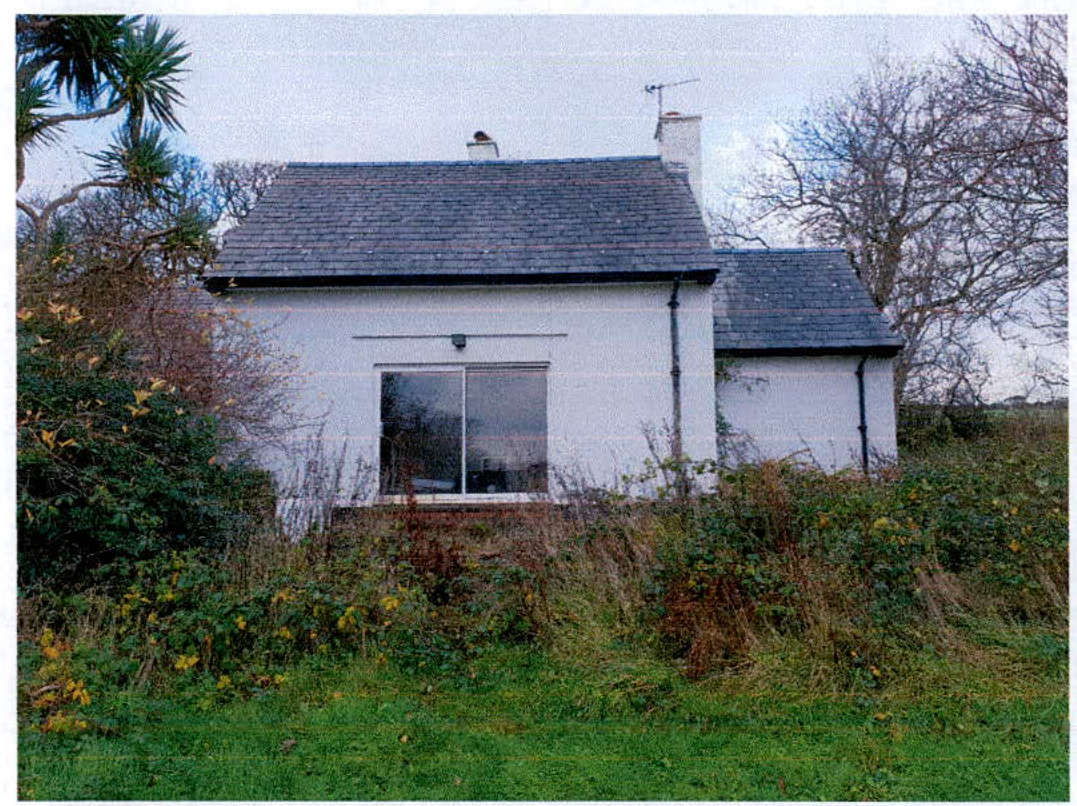
2.01 The overarching intent of the proposals is to create a family home for the Applicant, that utilises the benefits of the existing site to their full extent, including its sunny aspect and distant sea views, whilst making a positive contribution to its local context, visually, and to the wider environment in a number of ways. 2.02 Whilst the existing house is habitable, it is at best in poor condition and, at worst, of poor form (see photograph below); its current form and appearance could not be readily altered to suit modern family living, nor to create a living environment that would be particularly beneficial for the occupants.
2.03 As the existing house is not of architectural or historical interest, it is considered that the proposal to replace it with a new dwelling complies with Housing Policy 12 of the Isle of Man Strategic Plan 2016 and, as such, the proposals should be assessed under Housing Policy 14. 2.04 The Applicant's Brief established the size of the house, and a comprehensive review of the required accommodation, along with an analysis of the site in terms of sun path, topography, and views into and out of the site, established the basic premise of the design solution:- a) It would be substantially beneficial for the safety of the occupants to have vehicular access to, and parking within, the residential curtilage b) This would also be to the benefit of other road users as it would remove the need for the occupants to park on what is a relatively narrow road at the location of the Application Site. Parked vehicles would (and currently do) not only cause a potential hazard to vehicles travelling in both directions on Oatlands Road, but they would equally create a hazard for vehicles entering,
or emerging from, the properties on both sides of the road, adjacent to the Application Site c) To reduce the visual impact of the access, drive, and parking area, it would be beneficial to locate those on, or as close as possible to, the boundary, by locating the replacement dwelling further away from Oatlands Road d) This would have the additional benefit of reducing (albeit nominally) the visual impact of the proposed dwelling from Oatlands Road (as it would be slightly further away from the road) and allowing the occupants to look directly from the house across its landscaped areas e) Further, it would increase the natural daylight available to the occupants for much of the day by moving the house further away from the trees on the south-west boundary 2.05 The proposed access has been designed with the benefit of extensive advice from the Highway Development Control Officer, Sheila Henley, and Ms Henley's assistance is gratefully acknowledged. The access has been designed in accordance with the Manual for Manx Roads, and has been confirmed as being acceptable in principle. 2.06 The visibility splays required for the access dictate that a number of trees on site need to be removed. Consequently, local arboriculturist Ben Brooker from Manx Roots Limited was commissioned to undertake a Tree Survey and Report, and this has been submitted in full as part of the Planning Application suite of documents. 2.07 As can be seen in the Report, there are no category A trees on site and, of the three Category B trees, it is proposed that one is removed to facilitate the development. 2.08 The Report also includes guidance on, and requirements for, the protection of the retained trees, and a Mitigation Planting Plan that proposes replacement trees to mitigate the removal of the trees along Oatlands Road; the proposed trees have been chosen for their characteristics such as:-
all of which allows the provision of a formal linear group of trees to replace the existing informal group, thus maintaining roadside tree cover. 2.09 The proposals add a further tree along the boundary with the adjacent field to the south-east, such that the pair of trees further obscure the drive and parking areas from view from the Old Castletown Road. 2.10 Whilst it is considered that the proposals should be assessed against Housing Policy 14, it was not considered appropriate to impose a design that is in accordance with Policies 2-7 of Planning Circular 3/91 ('PC 3/91'); the existing house is certainly not of traditional form, so does not set a precedent for the site, and it is considered that a design that follows the guidance of
PC 3/91 would be incongruous, not sit well in its context nor maximise the benefit of the sunny aspect and views, and would not allow the proposed dwelling to benefit from passive heating and lighting solutions, to create the best and most sustainable living environment for the occupants. 2.11 Rather, the proposed massing of the building is intended to, visually, sit low against the rising land when viewed from the Old Castletown Road; its ridge is only 350 mm higher than the existing ridge (and lower than the existing chimneys), and the use of natural timber to clad the upper floor is a more muted material than the white render used at ground floor, in reference to rural Manx architecture, with the vertical split of the colours of the materials imitating those that are currently on site. 2.12 The detailed design of the proposed house was extensively discussed over a prolonged period with Planning Officer Lucy Kinrade; Ms Kinrade's input was most beneficial in developing the proposals and we are very grateful for, and acknowledge, the same. 2.13 The form of the building also reflects the existing, insofar that it is not consistently two storey, nor a single, monolithic, block; the twin gables and mix of single and two storey elements break up the massing in a way that would not be possible with a house designed in accordance with PC 3/91. The horizontal emphasis created by the use of the different materials at each level helps the house to sit low in its setting, as can be seen in the submitted CGI photomontage, taken from the same viewpoint as for the existing house, from Old Castletown Road. 2.14 Whilst, when viewed from the Old Castletown Road, the proposed house has moved to the right in comparison to the position of the existing, the house itself is only 2.0 m longer than the existing, and this maintains a very similar massing to the current built form when viewed from that, the most visible, public vantage point. Further, whilst the house has been moved away from the road for the reasons previously noted, a substantial portion of the house still sits on the footprint of the existing house. 2.15 Whilst it may be considered that the proposed house is not 'traditional' when judged against the guidance of PC 3/91, it is considered that the use of slate, lead, timber, and white render certainly reflects its rural Manx setting and that it will, accordingly, sit very comfortably in its local and wider contexts. 2.16 In assessing the relative floor areas of the existing and proposed houses, with the latter being generated by the requirements of the Applicant's Brief, it was considered reasonable that cognisance should be taken of what could be built as Permitted Development; if, for example, the proposed house was designed to be larger than the existing, without a garage, then a garage ( ) and a further extension could be added under Permitted Development. Rather than potentially creating a larger house in this way, the Applicant has asked that the house is designed as a single entity, to mitigate the possibility of future additional areas appearing to be ad hoc in any way. 2.17 The house as proposed, including the garage, is just under ; if the outlined above is deducted from that, the area would be . The existing house measures just over , so the increase to is just under .
2.18 It is acknowledged that even that is obviously greater than the increase referred to in HP14, but it is considered that, overall, there is no additional negative visual impact nor harm created by the proposals. Rather, giving consideration to the proposals holistically, there is an overall environmental improvement, both visually and in terms of reduced carbon emissions. 2.19 Should the Planning Application be successful, the Applicant intends to construct the house as a timber frame dwelling, using an on-Island supplier (initial, positive, discussions have already taken place), thus not only using an environmentally sustainable form of construction but, by using a local business, the carbon footprint of the building is reduced during construction. 2.20 The large south-facing windows are intended to not only provide excellent views out but, also, to increase solar gain on the southerly elevations, with such additional heat being retained through much higher levels of insulation than required under the Building Regulations (this being more readily achievable with a timber frame construction). 2.21 The central circulation core also has a very large rooflight so that it can utilise solar gain and act as a 'heat sump' in the centre of the house so that it can, in turn, be used to distribute the heat around the house as required, specifically to the rooms with a more northerly aspect, or to supplement the hot water system via heat exchangers. Due to its position within the house, the rooflight to the central core will be exposed to the sun throughout the day, thus maximising solar gain. 2.22 In addition, the extensive areas of glazing provide substantial amounts of natural light, thus reducing the reliance on a PSALI (Permanent Supplementary Artificial Lighting Interiors) installation, with the consequential reduction in energy usage and carbon footprint.
3.01 It is considered that the proposed dwelling accords not only with current Planning Policy but with the wider objectives of the Manx Government. 3.02 The existing house does not provide a standard of amenity commensurate with the 21st Century and would need to be changed beyond recognition to be able to do so. 3.03 Current Planning Policy, under HP12 of the Isle of Man Strategic Plan 2016, presumes that the replacement of an existing dwelling in the countryside will be permitted subject to certain criteria, with which these proposals comply. 3.04 Where such a replacement dwelling is permitted, it is assessed against HP14, which allows a substantial level of latitude in its method of assessment which, on an overarching basis, is primarily focussed on establishing a reasonable balance between the pros and cons of any proposal which, under Manx Planning Law, must be considered on its own merits. 3.05 This latitude, it is considered, would allow the overall benefits of the proposal to outweigh any perceived negative impact from the single aspect relating to the increase in size over and above the existing; it is not unreasonable to conclude that the existing house is simply too small for the residential curtilage in which it sits and, to not design a replacement dwelling of an appropriate size for the plot would be negligent, wasteful, and create undue pressure on land elsewhere that is not as suitable. 3.06 In replacing a building that is nearing the end of its useful life with one that is appropriate for the 21st Century, there is an overall environmental improvement that will be of benefit for many years to come. 3.07 As a consequence of the foregoing, it is requested that the Application is Approved.
Copyright in submitted documents remains with their authors. Request removal
