Loading document...
JANUARY 2020
dd: +44 (0)1752 689013 m: +44 (0)7831 281388 e: [email protected]
Arcadis. Unit 7, Chamberlain House Research Way Plymouth Science Park Plymouth, Devon PL6 8BT
| 01 | 16/09/2019 | K Woakes | S Cazaly | N John | First Issue |
| 02 | 26/09/2019 | K Woakes | M. Richards | N John | MUA review comments included |
| 03 | 07/10/2019 | K Woakes | S Cazaly | N John | Updated |
| 04 | 17/01/2020 | K Woakes | S Cazaly | N John | Updated |
| 05 | 22/01/2020 | K Woakes | S Cazaly | N John | Updated |
Author K Woakes Checker S Cazaly Approver N John Report No 10019771-ARC-XX-XX-RP-C-0015-05 Date JANUARY 2020
This report has been prepared for the Manx Utilities Authority (MU) (the "Client") in accordance with the terms and conditions of appointment (the "Appointment") between the Client and Arcadis UK ("Arcadis") for the purposes specified in the Appointment. For avoidance of doubt, no other person(s) may use or rely upon this report or its contents, and Arcadis accepts no responsibility for any such use or reliance thereon by any other third party.
1 INTRODUCTION ..... 1 1.1 Project Need ..... 1 2 APPRAISED OPTIONS ..... 3 2.1 Background to the Project and Early Feasibility Assessments ..... 3 2.2 Final Reviewed Facility Options ..... 5 2.3 Option 1 - The Cairn Site ..... 5 2.4 Option 2 - The Everlasting Bends Site ..... 6 2.5 Option 3 - The Basketball Court Site ..... 6 2.6 Option 4 - Pump to Onchan ..... 7 2.7 Option 5 - Pump to Baldrine STW ..... 8 2.8 Preferred Option ..... 8 3 SUPPORTING INFORMATION ..... 10 3.1 Site Access ..... 10 3.1.1 Vehicles Servicing the Site ..... 11 3.2 Marine Water Quality ..... 11 3.3 Environmental Appraisal Report ..... 12 3.4 Site Lighting ..... 12 3.5 Flood Risk Assessment ..... 13 3.6 Proposed Waste Strategy ..... 14 3.7 Public and Third-Party Consultations Undertaken ..... 14 3.7.1 Pre-Planning Meeting 1 ..... 14 3.7.2 Laxey Local Residents \& Garff Commissioners Meetings ..... 14 3.7.3 Ports and Harbours Meetings ..... 20 3.7.4 Pre-Planning Meeting 2 ..... 21 3.7.5 Pre-Planning Meeting 3 ..... 21 3.7.6 Public Consultation ..... 21 3.7.7 Fisheries Consultation ..... 22 4 ENVIRONMENTAL CONTEXT ..... 23 5 TWO-STOREY LOG-CABIN FUTURE USE ..... 24
This document is a statement in support of the Manx Utilities (MU) Planning Application for a new Sewage Treatment Works (STW) to serve the Laxey catchment, which is proposed on a site known as The Cairn on the northern side of Laxey River and at the eastern end of Laxey Harbour.
The Laxey STW project is part of the Regional Sewage Treatment Strategy Phase 2 (RSTS 2) for the Isle of Man and the primary objective of the project is to provide first time sewage treatment for Laxey. The project will involve the replacement of a historic outfall tidal sewage holding tank, originally built by the local Commissioners in 1912, and the construction of sewage treatment infrastructure on The Cairn site, which was purchased by MU in late 2017.
At present there are no sewage treatment facilities at Laxey and untreated sewage discharges directly to the sea via an outfall just to the east side of and beyond the harbour breakwater. To meet the European Bathing Water Quality Directive 2006 legislation requirement stipulated by Tynwald it is intended that the flow to full treatment (FFT) flows from the new works will achieve discharge consent parameters of Biological Oxygen Demand (BOD) of $40 \mathrm{mg} / \mathrm{l}$ and Suspended Solids (SS) of $60 \mathrm{mg} / \mathrm{l}$. Storm flows will be attenuated for a minimum of 1:30 year storm events and will be screened to 6 mm and treated with ultraviolet radiation (UV) before being discharged via the existing outfall.
The proposed main elements of the scheme are as follows;
Currently the majority of Laxey is served by a combined or partially combined sewage system. This takes combined flows of sewage and surface water from the Laxey catchment area and this flows by gravity down the valley and through to the lower parts of the village and out eastwards to a holding tank. This is situated at the eastern end of the site known as The Cairn, opposite the entrance to Laxey Harbour. The existing tank and gravity pipelines supplying it were constructed by Laxey Commissioners (as they were known at the time) during 1911-1912. Unscreened and untreated flow from this tank has been discharged on outgoing tides in an uncontrolled manner since that time. The discharge flows through an outfall which runs from the tank, under the line of the river channel, through a dedicated tunnel traversing the headland and along an outfall pipe discharging approximately 120 m east beyond the harbour wall.
During storm events there is a significant amount of surface water included in the foul flows that arrive at the works for treatment. The sewerage catchment is divided by the Laxey River, with approximately $50 \%$ of the catchment on the southern side of the river and $50 \%$ on the northern side. The Laxey catchment receives flows from Laxey village, a proportion of flows from the Lonan Parish north of Laxey, and a proportion of flows from Ballacannell to the south of Laxey.
Most of the network operates by gravity, however there is a small private sewage pumping station that serves a housing estate on the southern boundary of the catchment and another small publicly maintained pumping station that serves a small cluster of houses near to the northern extents of the network.
Thus, all sewage generated in the Laxey catchment gravitates to the tidal tank constructed on the harbour side from where it discharges in accordance with tidal conditions through an 18" cast iron outfall pipe discharging just outside and beyond the breakwater. The tidal tank is currently operational and was constructed within rock at the east end of The Cairn site.
There is no treatment currently at the site. The proposed Laxey STW will result in a substantial betterment to existing conditions for the proposed Marine Nature Reserve and at both Laxey and Garwick bathing waters. The treated effluent will achieve compliance with the European Union (EU) 1976 Bathing Water Directive (BWD) and the revised 2006 BWD as required by the Isle of Man Government.
To meet stated Tynwald objectives for the current parliamentary administration, it is now essential to ensure that all flows of sewage from the Laxey catchment are screened and treated. The present application seeks to achieve this in a manner which creates the lowest environmental impact during its lifetime and has a neutral visual appearance, matching the surface finishes of properties in the vicinity.
The investigations for potential treatment works sites for the Laxey catchment date from before 2009 when a report ${ }^{1}$ was issued by Dalrymple Associates which reviewed a series of possible locations for facilities in both Baldrine and Laxey. An initial list of 48 potential locations, covering both catchments with 40 in Laxey, was assessed and reduced to three sites in Laxey and five in Baldrine. The scope of options presented here detail the further considerations for the Laxey catchment only. The report considered local works locations as well as the "pump away" options to interface into the IRIS scheme at Onchan. The initial 40 Laxey sites considered in 2008 were:
[^0] [^0]: ${ }^{1}$ Eastern Sewage Treatment Works and Pumping Stations - Location Report Tasks 1 and 2, and Eastern Sewage Treatment Works and Pumping Stations - Location Report Tasks 3 and 4, both by Dalrymple Associates for DOT, January 2009
Note that many of these sites have been subsequently sold or used for other purposes not indicated in this list.
This study reduced the initial 48 suggested locations to 35 and then down to 23 , using considerations of available space, accessibility, infrastructure, zoning, ASSI, conservation designation, elevation, together with its landscape, coastal or scenic significance. The Dalrymple report further reduced the locations to four site cluster options, comprising ten locations as below; A. South Laxey Promenade cluster - sites 1, 3 and 6 B. Central Laxey Promenade cluster - sites 2, 12 and 13 C. Old Glen Mill - sites 5 and 28 D. Behind Shore Hotel - sites 7 and 14
Separately to this project, in August 2017 Manx Utilities commissioned an independent review of the RSTS 2 strategy. This was undertaken by consulting engineers MW Barber Associates Ltd. and the report was presented to the Tynwald Committee appointed to review the MU sewerage strategy in 2018.
The Barber Report ${ }^{2}$ stated under recommendation R3(a): "If planning consent is secured for The Cairns the preferred solution is to construct the sewage treatment works here and discharge to a new (or extended and refurbished) sea outfall (subject to further investigation and design)."
Further assessment in later years of sites potentially still remaining available further reduced this list to the following options in Section 2.2.
[^0] [^0]: ${ }^{2}$ Independent Review of Regional Sewage Treatment Strategy Phase 2, MW Barber Associates, February 2018; see http://www.tynwald.org.im/business/opqp/sittings/Tynwald\ 20162018/2018-GD0026.pdf (viewed 12th September 2019)
| Option Number | Option Title | Description |
|---|---|---|
| 1 | The Cairn Site | Located north-west of Laxey Harbour and adjacent to the existing tidal tank; All sewage treatment and pumping infrastructure is contained on the site, including a connection to the existing outfall. All the Laxey catchment flows gravitate to this point. |
| 2 | The Everlasting Bends Site | Located off the A2 Ramsey Road elevated above Laxey. Sewage treatment is located at the site, with storm storage, pumping and ultraviolet (UV) storm flow treatment located at the Cairn site and intermediate pumping situated at a mid-location on the hillside. |
| 3 | The Basketball Court Site | Located on an existing basketball court. Sewage treatment is located at the site, with storm storage, pumping and UV storm flow treatment located at the Cairn site and influent and effluent transfer pipelines between the sites. |
| 4 | Pump to Onchan | Storm storage, pumping and UV storm flow treatment located at the Cairn site, with a pumping main and three intermediate pumping stations along a residential and countryside route to Onchan, Douglas being the receiving catchment. |
| 5 | Pump to Baldrine STW | Storm storage, pumping and UV storm flow treatment at the Cairn site, with a pumping main and one intermediate pumping station along a residential and countryside route to Baldrine STW, all sewage treatment at Baldrine and utilising the existing outfall. |
A feasibility study was undertaken for the project, which appraised five options detailed below.
This site is directly adjacent to the north-west side of the existing tidal tank. The site is currently designated as 'Other Uses' in the 2016 Areas Plan for the East Working Map 1. A formal request for this to be changed was made to the Cabinet Office in 2018. The site is partly within an Area of Ecological Interest, primarily to the north, and is within the Laxey Conservation Area. The site (approximately 2.5 acres) has been purchased by MU.
The works will comprise a storm storage tank, pumping station, a screening facility, two Integral Rotating Biological Contactors (IRBCs) and odour control plant with an associated control building, all located on the north side of the harbour.
This option offers the benefits of close proximity to already existing infrastructure such as the existing outfall and the tidal storage tank. It has an overall reduced disruption and inconvenience to local Laxey residents and users of the surrounding roads. This will provide construction and operational cost savings. Also, the option requires least new infrastructure compared with other options. The land is already owned by MUA.
Disadvantages of the option are narrow access from Breeze Hill to the site and the location being within a prominent area. A new bridge would be required to allow vehicle access and the site will require careful choice of surface finishes and prominent green planting to take account of its location.
A concept discussed in the Barber Report, that Baldrine flows be treated at The Cairn site in Laxey, has been ruled out due to insufficient ground area available at this location for a third IRBC.
Any future need to extend or refurbish the existing outfall, (e.g. due to change in condition or future environmental legislation changes) will be assessed after the works comprising the subject of this present planning application have been constructed. Thus, any future work on the outfall would then be achieved with the flow being treated effluent rather than raw sewage.
This option, proposed by members of the public following the public exhibition in October 2018, places the works to the north of Laxey village on the southern side of the A2 Ramsey Road, locally known as the Everlasting Bends. The site is mixture of grazing fields and scrubland, elevated approximately 100 m above datum. It is approximately 500 m away from the nearest residential property.
Full treatment flows will be intercepted at The Cairn site and pumped up the slope to the Everlasting Bends site. Due to the high elevation difference between the two sites (approximately 100 m ), an intermediate pumping station will be required to pass flows to the works. Flows will be passed through two IRBC's and then gravitate back to the Cairns site to be discharged via the existing outfall arrangement (Option 2a). The option of a new treated effluent outfall that would be directionally drilled to a new sea discharge at the bottom of the cliff has also been considered (Option 2b). Access to the STW and the intermediate pumping station will require new roads and junctions from the A2 Ramsey Road and as the site is sloped, ground profiling and retaining walls will be required to provide level surfaces.
Screening and storm storage is still required at the Cairns site, along with storm flow UV treatment and odour control plant. Pipework from the Cairns site to the STW would be open cut in the slope, enabling both the pumping main and return pipework to be placed in the same trench.
The option will therefore require an additional intermediate pumping station when compared with Option 1, and a substantially larger pumping facility at The Cairn. Two new junctions and access roads will be required to serve the treatment works and pumping station which adds to the construction cost. Operational costs will also be higher due to the required additional pumping station and power demand and further location of the outfall when compared with Option 1. This option will result in three separate operational sites with parts served by entirely new power infrastructure.
This option locates the works in a residential area on the southern side of Glen Road that runs through the centre of Laxey, opposite the Laxey Football Club ground. A basketball court has been installed on the site relatively recently, and a tennis court and 5 -a-side football pitch are immediately adjacent the site to the south east and north west respectively. Full treatment flows will be intercepted at the Cairn site and pumped approximately 500 m up Glen Road to the site. Flows will be passed through two IRBC's and then gravitate back down Glen Road to the Cairns site for discharge via the existing outfall arrangement. Access to the STW will be from Glen Road with a turning head within the site for vehicle movements.
Screening and storm storage is still required at the Cairns site, along with storm flow UV treatment and odour control plant. Pipework from the Cairns site to the STW would be open cut within Glen Road, with both the pumping main and return pipework being placed in the same trench.
In summary, the same infrastructure is needed as per Option 1 plus larger pumps at the Cairn site to pass the flows to the basketball site. A greater pumping distance is required, and consequently higher operational and construction costs will be incurred.
The installation of the pumped sewer pipe linking The Cairn back to the Basketball site and the treated effluent return pipe returning along the same part of Glen Road would require the closure of the road for an estimated 2 to 3 months whilst the pipes were laid, together with shorter closures of Breeze Hill, the Laxey Bridge, and at the bottom of Minorca Hill. Due to the size of the pipes and the depth of excavation, full carriageway closures would be needed, and access to properties may in some cases be limited to pedestrian access only. Power would be supplied to the works from the opposite end of Glen Road, and whilst being a smaller sized excavation, would require full oneway traffic control over the section of road being excavated. Vehicle size limits may need to be temporarily imposed.
The option proposes to pump the sewage to Onchan and into the Meary Veg system for treatment.
The option proposes use of Option 1 site for storage, UV treatment of storm flows and a pumping station that will transfer dry weather flows to Onchan for treatment. Three additional pumping stations en route to Onchan along with a pumping main will be required. Storm flows will have to be screened and UV treated at Cairn Site and disposed of through the existing outfall as the current network in Onchan does not have sufficient capacity. This option requires flows to be pumped approximately 100m vertically and approximately 8.5km horizontally. Due to summer flows being relatively low and the distance of this pumped flow route, there is a risk of septicity in the flow so chemical dosing will be required. This requirement will add to the capital and operational costs.
The option results in high operational and maintenance costs due to multiple pumping stations required to deliver flows to Onchan.
The installation of the pumped sewer pipe linking The Cairn along the promenade and up on to Old Laxey Hill will require the closure of the road leading up to the end café for several months. Pedestrian access to this end of the promenade would not be safe as the civil engineering infrastructure required for the stabilising of the cliff behind the currently derelict house and up to the MER line would need a large working compound establishing, possibly onto parts of the beach.
Subsequent works on Old Laxey Hill across the MER line and then south west along the Douglas Road towards Baldrine would require either closures or ongoing traffic control with removal of local parking facilities along this main road as the work progresses over a number of months.
Whilst some pipeline sections may be laid on adjacent fields between Laxey and Baldrine, the section from Baldrine to the former PH and into Groudle will need to be in the road which would create substantial commuter delays along this road for a number of months. It may also be necessary to close the Groudle Road whilst work proceeds from
to the Glen Bridge. Suggestions from the public that this pipeline route could be used for creating a public cycleway are impractical as the land is not owned by MU and the substantial project funding would need to be entirely separate from the current application.
The installation of the intermediate pumping stations is also likely to be challenged by local residents and the acquisition of the required land must also be factored in to the disruption and delay this option would cause.
This is a variation of the 'pump away' option to pump flows from Laxey to Baldrine, with a new, larger combined STW being installed at the confluence of two main sewers within the network.
The Baldrine STW would consist of screening, storm storage and four IRBCs, plus UV treatment for storm flows prior to discharge to sea via the existing outfall.
Screening, storm storage and UV treatment would still be required at Laxey on Option 1 site, with storm flows discharging to sea via the existing outfall. However, the pumping distance and length of rising main for this option would be approximately half that of the Pump to Onchan proposal.
The option results in high operational cost when compared with Option 1 due to the distance and head (height) required for pumping.
Since the pipe route would be identical to Option 4, the installation under this option of the pumped sewer pipe linking The Cairn along the promenade and up on to Old Laxey Hill will similarly require the closure of the road leading up to the café for a number of months. Pedestrian access to this end of the promenade would remain unsafe as the civil engineering infrastructure required for the stabilising of the cliff behind the currently derelict house and up to the MER line would need a large working compound establishing, possibly onto parts of the beach.
Subsequent works on Old Laxey Hill across the MER line and then SW along the Douglas Road towards Baldrine would similarly require either closures or ongoing traffic control with removal of local parking facilities along this main road as the work progresses over a number of months.
Pipeline routing into a Baldrine works along or in the vicinity of Clay Head Road would also create major access obstacles for residents as a road closures may be unavoidable.
All five options have the same or similar local environmental, health and safety aspects. The environmental footprint of the options requiring pumping are far larger over the life of the project due to the substantially increased power requirements.
The most favourable option from a total lifetime cost and qualitative assessment perspective is Option 1 - The Cairn Site. Option 3, The Basketball Court site has a higher construction cost than Option 1 and the operational lifetime and Net Present Value (NPV) costs are also higher. All other options cost significantly more to initially construct than Options 1 and 3, and long-term operational costs are significantly higher. Although the works is located within a harbour environment, with suitable visual screening and appropriate measures to control odour and waste, the Cairn site option will have minimal impact on the day to day life of Laxey residents.
The Everlasting Bends Option (Option 2) places the STW outside of the immediate vicinity of Laxey, however a storm storage pumping station, screening and UV treatment will still be required on the Cairn site. An intermediate pumping station will be needed on the hillside immediately north of Laxey and new access roads will be required to serve both the SPS and new STW. Visual screening of both of these sites is likely to be very difficult due to their exposed hillside location.
The Basketball Court option places the STW in the centre of a residential area and close to frequently used public facilities, namely football pitches and a tennis court. A relatively new basketball court installation would have to be demolished and an alternative site for the court would need to be found. This option is likely to receive significant opposition from members of the public as the area has been developed primarily for sporting activities. Furthermore, a storm storage pumping station, screening and UV treatment on the Cairn site will still be required.
Both 'pump away' options will still require storm storage pumping stations, screening and UV treatment at the Cairn site and at Baldrine. Intermediate pumping stations are required due to the elevation and distance of the proposed route of the rising main, as well as air valves and washouts for ongoing maintenance. Significant disruption during construction of the rising main is anticipated due to the route being along or immediate adjacent to the A2 Ramsey Road, one of the principal highway routes across the island. Operational costs for pumping away are far higher than any of the other options, making these the least desirable options from an environmental impact perspective.
It has been concluded that the option with the least impacts to local residents and the environment is Option 1. Option 1 has the lowest total lifetime operational cost, making the total lifetime discounted NPV the most favourable of all options. A qualitative assessment that has been undertaken also ranks Option 1 as the highest.
Therefore, the preferred option for the first-time sewage treatment of flows from Laxey is the construction of a new STW on The Cairn site.
The Cairn site is currently accessed from Breeze Hill, which is a narrow public road, accessed from just north of the Laxey River Bridge on the B1 but is a cul-de sac and ends approximately 100m beyond the existing entrance to The Cairn site.
A trial was undertaken to see how tankers would cope with this route. The result of the trial using the smallest MU tanker was that the permanent operational access via Breeze Hill was rejected due to concerns of the pinch point on Breeze hill and the possibility of damage to residential property adjacent to the bottom of Minorca Hill. Such a small tanker would require multiple daily visits.
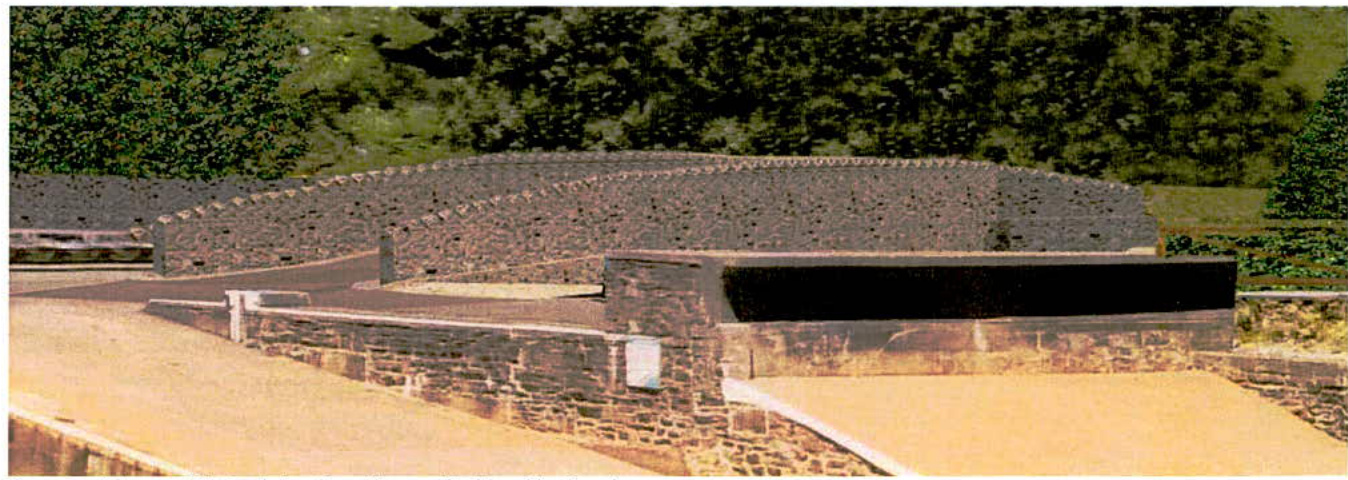
With the Breeze Hill access rejected the proposed vehicular access to the site will be via a new bridge over the Laxey River. This new permanent bridge between Laxey boatyard park and the proposed STW site is required for maintenance access as well as providing access for boat users to the north bank of Laxey River. This allows them to access compensatory spaces replacing those lost to the bridge abutment. Public preference on the bridge finishes was sought, obtained and these are shown below.
Proposed Access Bridge (view from the north east)
Proposed Access Bridge (view from the south side of harbour)
Copyright in submitted documents remains with their authors. Request removal
