Loading document...
Sunset Lakes, Leisure facility, Peel, Isle of Man
January 2020
| Manx Wildlife Trust: 7-8 Market Place, Peel. Isle of Man. | |
| Job number: | MWT 19_29 |
| Title: | Protected Species Working Method Statement |
| Client: | CCSE Leisure Ltd |
| Prepared by: | Sarah Hickey MRes |
| Verified by: | Adam Denard BSc (Hons) |
| Date of Issue: | 31 January 2020 |
| Version: | 2 |
| Revisions: | 1 |
| Status: | Final |
| This report is prepared by Manx Wildlife Trust Consultancy for the sole and exclusive use of CCSE Leisure Ltd in response to their particular instructions. No liability is accepted for any costs, claims or losses arising from the use of this report or any part thereof for any purpose other than that for which it was specifically prepared or by any party other than CCSE Leisure Ltd. Any biological records for wildlife found in survey will eventually be submitted to Manx Biological Recording Partnership. This report has been prepared by an environmental specialist and does not purport to provide legal advice. You may wish to take separate legal advice. The information which we have prepared and provided is true, and has been prepared and provided in accordance with the BS42020 2013 and Chartered Institute of Ecology and Environmental Management’s Code of Professional Conduct. We confirm that the opinions expressed are our true and professional bona fide opinions. | |
| Signed (Author) Electronic Signature Sarah Hickey | Signed (QA) Electronic Signature Adam Denard |
Control sheet ..... 2 Executive Summary ..... 4
Appendix I - Proposed Development Plan Appendix IIa - Native neutral grassland species for the Isle of Man Appendix IIb - Native trees and shrubs for the Isle of Man
The enclosed Precautionary Working Method Statement has been commissioned in relation to application number PA 19/01334/B to develop 0.15 hectares on land at Sunset Lakes leisure complex, off Ballagyr Lane, Peel, Isle of Man.
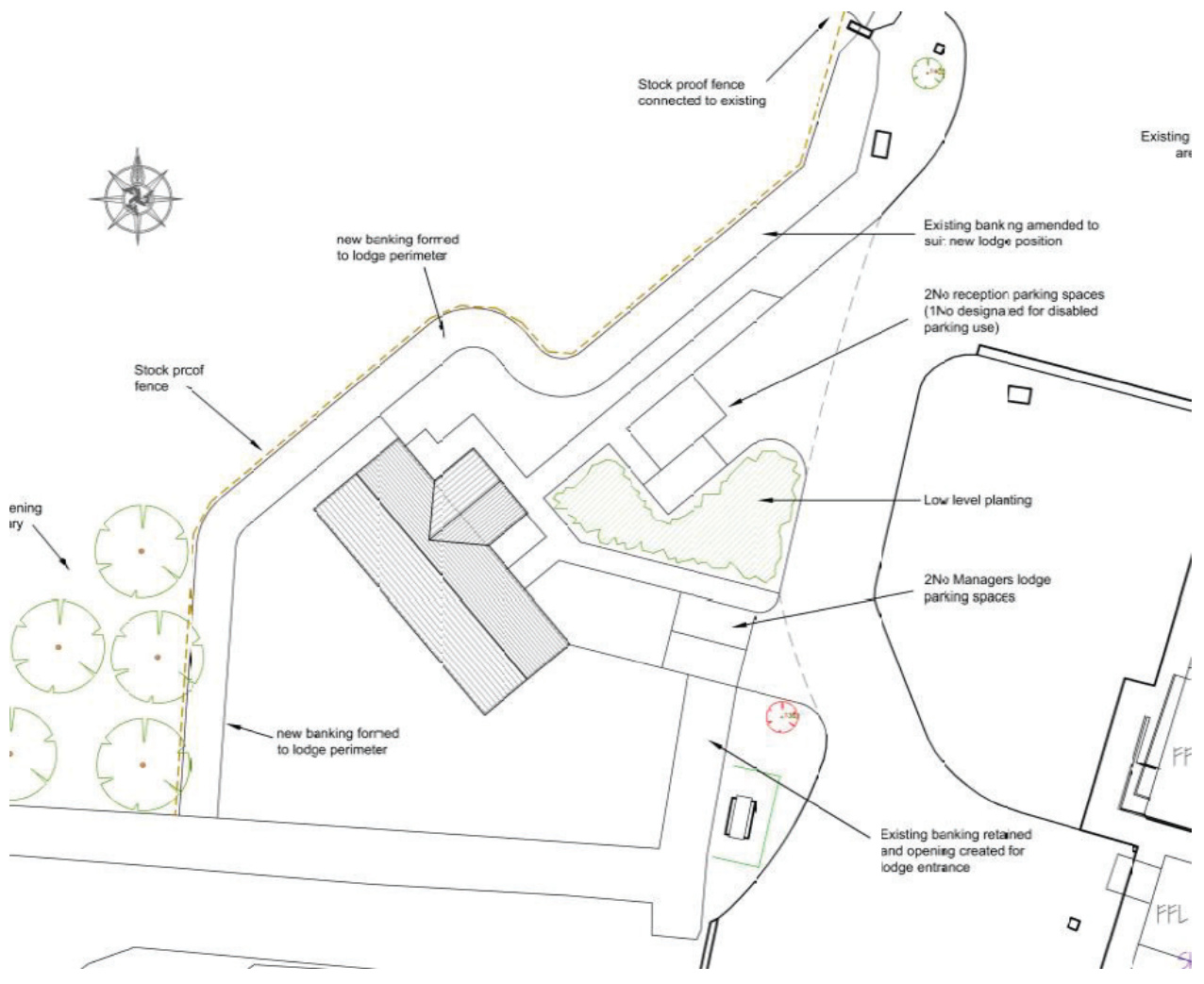
The proposed development comprises a single storey manager's lodge with landscaped embankment and tree cover for screening purposes.
The development will require the removal of approximately 25 m of hedgebank that is potential habitat for common lizard and breeding birds.
The site was subject to a walkover survey on 29 January 2020 to assess habitat suitability and inform recommendations for legal compliance and enhancement for biodiversity contained in this method statement.
1.1. MWT Consultancy was commissioned by CCSE Leisure Ltd to provide a Precautionary Working Method Statement (PWMS) for legally protected fauna (common lizard Vivipara zootoca and breeding birds) for a proposed development on land at Sunset Lakes leisure complex, Ballagyr Lane, Peel. 1.2. The proposed development area is 0.15 hectares in the south-east corner of an improved pasture field with accompanying traditional Manx 'stone and sod' hedgebank, sited on the western boundary of the complex (OS grid reference SC26009 84288). The surrounding area is characterised by intensively-grazed improved pasture enclosed by an extensive network of grassland and scrub hedgebanks. 1.3. The purpose of the report is to provide a method statement that will enable the proposed development to comply with planning conditions and legal requirements of the Isle of Man Wildlife Act 1990(as amended); in line with planning strategy, additional advice on enhancement for biodiversity is provided. {{image:141850}}
Figure 1: Site boundary within local context. (c) IOM Government aerial photographs 2018
2.1. From preliminary correspondence with the DEFA Ecosystem Policy Team, it was agreed that due to the time of year and potential disproportionate costs involved, artificial refugia presence surveys would not be undertaken. Instead, given the moderate suitability of the sod hedge for lizards, an assumption that lizards and breeding birds may be present will form the basis of the PWMS.
2.2. On 27/01/20 a walkover survey was conducted by Assistant Ecologist, Sarah Hickey, to identify habitat features present and assess their suitability to support common lizard and breeding birds. In conjunction with senior colleagues, the field results informed the following report to provide proportionate mitigation and enhancement advice. 2.3. Habitat was assessed for its potential to support common lizard Z.vivipara and for the potential to be utilised by breeding birds, to evaluate the potential impact of the proposed development and likelihood of offence under the Isle of Man Wildlife Act 1990 (as amended).
2.4. The survey was conducted outside the normal active period for common lizard and breeding birds; however, this did not present a constraint or limitation as the potential of the features to support common lizard and breeding birds was still apparent.
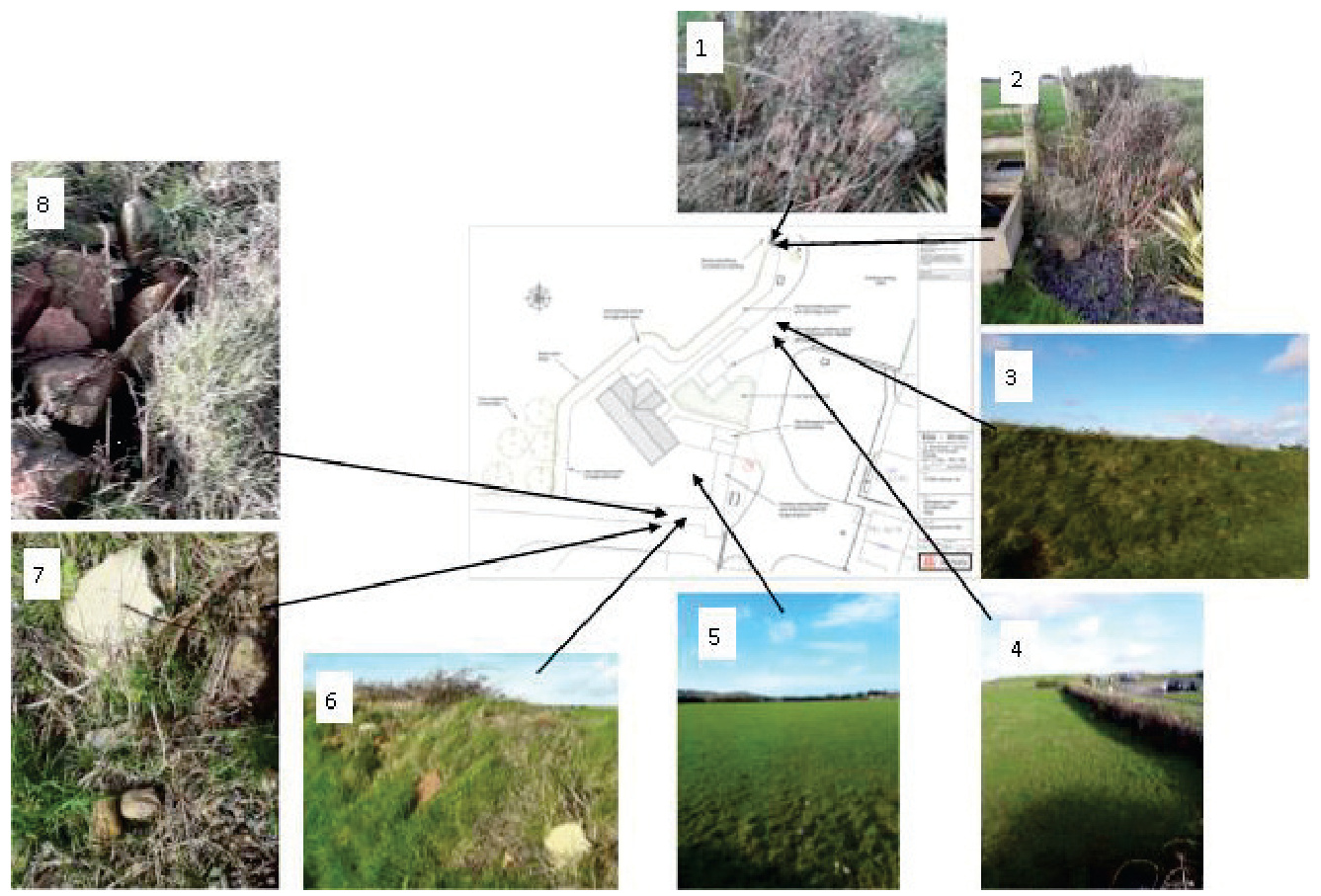
3.1. No lizards were observed during the walkover survey, which was expected due to the winter season and the cool temperature at the time of survey. 3.2. The vegetation in the field is perennial rye-grass monoculture with a uniform structure (see Figure 2 photograph 5 next page), although access to the field was not possible. 3.3. The Manx sod hedges appear to be relatively recent structures. Vegetation on the side facing the carpark consists largely of perennial rye-grass Lolium perene with small patches of common sorrel Rumex acetosa, common dandelion Taraxacum officinale, creeping buttercup Ranunculus repens, ragwort Senecio jacobaea, ivy Hedera helix and gorse Ulex europaeus (see Figure 2, photograph 3). 3.4. The grass-dominated vegetation is of a fairly uniform structure $<30 \mathrm{~cm}$. 3.5. The sides of the hedge facing into the field consist largely of dense bramble Rubus fruticosus and European gorse (see Figure 2, photograph 4). 3.6. Gaps in the vegetation on the sod hedge at the southern side of the field reveal a loosely constructed sandstone wall (photographs 6,7 and 8 ). Similar stonework is also visible next to the drinking troughs in the north-east corner of the site (photographs 1 and 2).
Figure 2: Representative habitat photos taken during walkover survey 27/1/20
Refer Figure 2 and Appendix I. 4.1. Habitats present are suitable for use by common lizard and common farmland birds (wren Troglodytes, dunnock Prunella modularis, robin Erithacus rubecula, blackbird Turdus merula) and possibly red list species of high conservation concern e.g. linnet Carduelis cannabina and song thrush Turdus philomelos 4.2. Key features for lizards are the grassland vegetation and scrub patches covering the hedgebanks and the rubble content of the bank structure. Combined these features provide foraging, basking and sheltering opportunities in the active season and overwintering niches for hibernation. 4.3. Bramble and gorse scrub on the west face of the hedgebank provide the main nesting habitat for birds (see Figure 2 Photograph 4), although ground nesting in the grassland by species such as meadow pipit may occur.
Avoid and retain 5.1. All vegetation covering the embankment must be cleared by cutting and strimming to $<5 \mathrm{~cm}$ in height during the non-active season (typically October to February inclusive) to render the habitat largely unsuitable for lizards. 5.2. Physical removal of the remaining hedgebank must not commence until sunny warmer days (at least 150C ambient temperature) from mid-April to August when lizards are likely to be active and the risk to injury and mortality will be lower. 5.3. Direction of work to remove hedgebank should be done from the midpoint outwards or in North to South or South to North direction to enable any lizards present to escape into neighbouring habitat. 5.4. Tools and materials should not be stored on grassland and scrub habitat overnight as these may be used by sheltering lizards. 5.5. If any lizards are encountered during operations all work must stop immediately and advice sought from MWT Consultancy tel: 844432.
5.6 Embankments to be created along the western boundary of the new development should resemble the dimensions and vegetation cover of the surrounding area. 5.7 Composition should be $70 \%$ grassland to $30 \%$ low scrub (e.g. bramble Rubus fruticosus, western gorse Ulex gallii, Burnet rose Rubus pimpinellifolia). 5.8 The structure should incorporate large stones that partly protrude from the earth for basking lizard and for access into the interior of the bank for shelter and protection. 5.9 The grassland could be created by allowing neighbouring species to colonise bare earth naturally in conjunction with regular cutting to favour tolerant grasses. Once established it should be every two to three years to retain a more open structure. If seed mixes are to be used, they should contain locally native species (see Appendix IIa).
Avoid and retain 5.10 Vegetation clearance must follow paragraph 5.1 5.11 If any nests are discovered during operations (this includes nests containing eggs, young or in the process of being built), all work should cease, and the nest must be safeguarded by a suitable buffer (this to be dependent on location of nest and species involved) until all dependent young have left the nest.
5.11 The proposed small tree planting area in the south west corner of the plans should use locally native woody species with an element of thorny scrub (refer Appendix IIb)
APPENDIX IIa - Native species for neutral grassland in the Isle of Man
Achillea millefolium Agrimonia eupatoria* A. odorata
Agrostis capillaris A. stolonifera A. vineale
Anthoxanthum odoratum Anthyllis vulneraria Arenaria serpyllifolia Campanula rotundifolia Carex caryophyllea C. flacca C. hirta C. nigra C. ovalis C. pallascens * C. panicea
Centaurea nigra Conopodium majus Crepis capillaris Cynosurus cristatus Dactylorhiza fuchsii D. incarnata D. maculata ssp. ericetorum D. purpurella
Daucus carota Deschampsia cespitosa Euphrasia spp. Festuca pratensis F. rubra
Filago minima Galium verum Hypochaeris radicata Knautia arvensis * Lathyrus pratensis Leontodon autumnalis Lotus corniculatus Luzula campestris L. multiflora ssp. multiflora L. multiflora ssp. congesta
Ononis repens Phleum bertolonii Pimpinella saxifraga Platanthera chlorantha Poa pratensis yarrow agrimony fragrant agrimony common bent creeping bent brown bent sweet vernal-grass kidney vetch thyme-leaved sandwort harebell spring sedge glaucous sedge hairy sedge common sedge oval sedge pale sedge carnation sedge common knapweed pignut smooth hawk's-beard crested dog's-tail common spotted-orchid early marsh-orchid heath spotted-orchid northern marsh-orchid wild carrot tufted hair-grass eyebright meadow fescue red fescue small cudweed lady's-bedstraw common cat's-ear field scabious meadow vetchling autumn hawkbit common bird's-foot-trefoil field wood-rush heath wood-rush heath wood-rush resthrrow smaller catstail burnet saxifrage greater butterfly-orchid smooth meadow-grass
| Potentilla anglica | trailing tormentil |
| P. reptans | creeping cinquefoil |
| Prunella vulgaris | self-heal |
| Ranunculus acris | meadow buttercup |
| R. bulbosus | bulbous buttercup |
| Rhinanthus minor | yellow-rattle |
| Rumex acetosa | common sorrel |
| Stellaria graminea | lesser stitchwort |
| Succisa pratensis | devil’s-bit scabious |
| Valeriana officinalis | common valerian |
| Vicia cracca | tufted vetch |
Page 4
| Latin name | English name | Manx name(s) | Notes | Best sites |
|---|---|---|---|---|
| Alnus glutinosa | common alder | farney | A good tree for wet places, except where the soil is very acid. | 1-4 |
| Betula pendula | silver birch | beith argid; billey veih | Prefers well-drained sites. | 1-4 |
| Betula pubescens ssp pubescens | downy birch | beith yiarg | Tolerates wetter, more acid soils than B. pendula. | 1-4 |
| Betula pubescens ssp tortuosa | downy birch | As above, but a more shrubby, upland subspecies. Has distinctive aromatic foliage. | 1-4 | |
| Corylus avellana | hazel | couyll | Thrives in most habitats, esp. richer soils on sheltered sites. | 1-4 |
| Fraxinus excelsior | ash | unjin | Thrives in most habitats, esp. richer soils. | 1-4 |
| Ilex aquifolium | holly | cullyn; hollin | Thrives best on fairly dry sites. | 1-4 |
| Juniperus communis | *juniper | euar ny greg | Very rare as a native plant; a plant of heather moorland. (Ornamental types are often planted - these are not the same!) Tolerates exposed sites. | 4 |
| Lonicera periclymenum | honeysuckle | ullaagagh | Hedges and scrub; tolerates coastal conditions. | 1-4 |
| Malus sylvestris | crab apple | gartag | Native trees (thought to be very rare) occur in sessile oakwood; otherwise much-planted. | 2-4 |
| Myrica gale | bog myrtle, gale | roddagagh | A fairly low-growing aromatic shrub, very attractive. Thrives in boggy conditions. | 1-4 |
| Pinus sylvestris | Scots pine | juys Albinagh | Long since extinct as a native but widely planted and valuable as one of the tallest tree types to grown on the Island; prefers well-drained habitats. Can be invasive of heathland so sites should be chosen with care. | 2-4 |
| Populus tremula | aspen | chengey ny mraane; cron craaee | A good tree for wet places. | 1-4 |
| LIST A continued... | |||
|---|---|---|---|
| Prunus padus | bird cherry | A UK native, rare on the Island - only one tree was ever found which was thought to be of non-planted origin. Prefers damp soils which are not very acid in nature. Will tolerate upland conditions but only in less acid areas | |
| Prunus spinosa | blackthorn; sloe | drine aim | Tolerant of coastal conditions and native to most of the Island - hence more suitable than hawthorn for most native planting. |
| Quercus petraea | sessile oak | darrag | Sessile oak occurs on wetter, more upland areas and more acidic soils than English oak, and is the more typical oak on Man; however, hybridisation between the two species makes it difficult to find "100% sessile" trees. |
| Quercus robur, Quercus robur x petraea hybrids | pedunculate or English oak; oak hybrids | darrag | English oak is more typical of drier, lowland areas than sessile oak. It has been planted extensively, and many oaks on the Island are intermediate in characteristics between the two species. These hybrids are themselves variable. |
| Rosa canina | dog rose | drughaig | A group of closely-related wild roses, of which the Isle of Man tends to have types which are typical of north-west England. In general these are downier than the dog-roses found in southern England. |
| Rosa sherardii | Sherard's downy-rose | A fairly common scrub and hedge species. | |
| Rosa pimpinellifolia | burnet rose | drine drughaig | A distinctive, very prickly wild rose with black rosehips. Thrives on well-drained soils near the sea. |
| Rubus fruticosus agg. | brambles | dress smeyr | Very variable, with lots of varieties indigenous to Man. Bramble usually spreads by itself. If it is to be planted, the use of stock local to the area is strongly recommended (with cultivated varieties, many of which are over-vigorous, to be avoided). |
| Rubus idaeus | raspberry | berrish yu croaw gharey | Usually occurs on the edges of woodland and heath. |
| LIST A continued... | Page 5 | |||
| Salix aurita | eared willow | shellagh chleayshag | A bushy, low-growing sallow of wet, acid moorland and curragh. Forms good bird habitat. | 1-4 |
| Salix caprea ssp caprea | goat willow; pussy willow | shellagh vooar | Uncommon on the Island. Prefers drier, more calcareous soils than the common grey "sallie". | 1-4 |
| Salix cinerea ssp. oleifolia | common sallow | shellagh; sallie | Common in wetland habitats throughout the Island. Some doubt as to how native this species is on the Island. | 1-4 |
| Salix repens | creeping willow | tuig-y-yeeigey | Vary variable, occurring on bogs and other nutrient-poor wet places. The variety of this species which occurs on dune slacks on the Ayres is less suitable for planting schemes. | 1-4 |
| Sambucus nigra | elder | tramman | Tolerant of coastal conditions; strong cultural significance. | 1-4 |
| Sorbus aucuparia | rowan | cuirn | strong Manx cultural significance | 1-4 |
| Ulex gallii | western gorse | aittin | More suitable than European gorse (U. europaeus) for native planting. | 1-4 |
| Ulmus glabra | wych elm | lhiouan | Much-planted; possibly native (hard to tell). Suitable for sites with base-rich soils. |
Planting of species which are very rare in their native, wild state is not recommended on semi-natural sites of high nature conservation value, due to the need to protect the genetic stock of existing populations of rare native species.
The "best sites" column is only intended as broad guidance; in most cases the habitat conditions and existing vegetation will give the best indication of whether any given species would be appropriate.
Copyright in submitted documents remains with their authors. Request removal
